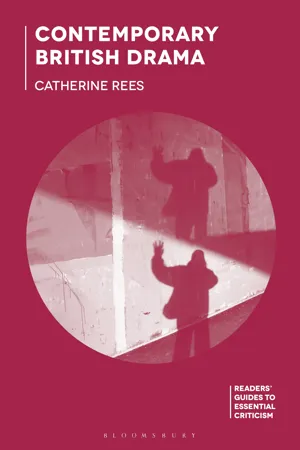
This guide offers a comprehensive account of British theatre from the 1960s to the present day. Placing critical commentary at the heart of its analysis, it explores how theatre critics and scholars have sought to understand and write about modern theatre, from the earliest reviews to revivals appearing decades later. With studies of contemporary reviews and archival material, Contemporary British Drama offers readers the opportunity to learn about British theatre in its original context and to chart shifting critical perceptions over the decades. It provides a crucial juxtaposition between the development of British theatre and its contemporaneous critical response, supplying an invaluable insight into the critical climate of recent decades.
From feminist playwrighting to In-Yer-Face theatre, this is the ideal companion for undergraduate students of literature and theatre in need of an introduction to the debates surrounding contemporary British drama.
- 170 pages
- English
- ePUB (mobile friendly)
- Available on iOS & Android
eBook - ePub
Contemporary British Drama
About this book
Information
CHAPTER ONE
The Rise of Political Theatre
What is political theatre?
The aim of this chapter is to provide the reader with a critical overview of political theatre in Britain from the late 1960s to the 1980s. This is clearly a potentially vast undertaking, so it will necessarily focus on specific playwrights and critical perceptions. However, in exploring the ways in which playwrights from this time responded to their political environment, the hope is to offer the reader a broad understanding of the relationship between theatre and politics during this period, theatre’s role as a commentator on society and theatre’s place within the wider political setting through an examination of critical response to the plays under consideration.
In starting to explore this topic it is useful to first discuss some possible definitions of political theatre. Michael Patterson defines it as “a kind of theatre that not only depicts social interaction and political events but implies the possibility of radical change on socialist lines: the removal of injustice and autocracy and their replacement by the fairer distribution of wealth and more democratic systems” (2003: 3–4). The first section of this quotation is relatively straightforward – theatre that responds to its social and political context and offers potential for change, but it is worth pausing for a moment to consider the second half of this citation – British political theatre is (nearly) always left-wing in emphasis and often overtly Marxist.
Critics and playwrights are surprisingly unified in their view that political theatre in Britain during this period is more or less synonymous with socialism or Marxism. Dorrian Lambley argues that “Marxism… has provided the dominant reference for the development of a radical oppositional theatre since the end of the Second World War” (1992: 34). Howard Brenton, a key political dramatist of the 1970s and 1980s describes in an interview from 1987, “a red theatre… under the theatre’s bed” (Mitchell, 1987: 196), suggesting Marxist principles in the underbelly of all theatre. During the late 1960s and 1970s, power changed hands between the Conservative and Labour party frequently; however, socialist principles are not always best served under a Labour government. As Brenton goes on to explain, “The Labour Party comes into power, dithers, hits obstructive tactics from the City, the Civil Service, and goes to pieces” (200). Catherine Itzin elaborates, “the Conservative government of 1970, and the Labour government of 1974, finally crushed […] hopes on the left, and fuelled the fire of political theatre” (1980: 7), suggesting that both political parties failed to offer a “clear Marxist alternative” (7) and therefore true political theatre involves an active stance against all conventional party politics in the search for a more radical socialist revolution.
Political dramatists of this time were hopeful, not just of raising and debating what they saw as social inequalities, but of creating the possibility of radical change through theatrical performance. When asked “Do you think theatre can have an active role in engaging in political struggle and bringing about social change”, Brenton’s reply was “No doubt about it” (Mitchell, 1987: 198). Edward Bond, a playwright under discussion in this chapter, was extremely active in providing a political education for his audiences, stating in interview, “My plays are fundamentally political because they say you cannot change anything unless you understand what you are doing” (Nicolás, 2016: 261), suggesting that revolution will come from understanding political injustices. Reflecting on this period, Patterson writes, “Given the sense of a changing world and the apparently very real possibility of restructuring society along socialist lines, it was predictable that these writers would turn to the most public and most immediate forum for expressing their concerns and aspirations, that of live theatre” (2003: 13).
Theatre’s position within society as a possible revolutionary force was also noted by those who would have motivation for suppressing its radical potential. Exploring the state of theatre under Margaret Thatcher in the 1980s, D. Keith Peacock notes that Arts Council funding of theatre can have a political agenda. Howard Brenton’s The Romans in Britain (1980) caused considerable controversy when it was first performed for its juxtaposition of the Roman invasion of Britain and the British military presence in Northern Ireland. Receiving its premiere at the National Theatre, some felt that taxpayers’ money should not be financing such politically sensitive theatre: “Calls were made in parliament for [the minister of the arts] to cut Arts Council’s Grant for partly funding such an ‘outrage’. This seemed to be the first evidence that the new right-wing government would resort to censorship of the arts under threats of the withdrawal of subsidy” (Peacock, 1999: 70). Over time, this approach led, Peacock argues, to an erosion of funding for radical theatre, with government policy “to offer support predominately to plays drawn largely from the canon of western theatre” (37), funding traditional and perhaps more conservative theatre to the exclusion of more politically radical work. Ultimately, Peacock sees that this change in policy led to a shift in how society views the purpose of theatre, “that theatre was not an agency of cultural, spiritual, social or psychological welfare, but an entertainment industry that was otherwise irrelevant to the workings of society” (215).
From radical potentials in the late 1960s to political impotence in the late 1980s, theatre in this period underwent significant change, but it was also a period of considerable critical reflection, with many playwrights and critics seeking to examine and explore theatre’s place in society and political theatre’s potential to provoke debate and create discussions. Unsurprisingly, plays produced during this time often incited critical hostility. Before I move on to examine three examples of political playwriting during this period, I want to take a moment to reflect upon exactly what is meant by “this period”, and how critical voices can help shape our understanding and definition of political theatre in the 1970s and 1980s.
Some key dates – 1968 and 1980
Writing about David Hare’s Pravda (1986), of which more later, Robert Wilcher suggests that there is a distinct timeframe in the politicising of British playwrights: “On the threshold of the 1980s, a number of commentators on the theatrical scene in Britain were detecting changes in both the political and cultural climate of the country and in the predicament of those dramatists who had come to prominence in the aftermath of 1968” (1990: 42). This bookending of the 1970s, as a period of notable political theatre, is common amongst critical responses to political playwriting. Steven Fielding is even more specific, arguing that Hare “came to political maturity around the time of May 1968” (2009: 372). The first sentence of Itzin’s Stages in the Revolution is “1968 was a historic year which politicised a lot of people” (1980: 1), C. W. E. Bigsby claims “1968 did see the birth of a genuine socialist theatre” (1981: 395) and Lambley also cites the decade between 1968 and 1978 as an important time for Marxist theatre, during which “a significant number of writers and workers in the theatre” were “profoundly determined” in the direction of Marxist politics (1992: 34). This critical mass of opinion helps us to catalogue and assess work of socialist perspective originating around this time, and it helps us make sense of what this theatre was trying to achieve. But it may also obscure more complex nuances or overstate the reality. John Bull refutes this critical tendency, arguing “The evidence is simply not there to sustain the claim” (1984: 9–10), and Dan Rebellato warns readers that reading meaning into events from history can simply reinstate current beliefs and prejudices: “writing a history in terms of the present may simply reinforce conditions that obtain in the present” (1999: 9). Nevertheless, it is clear that there exists a broad critical consensus that 1968 represented a critical year in the shaping of a generation of political writers.
1968 saw a series of radical changes and revolutions in many parts of the globe, perhaps most famously in May of that year when French workers and students went on strike, leading the country to the brink of a socialist revolution. Numerous other events across the world led to radical political upheaval, for example, mass protest against the Vietnam War, the assassinations of Martin Luther King and Robert Kennedy, mass civil rights marches, Enoch Powell’s infamous “rivers of blood” speech, the start of the Northern Irish Troubles, the Russian invasion of Czechoslovakia and the Six-Day War in Israel. These events “politicised a new generation” (Itzin, 1980: 3), and this growing momentum towards revolution was, for the sake of clarity, as we have seen above, explained by critical commentators as emanating from 1968 as a year of political instigation. This critical consensus creates a momentum whereby readers are encouraged to see political theatre as starting in 1968. Although this may be too simplistic (and the first text explored in this chapter actually pre-dates this year), it is a useful start date, and as such is frequently cited as front-end to analysis of British political theatre.
Another key date (or decade) frequently referenced as the beginning of the end of political theatre is 1980, or the 1980s more generally. If 1968 promised the blossoming of greater social equality, increased workers’ rights and the presence of wider political protest and engagement, the 1980s offered the country an altogether different political climate. The revolution of 1968 was effectively ended with the election of Margaret Thatcher in 1979, and the decade that followed set quite a different political tone. Critical commentary is again unified in its reading of this change of tone. Lib Taylor argues that the 1980s brought about a withdrawing from the mainstream for political playwrights:


Writing in the Sunday Times, John Peter agrees, “British drama hasn’t found a language to deal with the 1980s, when the issues are starker, politics tougher, and the moral choices more extreme” (15 May 1988).
Two of the playwrights discussed in this chapter, David Hare and Harold Pinter, found themselves at odds with the dominant capitalist ideology of the Thatcher era. David Pattie writes, “it is no wonder that Hare and other left-wing playwrights felt themselves to be out of step with the times; it is also not surprising that this should be a source of some pride; ‘these are fine times to be out of step with,’ as Hare himself said in 1989” (1999: 364–365).
Pinter’s career took a different turn in the 1980s, as he became much more involved with political playwriting. Yael Zarhy-Levo maintains that Pinter’s dramatic career has distinct phases, including “his later political phase (1983–1991)” (2009: 257). For critics, this represented a radical shift in his dramatic style, and one clearly motivated by political events. Basil Chiasson remarks that “when Pinter became actively political at the beginning of the 1980s, […] his dramas became more politically charged” (2013: 80), Maria Germanou sees a change in the 1980s “when he decided to make his political views public” (2013, 360) and Dirk Visser contends that, “during the 1980s Pinter’s plays saw a remarkable change, and so did his attitude towards his critics” (1996: 328). Harry Derbyshire also picks up on Pinter’s relationship with the critics, suggesting that his “truculent protests during the Thatcher years” led to regular “mockery from various quarters” (2009: 267).
Clearly there is some critical consensus that the political climate of the 1980s created a change in political playwriting, and that the theatrical economy of the era led to the undermining of radical political drama. As we have already seen, shifts in Arts Council funding in the 1980s saw support for canonical rather than subversive drama. Peacock outlines this situation: “At the close of the 1980s the theatre was considered by many, both inside and outside the profession, to be in a parlous state” (1999: 57). The possibility of socialist revolution imagined in the political unrest of 1968 was, by the end of the 1980s, a distant memory, and radical theatre had been undermined in favour of apolitical, big budget theatrical entertainment. For this reason, this chapter will examine political playwriting and use the late 1960s and the end of the 1980s as bookends with which to navigate the topic.
About this chapter
The playwrights discussed in this chapter are Edward Bond, David Hare, Howard Brenton and Harold Pinter. Between them, their plays span over 20 years of political playwriting from 1965 to 1988, sitting clearly at either end of the spectrum set out above. In some cases, critical responses to revivals of the original plays will also be examined, involving consideration of the new historical and political context. All these playwrights are heavily associated with political engagement, although their styles and subject matter vary considerably. They also differ in their relationship to the theatrical and political mainstream. To offer some context to the relationship between three of these writers, and their differing positions within the British establishment, this quotation from Edward Bond makes comparisons clear: when asked to comment on David Hare’s knighthood in 1998, and Harold Pinter’s acceptance of The Companion of Honour in 2002, he remarked, “I would sooner work under a desk lamp made of human skin at Auschwitz” (Saunders, 2004: 256).
Edward Bond: Saved and its theatrical legacy
The introduction to this chapter lists a series of significant political events of 1968. One of those was the abolition of stage censorship. Although the first play discussed in this chapter was first performed before the “official” advent of British political theatre in 1968, its performance is frequently cited as one of the key factors in ending stage censorship, which did take place with the passing of the Theatres Act on 26 September 1968.
Without reducing Saved (1965) to a single event review, it is commonly known that the play is most famous for its depiction of the abuse and stoning of a baby in a pram. This event, some “bad” language, and a scene in which a man darns a woman’s stocking whilst she is still wearing it, led the play to be refused a license for public performance in the UK. Under the system of theatrical licensing at the time, plays had to be licensed by the Lord Chamberlain before theatres could open them to a paying public, which effectively ensured that there was a system of stage censorship – anything that did not meet with the Lord Chamberlain’s approval was excised from public performance. Edward Bond refused to cut the scene in which a group of young males torment and murder the child, protesting that this scene was integral to the political purpose of the play (of which more later). As a solution to this stalemate, the Royal Court Theatre temporarily changed its license to that of a private members’ club, for which performances did not require a license, which allowed the performance within the Court space. However, the number of people still able to access this banned performance caused a headache for the government, appearing to make the licensing laws ineffectual and pointless. As Nicholas De Jongh puts it, “No other play this century posed such pressing, practical problems for a government” (2001: 214). The controversy of the Royal Court’s staging of the play, and subsequent legal action against the company, was also remarked upon in the press of the time. Defenders of the play, for example Sir Laurence Olivier, described as “star witness for the defence” by the Mail (Lewthwaite, 8 March 1966), were quoted supporting Bond in the press (he described the play as “first-rate dramatic form” (Observer,
21 November 1965)), and ultimately stage censorship was ended. The role of Saved in this process was clear – in 1968 Ronald Bryden in the Observer writes “the Saved case did more than any other to show up the absurdity of the eighteenth-century law which gives the Lord Chamberlain control over the theatre” (14 April 1968).
As might be expected, there was considerable press reaction to the original performances of Saved in 1965. There were certainly some hostile reactions. J. W. Lambert in the Sunday Times writes “there comes a point where both life and art are irretrievably debas...
Table of contents
- COVER
- SERIES TITLE
- TITLE PAGE
- COPYRIGHT
- CONTENTS
- INTRODUCTION: Some Key Terms and Ideas
- CHAPTER ONE: The Rise of Political Theatre
- CHAPTER TWO: The Gendering of Political Theatre: Women’s Writing and Feminist Drama
- CHAPTER THREE: In-Yer-Face Theatre: The Shocking New Face of Political Drama?
- CHAPTER FOUR: The “New” Political: Verbatim Theatre and Theatre of the “Real”
- CHAPTER FIVE: Global Theatres: Representing Race, Religion and Identity
- CHAPTER SIX: New Theatre Forms: Adapting the Novel and Filming the Stage
- CONCLUSION
- NOTES
- WORKS CITED
- INDEX
Trusted by 375,005 students
Access to over 1.5 million titles for a fair monthly price.
Study more efficiently using our study tools.
Frequently asked questions
Yes, you can cancel anytime from the Subscription tab in your account settings on the Perlego website. Your subscription will stay active until the end of your current billing period. Learn how to cancel your subscription
No, books cannot be downloaded as external files, such as PDFs, for use outside of Perlego. However, you can download books within the Perlego app for offline reading on mobile or tablet. Learn how to download books offline
Perlego offers two plans: Essential and Complete
- Essential is ideal for learners and professionals who enjoy exploring a wide range of subjects. Access the Essential Library with 800,000+ trusted titles and best-sellers across business, personal growth, and the humanities. Includes unlimited reading time and Standard Read Aloud voice.
- Complete: Perfect for advanced learners and researchers needing full, unrestricted access. Unlock 1.5M+ books across hundreds of subjects, including academic and specialized titles. The Complete Plan also includes advanced features like Premium Read Aloud and Research Assistant.
We are an online textbook subscription service, where you can get access to an entire online library for less than the price of a single book per month. With over 1.5 million books across 990+ topics, we’ve got you covered! Learn about our mission
Look out for the read-aloud symbol on your next book to see if you can listen to it. The read-aloud tool reads text aloud for you, highlighting the text as it is being read. You can pause it, speed it up and slow it down. Learn more about Read Aloud
Yes! You can use the Perlego app on both iOS and Android devices to read anytime, anywhere — even offline. Perfect for commutes or when you’re on the go.
Please note we cannot support devices running on iOS 13 and Android 7 or earlier. Learn more about using the app
Please note we cannot support devices running on iOS 13 and Android 7 or earlier. Learn more about using the app
Yes, you can access Contemporary British Drama by Catherine Rees in PDF and/or ePUB format, as well as other popular books in Literature & Literary Criticism. We have over 1.5 million books available in our catalogue for you to explore.