- 232 pages
- English
- ePUB (mobile friendly)
- Available on iOS & Android
eBook - ePub
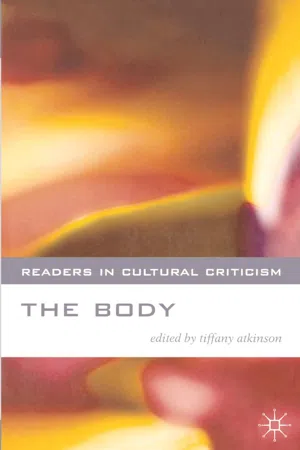
The Body
About this book
What do we mean when we talk about 'the body'? This Reader challenges the assumption that it can be invoked as a neutral, or indeed natural, point of reference in critical discussion or cultural practice. The essays collected here foreground the historical construction of 'the body' throughout a range of discourses from the modern to the postmodern, and seek to present it not as a biological 'given', but as a contestable signifier in the articulation of identities.
Information
1
Introduction
Tiffany Atkinson
Step into the gallery where the exhibits are human corpses, immaculately preserved, then flayed, dissected, sliced and posed with an artist’s precision and flair. Peer with impunity into the secret recesses of bellies, skulls, chest cavities, the wombs of pregnant women. Have your photograph taken with the skinned chess player whose brain rises like a loaf from his opened skull; gaze straight through a man laid out in thin transparent slices from the scalp to the hardened skin of the toes. In the gift shop afterwards, choose from a range of anatomical gadgets and desk toys, or post grisly cards to your friends. Before leaving you could even begin the legal procedure of bequeathing your own body to the project for subsequent exhibitions.
This is not futuristic fantasy, but the Body Worlds exhibition from German anatomist Gunther von Hagens, whose revolutionary technique of ‘plastination’ – removing the body’s fluids and replacing them with liquid plastic – enables bodies to be presented and observed by the public as never before. The exhibition, which has been touring Japan and Europe for several years, has been both controversial and a huge commercial success. Yet one might wonder why, given that we don’t need von Hagens to show us how bodies look on the inside: centuries of anatomical science already enable us to view them in infinitesimal depth and detail. The sensational appeal of Body Worlds has to do with the authenticity of the bodies on display: the viewer is not supposed to forget that they are real, a contemporary momento mori, asserting a democratising mortality in a culture which strives to keep disease and death as far as possible from everyday life. Here medicine, art and old-fashioned horror converge in a spectacle staged to challenge the taboos which dictate acceptable contexts for viewing the dead; or, in psychoanalytic terms, for containing the threat of the real.1
But these cadavers, glossy, exempt from decay, flamboyantly posed and, in von Hagens’s own words, ‘imbued with a new and characteristic identity’,2 have little to do with death’s ineffable ‘real’. Instead they reflect a sense of what it means to have a body in twenty-first century life; which is indeed to have a ‘characteristic identity’ above and beyond the blueprint of anatomy: a countenance which we likewise strive, by whatever means possible, to keep glossy, exempt from decay and appropriately (if not flamboyantly) posed. If anything, the exhibition serves more as a memento vivendi, reminding the viewer less of the body’s perishability than of its resilient plasticity in a technologised world. For how else is the body – living or dead – to be understood in a ‘real’ world informed by airbrushed images and special effects, cosmetic surgery and virtual reality, cybernetics and the genome? How do we recognise the real or natural in our own bodies? Even their most intimate processes own meanings which are not ours alone to determine, but always already inherited from culture, the medium in which we exist from earliest infancy. What we know of our bodies’ ‘nature’ is available to us only through the ideologies which fashion our understanding of the world and our place in it. Even death itself offers no consensus in this field. Consider how the testaments in the Body Worlds guidebook, from people who have already donated their bodies to the project, engage widely differing world-views: ‘I would like to make interested persons understand better what a “work of art” the human body is’ stated one donor. ‘I have always felt the need to provide my body for scientific purposes’ declared another. ‘Grave maintenance is obviously the last opportunity to fleece you’ opined (ironically, in the event) a third, while a fourth maintained that ‘when Jesus Christ rises from the dead, he will wake me up in a new body as it is written in the Bible’. What could the precise nature and meaning of the body possibly be in an era professing such divergent attitudes? How, for that matter, could any two people at the exhibition be seeing and understanding the same thing?
Contemporary culture loves body-gazing. Geri Halliwell’s figure, David Beckham’s tattoos, Michael Jackson’s face, the de rigeur gore of horror films and medical dramas, the ravaged subjects of newsreel footage, the person in the magazine or changing-room who may or may not look better in those clothes than oneself: all take their place in the daily negotiation of what it means to be embodied. But this fascination, far from proving the essential naturalness of bodies, emphasises how they are produced and made meaningful only by the discursive frameworks which position them as objects of knowledge. Clearly, this makes the significance of bodies both radically unfixed and historically contingent. Chaucer, for instance, gave his Wife of Bath gap teeth to signal her implicit licentiousness, not to comment on the shortcomings of medieval orthodontics. For Chaucer’s audience, physiognomy was a valid, common-sense way of discerning character through physique. Nor is this an entirely outmoded way of reading the body: the jutting jaw-line of the contemporary comic-book hero, for example, arguably functions in the same way.
Yet it is one thing to examine how the trappings of culture – fashion, body-language, permissible and taboo behaviours, sexual activity, even skin-colour – shape how the embodied subject is perceived. Only delve beneath the surface, however, and one will soon strike an inescapable material presence, the body as organism, whose status must be one of universal reality. Indeed, the biomedical rhetoric of Body Worlds suggests precisely that we are all, fundamentally, the same on the inside.
But even what we understand to be the ‘inside’ of the body has its own rich cultural history, and is intimately bound up with modern conceptions of the self. Notions of ‘inner personhood’ are a reflex which it seems counterintuitive to contest. As the ubiquitous TV talk-show verifies, expressing oneself, letting rip, coming clean, getting things off one’s chest and out in the open, has become a cultural imperative. Keeping things ‘bottled up’ is almost akin to disease in the popular imagination:3 thus we are daily enjoined by advertising, new age and therapy culture, pop lyrics and Hollywood cinema, to express our ‘inner selves’ as though our lives quite literally depended on it. The metaphors so often used to articulate this desire are an index of how closely expressive individuality is bound up with a profound sense of corporeal reality, privacy, depth and distinctness.
There is, however, an anecdote often invoked in critical discussions of embodiment which proves that the very notion of the body as a discrete social entity is neither universal, nor essential to human culture. Jonathan Sawday relates it thus:
A Melanesian, asked by [nineteenth-century anthropologist] Maurice Leenhardt what the west had contributed to the culture of the islands, did not reply by listing technological, scientific, or medical achievements, nor even (ironically) the disastrous disease history which was the product of western encounters with Pacific peoples … Instead his response undermined the very categories which framed the question: ‘What you have brought us is the body.’4
The western sense of ‘bodiliness’, apparently the most natural and self-evident ground of personhood, is thus revealed as a particular ideological understanding, and one which should by no means be taken for granted. On closer inspection, it is indeed hard to discern what exactly is denoted by ‘the’ body in an abstract, totalising sense, when even to visualise a body is to plunge immediately into the particulars of gender, race, age, posture and so forth. This in turn begs the question of why, and to what ends, a category of ‘the body’ exists for the west in ways so radically different from those of Pacific peoples. Michel Foucault’s enquiry of a quarter-century ago, ‘what mode of investment [in] the body is necessary and adequate for the functioning of a capitalist society like ours?’ is still pertinent.5 Or, to put it another way, we might ask how, to paraphrase Matthew Arnold, ‘each culture gets the bodies it deserves’.
Of course, this is not to say that the physical body does not ‘really’ exist. Even as you read this, yours may be asserting its hunger, discomfort or restlessness in frank contradiction. It is, rather, to foreground that how it exists, or becomes meaningful for us as embodied subjects, is produced by culture in ways which are not always immediately apparent. As feminist theorist Judith Butler maintains, ‘to call a presupposition into question is not the same as doing away with it; rather, it is to free it from its metaphysical lodgings in order to understand what political interests were secured in and by that metaphysical placing’.6 The cultural critic therefore ‘reads’ bodies in much the same way as s/he might read a literary text: not in the hope of revealing an essential truth about embodiment, but precisely to expose how various ‘truths’ and norms are constructed and broadcast as bodies are discussed, represented and managed in everyday life. For the very instability of the body’s significance offers leverage to the critic who is enlisted in processes of political change. The body’s meanings (and they are always plural) can be contested and reconfigured, not simply through physical modifications, but by activating and putting into circulation alternative understandings of embodiment. One might consider how queer theory, for example, has enabled the articulation and validation of a range of subject positions beyond the heterosexual convention. This is not merely an instance of greater discursive freedom, but the claiming of a real political space within which the very ‘norms’ of sexual practice can be exposed and materially renegotiated. Indeed, the multiple ways in which sexuality, gender and race have been theorised in the interests of urgent social transformation have been crucial to the increasing sophistication of contemporary ‘body theory’ and its impact on mainstream culture.
The celebrated ‘naturalness’ of the body is a key point of debate in this kind of rethinking, for seldom is the ‘natural’ invoked where it cannot secure some kind of political or economic interest. A trivial example of this can be found in the ‘bare-faced chic’ so cherished by the cosmetics industry. Anyone who has tried to achieve the ‘natural look’ will probably agree that it requires more painstaking artifice and a vaster array of products than a more up-front maquillage; but the agenda is of course to appear, not actually to be, natural (and to bolster the industry in the process, without, what’s more, even being seen to do so). ‘Naturalness’ is thus revealed as one among many masquerades available to the embodied subject, with the advantage, in an ageist culture, of suggesting youthfulness, innocence and purity. Yet, cosmetics aside, the positing of any kind of embodiment as ‘natural’ or ‘normal’ is freighted with political consequences, demanding as it must an opposing field of the unnatural and deviant, often in ramified and subtle ways. Naturalising is a cultural process: as Derrida has remarked, ‘there is no nature, only the effects of nature: denaturalisation or naturalisation’.7 The normative body cannot exist without its ‘other’. While it is relatively easy to observe this process with the advantage of cultural or historical distance, it takes a more astute and committed reader to examine current and familiar assumptions on the same critical terms. For bodies are not just objects of enquiry out there; they are the very location of the thinker’s here and now, a site of ongoing negotiation between subject and object, inside and outside, thought and sensation, personal and political, self and world. Indeed, their complex materiality makes them both readily confirm and, at the same time, potentially disrupt almost any dichotomy which culture thinks to impose.
For all of these reasons, an intellectual fascination with bodies is not in itself new. Science, philosophy, art, and even literary criticism have long been preoccupied with the nature and representation of mortality, the relation of body to mind, and the status of flesh in the technological world. Histories of the human subject are inevitably histories of the body, or, more precisely, of the problems embodiment poses to human consciousness and categorisation. It has become conventional to describe western attitudes to embodiment, from at least as early as Plato, as dualistic and hierarchical to the extent that mind, spirit and rational processes are systematically valued over matter, flesh, and sensory experience. It is, moreover, a characteristic of symbolic oppositions like this to become overdetermined, as other, prevailing coupled terms, such as those of gender or race, are mapped onto the hierarchical structure. According to this logic, a common critical tactic is to scrutinise texts for traces of those equations whereby ‘mind’ rationality masculinity culture ‘white’, or ‘body’ sensation femininity nature ‘black’, and so on, in an infinitely extended articulation of antithesis. Such hierarchised codings operate at the very core of western culture and ideology.
When considering bodies, the cultural critic must be alert to this tendency to cement difference as opposition. Yet s/he should also be wary of supposing that symbolic patterns wholly determine the way we actually live, or of assuming that they never change. To medievalist scholar Caroline Bynum, this is especially pertinent when assessing the place of the physical in cultures far removed from our own. For example, while dualities can be found in medieval accounts of embodiment, the divisions did not work in the same way that they do in a world that, since Descartes, equates identity to consciousness and relegates the body to secondary status. The medieval opposition between body and soul, or corpus and anima, invests the body with a different value. After all, within a Christian Catholic culture, God is made flesh and consumed physically in the eucharist, so that flesh, both God’s and the worshipper’s, becomes the source of personal salvation and the immortality of the soul. This symbolic economy cannot be said to debase the body. On the contrary, as Bynum asserts, medieval corporeality was in fact a ‘place for encounter with meaning, a locus of redemption’.8 Indeed, following the thirteenth-century theology of Thomas Aquinas, matter was held to be activated and informed by the principle of soul to such an extent that ‘[the] body, restored at the resurrection, retained all the specific structures it had in earthly life (organs, height, even – in certain cases – scars)’.9 Suffering and death thus owned radically different meanings from their present ones, when the body, as in the arch-narrative of Christ’s crucifixion and resurrection, was seen as existing continuously between life and afterlife. Only within such a framework could holy relics acquire so potent a signifying charge: their latent power being their empirical connection to the resurrected body of the saint. The anatomised objectification of the human frame in the terms of Body Worlds would have been unthinkable in medieval culture, for the body was an integrated, immanently divine part of a theological cosmos. To unravel the material body would have been to pick at the very fabric of the world.
Bynum also stresses that gender difference does not map so neatly onto the medieval body/soul axis as the modern reader might expect, refuting the critical generalisation that ‘vast binaries – reducible to a male/female binary – marched through the medieval past from Plato to Descartes’.10 While gender oppositions can be traced in medieval practice, story and belief, they are rendered more complex than the essentialised relation of femininity to flesh that obtains in later culture. Christ’s incarnation, the status of the Virgin, and the androgyny of God the creator and nurturer in Catholic theology all unsettle the grounds of a symbolically gendered hierarchy. Indeed, recent scholarship has tended to emphasise the fluidity of medieval gender positions, or at the very least, the radically different terms on which anything like an ‘identity-position’ was figured and experienced.11 While this brief account of Bynum’s work offers only the most simplistic preface to this collection’s focus on modern embodiment, it may also be a reminder of the complexity of relations between present and past, and, where bodies are concerned, the perils of adopting an uncritical stance toward homology or difference.
It is, of course, impossible to point to an exact moment when pre-modern bodies ceded to those of modernity. But what can be discerned about the broad contexts in which the structuring relation of soul and body become one of antagonism between mind and body, and a source of anxiety to the divided ‘self’? While medieval thought developed a richly nuanced concept of soul, it employed only rudimentary ideas of body, mind and person – all notions indispensable to modern individualist society. Clearly, at some point, the mind of the ‘I’ that thinks and reflects on itself, and the body that independently feels, desires, reproduces and sickens, emerged as objects of enquiry, thus founding the modern subject even as they threatened its coherence by pulling in opposite directions. Fields of knowledge which could establish body and mind as autonomous entities in this manner could not but have profound consequences for the ways in which human beings figured their own relation to the universe. The epistemological trails to this now familiar opposition were blazed most decisively in the early modern period by the strangely twinned discourses of anatomy and Cartesian philosophy.
With the opening of the cadaver to the scientific gaze, anatomists effectively became ‘the first modern persons to distinguish man from his body’.12 The first official public dissections, dated by the construction of the earliest anatomy theatres in Montpellier and Padua in the mid-sixteenth century, marked a decisive rupture of taboos around the ‘divine’ body which ...
Table of contents
- Cover
- Halftitle
- Title Page
- Copyright
- Contents
- General Editor’s Preface
- Acknowledgements
- 1 Introduction
- Depths
- Difference
- Deconstructions
- Summaries and Notes
- Suggestions for Further Reading
- Notes on Contributors
- Index
Trusted by 375,005 students
Access to over 1.5 million titles for a fair monthly price.
Study more efficiently using our study tools.
Frequently asked questions
Yes, you can cancel anytime from the Subscription tab in your account settings on the Perlego website. Your subscription will stay active until the end of your current billing period. Learn how to cancel your subscription
No, books cannot be downloaded as external files, such as PDFs, for use outside of Perlego. However, you can download books within the Perlego app for offline reading on mobile or tablet. Learn how to download books offline
Perlego offers two plans: Essential and Complete
- Essential is ideal for learners and professionals who enjoy exploring a wide range of subjects. Access the Essential Library with 800,000+ trusted titles and best-sellers across business, personal growth, and the humanities. Includes unlimited reading time and Standard Read Aloud voice.
- Complete: Perfect for advanced learners and researchers needing full, unrestricted access. Unlock 1.5M+ books across hundreds of subjects, including academic and specialized titles. The Complete Plan also includes advanced features like Premium Read Aloud and Research Assistant.
We are an online textbook subscription service, where you can get access to an entire online library for less than the price of a single book per month. With over 1.5 million books across 990+ topics, we’ve got you covered! Learn about our mission
Look out for the read-aloud symbol on your next book to see if you can listen to it. The read-aloud tool reads text aloud for you, highlighting the text as it is being read. You can pause it, speed it up and slow it down. Learn more about Read Aloud
Yes! You can use the Perlego app on both iOS and Android devices to read anytime, anywhere — even offline. Perfect for commutes or when you’re on the go.
Please note we cannot support devices running on iOS 13 and Android 7 or earlier. Learn more about using the app
Please note we cannot support devices running on iOS 13 and Android 7 or earlier. Learn more about using the app
Yes, you can access The Body by Tiffany Atkinson in PDF and/or ePUB format, as well as other popular books in Social Sciences & Gender Studies. We have over 1.5 million books available in our catalogue for you to explore.