One of the most profound thinkers of the twentieth century, Georges Bataille has only recently come to prominence in the Anglophone academy, partly through the influence of post-structuralism. Once seen as no more than a philosopher of eroticism and a writer of avant-garde pornography, Bataille is emerging as an absolutely central figure to discussions of culture, economy, subjectivity and difference.
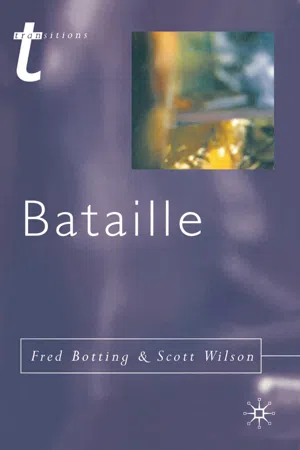
Batailleis the first volume of its kind to offer lucid, diverse and relevant examples of the ways of reading literary and cultural texts in the light of Bataille's work. The essays explore the significance of Bataillean notions like heterology, general economy, transgression and eroticism, through detailed readings of Shakespearean, Elizabethan and Jacobean literature; in analyses of Gothic and postmodern fiction; and in critiques of popular culture, rock music and Hollywood movies. In order to make Bataillean notions more comprehensible to contemporary readers, his concepts are situated in relation to the ideas of renowned critical and cultural theorists like Baudrillard, Deleuze, Derrida, Kristeva, Lacan, as well as Hegel, Freud, Nietzsche and Marx. Here the influence of Bataille is outlined in intellectual and historical terms and the significance of his work can be seen for both contemporary and futural modes of cultural analysis.
- 232 pages
- English
- ePUB (mobile friendly)
- Available on iOS & Android
eBook - ePub
Bataille
About this book
Information
Part I
Literature
1 W(h)ither Theory (?)
‘O-o-o-o!’ Theory is a game, a game of desire with a piece of string and a reel. To play, throw away a reel that is attached to a piece of string, making it disappear. Then pull it back. Two exclamations should accompany these motions: these have been transcribed as ‘fort’ (‘gone’) and ‘da’ (‘there’). The game was first observed by Sigmund Freud in Beyond the Pleasure Principle and considered to be an apparently baffling phenomenon, one which he tried to explain as ‘the renunciation of instinctual satisfaction’ (Freud 1984, 285). Considered as a whole, the game seems to operate within an economy of pleasure in which the ‘distressing experience’ of (maternal) loss is calmed by being returned to the equilibrium maintained by the pleasure principle. Disappearance is no more than a prelude to return: unpleasure is sustained in a pleasurable dialectic which ensures the overcoming of the distressing experience of loss. But the act of throwing away, Freud notes, ‘was staged as a game in itself and far more frequently than the episode in its entirety, with its pleasurable ending’. Unsure of the return of pleasure, the game cannot be interpreted simply in terms of the pleasure principle. Another motive is suggested: ‘at the outset he was in a passive situation – he was overpowered by the experience; but by repeating it, unpleasurable though it was, as a game, he took an active part’ (Freud 1984, 285). An ‘instinct for mastery’ is at work. Here, Freud’s analysis hesitates, uncertain whether the game is determined by the pleasure principle or whether it follows an independent instinct of mastery.
A hesitation and return to the title, itself a hesitation hinging on a parenthetical ‘h’: wither/whither theory(?). The question marks, in excess of the question, a recurrent moment of undecidability. It both contains and is contained by an imperative: is/should theory fade away; in which direction is it/should it be going(?). The question/imperative articulates both a fear of and a desire for the withering of theory as well as a wish for direction and an unwillingness to prescribe whither it should go. Divided between loss and recovery, ignorance and mastery, the hesitation concerns theory, questioning its identity and assurance, undermining its homogeneity, teleology and usefulness, disturbing its position by a tacit enquiry into its origins, destination and authority. The questioning subject is not outside this reflective movement: casting away and returning theory in the interchange of disappearance and (in)direction mirrors, with the duplicitous reiterability of difference, the casting away and returning of the subject to its question and its question to its direction.
The excessive movement of the fort/da game, its variations, repetitions and hesitations, its apparent lack of purpose, point and meaning, is not restricted by a rational or analytic economy of mastery. Overdetermined, the game accedes to a heterogeneity that refuses theoretical mastery even as it stages and repeats the subject’s desire to master body, psyche, image, signs, objects and others. The physical, psychical and symbolic dimensions of the game and the drive for the metastasis of an external and knowing subject position encounter a loss that both propels desire and renders mastery imaginary. Indeed, the incommensurability of the distressing experience and the heterogeneity of desire disclose, in the detours, displacements and re-turns of the game’s repetitive form, the im- or in-possibility of origin and authority. Repetition becomes constitutive, originary. It also implicates the game’s observer, Freud as narrator and father of psychoanalysis, in questions concerning his name, his mortality, his authority and his institution (see Derrida 1978b and 1987).
Theory/heterology
As a preface to an experience of theory, the fort/da game allows theory to emerge as a distressing experience. Or, emerging in relation to an irrecuperable and overpowering experience, the game establishes a point where the repetitions of theory enable the move from passivity in respect of the Other to activity and mastery in relation to the other. Theory, and its institutionalization, indeed, turns on a point of excess. David Carroll, introducing a collection of essays concerned with the states of ‘theory’, observes that ‘the thing to be instituted, to be made institutional, was not for us an already established, definable, determined concept but rather the complicated, heterogeneous, even contradictory object of our research, something whose systematization and institutionalization we had to approach critically and resist as much as possible’ (Carroll 1989, 6). Experience, too, marks an encounter with something heterogeneous. And experience also haunts theory with a subject that remains distinctly literary and powerfully positivistic in a post-romantic sense, a subject, moreover, that constituted a principal object of critique and interrogation in theoretical attacks on the traditional institution of English. But when it comes to experiencing theory or theorising experience, experience and theory are not the opposites that the battle between literary criticism and theory made them out to be. Foucault, for example, said he based his theoretical work on personal experience (Foucault 1988, 156).
A question of one’s relation to the present, experience, for Foucault, also involves questions of one’s relations to others and oneself: ‘an experience is something you come out of changed’ (Foucault 1991, 27). In an interview attesting to the importance of Bataille’s, Blanchot’s and Nietzsche’s writings for interrogating the limits of subjectivity, Foucault states: ‘to call the subject into question had to mean to live it in an experience that might be its real destruction or dissociation, its explosion or upheaval into something radically “other”’ (Foucault 1991, 46). In other writings, experience is understood as ‘the correlation between fields of knowledge, types of normativity, and forms of subjectivity in a particular culture’ (Foucault 1987, 4). An effect of discursive practices, experience is other to the subject at the same time as it is identified with the singularity of an individual’s own authentic and interiorised relation to the world. Yet experience also involves a kind of writing: ‘and an experience is neither true nor false, it is always a fiction, something constructed, which existed only after it has been made, not before; it isn’t something that is “true”, but it has been a reality’ (Foucault 1991, 36). Constructed, a fiction, experience is less the disjunction between what happens and what is said to happen, but signifies the competing ways events are interpreted. A pleasurable sensation of the correspondence of words and things, experience, in its unpleasant form, is also a mark of contradiction, of the incommensurability of the narratives, grand or otherwise, that frame the world. Partial, provisional and fragmentary, experience, as an effect of language rather than of an unmediated prediscursive relation between subjects, objects and others, becomes a way of reading, always circumscribed by modes of differentiation, misrecognition and exclusion. Unable to ground itself or the authenticity of its subject other than in fields of knowledge, experience occupies a space of transition between theories and practices. Made possible and knowable by specific discursive strategies that repeat something they cannot contain, experience also retains a residue of something or somewhere else. As loss, the actuality of experience is interminably deferred. Experience, moreover, becomes excessive and deficient: it alludes to a constitutive but unknowable outside and causes repetitive attempts at mastery to fold back on themselves. The folding back, another experience, opens a reflexive space for the subject, both returning it to its alienation and loss in the glimpse of the deficiency of its mastery of itself, its objects and its language, and engendering more repetitions to overcome its distress. In the folding back of and on experience, the residue, the remainder or excess, manifests the force of heterogeneous energies and elements that cannot be assimilated. Furthermore, if experience, in its complexity, partiality and doubleness, is associated with reading as well as with the dialectic of loss and mastery involved in the fort/da game and its interpretations, what of the experience of reading? Reading, and reading theoretical texts in particular, becomes a heterological practice.
In Inner Experience and the two other texts – Guilty and On Nietzsche – comprising Georges Bataille’s nomadic and intense Somme athéologique, the limits of thought and morality are shattered by experiences that exceed the bounds of rationality and utility. Extreme, intoxicating states of experience like anguish, joy, laughter or horror draw subjectivity beyond the prescriptions of social and philosophical systems in a movement of contestation. These experiences release an energy that cannot be contained, cannot be returned to orders based on rational or utilitarian economic principles. The energy is excessive, an expenditure that is neither profitable nor productive but simultaneously useless, extravagant and exorbitant. Reading Inner Experience is an experience delivering an uncomfortable sense of both pointlessness and excitement, an ‘unknowing’ produced in the text’s violent, poetic and disturbing heterogeneity, a disruptive energy expanding all to nothing. The sense of pointlessness is, in part, the point. Bataille’s texts address and communicate something unknown, something other at the heart of knowledge and communication. Hence they evoke the excess expenditure that, they argued, grounded and unfounded all systems of thought and social organisation. Breaking dialectical models, Bataille’s texts activated the ‘unemployed negativity’ on which they depended in a movement that was excessive, that interrupted and contested the possibility of closure and the security of limits (Bataille 1988c, 123, 136). Contestation, like the notion of transgression, is a mode of living and writing which connects Bataille’s and Blanchot’s textual practice in a manner that cannot be reduced to a simple or nihilisitic negation. For Foucault, glossing the relation, ‘contestation does not imply a generalized negation, but an affirmation that affirms nothing, a radical break of transitivity’ (Foucault 1977, 36). In transgression, moreover, it is not simply the crossing and recrossing of a limit that is at stake. Its movement affirms and annuls the limit in disclosing a loss of secure limits: ‘transgression carries the limit right to the limit of its being; transgression forces the limit to face the fact of its imminent disappearance, to find itself in what it excludes (perhaps, to be more exact, to recognize itself for the first time), to experience its positive truth in its downward fall’ (Foucault 1977, 34–5). The movement of Bataille’s texts, the contestation and transgression they induce, provokes a radical disturbance and discontinuity in the social and phenomenological subject, suddenly disclosed in all its instability and decentredness. The very assurance, unity, rationality and masculinity of this being was at stake, subject as it was to the negativity that engendered both violent exclusions and returns of suppressed energies.
Bataille’s writing is disturbing, particularly when it comes to the recognition of theory’s exclusion. The disturbance is manifested in the shattering of the pedagogical narrative which popularised and institutionalised French writings in Britain by means of an apparently unified thread connecting structuralism, psychoanalysis, Marxism and poststructuralism. Reading Bataille, a figure not included in the story, disclosed the very process of assimilation and mastery at work in the establishment of a seamless narrative thread. Literary theory repeated the patterns to which theory, according to Bataille, is eminently susceptible: theory, science, philosophy as servile and assimilative systems must be distinguished from heterological practice which introduces the destabilising factors of chance, violence and accident into a supposedly balanced equation. Theory, when associated with the introduction of something other into critical practice, retains an element of heterogeneity: it partakes of, according to Paul de Man, a ‘necessary pragmatic moment’ that weakens literary theory, ‘but adds a subversive element of unpredictability and makes it something of a wild card in the serious game of theoretical disciplines’, thereby disclosing the resistance that forms a ‘built-in constituent’ of literary theoretical discourse (de Man 1986, 8, 12).
Bataille’s distinction between theory and heterology is eloquently elaborated by Denis Hollier:
Theory does not know or even encounter its other. The other escapes it. But it is primarily because this other does not give itself to being known, because it has nothing to do with theory. There is, in fact, only homological theory; a theory of the other would change nothing, since it would not break the space of theory but just come down to the same thing once more. Moreover, in a certain sense, there has never perhaps been any other theory than theories of the other, as Jacques Derrida has suggested, since all theory is deployed along the pioneer frontiers of assimilation, intervening at points where homogeneity perceives that it is threatened. (Hollier 1988, 87–8)
In contrast, heterology, lying beyond the homogenising reach of scientific or theoretical knowledge, produces objects that exceed the category of objectivity:
The ‘objects’ produced by heterological practice are only defined by a certain virulence making them constantly overflow their definition. This virulence is almost one of refusal: they do not allow themselves to be subjected to concepts. Much the opposite, they reverse the action and, far from bending to lexical injunctions, they act back on the human mind, disturbing it with their stimulation. (Hollier 1988, 87–8)
The distinction between theory and heterology almost reinscribes the force of opposition, as discontinuity, that sustains theory in a symbolic economy of use and rationality. It almost repeats the restricted movement of the fort/da game by assimilating the distressing heterological experience in a process of exclusion and appropriation: the distressing experience is mastered by the manifestation of one’s control of the object and language; repetition reconstitutes and polices the borders and hierarchies articulating subject and object. An economy of appearance and disappearance, of regulated proximity and distance, the fort/da game operates according to the metaphor of vision, of a gaze that establishes the priority of the subject as one who places objects, images and signs in a subjacent position to manifest its own privilege in its projections of and on them. Throwing away both re-presents the subject in its imaginary ascendancy and throws words in the way of things: objects and signs become substitutions that violently exclude an excess that impels but never responds to mastery’s desire.
In the excessive movement of lexical elusiveness, however, in the virulence of its objects, heterology disturbs theory’s mastery. Heterology threatens theory with an excess, the awful possibility of the non-return of its objects and the disintegration of the restricted economy which sustains theory’s seeing, speaking and comprehending subject. Perhaps it is on this account that much poststructuralist writing has been greeted with suspicion and been subjected to strict regimes of differentiation and exclusion by various academic disciplines. For Jürgen Habermas, the line of thought which runs from Nietzsche to Bataille and Derrida marks an irrational and counter-enlightenment thread defining a recalcitrant anti-modernity (Habermas 1981, 13). Similarly, a certain unease regarding the inassimilability and unproductiveness of Foucauldian and Derridean positions to rational and political critique was manifested in early theoretical engagements in Britain. In an influential collection of essays widely attacked for their use of theory, Peter Brooker argued that Derrida’s critiques were ‘politically unfocused’, going on to declare that ‘his deconstructive procedure, if subversive, is incompletely dialectical, offering no guarantees of progressive acceleration and transformation’. The displacements that Derrida’s ‘procedures’ engender, it is argued, signify ‘a refusal of the problems of determination and real change’ (Brooker 1982, 67). An enlightened position delivering progress, political direction and rational assurance refuses to manifest itself. In Bataille’s terms the incompleteness and indeterminacy of the dialectic is crucial to interrogations of enlightenment distinctions between subject and object, thought and action, progress, change, words and things. However, the Marxist line of Brooker’s essay depends on enlightenment assumptions, thus situating it in the same rational, utilitarian and teleological framework as the object of its political critique. The essay, moreover, depends on the force of opposition which, regulated by a third, practically sacralised term ‘politics’, discloses the attack on the authority and ideological power of the institution of English as an aspiration towards, a demand for, authority and power, only arguably in relation to a different kind of institution and a different form of power.
The dialectic of rejection and projection, however, refuses to relinquish the representative role Marxism offers to the intellectual or the authoritative position of knowing subject conferred by enlightenment institutions of reason and utility (Young 1982 and 1988). The editor’s introduction to Re-Reading English articulates the repetitive dialectics of opposition by setting ‘pioneering theoretical work’ against ‘moribund literary criticism’ (Widdowson 1982, 8). It also, like many essays in the book, begins to expose the stresses opened up by the force of opposition within the binary orders of an enlightenment institution, stresses which disclose radical discontinuities and differences. In a comment on the wider discursive and political implications of rereading English, the introduction acknowledges an issue with which it cannot engage and which threatens the integrity of its position: ‘The “crisis” in English, then, is no longer a debate between criticisms as to which “approach” is best. Nor is it directly, yet, a question of English Departments being closed down along with other economically unproductive (and ideologically unsound) areas – although in Thatcherite Britain that is all too real a possibility’ (Widdowson 1982, 7). At the same time as literature, like theory, declares itself useful and productive in order to engage with larger political issues unravelling nineteenth-century articulations of nation, economy, culture and ideology, there is an acknowledgement of its marginal status within the very frameworks in which it wants to define itself but, by definition, is excluded from. Ideology only seems to pap...
Table of contents
- Cover
- Halftitle
- Title Page
- Copyright
- Contents
- General Editor’s Preface
- Acknowledgements
- Introduction
- Part I Literature
- Part II Economy
- Part III Culture
- Bibliography of Works Cited
- Bibliography of Bataille in English
- Critical Writing on Bataille in English
- Bataille: Annotated Bibliography of Critical Works in English
- Index
Trusted by 375,005 students
Access to over 1.5 million titles for a fair monthly price.
Study more efficiently using our study tools.
Frequently asked questions
Yes, you can cancel anytime from the Subscription tab in your account settings on the Perlego website. Your subscription will stay active until the end of your current billing period. Learn how to cancel your subscription
No, books cannot be downloaded as external files, such as PDFs, for use outside of Perlego. However, you can download books within the Perlego app for offline reading on mobile or tablet. Learn how to download books offline
Perlego offers two plans: Essential and Complete
- Essential is ideal for learners and professionals who enjoy exploring a wide range of subjects. Access the Essential Library with 800,000+ trusted titles and best-sellers across business, personal growth, and the humanities. Includes unlimited reading time and Standard Read Aloud voice.
- Complete: Perfect for advanced learners and researchers needing full, unrestricted access. Unlock 1.5M+ books across hundreds of subjects, including academic and specialized titles. The Complete Plan also includes advanced features like Premium Read Aloud and Research Assistant.
We are an online textbook subscription service, where you can get access to an entire online library for less than the price of a single book per month. With over 1.5 million books across 990+ topics, we’ve got you covered! Learn about our mission
Look out for the read-aloud symbol on your next book to see if you can listen to it. The read-aloud tool reads text aloud for you, highlighting the text as it is being read. You can pause it, speed it up and slow it down. Learn more about Read Aloud
Yes! You can use the Perlego app on both iOS and Android devices to read anytime, anywhere — even offline. Perfect for commutes or when you’re on the go.
Please note we cannot support devices running on iOS 13 and Android 7 or earlier. Learn more about using the app
Please note we cannot support devices running on iOS 13 and Android 7 or earlier. Learn more about using the app
Yes, you can access Bataille by Fred Botting,Scott Wilson in PDF and/or ePUB format, as well as other popular books in Social Sciences & Sociology. We have over 1.5 million books available in our catalogue for you to explore.