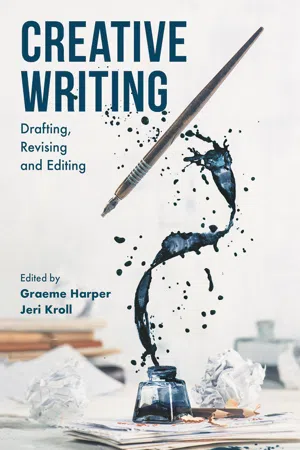
This stimulating edited collection focuses on the practice of revision across all creative writing genres, providing a guide to the modes and methods of drafting, revising and editing. Offering an overview of how creative writing is generated and improved, the chapters address questions of how creative writers revise, why editing is such a crucial part of the creative process and how understanding the theories underpinning revision can enhance writers' projects.
Innovative and thought-provoking, this book is ideal for undergraduate and postgraduate students of creative writing, along with all creative writers looking to hone and polish their craft.
- 262 pages
- English
- ePUB (mobile friendly)
- Available on iOS & Android
eBook - ePub
About this book
Information
EDITING
11 | EDITING AS DIALOGUE IN THE ACADEMY |
Abstract This chapter explores editing as a form of dialogue in the academy, where creative and professional writing teachers perform various editorial roles. One goal is to help students to learn the art of respectful and insightful conversation, which facilitates editing, preparing them for further study or for careers in a mercurial employment environment where editing, as a generic and transferable skill, is valued. Teaching genres such as the conventional and experimental essay can work towards that goal. During the second half of the 20th century, the essay has morphed in academia into risky and transgressive forms alongside the standard academic template. Both provide students with texts they can imitate but also can reveal how work is constructed. Teachers can give students freedom to experiment, which illuminates editing practice while ensuring that they grasp disciplinary discourses. Editing in a generic sense can be understood as a form of dialogue that occurs on several levels within a community of practice, with the goal of producing a finished piece of writing. Teachers situate themselves at various points along a dialogic continuum, functioning as information hubs and as models of editing expertise, forging mutually beneficial relationships with individuals and with class groups.
Keywords Editing · Essay · Generic and transferable skills · Creative writing · Professional writing
Introduction
Creative and professional writing teachers establish complex relationships with individual students and class groups through dialogue. Productive communication achieves a number of goals. Teachers impart editing expertise that enables undergraduates to perform successfully in a range of subjects and they also facilitate creativity, which works to optimize student aptitudes and to keep them engaged while acquiring additional ones. At the postgraduate level, teachers’ pedagogical goals include refining competencies as well as supporting the creation of publishable outcomes and ultimately the generation of new cultural knowledge. Students not only benefit, therefore, from editing proficiency while enrolled, but also develop it in a life-long process.
Undergraduates in the anglophone countries are introduced to expository prose forms subsumed under various names, among them the academic and personal essay, composition,1 research paper, media article, book review and report. Creative work includes poetry, short fiction and creative non-fiction, such as life writing. Some degrees now incorporate composing for digital platforms, but those areas are outside this chapter’s scope. The essay in its myriad configurations, including the creative non-fiction essay, illuminates the challenges students face and the variety of editorial methods – pre-eminent among them dialogue – that teachers develop to respond appropriately. The ultimate goal is to facilitate the production of a polished piece of writing that can be marked or submitted for publication.
All expository writing is conditioned by disciplinary rules and protocols. In the mid-20th century, C. P. Snow in ‘The Two Cultures’ (1963) foregrounded the epistemological and stylistic conflicts between the sciences and humanities. Disciplinary variance if not outright antagonism between those broad approaches to knowledge and culture has been explored since by scholars and cultural theorists in fields on each side of the divide.2 These divergent codes can confuse undergraduates seeking to find appropriate forms of expression. Pierre Bourdieu’s concept of codification has relevance here, since it reflects what occurs in higher education in relation to choosing suitable expressive modes: ‘To codify means to formalize and to adopt formal behaviour. There is a virtue proper to the form. And cultural mastery is always a mastery of forms’ (1990, p. 78). Students learn (if not master) the variety of citation styles taught in the academy, and along with those they develop an individual habitus within the context of disciplinary codes.3 Undergraduates in particular absorb biases, realizing that teachers favour certain styles and formats; they learn the jargon. In so doing, they might bury some of their individuality in exchange for approval and high marks, consciously or unconsciously adopting a ‘class’ or ‘house style’.
This risk applies both to expository and creative writing. At the Master of Fine Arts level, Mark McGurl (2009) has questioned the benefits to American literary culture of this pressure to conform, in particular in relation to the fiction that MFA graduates produce. Even in creative non-fiction, a form that appends the adjective ‘creative’, students comprehend that there are boundaries. Lee Gutkind maintains that creative non-fiction is always based in fact: ‘Creative nonfiction demands spontaneity and an imaginative approach, while remaining true to the validity and integrity of the information it contains’ (1997, p. 5). Yet forms that endure also morph, acquiring an elasticity and vitality that allows writers to renovate as well as to personalize them, as this chapter later demonstrates.
Creative and professional writing teachers, working in subject areas that include the essay and creative non-fiction, promote what can be called generic and transferable skills, including planning, critical thinking and manipulating appropriate linguistic structures. As Anne Lee says, these skills are in fact ‘transferrable to the workplace’ and can be understood as ‘employability competencies’ (Lee, 2014, p. 11),4 although studies of graduates in the anglophone countries call into question their work-readiness (Kiley, 2014). The ability to revise and edit, of course, is inseparable from the ability to write effectively. Given that careers for graduates include tertiary and community instruction in professional, academic and creative writing, related jobs in the communication industries and business, technology and the sciences (editing, publishing, journalism and report composition), and research positions in general, the manner in which teachers facilitate and model editing practice can be seen as vital to student development. They should aim, therefore, to help them to become agile writers and astute self-editors.
The challenge for all good editors – whether in academia or in the commercial world – is to communicate how each individual can negotiate a pathway between absolute adherence to disciplinary or generic principles and absolute freedom of expression. To return to a standard summary of what editors do, they shepherd clients through the process of discovering their best voice; in effect, sounding most like themselves at a particular time in a particular work. Undergraduate teachers, responsible for subjects grounded in a variety of expressive forms, and postgraduate supervisors too, perform very much as professional editors, depending upon the desired outcomes for assignments. For example, a publisher at Allen and Unwin, Jane Palfreyman, highlights the necessity for editorial flexibility, ‘us[ing] the metaphor coined by the famous Australian editor Beatrice Davis of “invisible mending”: fixing up the problems with no one outside the relationship any the wiser’ (Cosic, 2016, p. 51). With the advent of word-processing and the ‘track changes’ tool, students can accept, modify or reject teacher critique and produce a more polished piece of writing, either to submit it for final marking or to a magazine, contest or journal. This process encourages undergraduates and postgraduates to act as professionals.
As this chapter goes on to argue, creative and professional writing teachers can expand student understanding of editing processes by exposing them to both conventional and experimental work. The academic essay provides one template, while the personal or creative non-fiction essay has been transformed, since the mid-20th century, by writers from a range of social and ethnic backgrounds and gender orientations. Being given freedom to experiment does not mean that students will miss grasping disciplinary norms if teachers set up advantageous dialogic structures. In fact, editing in a generic sense can be conceived of as a form of dialogue that occurs between individuals and groups. By positioning themselves at various points along a dialogic continuum, teachers can monitor and mentor editing practice, encouraging objective and yet sensitive interactions between participants. Teachers function, therefore, as information hubs and as models of editing expertise.
The conventional essay and the essay revised
The essay is one of the dominant forms around which English subject instruction is built, complemented by term papers, capstone assignments, in-class and online exercises, quizzes, expository analysis of creative assignments, peer group collaborative activities and oral presentations. Teachers edit student essays to model acceptable scholarly and persuasive discourse. Yet the genre as practised since Michel de Montaigne invented it, publishing the first edition of his Essais in 1580, has undergone a transformation. Critical essays demand one type of response from students and the teachers who assess them, while creative non-fiction essays demand another. Montaigne himself mused about the challenges of his new form back in the 16th century:
It is a thorny undertaking … to follow a movement so wandering as that of our mind, to penetrate the opaque depths of its innermost folds, to pick out and immobilise the innumerable flutterings that agitate it. (Montaigne in Bakewell, 2010, p. 33)
The contemporary essay encompasses a range visible in the literary magazines, journals and collections published around the world (for example, the American, Australian or British essay, the ‘Best Of’ compilations). The history of essay as both verb (to try or test; assay or weigh) and noun encompasses a composition of moderate length on any particular subject or branch of a subject; originally implying want of finish, ‘an irregular, undigested piece…’, but now said of a composition more or less elaborate in style, though limited in range.
The use in this sense is app. taken from Montaigne, whose Essais were first published in 1580. (COED, pp. 293–4)
From suggesting something that was a draft, or posing of ideas in order to test them, the word gradually came to mean a formal composition in academe but also a polemic or personal disquisition in the literary press. It is nevertheless both the academic and personal essay that teachers are most often called upon to edit in composition and professional wri...
Table of contents
- Cover
- Halftitlepage
- Titlepage
- Copyright
- Contents
- List of Figures and Tables
- Introduction
- DRAFTING
- REVISING
- EDITING
- Biographical notes
- Index
Trusted by 375,005 students
Access to over 1.5 million titles for a fair monthly price.
Study more efficiently using our study tools.
Frequently asked questions
Yes, you can cancel anytime from the Subscription tab in your account settings on the Perlego website. Your subscription will stay active until the end of your current billing period. Learn how to cancel your subscription
No, books cannot be downloaded as external files, such as PDFs, for use outside of Perlego. However, you can download books within the Perlego app for offline reading on mobile or tablet. Learn how to download books offline
Perlego offers two plans: Essential and Complete
- Essential is ideal for learners and professionals who enjoy exploring a wide range of subjects. Access the Essential Library with 800,000+ trusted titles and best-sellers across business, personal growth, and the humanities. Includes unlimited reading time and Standard Read Aloud voice.
- Complete: Perfect for advanced learners and researchers needing full, unrestricted access. Unlock 1.5M+ books across hundreds of subjects, including academic and specialized titles. The Complete Plan also includes advanced features like Premium Read Aloud and Research Assistant.
We are an online textbook subscription service, where you can get access to an entire online library for less than the price of a single book per month. With over 1.5 million books across 990+ topics, we’ve got you covered! Learn about our mission
Look out for the read-aloud symbol on your next book to see if you can listen to it. The read-aloud tool reads text aloud for you, highlighting the text as it is being read. You can pause it, speed it up and slow it down. Learn more about Read Aloud
Yes! You can use the Perlego app on both iOS and Android devices to read anytime, anywhere — even offline. Perfect for commutes or when you’re on the go.
Please note we cannot support devices running on iOS 13 and Android 7 or earlier. Learn more about using the app
Please note we cannot support devices running on iOS 13 and Android 7 or earlier. Learn more about using the app
Yes, you can access Creative Writing by Graeme Harper,Jeri Kroll in PDF and/or ePUB format, as well as other popular books in Literature & Literary Criticism. We have over 1.5 million books available in our catalogue for you to explore.