eBook - ePub
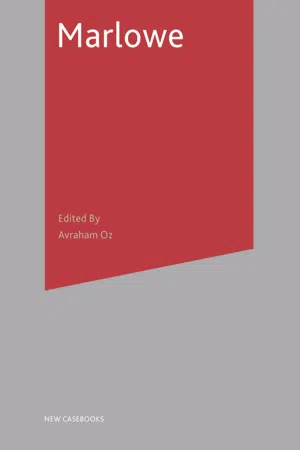
Marlowe
About this book
Christopher Marlowe is known not only as Shakespeare's most notable contemporary playwright, but also as one of the most intriguing figures of the English Renaissance. The mystery of his death in a fray at the age of 29 has inspired writers around the world, and his fiery career is no less intriguing. This New Casebook offers a wide-ranging selection of essays on Marlowe's major plays. Articles from the last two decades by leading critics of English early modern drama provide a variety of fresh, controversial and enlightening critical perspectives on five of Marlowe's plays: Tamburlaine the Great Parts One and Two, The Jew of Malta, Doctor Faustus, and Edward II.
Information
1
Strange and Estranging Spectacles: Strategies of State and Stage
EMILY C. BARTELS
But that was in another country.
(The Jew of Malta, IV.i.43)
Imperialism, stereotypes, and the state
To enter upon the Marlovian stage is to enter a landscape filled with strangers and strange lands. One after another of Christopher Marlowe’s plays focuses on a character type alienated from or marginalised within English society, and several situate that figure within a foreign setting. Their central characters include a Scythian barbarian, a black magician, a Machiavellian Maltese Jew, a homosexual king, and an African queen: their landscapes range from Carthage, to Malta, Persia, Babylon, Egypt, and beyond. Even the European settings seem markedly unfamiliar: England becomes a locus of uncertain authority, ruled by a homosexual king (Edward II) and his favoured ‘minions’ and contested by haughty, overpowering, and questionably noble nobles; Paris, a site of riots, massacres, and murders, also ruled by a homosexual king (Henry III); and Germany, a place where felonious, and potentially damnable, conjurations are admired rather than abhorred, and where devils are likely to appear. The extravagant spectacles (which, on one occasion, allegedly scared spectators from the theatre), the ‘great and thundering speech’ (Tamburlaine, 1:I.iii) of Marlovian blank verse, as well perhaps as the vernacular itself, which Steven Mullaney has suggested as a ‘strange tongue’, contributed also to the alterity of these alien worlds and figures.1
This preoccupation with the ‘other’, coming as and when it does, is no accident. For Marlowe’s representations respond to an increasingly dominant cultural obsession with foreign worlds and peoples, emerging with England’s nascent imperialism. As society attempted to come to terms with competing cultures and to establish its place beside and above them, it produced a discourse of difference, a discourse that interrogated and enforced the crucial, self-affirming distinctions between self (Europe, England, ‘representative man’, the status quo) and other (foreign cultures, nonconformists, alternative values). Marlowe participates in this self-scrutiny by producing his own ‘spectacle[s] of strangeness’.2 What makes his plays so remarkable, so subversive, and indeed, so important is that they combat his society’s attempts to prove the alien inexorably alien and expose cultural stereotypes and discriminations as constructs, strategically deployed to authorise the self over and at the expense of some other.
While the Spanish and Portuguese began to develop a substantial trade network in non-European countries during the early sixteenth century without England’s competitive intervention, the economic depression of the 1550s helped catalyse Elizabethan interest in the new goods, new markets, new jobs, and eventually new homes that such expansionism promised.3 Though England had no explicit imperialist agenda, the mid-sixteenth century witnessed relentless searches for north-east and north-west passages to the East as well as for Terra Australis, development of trade with Russia, India, the East and far East, and exploration and colonisation of the recently discovered ‘New World’. Figures such as Sir Francis Drake and Sir Walter Ralegh held prominent positions not only on the seas but also in the court, urging the nation forward, or rather outward, to the resources beyond.
Emerging with this impetus was an intensified desire for knowledge of unknown or partially known domains, a desire answered and evidenced by the energetic contemporary production of cross-cultural descriptions. Joannes Boemus’s Omnium gentium mores, for example, which describes the ‘aunciente maners, customes, and lawes, of the peoples enhabiting the two partes of the earth, called Affricke and Asie’, had circulated throughout Europe in several languages beginning in 1520 and continuing for almost a century after, and was translated into English in 1555 as The Fardle of Facions.4 John Leo Africanus’s ‘famous worke’, The Geographical Historie of Africa, which details the ‘exceeding strange creatures’ and ‘notable things’ (customs, races and religions, natural resources and material wealth, geographies and histories) of Egypt and Africa, had been similarly disseminated across Europe and was popularised in England and in English by John Pory’s 1600 translation.5 Travel literature also became eminently popular, particularly under the aegis of Richard Hakluyt, whose ‘life, from 1552 to 1616, paralleled the rise of a larger England’ and whose well-known collection of the ‘principal navigations’ undertaken from the 1540s onward and covering a vast array of places – from Russia, to Africa, America, and the Caribbean – vigorously promoted that rise.6 In addition to these textual collections, displays of foreign artifacts, and sometimes even people (Indians, Moors, and Turks), became fashionable during the mid-sixteenth to mid-seventeenth centuries, as England began to gather the ‘infinite riches’ of the outside world into its own ‘little room’.7
Yet as recent studies of colonialist discourse have suggested, the ‘knowledge’ that Europe produced about other worlds, during the early modern period as through the colonialist and even postcolonialist eras, was far from neutral. Instead it was vitally connected with Europe’s self-image and self-authorisation especially, though not exclusively, as Europe began to move toward empire. Europe’s growing expansionism at once required and threatened the crucial gap between self and other that could ‘justify’ the domination of other worlds. Encounters with other cultures, though recorded at times along with longstanding myths about cannibals, ‘Anthropophagi, and men whose heads/[Do grow] beneath their shoulders’ (Othello, I.iii.143–4) and with ‘actual’ scenes of marvels, unearthed foreign subjects with fairly normal appetites and anatomies, interested like their European ‘guests’ in self-protection and profit.8 However the levels of difference and similarity were actually experienced (something which is finally impossible to recuperate), cross-cultural discourse insisted repeatedly on difference.9
So too on the home front, within Europe and England, where the division between self and other was also in danger of breaking down. In England’s case (which is what I am most concerned with here), the pressure to define and display a superior nation produced within domestic texts, such as the chronicled histories, a similar institution of difference, fostering the illusion of a state fully able to separate the ‘we’ from the ‘they’, to effectively identify, contain, and control transgression.10
In his seminal study, Orientalism, Edward Said introduced important ways in which European colonialist discourse produces its object as ‘other’, creating through projection and negation an inferior and uncivilised ‘theirs’ ripe for the domination of a superior, civilised and civilising ‘ours’.11 For Said the other is not real but imaginary, mapped out more by ideology than by geography, though finally bounded as a real terrain by the imperialism promoted through that ideologic mapping.12 Though eminently useful, Said’s world picture is itself bounded by its own ideology, dividing its territory into West and East, self and other, and leaving out the complicating presence of the ‘third world’ of Africa (as Christopher Miller has pointed out) and of a fourth, the ‘New World’, neither of which can be accommodated within a self/other binarism.13 Nor, as both Miller and Homi Bhabha have argued, does Said’s model allow adequately for the ambivalences present in depictions not only of these other ‘other’ worlds, but also of the Orient itself.14 For though imperialist discourse masquerades as being monologic, stable, and sure, it is marked by significant contradictions.
This is nowhere clearer than in the case of cultural and cross-cultural stereotypes which were vital to early modern England’s production of both self and other and to its early move towards empire. Behind each iteration of these constructs lies a will to knowledge and a will to power, a desire to bound off absolutely and so to exploit, dominate, or suppress an identifiable other. As Bhabha has argued, stereotypes produce a kind of ‘radical realism’ and assert, through an excess of signification, a degree of probability and predictability beyond ‘what can be empirically proved or logically construed’.15 The stereotype seems to fix the other, to consolidate all we know about that other and all we need to know. Yet while these constructs take and give shape under the pretence of precision, fixity, and singularity, they are as polymorphic as they are perverse and contribute to a discursive field that is abstract, unstable, and conflicted.
Consider, for example, early modern conceptions of the Jew, who was sometimes a devil, sometimes (merely) an anti-Christian infidel, sometimes a cunning villain, sometimes a child-murderer, sometimes a usurer, sometimes some of the above, and sometimes none. Though Shylock and his prototype, Barabas, love their ducats at least as much as they do their daughters, Shakespeare’s Jew is a usurer while Marlowe’s is not. And while Barabas is all too ready to murder his daughter, along with anyone else who gets in his way, Shylock attempts murder only by law, according to a legitimate (though outrageous) contract. The Turk, too, came in various shapes and sizes, appearing as anything from an empire-mongering barbarian to a diabolical villain. On Marlowe’s stage alone, Turks range from Ithamore, the Jew of Malta’s base and scurrilous slave who has a ‘more the merrier’ attitude toward murder, especially of Christians; to the imperious Calymath (of the same play), who would rather dominate Malta’s Christians than kill them; to Tamburlaine’s Bajazeth, who displays the villainous excesses of the one and the imperiousness of the other, and stands ever ready to ‘glut [his] swords’ (III.iii.164) and ‘let thousands die’ (III.iii.138) in the name of empire. To complicate the matter further, these stereotypes had to compete with more positive though less publicised images – of the Jew, for example, as a victim of the state, scapegoated in times of financial crisis, or of the Turk as a masterful leader, whose forces were significantly better organised and equipped than those of the English.16
While the stereotype is produced as if it were the definitive type, what is clear in representations of these and other others is that the difference they prescribe is as variable as it is familiar. For Bhabha these discrepancies expose a deep ambivalence embedded in colonialist discourse, predicted anxiously on desire as well as fear, defence as well as mastery. Along similar, though deconstructionist rather than psychoanalytic lines, Miller has argued that Europe’s bifurcated vision of Africa expresses Europe’s own conflicted attitude toward the other, the self, and the possibility of ‘maintaining an identity in discourse’.17
These studies, in exposing the disturbances within colonialist representations, usefully complicate Europe’s expression of itself and suppression of the other, pressing us beyond Said and the assumption that colonialist discourse is always hegemonically in charge of itself and taking account of psychological and linguistic uncertainties that insistently disrupt self/other binarisms and the stereotypes constructed around them. Yet while the discrepancies within circumscriptions of the other may in part evolve from these pressures, they also serve strategically to further the colonialist cause, to amplify the critical difference between ‘them’ and ‘us’.
For in the first place, because each iteration of a type stands in conflict with a field of others, it produces a figure who is ultimately unknowable. The ‘other’ is pressed out of the grasp of knowledge precisely at the moment that he or (less often) she is given a fixed place within it. The problem is translated not as a gap in ‘our’ perspective or perception but as an incriminating gap in ‘their’ nature. While Shakespeare’s Romans repeatedly typecast Cleopatra as a strumpet, Enobarbus offers a far more alluring vision of the erotic Egyptian queen floating upon the Nile on her barge. Yet though his depiction is rich with detail, Cleopatra gets lost amidst it, as an object beyond the forms of art and nature, creating an unfillable and unnatural ‘gap in nature’ (Antony and Cleopatra II.ii.218).18 Throughout as here, the more the characters talk about her, setting one image against another, the less definable she becomes, dangerously evading the Romans’/‘our’ language and knowing, like the crocodile Antony describes that is ‘shap’d … like itself’, ‘is as broad as it hath breadth’ and so on (II.vii.42–3). Though the play alerts us to the gaps within the discourse, it also contributes to them and puts Cleopatra beyond our grasp, a figure a little less than kin and more than kind, who is neither the strumpet Philo and Demetrius create nor the erotic goddess Enobarbus sees, but rather is as erratic as she is alluring.
Beyond unknowability, all that can be known for sure about the ‘other’ points to where the self/other binarism leads: to the idea of the other as abstractly but unquestionably negative. Though stereotypes enlist a specificity that seems to ring ‘true’, the inconsistencies between and within them leave us with only the broadest and most negative outline. In most cases, the only constant among the other’s various guises is that he or she is in some way villainous or threatening at the least, whether because of greed, deception, excessive sexuality, murderous actions, or lack of faith (which means, in early modern discourse, Christian or Protestant faith). And it is that constant that prevails.
Indeed, it seems no coincidence that different alien types, such as the Moor and the Turk, the sodomite and the witch, are confused and conflated within early modern discourse, for their abstract negativity matters more than their specific dimensions. Othello, when calling up the ultimate image to condemn himself before his suicide, identifies himself not as a Moor but as a Turk, a ‘malignant and a turban’d Turk’ who ‘beat a Venetian and traduc’d the state’ (Othello, V.ii.353–4) and whom Othello allegedly ...
Table of contents
- Cover
- Title Page
- Copyright
- Dedication
- Contents
- Acknowledgements
- General Editors’ Preface
- Introduction
- 1. Strange and Estranging Spectacles: Strategies of State and Stage
- 2. Christopher Marlowe: Ideology and Subversion
- 3. Faces of Nation and Barbarism: Prophetic Mimicry and the Politics of Tamburlaine the Great
- 4. Marlowe, Marx, and Anti-Semitism
- 5. ‘So neatly plotted, and so well perform’d’: Villain as Playwright in Marlowe’s The Jew of Malta
- 6. Economic and Ideological Exchange in Marlowe’s Jew of Malta
- 7. Dr Faustus: Subversion Through Transgression
- 8. Doctor Faustus and Knowledge in Conflict
- 9. Reading Faustus’s God
- 10. The Terms of Gender: ‘Gay’ and ‘Feminist’ Edward II
- 11. Queer Edward II: Postmodern Sexualities and the Early Modern Subject
- Further Reading
- A Marlowe Chronology
- Notes on Contributors
- Index
Trusted by 375,005 students
Access to over 1.5 million titles for a fair monthly price.
Study more efficiently using our study tools.
Frequently asked questions
Yes, you can cancel anytime from the Subscription tab in your account settings on the Perlego website. Your subscription will stay active until the end of your current billing period. Learn how to cancel your subscription
No, books cannot be downloaded as external files, such as PDFs, for use outside of Perlego. However, you can download books within the Perlego app for offline reading on mobile or tablet. Learn how to download books offline
Perlego offers two plans: Essential and Complete
- Essential is ideal for learners and professionals who enjoy exploring a wide range of subjects. Access the Essential Library with 800,000+ trusted titles and best-sellers across business, personal growth, and the humanities. Includes unlimited reading time and Standard Read Aloud voice.
- Complete: Perfect for advanced learners and researchers needing full, unrestricted access. Unlock 1.5M+ books across hundreds of subjects, including academic and specialized titles. The Complete Plan also includes advanced features like Premium Read Aloud and Research Assistant.
We are an online textbook subscription service, where you can get access to an entire online library for less than the price of a single book per month. With over 1.5 million books across 990+ topics, we’ve got you covered! Learn about our mission
Look out for the read-aloud symbol on your next book to see if you can listen to it. The read-aloud tool reads text aloud for you, highlighting the text as it is being read. You can pause it, speed it up and slow it down. Learn more about Read Aloud
Yes! You can use the Perlego app on both iOS and Android devices to read anytime, anywhere — even offline. Perfect for commutes or when you’re on the go.
Please note we cannot support devices running on iOS 13 and Android 7 or earlier. Learn more about using the app
Please note we cannot support devices running on iOS 13 and Android 7 or earlier. Learn more about using the app
Yes, you can access Marlowe by Avraham Oz in PDF and/or ePUB format, as well as other popular books in Economics & Economic Theory. We have over 1.5 million books available in our catalogue for you to explore.