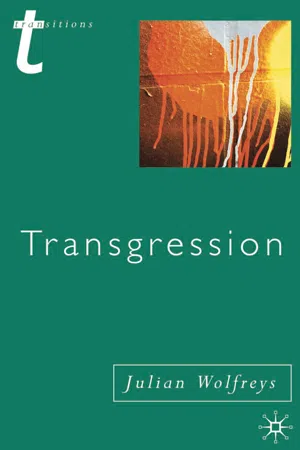
- 240 pages
- English
- ePUB (mobile friendly)
- Available on iOS & Android
eBook - ePub
About this book
Julian Wolfreys introduces students to the central concept of transgression, showing how to interpret the concept from a number of theoretical standpoints. He demonstrates how texts from different cultural and historical periods can be read to examine the workings of 'transgression' and the way in which it has changed over time.
Information
Part I
Making the Modern Subject
1 The ‘Endlesse Worke’ of Transgression: The Faerie Queene and the ‘darke conceit’ of Early Modern Identity
Introduction
This, the first chapter, divided according to particular conceptual and epistemological interests, is concerned with Edmund Spenser’s The Faerie Queene and the role transgression plays in the production of the poem’s narrative, particularly that narrative’s interests in male and female identity, imagery or subjectivity. The extensive nature of this closely focused chapter has to do with the necessary establishment of the grounds for understanding precisely why Spenser’s epic poem is so important in the constitution of historically given, specific identities. The chapter is interested, furthermore, in exploring through such readings of the text as I will offer here particular contexts – ideological, historical and discursive – which inform and produce the text. Moreover, the readings and the contexts that I strive to elucidate through them take, as central to the production of Spenser’s text, an underlying cultural and historical response to that which was perceived in the Early Modern Period as transgressive, whilst, simultaneously, apprehending how transgression becomes written into, and so generative of, Spenser’s various reactionary mediations of culturally transgressive identities at the time of writing.
It might be asked, not unreasonably, if, in beginning a book on transgression in the sixteenth century, at a point in the Early Modern period, why begin with Spenser, when there are so many, obviously more frequently read canonical writers available? A not unreasonable response to such a question might be to acknowledge in the wake of many Spenser scholars that, before one can even begin to speak of cultural politics, ideology and historicity in any conventional sense, The Faerie Queene transgresses formal identity. ‘[N]o classification of the Faerie Queene’s anomalous form’, as Michael West argues, ‘can be entirely satisfactory’ (West 1973, 1014). This ‘formal anomaly’ or rather, let us say, this transgression of discrete or unified formal identity is not merely formal, however, despite my somewhat disingenuous response. For I take it that form, even transgressive form, or deformation of form, is itself a culturally and epistemologically given manifestation of identity that is historical and material through and through. To argue this differently: the historicity of the text is in its own transgressive staging of deformation, breaking the boundaries or limits of form for cultural and ideological purposes.
In no small part, therefore, I am beginning with Spenser because The Faerie Queene is so intricately, densely bound up with a historical and ideological project of constructing national (masculine) identity from within a poetry, the very models of which articulate different national identities, and which must therefore be transgressed, translated, as it were, in order that the very idea of a modern English poetic subject be formed and articulated. This project belongs to a broader English response ‘to the stimulus of the Continental Renaissance with its own efforts [the most famous of which being Ariosto’s Orlando Furioso] at defining and creating an exemplar of Christian heroism’ (West 1973, 1013). However, while other authors such as Sir Philip Sidney subordinate national identity to the Christian ideal, Spenser transgresses both continental and traditional poetic forms and concerns in his attempt to give a place to the historical ‘taking-place’ or ‘becoming’ of the English subject in a space that is, for all its allegorical encryption, historicized. I take The Faerie Queene, then, as a founding moment in the self-conscious and mythologized historicization of the English male subject. Yet, this quasi-originary founding instance or inaugural mediation is far from being free of ambiguity, ambivalence, and even a level of undecidability with regard to its subject, the English Gentleman. The proper formation of the courtly male is engendered, simultaneously, through the celebration of heroism and the necessary transgression of propriety, identity and other related matters. Once more, unlike efforts to similar ends on the part of Raleigh or Sidney, Spenser’s project belongs amongst the more dubiously speculative, ‘skeptical voices like Bacon’s’ (West 1973, 1014) who question the possibility of fashioning an epic or heroic identity outside poetry. Such possibility – or more appropriately unknowability – is voiced by The Faerie Queene’s narrator, who remarks, ‘There is I know not what great difference / Betweene the vulgar and the noble seed’ (II.iv.1). The certitude for the founding of the subject remains absent, the spectrum of difference in the constitution of selfhood unreadable, except for the weak supposition that ‘skill to ride seemes a science / Proper to gentle blood’ (II.iv.1; emphasis added). Thus, this analysis of the problematic of the Early Modern constitution of selfhood centres on issues of identity, specifically male subjectivity and female identity or the representation of such in the poem, examining the ways in which Spenser’s text translates and transgresses the normative assumptions of such contexts.
When concentrating on the constructions of male subjectivity and the male’s production and projection of images of women and formations of female sexuality from the male subject’s perspective, it is to be noticed how, in the Spenserian text, the male subject reworks constantly and endlessly concepts and images of the feminine, concepts and images which are generated largely, if not completely, from cultural positions that are masculine, if not phallo- or logocentric. Inevitably, this must perforce take place from within the particular contexts to be considered. However, additionally Spenser utilizes specific discursive, cultural or ideological ‘place-holders’ of identity historically and materially given so as to generate and rethink – however accidentally or unconsciously – the conceptual parameters of certain potent visual images of women and the feminine in relation to the poem’s overarching project of self-fashioning. As Sheila Cavanagh has it, ‘In Spenser’s epic, women, however virtuous, generally evoke suspicion. Female sexuality remains intertwined with images of danger, actual or potential. Women and wickedness often seem synonymous’; and thus, ‘a muted but powerful ideological thread runs throughout The Faerie Queene which designates gender as the most salient distinguishing quality in the epic’ (1994, 1).
The female presence in the text, which seems initially to be at the edges of (and therefore marginal whilst paradoxically central to) male notions of selfhood, becomes in the Spenserian mythopoetic worldview both the specular object for the male gaze – a figure aware of its own objectification through the focus of the gaze of the male other – and the locus of desire. This situatedness of the female figure is revealed across every book of The Faerie Queene, through a series of repetitious, yet changing patterns, structures which are, therefore, exemplary of iteration, that process whereby repetition with a difference occurs. In such motion, that which generates, projects, produces or engenders is seen to be indebted to the very difference that is generative, and yet which such repetition would seek to control. Through a destruction of the very difference that is perceived as the essence of the other, Spenser’s iterable work relies on the transport of something essential in the configuration of the female other, from one specific example to another. Hence, it is at the most fundamental formal level that transgression is to be read. It is there, an intrinsic element in the structure of the poem; because, for every projection or mediation of the supposedly normative image to be ensured, such a ‘normative’ ideal must have its contours disrupted, deformed from the very start in order to be reformed or destroyed completely On the one hand, this serves male subjectivity economically, because it can always renew the locus and focus of its desire. On the other hand, such iterability of the other appears to take on a particular, transgressive force of its own, despite the author’s intention, social and hegemonic economies of female representation, or the desires of the various male protagonists. In this, the female – perhaps, and certainly particular singular images of women – arrive and retreat, transgressing actively their own marginal, passive cultural sufferance, only to challenge the efficacy of masculine control or authority over those very figures by which he strives to maintain his purpose.
Images of women in The Faerie Queene, then, far from being merely marginal prosopopoeic tropes simultaneously of desire and threat, become repositioned through the strong reading I wish to construct as crucial to the male subject in any project of self-realization. In this reading, the female image, femininity and female sexuality – all become available as the various transgressive and translated traces of a non-centred, radically and strategically non-complete alterity within and yet irreducible to phallic, masculine ontology. Crucially, one may come to read the female and the various projected images of women not as marginal or in any simple manner dialectically positioned outside the male self. Rather, they figure a non-centred, strategically incomplete, interior alterity. Apprehending this, we shall come to understand the text itself, and thus the project of fashioning the male subject, as always being in process. Neither finished nor closed off, the transformations and transgressions of the feminine as the ‘other-within’ become exemplary, yet singular traces that mark Spenser’s text, in his own words, as an ‘endless worke’ (IV. Xii. 1–2). Thus, it will be seen, The Faerie Queene constitutes an arena of often febrile activity and continuous supplementarity, through simultaneous production and negation as the mode of transgressive reinscription and translation. And it is with this supplementary process that I will engage critically.
Like the society and culture that produces The Faerie Queene, the six books of Spenser’s text display the ideological construction of the female as never completed, such is the ‘problem’, from particular patriarchal perspectives, of women. The very idea of ‘woman’ must be positioned as in need of constant and endless rehabilitation, reinvention and remapping as the locus of male interest. Beyond the discussion of sexual difference, I wish also to observe how difference in general is engendered by a cultural artefact, in this case the epic poem. The Spenserian epic mediates the high cultural traces of the late Elizabethan period through its representations of women, obviously enough. Through these culturally approved reproductions, and through the poet’s grafting of cultural attitudes towards women onto his male characters, we can understand how the text reinscribes the various cultural expressions of the ruling class’s gendered hegemonic infrastructure. The epic’s success relies on its ability to fictionalize, to allegorize and so mystify such expressions, hiding them within the fictions of the natural, the commonsensical or the seemingly inevitable. In this, cultural transgression takes place, for in its allegorizing modality, the epic poem rewrites the ideological impulses of a narrowly determined, if all powerful elite from Early Modern English society, and projects that cultural milieu back to itself as if it were all society, as if difference, dissent, dissidence were erased. Where difference is not erased, then, it and its dissident expressions are displaced onto the seemingly externalized and ideologically distanced matter of gender. Women become the locus for difference that must simultaneously be protected and recuperated into the act of endless self-fashioning, whilst also being the sites themselves of dissident, disruptive transgression in a poetic model of transference that assumes all sources of cultural problematization as being rooted in a wayward femininity. It is for such reasons that the epic poem appears to reiterate the same occasions, similar scenarios over and over again. Repeated events in which structural resemblance is paramount serve to produce the markers of particular contexts, which operate in the marginalization of any female voice or presence.
One necessary work, therefore, is to read the poem in such a manner that begins to redefine the female enunciation through a demystification of the assumptions in the text that lie behind the relationship between male self and female other. It will be understood, moreover, that such assumptions are based on particular patriarchal, humanist productions1 and re-enforcements of gender difference in the Early Modern period. In order to reveal the attempted imaginary and textual cultural marginalization of women (producing the image of the ideal courtly male involves putting women in their place psychically and structurally in the text), I will consider specific textual moments, specifically from Canto One of Book I as what should be a sketch towards a more sustained reading of Spenser’s poem as a whole. These moments are crucial in the reading of The Faerie Queene as transgressive text because they work through, and map out, forceful dialectical tensions that open unsuturable gaps, aporia in the logic of the text, its images and narratives. It is through such gaps that the text discloses ‘the process of production and manipulation behind what seems to be a plain statement’ (Evans 1986, 3).
Woman as cultural ‘function’ in the Early Modern period
The Faerie Queene maps and projects the female image endlessly. It must do so in order to maintain its implicit act of cultural surveillance. In order for this to take place, the images of women are variously, heterogeneously, re-invented within the poem’s economy of gendered representation. The female is never complete. This is at once a strategy aiming at containment of the ontology of the ‘female’ (as though women could be reduced to a single ontological mapping, as though the difference between women, and between women and men could be reduced, let us say, to the difference that is ‘woman’). Yet, it is also a tacit admission of the impossibility of the project, such is the problematic status of women in Early Modern patriarchal culture. Women are in numerous ways perceived as transgressive beings, their identities being always already of a transgressive order. Thus, in Spenser’s text, women provide the loci or sites for colonization, in the poet’s ‘endlesse worke’ of what Jonathan Dollimore has termed ‘cultural domination’ (Dollimore 1985, 14). Through the imposition of definitions, women are subjected to an endless ‘naming trick’ (Cixous 1986, 100) during the Early Modern period. Taking such arguments further, Luce Irigaray, discussing the transhistorical condition of women’s oppression in a response to a Freudian provocation, makes it patently clear that women were repeatedly excluded from patriarchal and masculinist discourses, except as their objects (Irigaray 1985, 13).2 Such containment and surveillance within a patriarchal culture is witnessed in the various books of the poem, through the constant re-working of the elements taken to constitute the female in her various culturally and mythopoetically generated guises of virgin, temptress, dragon, amazon and androgyne – and, inevitably, Gloriana, the always absent and idealized Queen/Goddess. Through such reproductions, and through the ideological masculinist or phallocentric attitudes expressed in the formation of such representations, one apprehends how the hegemonic values of the ruling classes are articulated.
In The Faerie Queene the production of the courtly gentleman and the concomitant exploitative projection of the female other are related to one another through the force of desire and the economies of production that determine the shape of the text. Thus, the text reveals itself as ‘fraught with contradiction, especially with regard to its construction of the other’ (Dollimore 1985, 14), in this case the images of women and their service as cultural ‘functions’. However problematic such a term might appear, it is necessary to recognize that the Spenserian text exploits gendered identities not in any directly or simply mimetic manner. Spenser’s ‘women’ are not real women, even though the sexual politics of the poem has to do, unequivocally, with both the desire and fear of woman as potential site of cultural and ideological agency. Rather, the female figures of The Faerie Queene operate as functions in and of the text. They are generative and/or transgressive. They bring about events, engender adventures, cause disruption and threaten chaos, interruption or destruction. At the same time, however, they also act as functions in that some of them are the justification for men’s adventures, boys’ stories. The figure and ...
Table of contents
- Cover
- Halftitle
- Title Page
- Copyright
- Contents
- General Editor’s Preface
- Acknowledgements
- Introduction: Transgressions or, Beyond the Obvious
- Part I Making the Modern Subject
- Part II Haunted Subjects
- Afterword
- Notes
- Works Cited
- Index of Proper Names and Titles
Trusted by 375,005 students
Access to over 1.5 million titles for a fair monthly price.
Study more efficiently using our study tools.
Frequently asked questions
Yes, you can cancel anytime from the Subscription tab in your account settings on the Perlego website. Your subscription will stay active until the end of your current billing period. Learn how to cancel your subscription
No, books cannot be downloaded as external files, such as PDFs, for use outside of Perlego. However, you can download books within the Perlego app for offline reading on mobile or tablet. Learn how to download books offline
Perlego offers two plans: Essential and Complete
- Essential is ideal for learners and professionals who enjoy exploring a wide range of subjects. Access the Essential Library with 800,000+ trusted titles and best-sellers across business, personal growth, and the humanities. Includes unlimited reading time and Standard Read Aloud voice.
- Complete: Perfect for advanced learners and researchers needing full, unrestricted access. Unlock 1.5M+ books across hundreds of subjects, including academic and specialized titles. The Complete Plan also includes advanced features like Premium Read Aloud and Research Assistant.
We are an online textbook subscription service, where you can get access to an entire online library for less than the price of a single book per month. With over 1.5 million books across 990+ topics, we’ve got you covered! Learn about our mission
Look out for the read-aloud symbol on your next book to see if you can listen to it. The read-aloud tool reads text aloud for you, highlighting the text as it is being read. You can pause it, speed it up and slow it down. Learn more about Read Aloud
Yes! You can use the Perlego app on both iOS and Android devices to read anytime, anywhere — even offline. Perfect for commutes or when you’re on the go.
Please note we cannot support devices running on iOS 13 and Android 7 or earlier. Learn more about using the app
Please note we cannot support devices running on iOS 13 and Android 7 or earlier. Learn more about using the app
Yes, you can access Transgression by Julian Wolfreys in PDF and/or ePUB format, as well as other popular books in Literature & Literary Criticism Theory. We have over 1.5 million books available in our catalogue for you to explore.