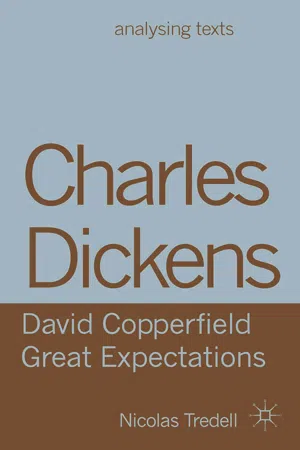
David Copperfield and Great Expectations are among Charles Dickens's most famous novels. In both books, the hero tells the vivid and absorbing tale of his education by life, presents a rich range of characters and scenes, and tackles profound moral, social and psychological themes.
Part I of this essential study:
- Provides lucid and penetrating analyses of key passages
- Discusses the crucial topics of patriarchy, class, obsession, eccentricity, death, breakdown and recovery
- Summarizes the methods of analysis and offers suggestions for further work
Part II supplies key background material, including:
- An account of Dickens's life and works
- A survey of historical, cultural and literary contexts
- Samples of significant criticism
Also featuring a valuable Further Reading section, this volume provides readers with the critical and analytical skills which will enable them to enjoy and explore both novels for themselves.
- 232 pages
- English
- ePUB (mobile friendly)
- Available on iOS & Android
eBook - ePub
Charles Dickens: David Copperfield/ Great Expectations
About this book
Information
PART I
ANALYSING DAVID COPPERFIELD AND GREAT EXPECTATIONS
1
Sons and Patriarchs
Near the start of both Copperfield and Expectations, the protagonist of each novel, then a small, vulnerable, fatherless boy, encounters a threatening, quasi-paternal male figure that suddenly appears in his life: Murdstone in the case of David, Magwitch in the case of Pip. The fathers of both boys are dead; while David’s mother is alive and feels affection for her son, she is not a strong character and cannot protect him from her second husband; David’s nurse, Peggotty, is deeply loving but limited in what she can do by her social position and temperament. Pip has lost not only his father but also his mother and five little brothers; he lives with his surviving sister, over twenty years his senior, and her husband, Joe Gargery, the blacksmith; but Mrs Joe, as she is known, is callous, quick to administer corporal punishment, incurious and unimaginative, and while Joe is loving towards Pip, in a way that is both boyish and maternal, he dare not stand up to his wife when she bullies her younger brother, fearing that to do so would only make matters worse.
Both David and Pip are in situations that make them vulnerable to the intervention of domineering men who are capable of verbal and physical violence and who, in different ways, play the patriarchal role traditionally assigned to the father. Murdstone, with a veneer of religiosity and respectability, insinuates himself into David’s household and becomes David’s stepfather, but, as this chapter will later show, he and his stepson soon come into violent conflict; Magwitch starts by laying violent hands on Pip but later becomes Pip’s secret benefactor, his ‘second father’, as he describes himself in the great recognition scene in chapter 39 of Expectations, which we will discuss in chapter 4 of this book. In both cases the encounters of the young protagonists with these patriarchal figures changes their lives. We can see harbingers of this change in the first passage we analyse, from Copperfield, which evokes David’s initial meeting with Murdstone.
The Wrong Hand: David Copperfield, pp. 66–8
‘But if you marry a person, and the person dies, why then you may marry another person, mayn’t you, Peggotty?’
‘You MAY,’ says Peggotty, ‘if you choose, my dear. That’s a matter of opinion.’
‘But what is your opinion, Peggotty?’ said I.
I asked her, and looked curiously at her, because she looked so curiously at me.
‘My opinion is,’ said Peggotty, taking her eyes from me, after a little indecision and going on with her work, ‘that I never was married myself, Master Davy, and that I don’t expect to be. That’s all I know about the subject.’
‘You an’t cross, I suppose, Peggotty, are you?’ said I, after sitting quiet for a minute.
I really thought she was, she had been so short with me; but I was quite mistaken: for she laid aside her work (which was a stocking of her own), and opening her arms wide, took my curly head within them, and gave it a good squeeze. I know it was a good squeeze, because, being very plump, whenever she made any little exertion after she was dressed, some of the buttons on the back of her gown flew off. And I recollect two bursting to the opposite side of the parlour, while she was hugging me.
‘Now let me hear some more about the Crorkindills,’ said Peggotty, who was not quite right in the name yet, ‘for I an’t heard half enough.’
I couldn’t quite understand why Peggotty looked so queer, or why she was so ready to go back to the crocodiles. However, we returned to those monsters, with fresh wakefulness on my part, and we left their eggs in the sand for the sun to hatch; and we ran away from them, and baffled them by constantly turning, which they were unable to do quickly, on account of their unwieldy make; and we went down into the water after them, as natives, and put sharp pieces of timber down their throats; and in short we ran the whole crocodile gauntlet. I did, at least; but I had my doubts of Peggotty, who was thoughtfully sticking her needle into various parts of her face and arms, all the time.
We had exhausted the crocodiles, and begun with the alligators, when the garden-bell rang. We went out to the door; and there was my mother, looking unusually pretty, I thought, and with her a gentleman with beautiful black hair and whiskers, who had walked home with us from church last Sunday.
As my mother stooped down on the threshold to take me in her arms and kiss me, the gentleman said I was a more highly privileged little fellow than a monarch – or something like that; for my later understanding comes, I am sensible, to my aid here.
‘What does that mean?’ I asked him, over her shoulder.
He patted me on the head; but somehow, I didn’t like him or his deep voice, and I was jealous that his hand should touch my mother’s in touching me – which it did. I put it away, as well as I could.
‘Oh, Davy!’ remonstrated my mother.
‘Dear boy!’ said the gentleman. ‘I cannot wonder at his devotion!’
I never saw such a beautiful colour on my mother’s face before. She gently chid me for being rude; and, keeping me close to her shawl, turned to thank the gentleman for taking so much trouble as to bring her home. She put her hand to him as she spoke, and, as he met it with his own, she glanced, I thought, at me.
‘Let us say “good night”, my fine boy,’ said the gentleman, when he had bent his head – I saw him! – over my mother’s little glove.
‘Good night!’ said I.
‘Come! Let us be the best friends in the world!’ said the gentleman, laughing. ‘Shake hands!’
My right hand was in my mother’s left, so I gave him the other.
‘Why, that’s the wrong hand, Davy!’ laughed the gentleman.
My mother drew my right hand forward, but I was resolved, for my former reason, not to give it him, and I did not. I gave him the other, and he shook it heartily, and said I was a brave fellow, and went away.
At this minute I see him turn round in the garden, and give us a last look with his ill-omened black eyes, before the door was shut.
We shall start by analysing the dialogue, as it is prominent in this passage. In talking to each other, David and Peggotty use some nonstandard kinds of English; both employ the contracted form ‘an’t’ for ‘are not’ and David says ‘mayn’t you’ instead of ‘may you not’. But there is a distinction between the child and the nurse: Peggotty has difficulty in pronouncing the unfamiliar word ‘crocodiles’, in contrast to David, who has been reading aloud to her about them and has clearly mastered the pronunciation; this establishes him as a character who already enjoys a higher degree of literacy and articulateness than Peggotty. Nonetheless, David is able to talk to Peggotty with more directness than he can talk to his mother and the nameless gentleman; with them he speaks only twice, curtly, and in Standard English forms: ‘What does that mean?’; ‘Good night’. But both with Peggotty and, though to a lesser extent, with the gentleman, David’s direct-speech dialogue is largely in the interrogative mode – that is, he is asking questions.
These questions are about adult topics. The first questions concern the nature of marriage and the constraints on who may marry whom. The second question is about why a gentleman might feel that David is highly privileged to receive a kiss from his mother. To David’s questions about marriage, Peggotty answers evasively; to his question about whether she is cross with him because of his questions, she answers, not with words, but with an all-embracing gesture that is hugely reassuring to the vulnerable young boy but compounds her evasiveness on the topic of marriage – immediately after the hug, she speaks in a way that seems intended to pre-empt further interrogation on the matter. To David’s question to the unknown gentleman, about the meaning of what the latter has just said, he receives, not a reply, but another gesture that is not affectionate but implicitly patronizing. Peggotty does at least try to offer some verbal response to David’s questions, even while trying to close the issue; but the gentleman does not reply verbally to David’s initial question, and he and David’s mother offer the boy, not explanations, but only remonstrations, exclamations and imperatives (‘Oh, Davy!’; ‘Dear boy!’; ‘Let us say “good night”, my fine boy’; ‘Let us be the best friends in the world!’). In the dialogue, the way in which David’s questions are answered evasively or not at all and his inability to extract straight answers from adults suggest his limited knowledge of grown-up life and his comparative powerlessness.
It is also notable that the unknown gentleman’s first words to David are not in dialogue but in the more distanced mode of indirect speech, which is woven into the narrative prose of the novel. Moreover, the narrator makes it clear that he is not claiming to recall the gentleman’s words precisely but is offering an approximation from a later, adult viewpoint; as he says, ‘my later understanding comes, I am sensible [that is, I notice or appreciate], to my aid’. This further distances the unknown gentleman by implying that he speaks in a way that is not quite comprehensible to a young boy. Indeed, his words contain an inappropriate sexual reference (the gentleman is implying that David is fortunate to be kissed by such a woman in the way that an adult male might be fortunate to be kissed by her). His parting compliment to David – that he is a brave fellow – is also rendered in indirect speech, as if David, at the end of his first meeting with the unknown gentleman, were pushing the compliment away from him. Mrs Copperfield’s gentle chiding of him, and her thanking of the gentleman, are also presented in indirect speech, as if to indicate that she, too, is becoming distanced from David.
The narrative prose of the passage shows an extensive command of vocabulary and syntax that signals the voice of the adult narrator. We have just seen how at one point, David makes it explicit that he is interpreting childhood experience – in this case, the words of the unknown gentleman – with adult understanding. A second shift into the present tense occurs in the last sentence of the extract: ‘At this minute’ – that is, the minute at which David is writing – ‘I see him turn round in the garden and give us a last look’. Here, however, the effect is not one of detachment, of the adult standing back from earlier experience and commenting upon it reflectively; rather, the use of the present tense, combined with the relatively simple, largely monosyllabic vocabulary – only four of the words in this 27–word sentence have more than one syllable – serve to close the gap between past and present, to show David plunged back into the experience in all its painful immediacy. For much of the passage the narrator stays within the child’s limited understanding of the situation while letting the reader infer what is actually happening – that is, that the unknown gentleman is courting David’s widowed mother with the idea of marrying her. The extract thus offers a kind of double vision in which the reader sees David’s experiences from both his boyhood and his adult perspectives.
The extract contains two especially elaborate paragraphs of narrative prose: the first describes Peggotty’s embrace of David, the second evokes David’s reading aloud of the story about the crocodiles. The first of these paragraphs opens with a long multiple sentence, punctuated by semicolons, which takes David from anxiety at having perhaps angered Peggotty to a sense of relief and reassurance that she still loves him. In this sentence, the implications of the adjective ‘short’, referring to her truncation of the discussion about marriage, are compensated by ‘opening’, where the present participle supplies a sense of greater expansiveness than the use of a finite verb (‘opened’) would have done; while the closing words of the sentence, ‘gave it a good squeeze’, with its monosyllables and its alliteration of ‘gave’ and ‘good’, convey a sense of safe enclosure. The repetition of the phrase ‘a good squeeze’ in the next sentence emphasizes this. This sentence goes on to make the general point that the buttons on the back of Peggotty’s gown always fly off whenever she slightly exerts herself, comically conveying Peggotty’s plumpness and the constriction of her gown. An example of this general point, specific to the present instance, follows: two of her buttons fly off when she squeezes David. This symbolizes both the amplitude of her affection (two buttons, not just one) and her lack of opportunity to express it, as a respectable woman without a husband or children of her own. The present participles in the last sentence of the paragraph (‘bursting’, ‘hugging’) reiterate the ideas of exuberant expansiveness and affectionate closure.
In the paragraph about the crocodiles, the sentence that starts ‘However, we returned’ is, at 79 words, the longest sentence of the extract. There is a significant shift in this sentence from the first- and third-person pronouns (‘I’, ‘she’, ‘he’), which are used elsewhere in the extract, to the first-person plural, ‘we’, as if David were talking about an experience that he and Peggotty share – or that David would like to share with her, since it later becomes apparent that Peggotty’s thoughts are elsewhere. The sentence goes on to describe the imaginary adventure that David is reading aloud as if it were a real one (‘we returned’; ‘we left’; ‘we ran away’); this suggests David’s capacity to become absorbed in fictional and in this case exotic narrative (the hinterland of the British Empire is implied here, as in other parts of Dickens). But after the long sentence ends, the next one immediately abandons ‘we’ for an ‘I’ stressed by its italicization; this shift of pronoun indicates David’s awareness of his distance from Peggotty and of the fact that, despite the previous use of the first-person plural, the imaginative experience has not been shared. A description that demonstrates Peggotty’s distraction follows, as she seems to be lost in thought and keeps sticking her needle into her face and arms, as if inadvertently mortifying herself for improper thoughts – thoughts, we may infer, about Mrs Copperfield’s possible remarriage.
The extract then returns to shorter paragraphs and sentences without semicolons, as David moves from his imaginary world and from Peggotty’s company to the reality of his mother and the unknown gentleman – though there is an implicit link, which later events in the novel will draw out, between that gentleman and the predatory crocodiles and alligators. The description of how David’s mother stoops on the threshold to take him in her arms and kiss him is much more straightforward and subdued than the account of Peggotty hugging David – no bursting buttons here; the kiss may be deeply felt but could be, from the description, merely conventional. Moreover, while Peggotty’s embrace of David excludes others and encloses the two parties, even if only for a brief space, in a world of their own, David’s possession of his mother’s hand is threatened by the gentleman’s attempt to touch hers. David signals his aversion to the gentleman by pushing his hand away, refusing to release his mother’s hand and to present the correct hand for the gentleman to shake. As if inverting a colloquial phrase, Dickens shows how David and the unknown gentleman get off, not on the wrong foot, but on the wrong hand.
The diction of the passage, the words that it uses, also help to convey the sense that something strange and unprecedented in David’s experience is happening. The adverb ‘curiously’ occurs twice, applied to the way David looks at Peggotty and to the way she looks at him. The phrase ‘so queer’ stresses the extremely peculiar nature of Peggotty’s expression. The adverb ‘unusually’, applied to his mother’s prettiness, further reinforces the sense that an extraordinary event is occurring, and this sense of the unusual develops into a sense of the unprecedented in the statement that David ‘never saw such a beautiful colour on my mother’s face before’. This signifies to the adult reader the way in which the gentleman’s presence has excited Mrs Copperfield.
It is also notable that the adjective ‘beautiful’ is used twice in this extract; here, and in the earlier description of the gentleman’s ‘beautiful black hair and whiskers’. This creates a subtle link between the man and the woman – a harbinger of their future marriage – as well as suggesting the physical attractiveness of the husband-to-be and signalling his masculinity through the mention of his ‘whiskers’. But the adjective ‘black’ assumes more negative connotations in the last sentence of the extract, where the adjective ‘ill-omened’ precedes it; the gentleman is taking on the characteristics of a villain of melodrama. The finite verb ‘shut’ at ...
Table of contents
- Cover
- Title page
- Copyright
- Contents
- General Editor’s Preface
- Acknowledgements
- Note on Quotations
- Introduction
- Part I: Analysing David Copperfield and Great Expectations
- Part II: The Context and the Critics
- Further Reading
- Index
Trusted by 375,005 students
Access to over 1.5 million titles for a fair monthly price.
Study more efficiently using our study tools.
Frequently asked questions
Yes, you can cancel anytime from the Subscription tab in your account settings on the Perlego website. Your subscription will stay active until the end of your current billing period. Learn how to cancel your subscription
No, books cannot be downloaded as external files, such as PDFs, for use outside of Perlego. However, you can download books within the Perlego app for offline reading on mobile or tablet. Learn how to download books offline
Perlego offers two plans: Essential and Complete
- Essential is ideal for learners and professionals who enjoy exploring a wide range of subjects. Access the Essential Library with 800,000+ trusted titles and best-sellers across business, personal growth, and the humanities. Includes unlimited reading time and Standard Read Aloud voice.
- Complete: Perfect for advanced learners and researchers needing full, unrestricted access. Unlock 1.5M+ books across hundreds of subjects, including academic and specialized titles. The Complete Plan also includes advanced features like Premium Read Aloud and Research Assistant.
We are an online textbook subscription service, where you can get access to an entire online library for less than the price of a single book per month. With over 1.5 million books across 990+ topics, we’ve got you covered! Learn about our mission
Look out for the read-aloud symbol on your next book to see if you can listen to it. The read-aloud tool reads text aloud for you, highlighting the text as it is being read. You can pause it, speed it up and slow it down. Learn more about Read Aloud
Yes! You can use the Perlego app on both iOS and Android devices to read anytime, anywhere — even offline. Perfect for commutes or when you’re on the go.
Please note we cannot support devices running on iOS 13 and Android 7 or earlier. Learn more about using the app
Please note we cannot support devices running on iOS 13 and Android 7 or earlier. Learn more about using the app
Yes, you can access Charles Dickens: David Copperfield/ Great Expectations by Nicolas Tredell in PDF and/or ePUB format, as well as other popular books in Literature & Modern Literary Criticism. We have over 1.5 million books available in our catalogue for you to explore.