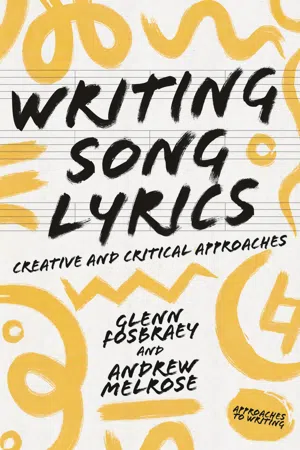
This book is unique in offering practical advice on writing song lyrics within a critically informed framework. Part I provides the theoretical underpinning, while Part II covers the creative process, pulling together all the best songwriting advice and offering practical exercises.
Fusing creative guidance with rigorous criticism, this is an essential companion for undergraduate and postgraduate students of songwriting, creative writing and music. Lively and accessible, it is a one-stop shop for all aspiring songwriters.
- 236 pages
- English
- ePUB (mobile friendly)
- Available on iOS & Android
eBook - ePub
About this book
Information
Part I
Foundations
1
How do we listen?
Defining what the ‘text’ is when we talk about pop songs
In conducting close critical readings of any text, be it a poem, a novel, a play or so on, we have the opportunity to look at both the text itself and at what lies beyond it; lyrics are no different. This methodology offers great benefits to us in our analyses and in aiding our understanding of the meaning, historical, critical and cultural context of the lyric. You might be asking, how important is this? Well, insofar as the lyricist is a writer just like other writers, I contend that it deserves the same critical consideration.
Nevertheless, given the nature of popular songs, in whatever genre (see below) deciding what constitutes ‘the text’ needs a different approach from literature. In a novel, for example, we can see what the text is: whatever appears within the pages, perhaps including the front and back covers, blurb and author bio if applicable, but the text is defined as the words of the novel itself. Everything is contained in the words, sentences, paragraphs, chapters and so on that make up the pages of the novel. The same is true for a poem. With a song, however, there are other factors to consider. The song is a combination of music and lyric, both of which can be read as well as heard; and then there is the accompanying material that surrounds the delivery. Should the ‘text’ include cover art, information found inside the sleeve or booklet, including lyric transcriptions (for hard copy) or website (for download/streaming). Should ‘text’ include music video? And to what extent should we allow these factors to influence our readings of the song? Once information is obtained, it’s hard to ignore or dismiss. If we have seen the music video for a song, it is likely to influence our perception of the song. Who can separate Robin Thicke’s ‘Blurred Lines’ (2013) from its video now; or Queen’s ‘Bohemian Rhapsody’ (1975), which was a seminal breakthrough in song delivery via video for television?
In this book the ‘text’ when we are talking about popular music is the song itself– the song coming out of speakers or headphones, without any other factors interfering with the experience. Imagine tuning a radio dial or getting Spotify, iTunes, or some such to randomly select you a song. You hear the song for the first time, don’t know who performed or wrote it, and have no knowledge of its music video or artwork. This is, perhaps, popular song analysis at its purest. From a straight gut reaction, we might mishear the lyrics; we might think the singer is female when he is a male, black when she is white, in his twenties when the singer is in his sixties, and it’s all relevant because what we are doing is processing what we don’t know alongside what we do. Such reactions, whether fact or error, still make for an analysis, after all it’s our first. Put yourself into this position and think about the time you stumbled across a much-loved song in this way. Later, when we find out more about the song and bring in the artist’s info, appearance or biography, our perspective will change, whether we want it to or not. This later analysis is also valid, but very different from the first. The first draws entirely on two things:
1.reader response (our reaction to the music based upon our own experiences), and
2.(which carries on from this first point) a quasi-structuralist criticism where we judge the song based upon what’s been before (but only what we have heard before, up to that point) and also the cultural context in which it is delivered and received. When we start to bring factors outside the text into our analyses, we will likely come up with a reading that is completely different to one that looks only at the text.
Now that we’ve defined what we mean by the text, we can begin to think about how to analyse it.
What do we look for in a song?
Although it could certainly be argued that many very successful songs have lyrics which don’t contain a great deal of depth, it doesn’t mean that lyrics are unimportant. Although these songs may prioritize the hook, the big chorus, the production or vocal acrobatics above the actual lyrical content, there are many, many others whose lyrics are intended to be front and centre.
Sometimes, a couple of lines and a general theme are enough to carry a song, regardless of what the rest of the lyrics are doing. Take Pharrell Williams’ ‘Happy’ (2013) as a prime example. At the time of writing, it was the biggest-selling single of the decade so far. The song revolves around the simple refrain ‘I’m happy’ and the repeated instruction for the listener to ‘clap along’. That the listener may not understand or agree with what they’re clapping along with – and with instructions including clapping along ‘if you feel like a room without a roof ’ and ‘if you feel like happiness is the truth’, this may well be the case – is irrelevant as they’re essentially clapping along to agree with the hook ‘I’m happy’. The rest of the lyrics’ function is only to back up the general feel of being happy, and once again, the fact that they include lines which stray into the nonsensical – ‘I’m a hot air balloon that could go to space/With the air, like I don’t care, baby, by the way’ – doesn’t impact on the song’s overall appeal. It can, indeed, be summed up by its one-word title. All Pharrell Williams had to do was to make it sound convincing. Although there is obviously nothing wrong with this as a writing technique, and no one can argue with Pharrell’s success, this isn’t what some writers want to be doing. As with most art forms, different people seek different things. In literature, some writers want to write page-turners that hit the top of the bestsellers list, and others want to create something profound that will last forever in the memory. Some film directors want to make a rip-roaring blockbuster simply to entertain, and others want to make art-house films to move their audience and make them question themselves and the society they live in. And so it is with songwriting. For every writer who wants nothing more for his lyrics than for them to be part of a whole package of entertainment within a song, there is the lyrist who wants her words to be meaningful, impactful and profound. For every Black Eyed Peas (‘The beat bump bumps in your trunk trunkas/The girlies in the club with the big plump plumpas’ [2003]), there’s a Joni Mitchell (‘We’re captive on the carousel of time/We can’t return we can only look behind’ [1970]). For every Girls Aloud (‘Don’t hit my what/Come hit my spot/Don’t pop the lock/Don’t hit my what/Come like my spot/Let me give it to ya/Break it down, Mr. Shock’ [2008]), there is a Leonard Cohen (‘As he died to make men holy, let us die to make things cheap’ [2016]). And so on. And that’s not to rubbish any artists or the style they choose to work in; it’s merely to observe that different lyricists have different goals in mind when they sit down to write (which we will explore later through our discussions of formula and persuasion).
The type of lyricist you’re going to be will depend greatly on what kind of listener you are. Don’t really pay much attention to lyrics and just want something (anything) to sing along to? Fine – no problem. The likelihood is, then, that your main focus won’t be on lyrics when you’re writing a song, and you’ll just write whatever words fit the melody and don’t sound too awful. Love lyrics and pore over the transcripts in search for meaning? You’ll likely spend a lot of time on your lyrics and fill them with hidden messages. Love lyrics because they help you get to know the artist? You may be drawn to self-confessional lyrics where you lay yourself bare on the page. Love wordplay, clever rhyme and poetic language, but aren’t fussed over what they mean? You might find yourself writing lyrics that are aesthetically pleasing but have no underlying message. Love lyrics that make a bold statement, be it political, social, racial or sexual? Then maybe that’s what you should write about. Not that as a lyricist you should ever limit yourself to one particular style, of course, but spend-ing a few seconds thinking about your relationship with lyrics in your life so far could be quite revealing about what you want to do with your lyrics, be it making an empowering statement about feminism or select-ing words because they rhyme and sound good.
Exercise 1
Think of your top five songs of all time, and make a few notes about why they’re your favourites.
Now think of your top five sets of lyrics of all time, and consider what it is about their words you love so much.
Lastly, compare the two lists and, if there are differences, think about the importance you attach to lyrics and the importance you attach to the other aspects (melody, singer, production, etc.)
Exercise 2
To flip things around, make a note of the five songs that you dislike the most. Note your reasons. Do they have to do with the overall sound (production)? The lyrics? An annoying earworm melody that you can’t shift for days after listening? The artist themselves?
Exercise 3
Nick Hornby wrote a wonderful book called 31 Songs (2014), where he wrote a personal essay (about 1,000 words each) on 31 of the tracks that he had the biggest connection with and his relationship with them. Choose one of the songs from your first top five list and do something similar. At what point in your life did you discover the song? Did you buy it, hear it on the radio, see its music video on TV or stream it? Was the attachment instant, or did it take awhile? Are any specific memories associated with it? Did it lead to your liking more songs from the same artist, and similarly, did it open gateways to other types of music? Apart from the song itself, is there anything else that you associate with it (e.g. music video, artist interview, gig, album cover, etc.)
After this short series of exercises, you’ll start to discover more about yourself as listener, and this will have an impact on what kind of writer you’ll be, whether it’s through directly aping a particular style or simply being drawn to specific subjects or themes and allowing these to emerge via osmosis into your lyrics.
Starting to analyse
Listen to a song of your choice, and consider the following questions:
Which perspective is used (first, second or third person)? Is there more than one?
Which tense is used? Is there more than one?
Who, if anyone, is being addressed?
How many ‘characters’ are present in the song?
What kind of emotional impact does it have on you?
What emotional impact do you think the writer is trying to have on you? Is the writer trying to persuade you of anything?
What, if any, ‘meaning’ do you take from the lyrics?
Are any words difficult to follow? If so, which ones?
What conclusions do you draw of the lyricist?
Does the song remind you of anything else you’ve heard before (either in terms of the sound, melody, vocal or lyrics)? If yes, what do the ‘other’ songs mean to you, and what memories or emotions do you attach to them?
Does there appear to be any metaphor, simile or symbolism present in the lyrics?
When you listen, who are you seeing as the ‘I’ character?
When you listen, who are you seeing as the ‘you’ character (yourself or another)?
To what extent does the song ‘speak to you’ about your own life?
To what extent does the song ‘speak to you’ about someone else’s life? And who might that be?
From this list of questions, which involve looking inside the text (just at the music and lyrics), and which require you to look outside (beyond just the music and lyrics).
2
Author, intention, biography
Historically, in music criticism the author’s intention has been central to us being able to ‘understand’ the lyrics. As Hopps says,
Never is the reliance on author’s intention more prevalent than it is in reading pop music, and it is commonplace for ‘commentators [to] read the lyrics literally, as transparent disclosures of the singer’s biography. (2009: 9)
On 23 April 2016, Beyonce’s album Lemonade was released, with the song ‘Sorry’ (2016). It includes the line ‘He only want me when I’m not there/He better call Becky with the good hair.’ The reaction on the internet was immediate and widespread, with articles in Vanity Fair, Hello, Independent, NME, Daily Mirror, Daily Mail, MTV, Metro, Vogue, Cosmopolitan, NBC News, CNN.com, BBC.co.uk, Daily Express, Daily Star, and Huffington Post (to name just some), all of which ran stories that sought to discover the identity of the ‘Becky’ character. Indeed, a Google search of ‘Becky with the Good Hair’ on 6 July 2017 brought with it 2,480,000 results. Why, though, do we immediately assume there is weight and meaning and reality to the line in ‘Lemonade’, instead of thinking that Beyonce may simply have been floundering for a rhyme with ‘there’ and plumped for ‘hair’, then worked in a random female character to fill the line? Beyonce certainly has form when using perfect rhymes in songs, so it’s not too much of a leap. Look at it this way: if Stephen King had written a ‘Becky with the good hair’ into his new novel, would it have caused this furore?
The Beyonce ‘Lemonade’ saga continued, with speculation around new Jay-Z album ‘4:44’, where, apparently, ‘instead of raving about the music and collaborations, fans appear to be more interested in the fact he addresses his rocky relationship with Beyonce’ (Shenton 2017).
This desire to discover more about an artist is nothing new, of course, with fan clubs and band newsletters having been around for decades, but this kind of instant access to biography, and the ease with which it can be obt...
Table of contents
- Cover
- Halt Title
- Series Page
- Title Page
- Copyright
- Dedication
- Contents
- Introduction
- Part I Foundations
- Part II Speculations
- Conclusion
- References
- Index
Trusted by 375,005 students
Access to over 1.5 million titles for a fair monthly price.
Study more efficiently using our study tools.
Frequently asked questions
Yes, you can cancel anytime from the Subscription tab in your account settings on the Perlego website. Your subscription will stay active until the end of your current billing period. Learn how to cancel your subscription
No, books cannot be downloaded as external files, such as PDFs, for use outside of Perlego. However, you can download books within the Perlego app for offline reading on mobile or tablet. Learn how to download books offline
Perlego offers two plans: Essential and Complete
- Essential is ideal for learners and professionals who enjoy exploring a wide range of subjects. Access the Essential Library with 800,000+ trusted titles and best-sellers across business, personal growth, and the humanities. Includes unlimited reading time and Standard Read Aloud voice.
- Complete: Perfect for advanced learners and researchers needing full, unrestricted access. Unlock 1.5M+ books across hundreds of subjects, including academic and specialized titles. The Complete Plan also includes advanced features like Premium Read Aloud and Research Assistant.
We are an online textbook subscription service, where you can get access to an entire online library for less than the price of a single book per month. With over 1.5 million books across 990+ topics, we’ve got you covered! Learn about our mission
Look out for the read-aloud symbol on your next book to see if you can listen to it. The read-aloud tool reads text aloud for you, highlighting the text as it is being read. You can pause it, speed it up and slow it down. Learn more about Read Aloud
Yes! You can use the Perlego app on both iOS and Android devices to read anytime, anywhere — even offline. Perfect for commutes or when you’re on the go.
Please note we cannot support devices running on iOS 13 and Android 7 or earlier. Learn more about using the app
Please note we cannot support devices running on iOS 13 and Android 7 or earlier. Learn more about using the app
Yes, you can access Writing Song Lyrics by Glenn Fosbraey,Andrew Melrose in PDF and/or ePUB format, as well as other popular books in Literature & Literary Criticism. We have over 1.5 million books available in our catalogue for you to explore.