- 328 pages
- English
- ePUB (mobile friendly)
- Available on iOS & Android
eBook - ePub
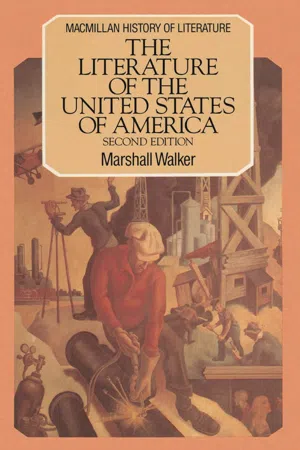
The Literature of the United States of America
About this book
American literature over the last four hundred years has developed distinctive qualities and traditions, partly engendered by the land itself. The rich variety of literature flourished as the land was colonised and cultivated. In this new edition Marshall Walker has updated his wide-ranging study of American literature by giving greater attention to poets from Hart Crane and e.e.Cummings to John Ashbery and A.R.Ammons and to novelists from William Burroughs and Kurt Vonnegut to John Irving. More space is given to drama, from the later works of Tennessee Williams and Arthur Miller to the plays of Sam Shepard and David Mamet. The special concerns of Black, Jewish and Women writers are explored as this book demonstrates that American literary history can no longer be considered largely in terms of regional dominances.
Information
1
Terms of a Tradition
‘THE land was ours before we were the land’s’, writes Robert Frost (1874–1963) in ‘The Gift Outright’ (1942). He is thinking about the effort early American settlers had to make to commit themselves to a vast new country ‘vaguely realising westward’. The land itself could be appropriated by men and women of sufficient ingenuity, strength and determination. Transforming a frontier into ‘home’ took longer and required imagination. Every life lived in the new land brought home closer. Every artistic response to America acknowledged it as the artist’s field of activity, his own place; and as artists of all kinds grew in number, the land increasingly possessed them.
The Pilgrims of the Mayflower who entered Cape Cod Harbor on 21 November 1620 and made a landing in snow at what is now Provincetown, Massachusetts, were still spiritually possessed by England. Separatists from the Church of England who sought to restore the church to its ‘primitive order, liberty, and beauty’, they were themselves shaped, even in their rebellion, by English life, language and ideas. Nothing in their past could have prepared them for the exotica of Indian culture, and nothing in England could have anticipated the sheer scale of the new country. They would become American only through generations of strenuous mental as well as physical adjustment and improvisation. The history of American literature is a sequence of spiritual appropriations of, and by, the land which the settlers and their descendants found and altered as it altered them.
The prime fact of America is its physical size, its huge distances. Gertrude Stein (1874–1946) says, ‘In the United States there is more space where nobody is than where anybody is. That is what makes America what it is.’ With an area of 3,615,122 square miles, America is slightly smaller than the People’s Republic of China and less than half the size of the Soviet Union, but to settlers from Britain, Ireland and the populous countries of Europe it presented a varied, alien geography of awesome proportions and mysterious extent. The size of the country is the basis of its political organisation, a federal system of government in which the central authority of Washington is complemented by separate, largely autonomous administrations in each of the forty-eight contiguous states, in Alaska to the northern extreme of the continent, and Hawaii in the mid-Pacific.
A sense of space is fundamental to the work of writers as diverse as James Fenimore Cooper (1789–1851), Mark Twain (1835–1910), Willa Cather (1876–1947), Wallace Stevens (1879–1955), John Steinbeck (1902–68), William Carlos Williams (1883–1963) and Jack Kerouac (1922–69). It is there in the nineteenth-century panoramic landscape paintings of Thomas Cole, Albert Bierstadt and Frederick Erwin Church, as well as in the monumental effects of Thomas Hart Benton and Grant Wood. Size and distance are implicit in the grandiose polytonal music of Charles Ives and in the widely spaced chords and gapped arpeggio melodies of Aaron Copland. Towering images of space assert human ingenuity in city architecture from New York to Los Angeles. Perhaps the most spectacular response to the scale of American landscape was the attempt in 1971–2 by Christo, a Bulgarian-born artist, to construct his ‘Valley Curtain’ near Aspen, Colorado, a hawser slung between two mountains 1,250 feet apart and carrying an orange curtain weighing four tons.
There is still plenty of space ‘where nobody is’ in America. From some ten million people in 1820 the population has grown by more than twenty times, yet any substantial journey along the country’s nearly four million miles of roads will bring the traveller – especially one accustomed to the congestions of Britain and Europe – a new sense of arrival and departure. Small towns and villages are definable incidents along the way; they do not just melt vaguely into each other. A small place makes its point, still, as a settlement in the great space of America. There is romance in this, and, outside the major cities, it fosters those local and regional characteristics which are, to a large extent, based on climate.
America’s eastern seaboard runs from the northern climate of New England down to the semi-tropical states fringing the Gulf of Mexico. A journey down the centre of the country leads from the cutting winds of the Dakotas to the fetid airs of the Mississippi delta. Western climates range from the English affinities of Washington and Oregon to the hot, dry deserts of Arizona. There is a corresponding variety of flora and fauna, from timber-wolves to alligators and conifers to cactus. When to all this are added the diverse national origins of the thirty-five million people who emigrated to America between 1830 and 1914, the result is the supreme paradox of the post-Civil-War USA. It is both a single nation held together by a Federal government, transport lines, the English language, and coast-to-coast Coca-Cola, and many countries, none of which is uniquely indentifiable as the real America. Paul Simon’s (b. 1941) wistful song ‘America’, popular in the late 1960s when to be young was to be nomadic, brings these elements together:
‘Kathy’, I said
As we boarded a Greyhound in Pittsburgh,
‘Michigan seems like a dream to me now
It took me four days to hitch-hike from Saginaw.
Ive come to look for America.’
Discovery and Settlement
Christopher Columbus was looking for the Indies, not for the America he is wrongly credited with discovering in 1492. Asiatics must have preceded him and possibly African and Egyptian voyagers. Norwegian archaeology has dated the foundations of seven buildings in the north end of Newfoundland at around the tenth century, and Scandinavian sagas of the eleventh and twelfth centuries refer to Norsemen who crossed the ocean. A world map drawn some fifty years before the voyage of Columbus, and now in Yale Unversity Library, shows a large island called Vinland, south-west of Greenland. A Latin inscription proclaims Leif Eriksson (son of Eric Rauthe, or Eric the Red) and his men as the discoverers of this island and says that Pope Paschall II sent Bishop Eric Gnupson to civilise it. Columbus himself got no further than an island in the Caribbean which he named ‘San Salvador’. Believing he had attained his goal he called the natives ‘Indians’.
The name ‘America’ derives from the Italian explorer Amerigo (or Americus) Vespucci who made four voyages to the New World. In 1502 Vespucci landed on the coast of Brazil, but in his report of a voyage of 1497 he mentions touching upon a coast ‘which we thought to be that of a continent’. If he was right, the touch would give him precedence not only over Columbus in reaching the American mainland, but also over John Cabot whose voyage of 1497 under patent from Henry VII took him only to Cape Breton Island. It was in Cabot’s second voyage the following year that he explored other parts of North America as a basis for England’s claim to the continent.
The English were slow to begin their settlement of the New World. In 1583 Sir Humphrey Gilbert failed in an attempt to settle Newfoundland, and the 1585 expedition to what is now North Carolina, sponsored by Sir Walter Raleigh, survived only a year. Other attempts to settle ‘Virginia’, as the entire Atlantic seaboard of America was then called, also failed and it was not until 1607 that the first permanent colony was established by Captain John Smith at Jamestown. With this first successful settlement American literature properly begins and the first report is written of a ‘fruitful and delightsome’ virgin land of promise waiting for man to realise prelapsarian opportunities for ever lost to him in Europe.
A new Eden and the American Dream
The Irish philosopher, Bishop George Berkeley, expressed the yearning of fellow-intellectuals with his vision of a new world of ‘innocence where nature guides and virtue rules’. Berkeley’s plan for a Christian college for the natives in Bermuda failed, and, for the nine and a half million people who sailed the Atlantic in the first hundred years of America’s history as a nation, reality was often a harsh climate, misfortune and enduring social inequality. The myths that kept them going and lured others form the basis of the American Dream. The New World would be an Arcadia, a new Eden, a Kingdom of Heaven on Earth where, uninhibited by the restraints of older societies, a man could practise his trade or his religion with freedom and control his political destiny – he could be Adam again.
John Smith’s (1580–1631) A Map of Virginia (1612) says of Virginia that ‘heaven and earth never agreed better to frame a place for man’s habitation’, and his A Description of New England (1616) develops the image of America as a Promised Land. Though under constant pressure from the many hardships of colonial life, the image is sustained with religious conviction by the Pilgrims of Plymouth, the first New England colony, and by the Puritans who founded the Massachusetts Bay Colony in 1629–30. More than half the Plymouth colonists died of disease, exposure or deprivation in the first American winter but, with help from the Indians, the year 1621 yielded a good harvest which prompted the first American Thanksgiving. William Bradford’s (1590–1657) History of Plymouth Plantation (1620–50; pub. 1856) soberly narrates the hard facts of colonial survival, but is clearly the work of a man who deeply believes in the Christian destiny of the enterprise. Cotton Mather’s (1663–1728) Magnalia Christi Americana (‘The Great Deeds of Christ in America’, 1702) confirms the New World as chosen by God for the purpose of rewarding faith with prosperity. When to this view was added the force of eighteenth-century confidence in the inevitability of man’s intellectual and material progress, the Dream was firmly established as the foundation of American national consciousness, both religious and secular.
The possibilities seemed endless. In his first Inaugural Address on 4 March 1801 President Thomas Jefferson (1743–1826) spoke of the country’s having ‘room enough for our descendants to the 100th and 1000th generation’. The New World looked not to the past, where Europe lay mired in corruption, but to the present and the future. Corruption, of course, could seduce, as the characters of Henry James’s (1843–1916) novels sometimes discover to their cost, though Europe invariably broadens their perceptions while it despoils them of their American innocence. Thomas Appleton (1812–84) is supposed to have made his most famous epigram from Europe’s fatal attraction to lapsed Americans: ‘Good Americans, when they die, go to Paris’. In 1825 Noah Webster (1758–1843), a descendant of William Bradford and originator of the famous ‘Webster’s Dictionary’, announced that ‘American glory begins at the dawn’. For the Democratic Review in 1839: ‘Our national birth was the beginning of a new history . . . which separates us from the past and connects us with the future only’. Despite the internecine conflict of the Civil War, such apostolic confidence seemed validated by the rapid industrialisation of the nineteenth century and endorsed by the optimistic individualism of Ralph Waldo Emerson (1803–82), Henry David Thoreau (1817–62) and other ‘Transcendentalist’ writers. As society grew increasingly secular, material progress became at once the Dream’s expression and proof. ‘The business of America is business’, Calvin Coolidge said in 1925. It was the most profitable business in history, and the American way of life became the envy of the world, a dream come true.
Even Emerson acknowledges that the world contains more than ideal states of being, but maintains his belief in the unity of things; ‘All over the universe’, he writes in his journal in 1842, ‘there is just one thing, this old double’. There are aspects of the world which are ordinary or ‘vulgar’ and slavery was bad, but probably the only unalloyed evil Emerson could have recognised would have been that of seeing things differently from himself. The doubleness of things means simply higher and lower, not good and bad. A weed is a plant ‘whose virtues have not yet been discovered’. Other worldlier men were less optimistic and the rhetoric of the Dream bred its own opposite. While Emerson cries, ‘Here’s for the plain old Adam, the simple genuine self against the whole world’, Henry James senior (father of the novelist) inveighs against Emerson’s ‘unconsciousness of evil’ and objects that ‘nothing could be more remote . . . from distinctively human attributes . . . than this sleek and comely Adamic condition.’ In Moby-Dick (1851) Melville (1819–91) makes his whale a symbol of Emerson’s ‘just one thing’ but the thing includes evil at its most elemental. Realism was not the sole preserve of literary men. George Washington himself predicted that the thirteen states whose Declaration of Independence their Congress approved on 4 July 1776 would be rent by civil war. In 1803 Fisher Ames, a leading New England Federalist (that is, a supporter of strong central government even at the expense of the individual liberty so highly valued by Thomas Jefferson and his followers), rejected almost every aspect of the Dream: ‘Our country is too big for union, too sordid for patriotism, too democratic for liberty.’
The last aphorism extracted from Pudd’nhead Wilson’s Calendar in Twain’s (1835–1910) The Tragedy of Pudd’nhead Wilson (1894) reads ambiguously:
October 12, the Discovery. It was wonderful to find America, but it would have been more wonderful to miss it.
In Democratic Vistas (1871) even the profligately affirmative Walt Whitman (1819–92) admits that ‘Society, in these States, is canker’d crude, superstitious, and rotten .... The problem of the future of America is in certain respects as dark as it is vast’. The vastness of things worries Saul Bellow’s (b. 1915) hero in Henderson the Rain King (1959): ‘America is so big, and every one is working, making, digging, bulldozing, trucking, loading, and so on, and I guess the sufferers suffer at the same rate.’ A century after his country’s birth, Henry Adams (1838–1918) is nostalgic for the splendid, clean potency of the American Adam: ‘Stripped for the hardest work, every muscle firm and elastic, every ounce of brain ready for use and not a trace of superfluous flesh on his nervous and supple body, the American stood in the world a new order of man’. Early twentieth-century reality is the terrible energy represented by the Dynamo in Chapter XXV of The Education of Henry Adams (privately printed in 1907; published 1918), an immense mechanic power which brutally accelerates America and the world towards disintegration. A soulless, mechanised America ‘slides by on grease’ in the giant, finned automobiles of Robert Lowell’s (1917–77) poem ‘For the Union Dead’ (1965). William Burroughs (b. 1914), another enemy of technology, flatly denies the shibboleth of the American Dream in his novel The Naked Lunch (1959): ‘America is not a young land: it is old and dirty and evil before the settlers, before the Indians. The evil is there waiting.’
Huckleberry Finn and his kind
Ernest Hemingway (1899–1961) says that ‘all modern American literature comes from one book by Mark Twain called Huckleberry Finn (1884) . . . it’s the best book we’ve had. All American writing comes from that.’ In an introduction to an edition of the novel (1950), T. S. Eliot (1888–1965) calls Huck ‘one of the permanent symbolic figures of fiction, not unworthy to take a place with Ulyss...
Table of contents
- Cover
- Halftitle
- Title Page
- Copyright
- Contents
- Acknowledgements
- List of Plates
- Editor’s Preface
- Map
- 1. Terms of a tradition
- 2. The colonies
- 3. The revolution
- 4. The waiting poem
- 5. Renaissance
- 6. Realisms
- 7. Modernisms
- 8. War and post-war
- 9. Diversity
- Chronological table
- Further reading
- Index
Trusted by 375,005 students
Access to over 1.5 million titles for a fair monthly price.
Study more efficiently using our study tools.
Frequently asked questions
Yes, you can cancel anytime from the Subscription tab in your account settings on the Perlego website. Your subscription will stay active until the end of your current billing period. Learn how to cancel your subscription
No, books cannot be downloaded as external files, such as PDFs, for use outside of Perlego. However, you can download books within the Perlego app for offline reading on mobile or tablet. Learn how to download books offline
Perlego offers two plans: Essential and Complete
- Essential is ideal for learners and professionals who enjoy exploring a wide range of subjects. Access the Essential Library with 800,000+ trusted titles and best-sellers across business, personal growth, and the humanities. Includes unlimited reading time and Standard Read Aloud voice.
- Complete: Perfect for advanced learners and researchers needing full, unrestricted access. Unlock 1.5M+ books across hundreds of subjects, including academic and specialized titles. The Complete Plan also includes advanced features like Premium Read Aloud and Research Assistant.
We are an online textbook subscription service, where you can get access to an entire online library for less than the price of a single book per month. With over 1.5 million books across 990+ topics, we’ve got you covered! Learn about our mission
Look out for the read-aloud symbol on your next book to see if you can listen to it. The read-aloud tool reads text aloud for you, highlighting the text as it is being read. You can pause it, speed it up and slow it down. Learn more about Read Aloud
Yes! You can use the Perlego app on both iOS and Android devices to read anytime, anywhere — even offline. Perfect for commutes or when you’re on the go.
Please note we cannot support devices running on iOS 13 and Android 7 or earlier. Learn more about using the app
Please note we cannot support devices running on iOS 13 and Android 7 or earlier. Learn more about using the app
Yes, you can access The Literature of the United States of America by Marshall Walker, A. Norman Jeffares in PDF and/or ePUB format, as well as other popular books in Literature & North American Literary Criticism. We have over 1.5 million books available in our catalogue for you to explore.