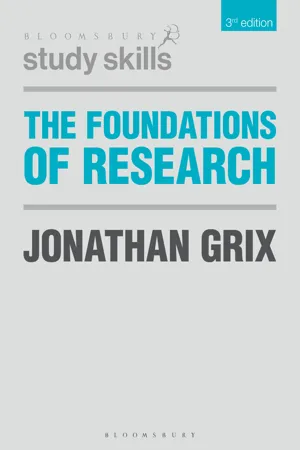
Fully revised for the third edition, this popular text provides an advanced yet accessible introduction to the tools, terminology and research perspectives that students need to know in order to engage in academic debate and successfully complete research-based assignments. It first explores the language and nature of research, before developing readers' understanding of different research methods and the role of theory in research. Chapters are complemented by examples, boxed summaries of key ideas and suggestions for further reading.
This text will be an essential resource for advanced undergraduates and postgraduates of all disciplines.
New to this Edition:
- Includes new examples and material on managing the research process
- 183 pages
- English
- ePUB (mobile friendly)
- Available on iOS & Android
eBook - ePub
The Foundations of Research
About this book
Information
1 The Nature of Research
This chapter introduces:

The aim of this first chapter is to begin to familiarise you with the nature, tools and terminology of the research process. Central to my aims is the ‘demystification’ of research, be it a BSc or BA dissertation, an MSc, MA, MPhil, PhD or DPhil. The emphasis is on the foundations of research and many of the terms and much of the process will be applicable to all sustained research in the human sciences. The following advice will also be of interest to researchers who have to write lengthy dissertations or structured research reports. From time to time it will be necessary to address specific points relating to a higher degree, that is, the PhD, as these are not relevant to advanced undergraduates or all postgraduate work. The majority of the points made, however, are fundamental to all research. This chapter also touches on the differences between undergraduate, postgraduate and especially PhD research.
First, I discuss the language of research; that is, the manner in which it is presented and why it is important to learn the generic terms of research in order to dispel the mystery surrounding the -isms and -ologies that pepper research papers, research methods books and courses. I then turn to the nature of research, distinguishing between undergraduate dissertations, MAs and PhDs. PhDs are given a special section, because they differ in so many ways from the other two. The final three sections touch on where to study, time management and familiarising yourself with the task ahead. All these factors are relevant to what I am concerned with here: the foundations of research. The choice of where to study is most relevant for postgraduates, but also for those undergraduates wishing to continue their studies. Time management is a research skill and is essential for both undergraduates and postgraduates. Finally, we turn to the most obvious, yet underused idea of simply looking at what it is you are supposed to be producing. Before we can embellish our work with wonderful, sophisticated and insightful statements, we need to know the mechanics of research: for example what does a dissertation or thesis look like?

While we all know the old cliché ‘knowledge is power’, it is worth reflecting on the ways in which knowledge is discussed, disputed and disseminated. In the human sciences there are a number of different ‘discourses’ between disciplines, for example economics, history and cultural studies. Common to most discourses is the basic language of research. Given the variety of uses of the terms and terminology of human science research, it is hardly surprising that students rarely have a firm grasp of the tools of their trade. Different academics in different disciplines attach a wide range of meanings and interpretations to the terminology of research. One person’s ‘theory’ is another’s ‘taxonomy’, while another researcher’s ‘ideal type’ is another’s ‘theory’, and so on. With little or no knowledge of the standard reference points in general research, you are likely to produce a dissertation or thesis which is unclear and imprecise; learning the rules of the game simplifies the process, makes it transparent and takes away the fear associated with the unknown. It is my contention that in order to be able to work within the parameters of the human sciences, you need to be very clear about what the tools and terminology of research are and what they mean before you can begin researching. If you spend a little time learning the language of research, discovering what the terms and concepts mean and how they can be employed, the mystery associated with much of academic work, especially at the postgraduate level, will begin to disappear.
This may sound trivial, but given the fact that many students – and seasoned academics, too, for that matter – have difficulty differentiating between crucial terms such as ‘ontology’ (what is out there to know about) and ‘epistemology’ (what and how can we know about it), their subsequent research is bound to suffer, as knowledge of these two key terms and their place in research is essential to understanding the research process as a whole.
These particular terms (ontology and epistemology) are often shrouded in ambiguity, partly created by the language in which they are explained, leaving the reader more confused than she was before she began reading. There is an obvious and urgent need for agreement on the meaning of specific generic terms across the disciplines in the human sciences to prevent the confusion which surrounds many concepts at present. Suffice it to say that this should not be understood as a call for unity of methodological approaches, as diversity is essential for the vibrancy of the human sciences, but rather a call for clarity on key terms that can cross disciplines.
What other reasons are there for needing to know and understand standard terms and concepts in social research? A simple example will do: consider a would-be bricklayer who does not know the difference between a trowel, a spirit level and a chisel. These are the basic tools of his trade, without which no wall can be built. Each tool has a specific purpose and, if it were used wrongly (or in the wrong order), for example taking a chisel to lay bricks, the results would be disastrous. In research, specific tools have specific purposes and, if one is to employ them correctly, one must first understand what they mean, what they are meant to do and how and when to use them. The lack of clarity and constancy of the social-research lexicon has led to a minefield of misused, abused and misunderstood terms and phrases with which students must contend. It has also led to confusion surrounding the presentation of assumptions upon which research is based. There is a need to be clear about these assumptions and a need to know the research traditions from which these assumptions spring. Thus, by familiarising ourselves with the technical language of research, we effectively demystify it.
No discussion about the language of research, however, can avoid mentioning the bewildering array of -isms and -ologies used in presenting research. Many of these terms are used wrongly or imprecisely, which adds to the mystery of research and the impenetrability of much of its output. Use of specific terms, for example, ‘variables’, ‘relationships’, ‘measuring’, ‘covariation’ and ‘hypotheses’ (see also Ragin and Amoroso 2010: 12–14), denote a sense of seriousness, of sound academic judgement, but the fact of the matter is that merely using specific terms is no guarantee of solid research. This is similar to those students who state boldly in their essays that they have ‘critically assessed’ the topic at hand; saying the word ‘critical’ – however many times – does not equate to actually critically assessing anything. Many researchers, as we shall see in the following chapters, refuse to use the specific language touched on above when undertaking and presenting their work, as they seek to distance themselves from particular research paradigms (most notably ‘positivism’ – see Chapter 5).
Undergraduate dissertations and MA dissertations have many things in common. Both are pieces of sustained research of up to and around 10,000–15,000 words. It is often said that the best undergraduate essay gets near to or attains Master’s level of work. At the Master’s level, students are expected to be far more independent in their choice and execution of research projects. Also, a Master’s in many social science topics would usually contain an empirical case study, unless, of course, its key concern was of a more theoretical nature. Such an empirical study usually means a sustained amount of time spent on fieldwork, something only a minority of undergraduates would have the time or resources to do. Nonetheless, a solid undergraduate dissertation should exhibit some characteristics similar to those of an MA dissertation: a clear presentation of the problem; clear research questions or hypotheses; an assessment of the current literature around the topic at hand; a discussion of the methods, methodology and sources employed in the project; a section which attempts to address the research questions posed; and a clear evaluation of the findings. Each of these sections, as I shall point out throughout the following chapters, is logically interlinked.
If we leave the differences to one side, the question still remains: what is research? Generally speaking, research at BA, MA and PhD level will have a number of things in common:
1.You will have a question to ask or problem to solve (Chapter 3 discusses how to arrive at such a question).
2.You will set about answering your question by sifting through a variety of data and sources, using specific research methods (Chapter 7 introduces the best-known).
3.You will need a methodology to be able to answer your questions (Chapters 2, 3, 4 and 5 discuss the underpinnings of research).
4.You will need to think about how your project adds to knowledge on this topic by either generating new knowledge, making an intervention in the current literature or clarifying or furthering existing work.
The distance between a solid MA (Master of Arts; Magister Artium) dissertation and a PhD (Doctor of Philosophy; Philosophea Doctor) is smaller than that between BA (Bachelor of Arts; Baccalaureus Artium) and PhD, as the Master’s student will already have had to contend with many issues confronting a doctoral candidate. The leap from a BA to a PhD is great, but not unbridgeable. The most obvious unique aspect of doctoral research is the emphasis it places on the individual. There are few taught elements of the degree, except for research training, and the student is expected to have a high level of self-discipline in order to be able to cope with only minimal guidance and structure – in comparison to what students at BA or MA level are used to. (This is not the case in the USA, where PhDs entail required coursework. This is also not the case in the growing number of ‘taught’ doctorates that are now available, usually in more applied areas of study, for example education.) In addition, PhD students will have to go through a comprehensive viva examination, defending the work they have submitted. Self-discipline, of course, is needed for all types of sustained research and is easier to produce if you have a keen interest in a subject in the first place. This makes the choice of topic important for undergraduates, essential for an MA and absolutely crucial for a PhD.
A PhD can be successfully completed by anyone who has a certain amount of intelligence, and, importantly, the degree of commitment necessary. This is not to suggest that obtaining a doctorate is easy. Commitment and steely determination are essential, but of little use if not accompanied by an open and enquiring mind and a willingness to take criticism and advice and to listen and learn from others. Herein lies the first difficulty: to complete a higher degree successfully, you will have to reassess and recalibrate your often deeply held opinions in the light of the new material, arguments and debates that you will encounter on your learning journey.
The first thing to note about a PhD is what it is not. It is rarely a magnum opus, the study of all studies ever on a specific topic (many educational systems, for example Germany, cater for this by offering a higher doctorate option). There is plenty of time to produce this afterwards, as most great thinkers in fact have. For example, Albert Einstein and Karl M...
Table of contents
- Cover
- Half Title
- Forehead
- Title Page
- Copyright
- Dedication
- Contents
- List of Figures
- List of Tables
- Preface
- Introduction
- 1 The Nature of Research
- 2 The ‘Nuts and Bolts’ of Research
- 3 Getting Started in Research
- 4 The Building Blocks of Research
- 5 Introducing the Key Research Paradigms
- 6 The Types and Uses of Theory in Research
- 7 Introducing Research Methods
- 8 Academic Standards, Plagiarism and Ethics in Research
- Conclusion: Summary of Key Points
- Appendix 1 Stages of the Research Process
- Appendix 2 Glossary of Research Terms
- Bibliography
- Index
Trusted by 375,005 students
Access to over 1.5 million titles for a fair monthly price.
Study more efficiently using our study tools.
Frequently asked questions
Yes, you can cancel anytime from the Subscription tab in your account settings on the Perlego website. Your subscription will stay active until the end of your current billing period. Learn how to cancel your subscription
No, books cannot be downloaded as external files, such as PDFs, for use outside of Perlego. However, you can download books within the Perlego app for offline reading on mobile or tablet. Learn how to download books offline
Perlego offers two plans: Essential and Complete
- Essential is ideal for learners and professionals who enjoy exploring a wide range of subjects. Access the Essential Library with 800,000+ trusted titles and best-sellers across business, personal growth, and the humanities. Includes unlimited reading time and Standard Read Aloud voice.
- Complete: Perfect for advanced learners and researchers needing full, unrestricted access. Unlock 1.5M+ books across hundreds of subjects, including academic and specialized titles. The Complete Plan also includes advanced features like Premium Read Aloud and Research Assistant.
We are an online textbook subscription service, where you can get access to an entire online library for less than the price of a single book per month. With over 1.5 million books across 990+ topics, we’ve got you covered! Learn about our mission
Look out for the read-aloud symbol on your next book to see if you can listen to it. The read-aloud tool reads text aloud for you, highlighting the text as it is being read. You can pause it, speed it up and slow it down. Learn more about Read Aloud
Yes! You can use the Perlego app on both iOS and Android devices to read anytime, anywhere — even offline. Perfect for commutes or when you’re on the go.
Please note we cannot support devices running on iOS 13 and Android 7 or earlier. Learn more about using the app
Please note we cannot support devices running on iOS 13 and Android 7 or earlier. Learn more about using the app
Yes, you can access The Foundations of Research by Jonathan Grix in PDF and/or ePUB format, as well as other popular books in Study Aids & Research in Education. We have over 1.5 million books available in our catalogue for you to explore.