- 184 pages
- English
- ePUB (mobile friendly)
- Available on iOS & Android
eBook - ePub
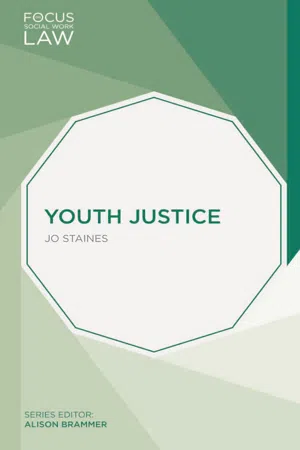
Youth Justice
About this book
This book provides social work practitioners and allied professionals with an applied understanding of the formal legislation, policy and guidance relating to young people who are considered 'at risk' of, accused of, or convicted of involvement in offending or anti-social behaviour.
Information
1
UNDERSTANDING AND PREVENTING OFFENDING BEHAVIOUR
AT A GLANCE THIS CHAPTER COVERS:
♦ the extent of youth offending
♦ risk, needs and responsivity and the scaled approach
♦ community-based prevention and early intervention programmes
♦ civil legislation
♦ anti-social behaviour
♦ gang injunctions
♦ discrimination and rights
Every local authority has a duty under s. 37 CDA 1998 to work towards the reduction of crime and disorder, with an explicit emphasis on preventing offending by children and young people. This is echoed in the YJB’s National Standards for Youth Justice Services (2013a) with National Standard 1: ‘Preventing Offending’ stipulating that local strategies and services are established to prevent children and young people from becoming involved in crime and/or anti-social behaviour, and to support their parents/carers and families. The use of preventative and diversionary measures is emphasized by the UNCRC 1989, recognizing that such measures can be cost effective by avoiding the need for full judicial proceedings, reducing stigmatization, and having beneficial outcomes for children. However, such programmes must ensure that children’s rights and safeguards are fully respected. For example, individual orders should only be used where there is convincing evidence that the child is involved in or has been clearly identified as being at risk of involvement in offending or anti-social behaviour, where they acknowledge responsibility and give consent, and where the acknowledgment will not be used against them in any subsequent legal proceedings.
The chapter begins with a consideration of the extent of youth offending and the public perception of youth crime to provide a context for reflecting on formal responses to unwanted behaviour. It addresses the focus on the assessment of ‘risk factors’ for involvement in offending or anti-social behaviour, the development of ASSET and ASSETPlus, and the scaled approach to youth justice interventions. Consideration is then given to the YJB’s Youth Crime Prevention Strategy and wider community-based prevention initiatives such as the Troubled Families Programme, Sure Start, Children’s Centres and parenting support programmes, which, whilst having a broader remit, aim also to prevent involvement in offending and anti-social behaviour. Although not part of the youth justice system per se, these interventions are often a precursor to civil legal measures implemented to combat early involvement in offending behaviour, such as injunctions to prevent nuisance and annoyance (IPNAs), curfew orders and dispersal orders, which are then discussed.
The extent of youth offending
Official statistics typically underestimate the extent of offending behaviour, because unreported offending behaviour cannot be included, but in general they do correlate well with self-reported offending behaviour by children and young people, which consistently shows that approximately 25 per cent of young people admit to involvement in anti-social or offending behaviour in the previous 12 months (Halsey and White, undated). Conversely, official statistics are likely to overestimate the proportion of crime that can be attributed to young people as such figures tend to exclude ‘white-collar’ crime and offences committed by corporate bodies or the state; young people’s behaviour is also more visible and more closely monitored (by parents, teachers, security staff and community members, as well as by the police) than that of older people, resulting in an increased focus on youth offending.
It is very difficult to unpick changes and patterns in youth offending behaviour and distinguish ‘real’ changes from those that result from a change in recording practice, police action, or sentencing policy. For example, from 1992–2003 there was a significant decline in detected youth crime but this was apparently reversed between 2003–2008 (Pickford and Dugmore, 2012). However, much of this reversal can be related to changes in police practice due to the Labour government’s target to increase offences brought to justice (OBTJ) (also known as ‘sanction detections’), rather than because there was a genuine increase in youth offending (MoJ, 2013a). To meet the OBTJ targets, many police forces focused, in particular, on less serious offences committed by young people – those offences easiest to pursue and detect – resulting in an apparent increase in youth crime, especially that committed by girls. Once the target was removed, declines in youth crime, particularly offences committed by first-time offenders, were notable. Indeed, the number of first-time entrants to the youth justice system fell by 75 per cent from a peak of over 110,000 in 2006/2007, to 27,854 in 2012/2013 (MoJ, 2014) (See Figure 1.1).
In 2011/2012 there were 167,995 arrests of young people aged 10–17 for notifiable offences (MoJ, 2014), accounting for 13.6 per cent of all arrests; those aged 10–17 make up only 10.8 per cent of the population of England and Wales, suggesting that young people are over-represented in the criminal justice system. The majority of arrests of young people were of boys (11.3 per cent of all arrests), with just 2.3 per cent of all arrests being girls aged 10–17. The number of young people who are diverted from the youth justice system through triage or other diversionary processes is not known, but police contact with children and young people in 2012/2013 led to 30,778 reprimands, final warnings or conditional cautions being given, a reduction of 64 per cent since 2002/2003 (MoJ, 2014). There were 98,837 proven offences by young people in 2012/2013; a decrease of 28 per cent from the previous year (MoJ, 2014); the majority (77 per cent) of these were committed by young people aged over 15, and by boys (82 per cent). Almost 44,000 young people were sentenced at all criminal courts in 2012/2013, 28 per cent fewer than the year before (MoJ, 2014); the sentences received are discussed in subsequent chapters.

Figure 1.1: Trends in first-time entrants to the youth justice system, 2002/2003–2012/2013
Source: Ministry of Justice/Youth Justice Board, 2014
The most common offences committed by young people are violence against the person (including common assault) (21 per cent), theft and handling (19 per cent), and criminal damage (11 per cent). More serious offences, such as sexual offending, are rarer with less than 2 per cent of proven offences committed by young people in 2012/2013 being sexual offences (MoJ, 2014).
On-the-spot questions
1 Why is it important to measure the extent of youth crime?
2 Why is measuring the extent of youth crime problematic?
Public perceptions of youth offending
Although the number of offences committed by young people and the number of young people involved in the youth justice system appear to be decreasing, research suggests that the public perceive youth offending to be increasing and the fear of youth crime remains high (Hough and Roberts, 2004; Pickford and Dugmore, 2012). Any work conducted with young people involved in the youth justice system is thus set against a backdrop of public antipathy, and sometimes hostility, towards children and young people (Hough and Roberts, 2004; Ipsos MORI, 2006). For example, the Crime Survey for England and Wales (formally the British Crime Survey) includes a question (within the sub-section on antisocial behaviour) about ‘teenagers hanging around on the streets’, suggesting that such behaviour is inherently negative. This raises questions about children and young people’s right to free assembly and appropriate provision for children and young people. The UN Committee on the Rights of the Child (2008) expressed significant concern at the ‘general climate of intolerance and negative public attitudes towards children, especially adolescents, which appears to exist in the UK, including in the media’, and put forward almost 120 recommendations on how to improve children’s rights in the UK in general, including reducing the intolerance shown towards children and young people.
On-the-spot question
How do public perceptions of youth crime influence the development of policy and legislation?
Characteristics of known young offenders
Positivist research by a number of academics and organizations (for example, Rutter et al., 1998; Hagell, 2002; Hammersley et al., 2003; HM Inspectorate of Prisons, 2003; Arnull et al., 2005; YJB, 2005; Farrington and Welsh, 2007) has identified a range of social, biological and structural factors common to those involved, or seen at risk of being involved, in offending behaviour – some of which are considered within the ASSET/ASSETPlus frameworks developed by the YJB. Such characteristics may be static factors – including gender, a history of offending within the family, abuse or loss, brain trauma and pre-natal difficulties such as foetal alcohol syndrome – whilst others are (or can be) dynamic factors – such as the experience of poverty, negative peer relationships, inconsistent parenting, low educational attainment and/or non-attendance at school, mental health difficulties, or substance misuse. It is not yet fully understood how or why combinations of factors result in offending behaviour (Fox and Arnull, 2013), but it is known that many of the risk factors are inter-related – for example, the risk factors associated with mental health problems and offending correlate and overlap (Khan, 2010), and those for youth offending are largely similar to those for educational underachievement (YJB, 2005). Many of these factors are exacerbated by individual and structural discrimination. For example, approximately one-fifth of young people in custody have some form of learning disability (Bryan et al., 2007); and many young people with learning difficulties come from lower socioeconomic backgrounds, which can further exacerbate the problems they experience (Fyson and Yates, 2011; Fox and Arnull, 2013), resulting in their over-representation within the youth justice system. Similarly, the over-representation of black and minority ethnic young people in custody may be exacerbated because there are also disproportionate numbers of black and minority ethnic males with mental health problems and learning disabilities (Fox and Arnull, 2013).
Risk, needs and responsivity, and the scaled approach
A plethora of theories of youth offending exist, from early theories of classicist notions of free will to cultural explanations (see, for example, Newburn, 2013); currently, individualistic, positivist theories of crime causation are dominant within youth justice policies and legislation. This is demonstrated through the focus on early intervention and the belief that it is possible to identify those young people who are at risk of offending and/or of causing serious harm to others, based on the characteristics identified above. This has led to investment in actuarial risk prediction devices, aimed at identifying both the risk of reoffending and the risk of causing serious harm (Baker, 2005). Within the CDA 1998 and subsequent legislation, New Labour prioritized and promoted a risk-based approach, with an emphasis on the prevention of offending through a multi-modal method of working (Fox and Arnull, 2013). The Coalition government continued the focus on identification, targeting and early intervention within the Social Justice Strategy (Department for Work and Pensions, 2012).
The scaled approach
The scaled approach to sentencing (discussed further in Chapter 4) has replaced proportionality of sentencing with progressive interventions of increasing intensiveness for each successive offence (Cavadino et al., 2013) and is underpinned by the risk, needs and responsivity framework. It incorporates the use of a national assessment tool commissioned by the YJB and is based on three principles:
1 the risk principle – the most intensive interventions should be reserved for those posing the highest risk of recidivism;
2 the needs principle – interventions should target the needs or issues most associated with the perceived causes of the particular offending behaviour;
3 the responsivity principle – planned interventions should take into account the characteristics of the young person, including their age, gender, ethnicity, personality, motivation and ability, to facilitate a positive response.
This approach explicitly links the risk assessment score to the nature, frequency, intensity and duration of subsequent interventions (CJIA 2008). The appropriate level of YOT intervention (standard, enhanced or intensive) is decided primarily on assessments of the likelihood of re-offending and the risk of serious harm posed to others, as identified through the national assessment tools.
Risk assessments – ONSET, ASSET and ASSETPlus
Despite criticisms of positivist approaches (see Newburn, 2013), the ONSET and ASSET assessment tools were developed by the YJB, underpinned by risk and protective factor research (YJB, 2005); these tools have recently been reviewed and a new model, ASSETPlus, is due for national implementation in 2014/2015 (YJB, 2013b). These assessment tools ask practitioners to consider the impact of a range of risk factors, divided into family, community, school and personal/individual factors, which may be either static (for example, having previously been looked after) or dynamic (Baker et al., 2011; see also Fox and Arnull, 2013). ASSETPlus aims to provide a single ‘end-to-end’ dynamic assessment and plan for a young person that follows them through the youth justice system, from pre-court diversionary work through to custody (YJB, 2013b). The scope of ASSETPlus has expanded considerably, reflecting developments in research, to include speech, language and communication needs, gangs and gang-associated behaviours, the (inappropriate) use of technology, and to have an increased focus on factors for and against desistance, reflecting the Every Child Matters 2003 and Children Act 2004 agenda of achieving positive outcomes for all children (Fox and Arnull, 2013). ASSETPlus also aims to be alert to the risks of a young person being vulnerable to sexual exploitation, although it is couched in terms of their susceptibility to being influenced by others.
These assessment tools are then used to identify children who reach a (variable) threshold for prevention and early intervention programmes (discussed below); determining the level of intervention necessary within the scaled approach (Chapter 4); planning, delivering and monitoring interventions for young people; and assessing the possibility of the young person causing serious psychological or physical harm to someone, thus triggering Multi-Agency Public Protection Arrangements (MAPPA) (Chapter 4).
There has been considerable criticism of basing youth justice interventions on a system of risk assessments, rather than on a deeper understanding of individual circumstances. Risk-based approaches have been criticized for being reductionist, generalist and ambiguous (Case, 2007; Bateman, 2009; Case and Haines, 2009). It is questionable whether it is either possible or appropriate to reduce young people’s lives to simple, calculable risk factors or whether such risk factors can be generalized to all young people, regardless of gender, age, culture, background or lifestyle (Pickford and Dugmore, 2012). Any assessment of risk is based on probability; while assessment tools may be relatively accurate in identifying risk across a particular group of young people, tools such as ASSET have a predictive accuracy of only 60–70 per cent in regard to a specific, individual young person (YJB, 2008a). Perhaps more fundamentally, there is debate as to what is a ‘risk factor’ (a cause, correlate, symptom, predictor) and what is being predicted – general delinquency, anti-social behaviour, low-level or serious offending, or reoffending? High risk scores may be due to high welfare needs (Pickford and Dugmore, 2012), o...
Table of contents
- Cover
- Title
- Copyright
- Contents
- Table of cases
- Table of legislation
- Acknowledgments
- Abbreviations
- Using this book
- Introduction
- 1 Understanding And Preventing Offending Behaviour
- 2 Arrest And Detention By The Police
- 3 In The Youth Court
- 4 Community Sentences
- 5 Custodial Sentences
- 6 Conclusions
- Key sources and useful websites
- Glossary
- Bibliography
- Index
Trusted by 375,005 students
Access to over 1.5 million titles for a fair monthly price.
Study more efficiently using our study tools.
Frequently asked questions
Yes, you can cancel anytime from the Subscription tab in your account settings on the Perlego website. Your subscription will stay active until the end of your current billing period. Learn how to cancel your subscription
No, books cannot be downloaded as external files, such as PDFs, for use outside of Perlego. However, you can download books within the Perlego app for offline reading on mobile or tablet. Learn how to download books offline
Perlego offers two plans: Essential and Complete
- Essential is ideal for learners and professionals who enjoy exploring a wide range of subjects. Access the Essential Library with 800,000+ trusted titles and best-sellers across business, personal growth, and the humanities. Includes unlimited reading time and Standard Read Aloud voice.
- Complete: Perfect for advanced learners and researchers needing full, unrestricted access. Unlock 1.5M+ books across hundreds of subjects, including academic and specialized titles. The Complete Plan also includes advanced features like Premium Read Aloud and Research Assistant.
We are an online textbook subscription service, where you can get access to an entire online library for less than the price of a single book per month. With over 1.5 million books across 990+ topics, we’ve got you covered! Learn about our mission
Look out for the read-aloud symbol on your next book to see if you can listen to it. The read-aloud tool reads text aloud for you, highlighting the text as it is being read. You can pause it, speed it up and slow it down. Learn more about Read Aloud
Yes! You can use the Perlego app on both iOS and Android devices to read anytime, anywhere — even offline. Perfect for commutes or when you’re on the go.
Please note we cannot support devices running on iOS 13 and Android 7 or earlier. Learn more about using the app
Please note we cannot support devices running on iOS 13 and Android 7 or earlier. Learn more about using the app
Yes, you can access Youth Justice by Jo Staines in PDF and/or ePUB format, as well as other popular books in Politics & International Relations & Social Policy. We have over 1.5 million books available in our catalogue for you to explore.