- 228 pages
- English
- ePUB (mobile friendly)
- Available on iOS & Android
eBook - ePub
About this book
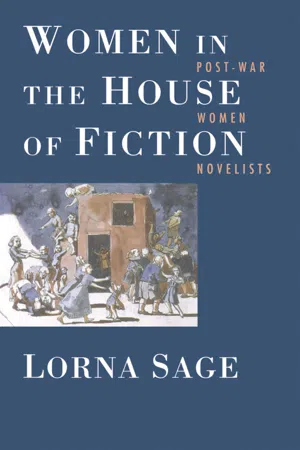
The novel was once upon a time the genre women felt at home in. This wide- ranging and detailed study of contemporary novelists explores the forms of nostalgia (shared by many feminist critics) for a 'woman's novel'; and the subtle or savage strategies which have turned the house of fiction upside down. The result is a critique of the nature of narrative now; and a celebration of the energies that are undoing our definitions of women's work.
Information
1
After the War
SIMONE DE BEAUVOIR
We are no longer like our partisan elders; by and large we have won the game.
(Simone de Beauvoir, The Second Sex, 1949)
Feminism was over. When Simone de Beauvoir in The Second Sex heaped up all the anthropological-philosophical-sociological-psychological evidence on the dependence and Other-ness of women, she was researching a vanishing race:’ ... already some of us have never had to sense in our femininity an inconvenience or an obstacle’.1 She stood at the end of a century and a half’s romantic enlightenment, a human individual (almost) at last. In theory, she would have been horrified at the thought that she heralded yet another era of self-consciousness and polemic on the part of women writers. Actually, of course, as The Second Sex testifies, she found a new world among the horrors. And it’s this fertile contradiction – between her yearning towards universality, and her fascinated reflexiveness – that makes her the inevitable starting-point for a study of contemporary women novelists.
She is, besides, the forerunner who makes women writers and critics most uneasy – truly a mother-figure in this at least, that she has been much disliked and repeatedly rejected. Deirdre Bair’s fat 1990 Simone de Beauvoir, A Biography confirms the impression of a heroine with feet of clay, a woman who systematically re-wrote her life in order to sustain a myth of moral equality. It’s a longstanding theme. Back in 1975 Jean Leighton, in Simone de Beauvoir on Women, wrote, in a tight-lipped footnote: ‘I’m afraid Simone de Beauvoir ... evinces certain attitudes typical of the “token” woman who “made it’”.2 Bair, who obviously has some difficulty in restraining her disapproval of her subject, quotes a pained Anna Boschetti:
Simone de Beauvoir’s trajectory is conditioned ... by her relationship to Sartre. It reflects the traditional sexist division of labour. Sartre develops existentialism’s philosophical, aesthetic, ethical and political principles. His companion applies, disseminates, clarifies, supports, and administers them.3
And as Bair shows, Beauvoir did worse: she more or less pimped for Sartre, arranging for a succession of younger women to play the womanly roles, while struggling to reserve the part of soul-mate for herself. The offence, then, is two-fold: first, her distance from other women; and secondly, her failure to sustain it. No wonder she annoys.
However, there seems to be more to it than this. Beauvoir disturbs because she faced head-on a paradox that feminism has had to live with ever since: that the shifts in language and thinking which make it possible to see ‘woman’ as a construct also, and simultaneously, devalue women’s experience. Sartre’s attack on ‘essences’, in which Beauvoir joined, illuminated for her the ways in which women were made, and the fictions by which their seemingly stable natures were supported. But the hierarchy of languages and genres remained in place – philosophy was ‘creative’ in the highest sense, while novels and autobiography (for example) were more like testimonies or case-studies. The universalising language of ‘mankind’ – even when it was attacking universals – kept its traditional prestige; just as, in the form of structuralisms and post-structuralisms, it has continued to do. The relations between feminism and philosophy still fall very easily into good old-fashioned patterns – as, for instance, when a young novelist like Leslie Dick says her first book ‘enacts an Oedipal drama, being both an appeal to and an attack on its own symbolic mother (feminism) and its symbolic father (theory)’.4 Beauvoir writes like a novelist in love with a philosopher, and so she raises again and again the spectre of ‘transcendence’. Feminist critics have worked out ways of reading which distance women’s texts from the notion of a neutral language of authority – but these strategies don’t work with Beauvoir.
One recent example: Martha Noel Evans complains of Beauvoir’s ‘inability to construct with pride a female model of reading and writing’.5 Beauvoir simply won’t give Evans what she wants, which is a refuge from ‘heterosexual paradigms based on notions of opposition or even complementarity’ (p. 121), ‘a change from position to positionlessness’ (p. 154). Evans’s own language reveals something of the source of her irritation: she too wants to talk transcendence, but in way which eliminates rivalry, conflict, collaboration. Beauvoir’s writing ‘establishes a model of reading based on the dynamics of the traditional heterosexual couple with herself as the dominant male and the reader as the yielding female’ (p. 90). In short, Beauvoir has a position, one she shares with Sartre.
So she remains ‘the messenger who brings the bad news’,6 the one who resists assimilation to the canon, yet can’t be left out. It’s hard now to capture the glamour surounding her 1950s image – a woman who spent her days in cafés, lived in hotel rooms, and built a home out of words. The end of Memoirs of a Dutiful Daughter (1958) is one of the classic escape scenes of modern autobiography: Beauvoir at twenty, in 1929, grabbing the world and the future in Sartre (‘the dream-companion I had longed for since I was fifteen ... the double in whom I found all my burning aspirations raised to the pitch of incandescence’,7 while her adored school friend ‘Zaza’ dies tragically into fiction, destroyed by her family’s repressive pieties and her own emotional generosity. Beauvoir chooses herself, existentialist-fashion. The autobiographies say more about passion and commitment (‘the identical sign on both our brows’)8 than they do about the content of her thinking. However – and not entirely by coincidence – another woman philosopher and novelist fills the gap. Iris Murdoch wasn’t in love with Sartre, but her book on him (Sartre, 1953, her first published book) registers his intellectual seductiveness. We are seeing the end of an era of essentialism:
When purposes and values are knit comfortably into the great and small practical activities of life, thought and emotion move together. When this is no longer so, when action involves choosing between worlds, not moving in a world, loving and valuing, which were once the rhythm of our lives, become problems.9
You can catch something of the excitement of the choices Sartre and Beauvoir were involved in when Murdoch compares the very British (and behaviourist) language of Gilbert Ryle’s The Concept of Mind with their splendidly problematic scenarios:
The ‘world’ of The Concept of Mind is the world in which people play cricket, cook cakes, make simple decisions, remember their childhood and go to the circus, not the world in which they commit sins, fall in love, say prayers or join the Communist party. (pp. 50–51)
It’s a contrast betweeen lives where the over-all pattern is established, and existences in which everything is to be invented. Murdoch coolly plays the two off against each other, but acknowledges the force of Sartre’s argument that human ‘nature’ must give way to the human ‘situation’; and that we must struggle to choose ourselves continuously – even though bad faith (unreflective acceptance of traditional codes, settling into spurious definitions of one’s ‘character’, ‘acting’ a commitment) infects almost every choice.
Murdoch – who in the end would want to dissent in all sorts of ways (see Chapter 3) – nonetheless saw in these existentialist preoccupations ‘a sort of myth of our condition .... the situation of a being who, deprived of general truths, is tormented by an absolute aspiration .... the expression of a last ditch attachment to the value of the individual’ (pp. 108–109). And she too is speaking the language of ‘mankind’ (‘our condition’, ‘a being’, ‘the individual’). Beauvoir had been sharing Sartre’s world in a much more intimate and problematic sense. She lived, as she later said, in ‘a delectable but chaotic stew’.10 And one consequence was that for some time she found it very difficult to write and think on her own account (though, of course, her relation to Sartre symbolised just this – the vocation of intellectual, gender transcended). The very aspirations that led her to think of herself as an ‘individual’ also helped to bamboozle her:
To accept a secondary status ... would have been to degrade my own humanity, and my entire past rose up in protest against such a step. Obviously, the only reason for the problem presenting itself to me in these terms was because I happened to be a woman. But it was qua individual that I attempted to resolve it. The idea of feminism or the sex war made no sense whatever to me.11
Her best work, when it came, wrestled with exactly this dizzying overlap between the human situation and the woman’s situation. Not indeed ‘the sex war’ as previously understood, but a much more asymmetrical struggle.
L’lnvitée (She Came to Stay), 1943, her first novel, is all about ‘happening’ to be a woman, and is splendidly savage, ambiguous and autobiographical. It draws on the period when she and Sartre confided and collaborated most intensely, and reveals the particular shades their shared world took on in her imagination. To start from a very minor moment – a stranger pinned in cruelly sharp focus in a café:
The woman with the green and blue feathers was saying in a flat voice: ‘ ... I only rushed through it, but for a small town it’s very picturesque.’ She had decided to leave her bare arm on the table, and as it lay there, forgotten, ignored, the man’s hand was stroking a piece of flesh that no longer belonged to anyone.12
This reflects the sport of people-watching with which she and Sartre beguiled a good deal of their time. The game, described in The Prime of Life, was to spot and analyse vignettes of mauvaise foi – ‘which, according to him, embraced all those phenomena which other people attributed to the unconscious mind .... semantic quibbling, false recollections, fugues, compensation fantasies, sublimations and the rest.’ ‘We found the women,’ she remarks later in the same volume, ‘more interesting and amusing than the men.’13 And indeed a version of this particular woman turns up in Sartre’s Being and Nothingness (also published in 1943) as a prize example of bad faith. The man is taking her out to dinner for the first time, and is hinting at a more intimate relation, but in such a way that the woman can take him as merely a friend – and she enjoys the ambiguity. Eventually, he takes her hand:
The young woman leaves her hand there, but she does not notice that she is leaving it. She does not notice because it so happens that she is at that moment all intellect. She draws her companion up to the most lofty heights of sentimental speculation ... she shows herself in her essential aspect – a personality, a consciousness. And during this time the divorce of body from the soul is accomplished, the hand rests inert between the warm hands of her companion – neither consenting nor resisting – a thing.14
It’s a memorable instance of the way in which their bifocal vision penetrated the world. But what is perhaps most extraordinary about it – as Hazel E. Barnes observed in an incredulous footnote in The Literature of Possibility – is that ‘neither Sartre nor de Beauvoir points out that there is bad faith on the man’s side as well. His choice of ambiguous words is explicitly designed to allow him to retreat rapidly to the plane of polite friendship in case he has misjudged the situation.’15
Barnes is right, obviously. Why are the women ‘more interesting and amusing than the men’? Because, it seems, they are the specialists in bad faith. (Murdoch, discussing this incident, is irresistibly reminded of Gwendolen agreeing to marry Grandcourt in George Eliot’s Daniel Deronda.) A few more examples from Sartre will establish the point that the feminine is associated with fake consciousness: there is the homosexual in Being and Nothingness whom Sartre maintains has not chosen to be one in good faith; even better, the wartime collaborator:
The collaborator speaks in the name of force, but he is not force; he is the ruse, the guile which gets its strength from force; he is even charm and seduction since he seeks to bring into play that attraction which, according to him, French culture exercises over the Germans. It seems to me almost certain that there is in collaborationism a curious atmosphere of masochism and homosexuality.16
His notorious analysis of ‘the slimy’ (the quality in the world that would pull down consciousness) evokes an ecstasy of revulsion: ‘It is a soft, yielding action, a moist and feminine sucking .... In some sense it is like the supreme docility of the possessed, the fidelity of a dog who gives himself even when one does not want him any longer ... a surreptitious appropriation of the possesssor by the possessed.’ Or again,’ ... the revenge of the In-itself, a sickly sweet, feminine revenge.’17 Barnes is moved by this display to say sternly that ‘such an implied comparison of women with either the slimy or the In-itself is inconsistent with his view of the character of all human consciousness and with the belief that one chooses to live one’s sex just as much as any other physical characteristic.’18 But in fact ‘all human consciousness’ didn’t include women; you might almost say it was defined over against them.
To get back to Beauvoir’s woman with the green and blue feathers: she is a lot sadder than Sartre’s (she speaks in a ‘flat voice’, what she says is less pretentious, to relinquish an arm is a more desperate gesture than mislaying a hand). Nonetheless her bad faith is pinned down in that small phrase ‘had decided to’. And the man is hardly there at all to account for his part in the act. The point of view from which this is observed belongs to Françoise, the heroine of L’Invitée, a projection of Beauvoir herself and (unsurprisingly) wedded to the notion of self-chosen individuality. She is outside the frame, no mere ‘character’, and the novel’s opening scenes make the satisfactions of standing back very clear:
Each one of these men, each one of these women present here tonight was completely absorbed in living a moment of his or her insignificant existence. Xavière was dancing. Elizabeth was shaken by convulsions of anger and despair. ‘And I – here I am at the heart of the dance-hall – impersonal and free. I am watching all these lives and all these faces. If I were to turn away from them, they would disintegrate at once, like a deserted landscape.’ (p. 21)
Even those she’s close to (Elizabeth, Xavière) r...
Table of contents
- Cover
- Halftitle
- Title Page
- Copyright
- Dedication
- Contents
- Preface
- 1 After the War
- 2 Displaced Persons
- 3 The Middle Ground
- 4 The Movement
- 5 Divided amongst Ourselves
- Notes
- Index
Trusted by 375,005 students
Access to over 1.5 million titles for a fair monthly price.
Study more efficiently using our study tools.
Frequently asked questions
Yes, you can cancel anytime from the Subscription tab in your account settings on the Perlego website. Your subscription will stay active until the end of your current billing period. Learn how to cancel your subscription
No, books cannot be downloaded as external files, such as PDFs, for use outside of Perlego. However, you can download books within the Perlego app for offline reading on mobile or tablet. Learn how to download books offline
Perlego offers two plans: Essential and Complete
- Essential is ideal for learners and professionals who enjoy exploring a wide range of subjects. Access the Essential Library with 800,000+ trusted titles and best-sellers across business, personal growth, and the humanities. Includes unlimited reading time and Standard Read Aloud voice.
- Complete: Perfect for advanced learners and researchers needing full, unrestricted access. Unlock 1.5M+ books across hundreds of subjects, including academic and specialized titles. The Complete Plan also includes advanced features like Premium Read Aloud and Research Assistant.
We are an online textbook subscription service, where you can get access to an entire online library for less than the price of a single book per month. With over 1.5 million books across 990+ topics, we’ve got you covered! Learn about our mission
Look out for the read-aloud symbol on your next book to see if you can listen to it. The read-aloud tool reads text aloud for you, highlighting the text as it is being read. You can pause it, speed it up and slow it down. Learn more about Read Aloud
Yes! You can use the Perlego app on both iOS and Android devices to read anytime, anywhere — even offline. Perfect for commutes or when you’re on the go.
Please note we cannot support devices running on iOS 13 and Android 7 or earlier. Learn more about using the app
Please note we cannot support devices running on iOS 13 and Android 7 or earlier. Learn more about using the app
Yes, you can access Women in the House of Fiction by Lorna Sage in PDF and/or ePUB format, as well as other popular books in Literature & Modern Literary Criticism. We have over 1.5 million books available in our catalogue for you to explore.