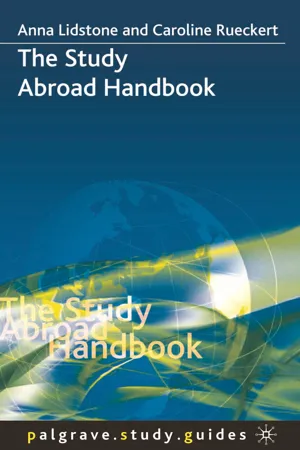
The Study Abroad Handbook is a detailed guide for students who want to study in another country. With information on the practical, financial and emotional aspects of the study abroad experience, the book also includes tips and anecdotes from a diversity of international students.
Like most things in life that are worth doing, studying abroad is challenging. We will warn you from the outset that it will require a lot of work, both before you leave, while you are abroad and when you get home again. It can be stressful, exhausting, overwhelming and very, very challenging. But you will also find yourself doing things you could never imagine doing, and pushing beyond what you thought were your limits. You will find emotional and psychological resources you didn’t know you had, and find reserves of stamina, endurance and determination beyond anything you could predict.
Throughout our own years of study in various countries, in our travelling, and in the course of preparing this book, we have talked to hundreds of students who have studied in a diversity of programmes across every continent. Consistently, students have told us that studying abroad was the best thing they have ever done, whether because of its challenges or despite them.
Taking the question ‘Why study abroad?’ as its starting point, this chapter will guide you through what you will need before you embark on the journey that is studying abroad, helping you to put into place the components that will allow you to plan confidently and make your study experience abroad the best it can be.
Why study abroad?
Some of the answers we have heard to this question are:
To learn about another culture
To build self-esteem and confidence
For the adventure
For the chance to travel
To learn and practise a language
To have fun
For the career opportunities
To study something new
For the cheaper tuition
For contact with experts and specialists in my field
My partner was working abroad and I wanted to take advantage of being there
I wanted my children to learn about the world
To build global citizenship and an international perspective
To learn about my family history
I needed a change of scenery
For the independence
It was the scariest option and I wanted to push myself
To make new friends
I was tired of my home town
All my friends had studied abroad and I wanted to as well
For the experience
For the job training
To learn about the roots of my religion
I wanted to challenge myself
There were more opportunities abroad than at home
I studied abroad to experience a different lifestyle, and to see more on the other side of the world. There is a Chinese saying ‘to walk thousands of roads is better than to study thousands of books’. I completely agree with that. Knowledge and humanity can be gained through experiences. I also wanted a year to think about the past, and to plan my future.
Carol, an undergraduate from Hong Kong
Some enjoyed the experience immensely and couldn’t wait to do it again. Others had more challenging experiences, but said they would still do it again because they learnt so much from it. Over and over, we have heard that students’ study experiences abroad have been life changing and have opened up possibilities for them that they could never have predicted.
A personal journey – Why do you want to study abroad?
One of the most important factors of studying abroad is how personal the experience is. While there are consistent themes in what students gain from their time abroad, it is striking how unique and individualized each experience is. Your study abroad will be unique to you. You will make unique decisions, create unique opportunities for yourself and experience your programme differently from anyone else. Throughout this book, you will be encouraged to consider what options work for you, and how you can achieve your goals.
Even the idea of studying abroad means different things to different people. When you see the term you might immediately think of an intensive two-week summer language course in France. Or a year off from your undergraduate degree to travel. Perhaps an invigorating and exciting academic atmosphere to explore a subject not currently available to you. Some people might see ‘abroad’ as being the other side of the world, while for others it might just mean crossing a single border. For some, going abroad requires still being able to speak their own language. For others, ‘abroad’ suggests the chance to master a new one. Take a moment to consider what assumptions and expectations you bring to the idea of studying abroad.
What does studying abroad mean to you?
It might be helpful if you write down your answers. Your priorities will probably shift when you start the research process and you might forget your initial responses. If you write them down, you can come back to them later and see what has changed and what has remained consistent.
What immediately comes to mind?
Be honest. What do you visualize? Do you see yourself in an academic robe among the pillars of Oxford or Harvard? Leaving class to go down to the beach to surf? Donning a backpack on weekends to explore the Great Lakes or the Rocky Mountains? Coffees in pavement cafes in Europe? Going on archeological digs to the Egyptian pyramids? Sketching the Great Wall of China? Mastering a new language? The possibilities are infinite. Only you know what really comes to mind when you contemplate this idea.
What do you hope to get out of the experience?
Think abstractly. We’ll come back to the specifics. What is it you really want to achieve? Are your immediate hopes focused on the place? On academic priorities? On personal aspirations?
What have you been taught about studying abroad?
Have you been taught by your family that either (a) you must study abroad (What do YOU think?) or (b) that would be a terrible thing to do? What are the cultural assumptions about studying abroad where you live and in your social community? Is it assumed that you will go abroad? Have you been told that this will help you to be popular/respected/liked/employable? (This may or may not be true, but it’s important that you are aware that this is a factor for you.) Have you been taught which countries or which courses you SHOULD be pursuing? (Remember that those opinions are going to seem a very long way away when you are in the middle of a programme in another country.) Have you been taught by your family or community that some things are not options for you, because of your background, talents or personality? What factors are restricting your sense of the possibilities available to you? Do you agree with them?
Whose idea was it?
It’s OK if someone else put the idea in your head. But if you do it for someone else, to fulfil someone else’s dream, you might not be very happy with the outcomes. At some point, it will need to become your idea.
Your assumptions and expectations will come up over and over again as you go through the process of refining the possibilities. These are an important part of who you are. Being aware of what assumptions you are making will help you to leave yourself open to as many different options as possible. You will also have to continually reassess your expectations as you proceed.
Advantages of studying abroad
So, you probably now have some sense of what you want to achieve by studying abroad, but there might be potential benefits and advantages that you haven’t really thought about. Let’s look at some of them in a bit more detail.
Educational opportunities
Studying abroad can offer substantial benefits in terms of connecting what you learn in the classroom with what you can learn in wider contexts in specific disciplines. For example, if you are passionate about ancient history, imagine studying in Greece or Rome, surrounded by ancient architecture, primary sources in their original languages, and the chance to understand the geographical and historical context of what you are studying.
I think sharing your views on the world with other people from different backgrounds truly has the power to make you a better person…going traveling is a pause, a way to put your life on “hold” for a while and think about what you are really seeking in life. There is something great about getting thrown in an environment that you don’t know and getting to know everything from scratch.
Danielle, an undergraduate studying in Montreal
Even if your interests are not so easily matched with a geographic region, studying a subject in another country can give you insight into different ways of approaching your subject, different methodologies for solving problems that arise in that subject, and an increased awareness of the kinds of knowledge that is valued in other countries.
If you work in a highly specialized academic area, especially as a postgra...
Table of contents
Cover
Title Page
Copyright
Contents
Acknowledgements
Introduction
1. Starting Out
2. Defining your Priorities
3. Researching your Options
4. Managing your Finances
5. The Application Process
6. Preparing for Departure
7. Living Abroad
8. Staying Healthy
9. A Changing Relationship to Home
10. Additional Challenges
Conclusion
Index
Trusted by 375,005 students
Access to over 1.5 million titles for a fair monthly price.
Study more efficiently using our study tools.
Frequently asked questions
Yes, you can cancel anytime from the Subscription tab in your account settings on the Perlego website. Your subscription will stay active until the end of your current billing period. Learn how to cancel your subscription
No, books cannot be downloaded as external files, such as PDFs, for use outside of Perlego. However, you can download books within the Perlego app for offline reading on mobile or tablet. Learn how to download books offline
Perlego offers two plans: Essential and Complete
Essential is ideal for learners and professionals who enjoy exploring a wide range of subjects. Access the Essential Library with 800,000+ trusted titles and best-sellers across business, personal growth, and the humanities. Includes unlimited reading time and Standard Read Aloud voice.
Complete: Perfect for advanced learners and researchers needing full, unrestricted access. Unlock 1.5M+ books across hundreds of subjects, including academic and specialized titles. The Complete Plan also includes advanced features like Premium Read Aloud and Research Assistant.
Both plans are available with monthly, semester, or annual billing cycles.
We are an online textbook subscription service, where you can get access to an entire online library for less than the price of a single book per month. With over 1.5 million books across 990+ topics, we’ve got you covered! Learn about our mission
Look out for the read-aloud symbol on your next book to see if you can listen to it. The read-aloud tool reads text aloud for you, highlighting the text as it is being read. You can pause it, speed it up and slow it down. Learn more about Read Aloud
Yes! You can use the Perlego app on both iOS and Android devices to read anytime, anywhere — even offline. Perfect for commutes or when you’re on the go. Please note we cannot support devices running on iOS 13 and Android 7 or earlier. Learn more about using the app
Yes, you can access The Study Abroad Handbook by Anna Lidstone, Caroline Rueckert in PDF and/or ePUB format, as well as other popular books in Studienhilfen & Studienführer. We have over 1.5 million books available in our catalogue for you to explore.