Provides research based advice and practical suggestions to help students beat procrastination and perform better at university or college. Written by a recent graduate, the author gives students a chance to explore the root causes of procrastination and some of the best ways of eliminating it. With a combination of theory, practice, and case study stories and tips from other students, this book will help students seize the date and get more work done.
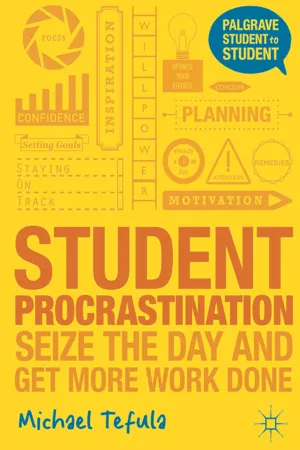
- 144 pages
- English
- ePUB (mobile friendly)
- Available on iOS & Android
eBook - ePub
About this book
Information
Part 1
The Four Ps of Procrastination


The Four Ps of Procrastination are a way of categorising the causes of students unnecessarily putting things off. Knowing which of the four Ps apply in a particular bout of procrastination should help you tailor an appropriate response to combat the affliction. At the end of each of the next four chapters, diagnosis corners will provide hints on areas that may be worth considering in this regard.
1
Probability of Payoff

The Procrastination Connection
Do you lack the necessary skills and confidence in your work? Does making an eff ort seem meaningless? Or perhaps fear of failure and perfectionism have paralysed you from making a start. Whatever the case, this chapter will help you understand how and why these factors contribute to procrastination.
What are your chances?
Would you bother going to a test if the examiner told you upfront that they were going to fail you? Would you even bother preparing for it? I know I wouldn’t. Or how about this: would you ever ask someone out on a date if they told you in advance that they were going to say no? I suspect not.
Our motivation to pursue a goal or to start working on an assignment is usually dependent on whether we think we can achieve that goal or successfully complete that assignment. By the same token, our motivation to work usually depends on how much we value successful completion of a task (Wigfield, 1994).
Researchers in the field of achievement and motivation took note of this notion over 50 years ago (see Atkinson, 1957) and have since been hammering away at understanding the phenomenon better.
To date, one of the key theoretical models that have proved to be reliable in predicting the performance and persistence of students is the expectancy-value model of achievement (Wigfield and Eccles, 2000).
Despite the economics-sounding name, the principles of expectancy-value theory are simple and can be whittled down to two key components that lie within its name – expectancy and value.
Bluntly put, this theory posits that we will only do something if we expect to succeed at it and when this success is valuable or meaningful to us. Remove or lower either of these factors and we end up not acting on a goal or objective.
Inspired by the above comes the first P of procrastination: probability of payoff. This element of student procrastination is based on: (1) the expectancy of success (probability), and (2) the worthiness of an outcome (payoff). In the following sections we explore how these factors influence student procrastination and what the main symptoms are in this regard.
Expectancy
Before you start your university work, at some point you will wonder what your chances of success are. Thoughts on your ability to succeed will include internal beliefs about your abilities and external beliefs about the outcome of your actions.
These two notions are sometimes referred to as efficacy expectations and outcome expectations (Bandura, 1997), and having deficiencies in either can contribute to how much you procrastinate. Let us consider each in a bit more detail.
Efficacy expectations are internal beliefs about your abilities (the word ‘efficacy’ is just another term for ‘having the skill to do something’) – for example, how good you think you are at writing essays. Outcome expectations, on the other hand, are external beliefs that your skills and effort will lead to a certain result (Eccles and Wigfield, 2002).
One way of visualising the above contrast is with the following diagram and questions:

When procrastinating, you should look out for which of the two components on the left side of the equation may be holding you back. Indeed, it is entirely possible for you to have great confidence in your abilities (i.e., knowing that you can produce good-quality work), while having little to no confidence in the outcome of your efforts (i.e., doubting that your performance and application of skill will be rewarded).
Likewise, you may know exactly what needs to be done to score really well on an assignment, and know what boxes to tick on the syllabus (high outcome expectation), yet you may procrastinate because you either lack the technical skill to do those things or you doubt your execution will be of a high enough quality to attract high marks.
Therefore, as a student, be wary of the role efficacy and outcome expectancies play in how much you procrastinate. Whether you think you have what it takes to do well, and whether you believe skills and effort are rewarded appropriately, will determine how moved you are to start your work.

• If what you believe about your chances of success contributes to procrastination, can you think of ways in which you could reduce the habit by working on your efficacy and outcome expectations?
• Suggested reading: Chapter 5 – Competence and Confidence.
Payoff
The second factor to consider in probability of payoff is the payoff itself (or value). After all, why would any student bother working hard to complete an assignment if its results were meaningless?
A good example of the payoff concept at play in the UK is the way the first year of university is structured on some courses. Where it doesn’t contribute to the final grade upon graduation, nothing is more tempting than to put off as much work as possible the moment you hear the following words of liberation: ‘The first year doesn’t count!’
In fact, first-year students on such courses often struggle for motivation when they realise that efforts in the opening year will not contribute to their degree classification. I certainly did not thrive until my second and final years of study, and the reasons are clear: we need to have a strong reason for doing something. Otherwise, we end up not trying at all.
So what type of payoff-related reasons drive effort, the lack of which lead to procrastination? The answer can be found in four key tenets brought to light by psychologists many years ago. These are: (1) attainment value, (2) intrinsic value, (3) cost, and (4) utility value (Eccles et al., 1983). Each of the reasons is explained in turn below.
Attainment value
Attainment value is how important you think it is for you to do well on an assignment. It is also about your needs and personal identity. For example, a student might not care much for grades. Instead, they might consider themselves more creative in nature than academically focused. In this instance, they place a low attainment value in preparing for exams and as a result end up more likely to delay revision, for instance.
Likewise, a music student with a love for playing guitar may find it easier to prepare for a gig than for a graduate job interview in a large corporation. Such a student probably identifies with music more than a 9-to-5 job and would therefore be less motivated to practise interview questions.
In contrast, if you always got good grades in school and you identify yourself as someone that loves to learn, you are more likely to place a high attainment value in doing well at university. For this reason you would be expected to have more motivation in this area, even when faced with setbacks.
Joe Barry, a recent University of Warwick graduate who now works in finance, is a particularly good example of someone who used to do well in school and continues to identify himself with doing well:
‘I recall submitting my first essay in first year and getting a mark of 52. I went to the lecturer as I was in shock. However, he greeted me as follows: “I bet you were the cleverest in your college right?,” to which I begrudgingly responded “Yes, I suppose so”.The lecturer went on to say that everyone at the university was the best at their old college as well and that I was no longer a big fish in a small pond. Regardless, that spurred me on to make myself that big fish again.’
As expected, attainment value is part of the reason why students can be lazy in some parts of their university work while working extremely hard in other areas. On the whole, if the successful completion of a task isn’t aligned with who you are, or who you would like to be, you are more likely to procrastinate in completing that task.
Intrinsic value
The next tenet to consider is intrinsic value. This relates to how much you enjoy doing something. It is when the journey – and not necessarily the destination – is the reward. In essence, intrinsic value pertains to the gratification you get from doing something while you are doing it. The process is enjoyed without great emphasis on the outcome.
For example, if you have a driving licence, think back to when you had just passed your driving test. You would look for any opportunity to go out for a drive, not so much to get somewhere, but to enjoy the process of driving itself. That is intrinsic motivation. It is akin to having a passion for something, and in such instances we procrasti...
Table of contents
- Cover
- Title
- Copyright
- Contents
- Preface
- Introduction
- What Is Procrastination?
- The Four Ps of Procrastination
- How to Beat Procrastination
- Appendices
- Acknowledgements
- Bibliography and Further Reading
- Index
Trusted by 375,005 students
Access to over 1.5 million titles for a fair monthly price.
Study more efficiently using our study tools.
Frequently asked questions
Yes, you can cancel anytime from the Subscription tab in your account settings on the Perlego website. Your subscription will stay active until the end of your current billing period. Learn how to cancel your subscription
No, books cannot be downloaded as external files, such as PDFs, for use outside of Perlego. However, you can download books within the Perlego app for offline reading on mobile or tablet. Learn how to download books offline
Perlego offers two plans: Essential and Complete
- Essential is ideal for learners and professionals who enjoy exploring a wide range of subjects. Access the Essential Library with 800,000+ trusted titles and best-sellers across business, personal growth, and the humanities. Includes unlimited reading time and Standard Read Aloud voice.
- Complete: Perfect for advanced learners and researchers needing full, unrestricted access. Unlock 1.5M+ books across hundreds of subjects, including academic and specialized titles. The Complete Plan also includes advanced features like Premium Read Aloud and Research Assistant.
We are an online textbook subscription service, where you can get access to an entire online library for less than the price of a single book per month. With over 1.5 million books across 990+ topics, we’ve got you covered! Learn about our mission
Look out for the read-aloud symbol on your next book to see if you can listen to it. The read-aloud tool reads text aloud for you, highlighting the text as it is being read. You can pause it, speed it up and slow it down. Learn more about Read Aloud
Yes! You can use the Perlego app on both iOS and Android devices to read anytime, anywhere — even offline. Perfect for commutes or when you’re on the go.
Please note we cannot support devices running on iOS 13 and Android 7 or earlier. Learn more about using the app
Please note we cannot support devices running on iOS 13 and Android 7 or earlier. Learn more about using the app
Yes, you can access Student Procrastination by Michael Tefula in PDF and/or ePUB format, as well as other popular books in Study Aids & Study Guides. We have over 1.5 million books available in our catalogue for you to explore.