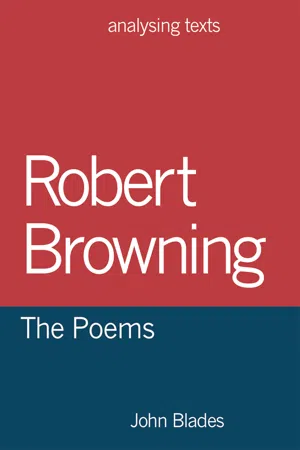
This stimulating study takes a fresh look at Browning's poetry and at some of the key themes that run through his work. Part I uses carefully selected extracts for close textual analysis, while Part II examines Browning's life, contexts and a sample of criticism. Using some of Browning's most widely studied poems, this book will develop students' close reading technique and help them to articulate their own responses to poetry.
The volume is an ideal introductory guide for A Level and undergraduate English Literature students, or anyone studying Browning's poems for the first time.
- 247 pages
- English
- ePUB (mobile friendly)
- Available on iOS & Android
eBook - ePub
Robert Browning: The Poems
About this book
Information
PART 1
ANALYSING BROWNING’S POETRY
1
Sex, Murder and the Construction of Identity
In this chapter we will be examining extracts from three of Robert Browning’s poems taken from different stages in his writing life, primarily in order to investigate how he develops the identities of his characters, especially in terms of their gender. These are
‘My Last Duchess’
‘Porphyria’s Lover’
‘The Laboratory’
The chapter also sets out to show different attitudes to sex in these poems and the part it plays in impelling the lives of the principal characters, each of whom is involved in some way in a murder. In particular we will try to bring out the ways in which Browning focuses on the psychology of his characters, what motivates them, how it drives them to extremes of action and how they respond to these actions.
Above all, the chapter will try to demonstrate the role of Browning’s highly original techniques and approaches. Browning had failed in his early determination to write successful plays for the commercial theatre, but in dedicating himself to a career of poetry he applied some of the important methods of the stage to his new arena, methods that proved both revolutionary and controversial, and whose effects are still seminal in the literature of today.
‘My Last Duchess’
Our first poem, ‘My Last Duchess’, is an important, highly sophisticated poem in which Browning’s trademark irony plays a crucial part. At the centre of its sophistication lies a double perspective, the one standing inside the speech, narrating, and the other detached, observing and assessing. It is this double perspective that gives the poem its multiple ironies and much of its great appeal.
‘My Last Duchess’ is Browning’s first stab at portraying characters of Renaissance Italy – which provides the setting for so many of the characters in the 1855 volume Men and Women. The poem first appeared in 1842 and seems to have grown out of sketches Browning had made fifteen years earlier for his long poetic narrative Sordello. ‘My Last Duchess’ marks Browning’s radical departure from his old manner as he begins to achieve the critical success and popularity that had eluded his earlier work. At the heart of this success is the technique of the ‘dramatic monologue’ which Browning brought to perfection, and for many readers ‘My Last Duchess’ is the ultimate consummation of this form (we will discuss the many features of the dramatic monologue as we explore those poems embodying it, but you may like to check the Glossary for a summary of its key elements).
In this poem, as in so many of Browning’s, we come to something like an understanding of the poem’s circumstances only at the end of its monologue, and even then we are likely to feel that this is merely partial (in both senses of the word). Reading this breathtakingly enigmatic poem, we are located in the position of an outsider, an eavesdropper, come to the table late. We come by information piecemeal, obliquely, and the poem is riddled by many silences or lacunae, so that we are repeatedly constrained to join up the dots and make connections as we strive to see the situation from within (a striving which is repeatedly thwarted).
The poem’s details are often understated or entirely omitted, with the result that the reader quickly becomes an active participant in a text which is very much concerned with reading and watching (the two men watch the duchess watching them, as the duke had watched her, and ‘her looks went everywhere’). We watch the watchers.
For the reasons behind this, we need look no further than the nature of the monologue – the speaker of a monologue has no obligation to explain things to himself. Yet, on the other hand, the role of the Count’s envoy is a superb technical device in the poem, working to situate us naturally inside the monologue: the duke simultaneously enrols both ourselves and the envoy into the circumstances concerning his previous wife.
In his dealings here with the envoy, the duke plainly has a number of identifiable aims (‘my object’) and equally clearly he wishes to impress for a good report to be transmitted to the Count. However, since marriage negotiations are already quite advanced the duke is now directing his strategy onto key details, among which is the fate of his previous duchess – and the reasons behind it. The portrait painted on or in the wall (probably a fresco, and so she is literally immured) presents the duke as well as Browning with the chance to expatiate on the woman and her fate.
Put bluntly, the situation compels the duke to reveal his values and expectations in a prospective marriage, especially those regarding his wife’s conduct. His previous duchess, a spirited and highly cordial woman, treated everyone alike and gave no special reverence to an aristocrat with a lengthy pedigree:
… all and each
Would draw from her alike the approving speech ... (29–30)
With noticeable irony, the painting of the dead woman renders her ‘as if she were alive’ (lines 2 and 47), thereby setting up a dichotomy in the poem of art and life. His account of the duchess leaves us in no doubt about her vitality and her charm, which become, firstly, sources of frustration then objects of deep envy, ending in abhorrence. Personally and metaphorically she evades him utterly – living beyond his expectations. His shameful and uninspired remedy to this is murder: to put an end to those indiscriminate smiles, ‘I gave commands’.
Life itself, in all its vitality, simply eludes the duke, while sophistication takes the possessive form of collecting and concealing, especially material articles: women, painting, statues. He has come to regulate his lacklustre existence through manageable items of luxury. Take his Neptune: a ‘rarity’, depicting a male ‘taming’ the life of the horse just as Neptune himself has been tamed, reduced to the form of a bronze. All ‘for me’ – his insipid world is organised by and wholly for himself.
We now need to start looking in more detail at this important poem by tackling an analysis of it in two parts; the first part I have selected is lines 1–34, the second from line 34 to the close.
Passage (i) lines 1–34
That’s my last Duchess painted on the wall,
Looking as if she were alive; I call
That piece a wonder, now: Frà Pandolf’s hands
Worked busily a day, and there she stands.
Will’t please you sit and look at her? I said 5
‘Frà Pandolf’ by design, for never read
Strangers like you that pictured countenance,
The depth and passion of its earnest glance,
But to myself they turned (since none puts by
The curtain I have drawn for you, but I) 10
And seemed as they would ask me, if they durst,
How such a glance came there; so, not the first
Are you to turn and ask thus. Sir, ’twas not
Her husband’s presence only, called that spot
Of joy into the Duchess’ cheek: perhaps 15
Frà Pandolf chanced to say ‘Her mantle laps
Over my lady’s wrist too much,’ or ‘Paint
Must never hope to reproduce the faint
Half-flush that dies along her throat’; such stuff
Was courtesy, she thought, and cause enough 20
For calling up that spot of joy. She had
A heart ... how shall I say? ... too soon made glad,
Too easily impressed; she liked whate’er
She looked on, and her looks went everywhere.
Sir, ’twas all one! My favour at her breast, 25
The dropping of the daylight in the West,
The bough of cherries some officious fool
Broke in the orchard for her, the white mule
She rode with round the terrace - all and each
Would draw from her alike the approving speech, 30
Or blush, at least. She thanked men, - good! but thanked
Somehow - I know not how - as if she ranked
My gift of a nine-hundred-years-old name
With anybody’s gift.
To begin at the beginning, the opening word of the poem itself is of utmost significance, telling us such a lot about the rest of the poem.
That’s ... (1)
As deixis, the word points of course. And as such tells us that someone – the Duke of Ferrara as speaker – is doing the pointing. And so there must be a listener too, and this is a key feature of Browning’s dramatic monologues. To summarise then. We have a speaker, a listener and the more distant ‘that’ pointed at. These are the three basic triangulation points of the whole poem, set up in that very short opening word, and this triangle is the governing principle of the poem.
In spite of the anonymity in the word ‘That’, we learn quickly it refers to a painting of the speaker’s previous duchess. Yet, strictly speaking, she remains anonymous – she is the woman in his mind, an object to be dismissed as ‘that’. The next line reveals she is dead but, in a real way, she continues to live, flourishes defiantly in the painting and most vividly in the duke’s consciousness, as the rest of the poem will reveal. Art brings the dead back to life, imbuing a kind of immortality.
Escorting an envoy round his palace, the duke draws aside a curtain to reveal this hidden portrait. Her ‘pictured countenance’ may be in a frame painting or, perhaps, in the form of a fresco, painted directly into the plaster of the wall. The distinction is important because he now has her fixed, formulated, helpless on his wall.
Thus we learn early on that Browning’s words are highly particular, often highly charged. For instance, the word, ‘looking’ in line 2 – does it mean simply the picture seems alive? Or does it mean the duchess herself is looking? Of course, it means both, and yet the latter implies that she persists as a haunting indictment of her putative owner. So she must remain, somewhat theatrically, confined behind a cloak, fixed onto the wall.
The opening lines are interesting too in setting a tone. Line 1 is a fairly cold, flat direct statement, blandly extended by line 2, seemingly an afterthought. The tone is disengaged, blasé, encouraging the idea that the duke is simply strolling around his palace, parading his material objects for effect. And yet this apparent composure appears wholly contrived for his prospective father-in-law.
The flat tone resembles that of an inventory, making the woman behind it a mere afterthought. The duke becomes only slightly more animated when he muses that it is a ‘piece of wonder’ (3). With no small irony, the word ‘wonder’ refers both to the woman and to the art object – but for different reasons in each case.
To be fair, the duke does admire the craftsmanship of Frà (i.e. ‘Fratello’ or brother) Pandolf, as he later admires that of the sculptor, Claus of Innsbruck (56). It is a wonder too how the artist managed to evoke the likeness of the remarkable former wife, so much so that the painting mordantly generates a painful recollection of her life. This device is a common theme in Browning’s work, the way in which a work of imagination can itself set off the imagination, often through the memory (a feature of increasing interest to Victorian psychologists).
In the process of itemising his hoard of treasures, the Duke of Ferrara is suddenly halted by the portrait, inviting the Count’s envoy to sit. She ‘stands’ while he sits. Overly courteous to the envoy, the duke even addresses this servant unctuously as ‘Sir’! (25). Now beginning to enliven the portrait, his own emotions are becoming more stirred. However, the question is begged of why, if the Count’s envoy comes to discuss arrangements for the daughter’s marriage, does the duke dwell on his previous spouse? One answer lies in his exposition itself.
With the duke’s deliberate reference to ‘Frà Pandolf’, we begin to get the impression of how calculating he is in almost his dealings. Manipulating the envoy’s route, controlling his ex-wife’s world, even deciding its end. He is a man for whom control, organisation and constraint represent his primary rationale. He anticipates how the envoy may respond to the portrait, because every previous viewer of it has prompted him to expand on
The depth and passion of its earnest glance … (8)
To the duke, the painting seems almost alive – so much so that he points to ‘she’ and ‘her’ once the poem is on its way, gradually conflating the woman and her image (both on the wall and in real life), until she comes vividly alive to him. Line 7’s ‘strangers’ recalls those men with whom the duchess had played, flirted and ‘thanked’ in lines 27 on. Yet the sycophantic aristocrat tries to convince the envoy that the curtain is drawn back only for a select few (10).
Notice how the verb ‘durst’ or ‘dares’ in line 11, hinting at the duke’s domineering nature, implies that the envoy has clearly dared to ask about the portrait, in the moment before the start of the poem (an example of how Browning fills out his scene by suggesting events outside of the monologue – see another example at lines 52–53). As the listener, the envoy functions as our agent in the poem – a common dramatic or filmic device – with the result that the duke is effectively addressing us, the reader.
We quickly discover there is something mysteriously elusive about this painting. In discussing our own response to works of art, words and verbal definition can take us only so far, and for the duke this painting has especial difficulties. It is a great realist painting in itself (‘as if she were alive’), yet crucially it has poignant personal associations for him (after all, she is not just anybody). Not surprisingly, his exegesis of it/her is highly flavoured – as this monologue itself, very much a partial interpretation.
H...
Table of contents
- Cover
- Halftitle
- Title
- Copyright
- Contents
- General Editor’s Preface
- Introduction
- Part 1 Analysing Browning’s Poetry
- Part 2 The Context And The Critics
- Glossary of Literary Terms
- Further Reading
- Index
Trusted by 375,005 students
Access to over 1.5 million titles for a fair monthly price.
Study more efficiently using our study tools.
Frequently asked questions
Yes, you can cancel anytime from the Subscription tab in your account settings on the Perlego website. Your subscription will stay active until the end of your current billing period. Learn how to cancel your subscription
No, books cannot be downloaded as external files, such as PDFs, for use outside of Perlego. However, you can download books within the Perlego app for offline reading on mobile or tablet. Learn how to download books offline
Perlego offers two plans: Essential and Complete
- Essential is ideal for learners and professionals who enjoy exploring a wide range of subjects. Access the Essential Library with 800,000+ trusted titles and best-sellers across business, personal growth, and the humanities. Includes unlimited reading time and Standard Read Aloud voice.
- Complete: Perfect for advanced learners and researchers needing full, unrestricted access. Unlock 1.5M+ books across hundreds of subjects, including academic and specialized titles. The Complete Plan also includes advanced features like Premium Read Aloud and Research Assistant.
We are an online textbook subscription service, where you can get access to an entire online library for less than the price of a single book per month. With over 1.5 million books across 990+ topics, we’ve got you covered! Learn about our mission
Look out for the read-aloud symbol on your next book to see if you can listen to it. The read-aloud tool reads text aloud for you, highlighting the text as it is being read. You can pause it, speed it up and slow it down. Learn more about Read Aloud
Yes! You can use the Perlego app on both iOS and Android devices to read anytime, anywhere — even offline. Perfect for commutes or when you’re on the go.
Please note we cannot support devices running on iOS 13 and Android 7 or earlier. Learn more about using the app
Please note we cannot support devices running on iOS 13 and Android 7 or earlier. Learn more about using the app
Yes, you can access Robert Browning: The Poems by John Blades in PDF and/or ePUB format, as well as other popular books in Literature & English Literary Criticism. We have over 1.5 million books available in our catalogue for you to explore.