- 268 pages
- English
- ePUB (mobile friendly)
- Available on iOS & Android
eBook - ePub
About this book
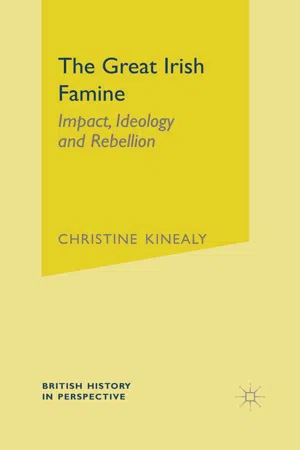
The Great Irish Famine of 1845-51 was both one of the most lethal famines in modern history and a watershed in the development of modern Ireland. This book - based on a wide range of little-used sources - demonstrates how the Famine profoundly affected many aspects of Irish life: the relationship between the churches; the nationalist movement; and the relationship with the monarchy. In addition to looking at the role of the government, Kinealy shows the importance of private charity in saving lives. One of the most challenging aspects of the publication is the chapter on food supply, in which Kinealy concludes that, despite the potato blight, Ireland was still producing enough food to feed its people. The long-term impact of the tragedy, notably the way in which it has been remembered and commemorated, is also examined.
Information
1
REMEMBERING THE FAMINE
The Irish Government wholeheartedly shoulders its responsibilities in acknowledging the importance of the Famine, which so signally marked us as a people, which vastly expanded our diaspora, and in which modern Ireland itself was born.1
(Avril Doyle TD Chairperson of Famine Commemoration
Committee in the Republic of Ireland, 1995)
Committee in the Republic of Ireland, 1995)
‘The Famine was a defining event in the history of Ireland and of Britain. It has left deep scars. That one million people should have died in what was then part of the richest and most powerful nation in the world is something that still causes pain as we reflect on it today. Those who governed in London at the time failed their people through standing by while a crop failure turned into a massive tragedy. We must not forget such a dreadful event’.2
(Tony Blair, PM of the United Kingdom, 1997)
Belfast City Council is to erect a stained glass window in memory of those from the city who died in the Great Famine – despite a DUP (Democratic Unionist Party) attempt to block the move . . . Councillor Sammy Wilson said there was no evidence that the Famine played a major role in the history of Belfast and said the motion gave succour to anti-British, Sinn Féin propaganda’.3
(Irish News, Belfast, 4 February 1997)
Few commemorative events have captured the public, private and political imagination as did the 150th anniversary of Ireland’s An Gorta Mhór, the Great Hunger or Famine.4 Significantly, Blair’s address provided an open admission that the Great Famine was as much a part of Britain’s history as Ireland’s. The same point had frequently been made in Ireland. In 1995, the well-respected broadsheet, the Irish Times, had declared that ‘the Great Famine was the most culpable episode in the troubled rule of Britain and Ireland’.5 Yet, despite the general acceptance of the awfulness and significance of the Famine, it was rarely taught in Irish schools or universities and little had been published on it. Instead, the dominant school of thought within Irish history, known generically as revisionism, had argued that the Famine was not a significant event in modern Irish history, but that it merely acted as a catalyst for changes which were occurring anyway.6 Moreover, the Famine was depicted as inevitable and it was suggested that the British government could have done little more than they did to save lives.7 This interpretation had dominated academic discourse since the 1930s, with varying degrees of intensity. One of its key purposes was to revise the traditional nationalist or popular interpretation of the Famine, whilst claiming that it had no political purpose of its own. Those who challenged it, however, were accused of having a covert agenda or being politically motivated.8 Clearly, the revisionist interpretation did not exist in an intellectual or political vacuum and its writings – especially by non-academics – were shaped (and constrained) by events within Ireland at the end of the twentieth century, notably, the ‘Troubles’. One consequence of revisionism was ‘to undermine the basis of Irish nationalism and leave Ireland without the heroes of historical memory . . . [and to] play down the British responsibility for the catastrophic aspects of the Irish experience’.9 Moreover, the revisionist domination meant that intellectual debate in Ireland was effectively constrained, and to take a counter-position was tantamount to declaring support for the national struggle.10
A Forgotten Famine?
The reluctance of Irish historians to engage with the Great Hunger was particularly curious given that the Famine was a watershed in the development of modern Ireland. Moreover, the scale of population loss was remarkable; over one million people died and an even greater number emigrated during a six-year period, thus cutting the population by over 25 per cent. And even after good harvests returned to Ireland, the population decline continued. Until the 1990s, however, the two standard books on the Famine were by Robin Dudley Edwards and Desmond Williams, The Great Famine: Studies in Irish History, which was academically acclaimed but of uneven quality, and the academically panned but best-selling, The Great Hunger, by Cecil Woodham-Smith. The Taoiseach, Eamon de Valera, commissioned the former in 1944 to commemorate the hundredth anniversary of the Famine. Despite receiving a large subvention from the government, the publication did not finally appear until 1956 and was just over half the size of that which had been agreed. The chapters were uneven in quality and lacked coherence (some lacked footnotes, one set having been lost in a London taxi-cab by one of the editors). The final product was also a disappointment to de Valera, whilst Dudley Edwards admitted that the authors had not paid sufficient attention to it.11 The editors’ introduction (which had been ‘ghost’ written by a junior historian) captured the spirit of much revisionist writing by refusing to engage with some of the more unpleasant aspects of the disaster, such as mortality and the responsibility of the government. The introduction also criticized popular and folk interpretations for viewing ‘the failure of the British government in a sinister light’.12 Yet, in spite of its many shortcomings, the book sold well and received favourable reviews from fellow acadmics.13
In contrast, Cecil Woodham-Smith’s Great Hunger, published in 1962 and which provided a more comprehensive and meticulously researched view of the Famine by a non-academic, was derided by many Irish historians; one of the examination questions asked of undergraduate history students in University College in Dublin in 1963 was ‘The Great Hunger is a great novel. Discuss’.14 The author was also attacked on a personal level. Professor Roy Foster, for example, described Woodham-Smith as a ‘zealous convert’.15 Its abundant sales and frequent reprints in Ireland, Britain and America, however, demonstrated not only the gap between popular and academic perceptions of the Famine, but also how deeply entrenched an orthodoxy of the Famine had become within the Irish academic community.
The dearth of Famine publications was followed during the sesquicentenary commemorations with what appeared to be a glut. Between 1995 and 1997 more books were published on the Famine than in the previous 150 years. More significantly, a new generation of historians, mainly from universities outside Ireland, challenged the revisionist school of history, which had dominated academic history since the 1930s, but more intensely since the 1960s. The Famine, which had been ignored or marginalized by Irish historians, suddenly became intellectually admissible. The willingness to revisit the Famine was explained by Mary Daly of University College, Dublin, whose earlier writings on the Famine had been conservative and marked by an attempt to play down the level of mortality and responsibility of the British authorities.16 In a public lecture in Belfast in 1995 she admitted to having adopted this form of self-censorship saying, ‘Now we are in a cease-fire situation, we can talk about aspects of history which we may previously have felt uncomfortable with.’17 Such an explanation demonstrated the linking of certain sensitive topics in Irish history with the political situation in Northern Ireland. Clearly, the military campaign by the Irish Republican Army and other paramilitary groups had restricted academic debate even in parts of Ireland not directly involved in it.
The political significance of Famine commemorations was increased by the fact that they coincided with an IRA cease-fire between 1994 and
which marked one of the most significant steps towards a peace process since the renewed round of ‘Troubles’ in 1969. At the launch of its programme in June 1995, the government minister in charge of the Republic of Ireland’s Famine Commemoration Programme declared that ‘the Peace Process allows us all the more freely to explore the truth. The relations between the two islands have now reached a maturity which allows us to look at our history objectively and to tell the story as it was... After all, the Famine is not just an Irish event, it was just as much a British event, a shared experience.’18 The progress towards peace was intensified with the coming to power in Britain of the Labour Party in
with a resolution of the Troubles being made a political priority. Irish politics and Irish history were discussed in the public domain in a way that had not seemed possible in the highly charged atmosphere of the 1980s and early 1990s.
On the first anniversary of the IRA cease-fire in 1995, an Irish Times journalist explained how the revisionist viewpoint had become the accepted dogma, but that just as the political context had changed, revisionism also would have to adapt. He wrote that the cease-fire had changed the politics of both the North and the Republic of Ireland definitively, allowing the removal of power from a powerful clique of anti-nationalists who had attempted to repress all dissent. Radical voices within Ireland or those who tried to critically understand the situation in the North had been denounced as nationalists. Consequently, whilst the conflict continued it had ‘the effect of stifling all debate about certain aspects of Irish society’, including debates on the Famine. However, the same interests which had nurtured the development of revisionism had responded with ‘increasingly vicious attacks on those who advance alternative viewpoints [which] demonstrates a kind of menopausal fear of their own impending obsolescence’.19
The Famine commemorations also coincided with a cultural revival within Ireland and further afield. An improbable showcase for Ireland’s success was provided by the Eurovision Song Contest, which Ireland won a record four times between 1992 and 1997. In 1994 television audiences throughout Europe were exposed to seven minutes of traditional Irish dancing, which borrowed freely from other styles and cultures and which was led by two Irish-American dancers. Riverdance did the apparently impossible; it made Irish dancing both sensual and commercially lucrative.20 More importantly, it was critical in ‘redefining Ireland’s media image in the world . . . as it jostled for position and exerted its political influence within Europe’.21
Two legacies of the Famine were that the role of women was weakened, whilst the position of the Catholic Church was strengthened considerably. Late nineteenth-century society had been increasingly patriarchal – primogeniture and the Catholic Church undermining women’s traditional economic role within society – but women found a new voice in Ireland at the end of the twentieth century. Mary Robinson gave Ireland a high-profile president who was intelligent, stylish and, like Riverdance, international rather than insular in approach. The birth of the so-called ‘Celtic Tiger’, by which Ireland was transformed into the fastest growing economy within Europe, consolidated and amplified the newfound attractions of Ireland to an audience that was not merely comprised of emigrants of Irish descent. The Republic of Ireland, with its new found prosperity, poise and popularity was ready not only to take its place on the world stage, but also confident enough to confront the horrors of a lethal famine that had occurred 150 years earlier; an event which had changed the course of modern Irish history yet which had been ignored, marginalized or sanitized by generations of professional historians.22
Yet, even before the anniversary and the official commemorations commenced the desire of the Irish people to know more about the Famine was apparent. The publication of The Famine Diary in 1992, which provided a narrative account of a famine victim and his wife who emigrated and died on Grosse Ile, the quarantine station outside Quebec, encapsulated and reinforced a popular understanding of the Famine experience. Within two months of publication it was a best-seller, helped by media interest in a ‘good story’ and endorsements by Irish charities working in the Third World. A few months later, however, the diary was found to be not a contemporary account, but a compilation of newspaper articles that had first been published in 1895 in Canada. A Catholic priest had then reworked it and added a number of new characters.23 Nevertheless, the diary clearly filled a void, whilst demonstrating that the revisionist interpretation had failed to displace or even adequately challenge the traditional nationalist interpretation of the Famine. A collection of essays by Irish and Irish-American contributors, edited by Senator Tom Hayden and published in 1997, suggested that there existed a moral and spiritual need to remember because ‘A Famine repressed breeds an incipient hunger of its own, a hunger to know, to grieve, to hold accountable, to resolve and to honour.’ Moreover, he argued, the inability to face up to the Famine was continuing to cast a shadow over the struggle for peace, justice and reconciliation between Irish and British people.24
Within Ireland there was initially some doubt as to whether the Government of the Irish Republic would play an official role in the Famine commemorations. The IRA cease-fire in 1994 undoubtedly played a part in the decision to do so. Nonetheless, how could an event so tragic and which had so long been neglected be appropriately remembered? In May 1994, the government set up an inter-departmental committee chaired by the Minister of State, Tom Kitt. Despite a change of government, the project continued, although Avril Doyle TD, Minister of State at the Department of the Taoiseach, replaced Kitt in January 1995. Following the appointment of Doyle, the scale and scope of the Committee increased. In June, the Irish government announced a publicly funded programme drawn up by the recently constituted National Famine Commemoration Committee. The programme was described as ‘wide, varied, with a heavy emphasis on education, on scholarships and famine relief projects in the modern world’.25 Avril Doyle was provided with a budget of £250 000, a substantial portion of which – £115 000 – was given to four Irish historians to supervise new research by a team of postgraduate researchers.26 She explained this emphasis on the grounds that ‘If we understand our history, we can transcend it’. Nine Poor Law unions were chosen for the ‘high quality detailed survey’ which was to have a special focus on new technologies and methodologies. The research findings were intended to result in a publication and an international conference in 1997 – a timetable that was more in keeping with the schedule of politicians than with the requirements of historical research. In 1997 a conference was held, although the papers and subsequent publication were by established scholars rather than based on the new research financed by the Famine Committee.27
Because the Committee believed that the ‘story must be told to the widest possible audience through video, TV and the media generally’, sponsorship was provided for an RTE documentary and a bilingual schools essay project. Local involvement was actively encouraged, whilst the Famine message was also to be made available to the Irish diaspora. The remaining money was used to assist a limited number of projects not only within Ireland, but also in Britain, the United States and Australia. As a consequence, an eclectic mixture of events was sponsored including an exhibition of art inspired by the Famine, a commemoration concert to include a commissioned ‘Famine Suite’ and the erection of a national monument. Avril Doyle also undertook a lecture tour of the United States accompanied by a small number of historians and academics, amounting to a famine roadshow.
One of the most ambitious aspects of the Committee’s programme was the acknowledgment that the Irish people were still coming to terms with the Famine, Doyle asserting that ‘For our own sakes we need the catharsis of a commemoration which fully recognizes t...
Table of contents
- Cover
- Title
- Copyright
- Contents
- List of Tables
- Acknowledgements
- 1 Remembering the Famine
- 2 The Government’s Response to the Crisis
- 3 Philanthropy and Private Donations
- 4 Food supply and Trade
- 5 Riot, Protest and Popular Agitation
- 6 Religion and the Churches
- 7 Repeal, Relief and Rebellion
- Epilogue
- Notes
- Select Bibliography
- Index
Trusted by 375,005 students
Access to over 1.5 million titles for a fair monthly price.
Study more efficiently using our study tools.
Frequently asked questions
Yes, you can cancel anytime from the Subscription tab in your account settings on the Perlego website. Your subscription will stay active until the end of your current billing period. Learn how to cancel your subscription
No, books cannot be downloaded as external files, such as PDFs, for use outside of Perlego. However, you can download books within the Perlego app for offline reading on mobile or tablet. Learn how to download books offline
Perlego offers two plans: Essential and Complete
- Essential is ideal for learners and professionals who enjoy exploring a wide range of subjects. Access the Essential Library with 800,000+ trusted titles and best-sellers across business, personal growth, and the humanities. Includes unlimited reading time and Standard Read Aloud voice.
- Complete: Perfect for advanced learners and researchers needing full, unrestricted access. Unlock 1.5M+ books across hundreds of subjects, including academic and specialized titles. The Complete Plan also includes advanced features like Premium Read Aloud and Research Assistant.
We are an online textbook subscription service, where you can get access to an entire online library for less than the price of a single book per month. With over 1.5 million books across 990+ topics, we’ve got you covered! Learn about our mission
Look out for the read-aloud symbol on your next book to see if you can listen to it. The read-aloud tool reads text aloud for you, highlighting the text as it is being read. You can pause it, speed it up and slow it down. Learn more about Read Aloud
Yes! You can use the Perlego app on both iOS and Android devices to read anytime, anywhere — even offline. Perfect for commutes or when you’re on the go.
Please note we cannot support devices running on iOS 13 and Android 7 or earlier. Learn more about using the app
Please note we cannot support devices running on iOS 13 and Android 7 or earlier. Learn more about using the app
Yes, you can access The Great Irish Famine by Christine Kinealy in PDF and/or ePUB format, as well as other popular books in History & British History. We have over 1.5 million books available in our catalogue for you to explore.