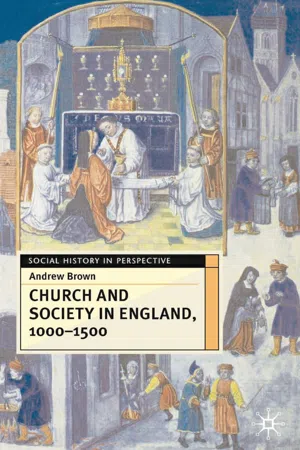
What impact did the Church have on society? How did social change affect religious practice? Within the context of these wide-ranging questions, this study offers a fresh interpretation of the relationship between Church, society and religion in England across five centuries of change.
Andrew Brown examines how the teachings of an increasingly 'universal' Church decisively affected the religious life of the laity in medieval England. However, by exploring a broad range of religious phenomena, both orthodox and heretical (including corporate religion and the devotional practices surrounding cults and saints) Brown shows how far lay people continued to shape the Church at a local level.
In the hands of the laity, religious practices proved malleable. Their expression was affected by social context, status and gender, and even influenced by those in authority. Yet, as Brown argues, religion did not function simply as an expression of social power - hierarchy, patriarchy and authority could be both served and undermined by religion. In an age in which social mobility and upheaval, particularly in the wake of the Black Death, had profound effects on religious attitudes and practices, Brown demonstrates that our understanding of late medieval religion should be firmly placed within this context of social change.
- 253 pages
- English
- ePUB (mobile friendly)
- Available on iOS & Android
eBook - ePub
Church And Society In England 1000-1500
About this book
Information
Chapter 1: Anglo-Saxon Church and Society c.1000
About the year 1001, a peasant ploughing a field at Slepe, in a manor belonging to the abbey of Ramsey, stumbled upon the bones of four bodies hidden in the soil. One set of bones was extravagantly identified in a dream as those of St Ivo, a Persian bishop, no less, who had spent his last days in England as a hermit. A great crowd witnessed the translation of these relics from Slepe to the abbey. So that the relics would be accessible for public veneration, the sarcophagus containing them was allowed to protrude through the abbey walls into the world outside. A spring gushed from the sepulchre and became the source of many cures. Some people were sceptical: a foreign monk suspected the cult to be nothing more than the product of silly, superstitious rustics, who were habitually deceived out of heathen error into making cults of springs and bones. But his objections were stilled by the spring’s miraculous powers.1
Envisage multitudes of pious peasants flocking to monasteries and their relics: does this epitomize the place of the Church in late Anglo-Saxon society? Alas, the attempt to peer through the miracle story into a field of common folk meets a reflection of the abbey’s own traditions, fears and ambitions. St Ivo’s story was written down by Goscelin in the late 1080s at the request of the community at Ramsey, at a difficult time in the monastery’s history.2 The Norman conquest did seem to pose a threat to cherished Anglo-Saxon cults; Ramsey’s hold over the manor of Slepe had been disputed. The miracles ‘authenticated’ the cult for a new Norman abbot and a wider foreign elite; it established the monastery’s claim to the manor. The miracles followed a long tradition of hagiography in which crowds of pious peasants, as well as objections to cults, were de rigueur. The picture of superstitious ‘rustics’ and of a sepulchre, both inside and outside the cloister walls, is not a description of ‘fact’, but a textual construction of corporate identity in which the contours of monastic life are set in high relief against the world outside. The story of St Ivo at Ramsey reflects a genre rather than describes a ‘reality’.
There are other problems. Even at face value, the story offers an ambiguous picture of lay religion: pious crowds awaiting miracles, and yet, according to the sceptical monk, an underworld of semi-heathen rustics. Was late Anglo-Saxon England ‘Christian’ at all? Church organization in Roman Britain had been all but destroyed in the wake of pagan Germanic invaders and settlers after the fifth century; in the more recent past, Viking settlement in the Danelaw region of the north in the ninth century had disrupted ecclesiastical life. We might expect to encounter pagan survivals or Scandinavian religion. But the nature and depth of belief among lay people is hard to assess, as we shall see. To begin with, it is easier to gauge the place of the Church in Anglo-Saxon society, by looking at the more tangible evidence for its influence: evidence such as the buildings, personnel and organization showing the reach of its ministry, and evidence such as its pronouncements and instructive literature expressing its ideals.
(i) The Church and Pastoral Reform
The potential influence of Christianity was certainly far greater in the eleventh century than it had been in the seventh or eighth. By then church buildings were much thicker on the ground. In the sixth century, Pope Gregory had envisaged the establishment of a network of bishoprics, centred on Canterbury, to accomplish the process of conversion, but although bishops did become heavily involved in pastoral efforts and created a diocesan structure, Christianity had spread to the countryside largely through the establishment of monastic houses or ‘minsters’ (and under the inspiration too of ‘Celtic’ missionaries detached from the Roman tradition).3 There is still some dispute over the nature and function of these churches.4 A ‘monasterium’ or ‘minster’ could refer interchangeably to a church staffed by regular monks or by secular clergy. Either way ‘monks’ might perform similar tasks to the ‘secular clergy’: the Benedictine ideal itself had never precluded pastoral activity from a life of ascetic withdrawal. The early minsters seem to have established large ‘parochiae’, along existing regional boundaries, royal vills or large agrarian estates; many may well have acted as a base for an itinerant team ministry to carry out pastoral work in remoter areas. Perhaps such work was not the function of all minsters, but the siting of many of them does suggest a deliberate pastoral scheme: most of the inhabitants of Surrey by the tenth century, for instance, would have been within a short morning’s walk of such a church.5
Pastoral effort, however, should not be seen as the product of a single clerical will. The Anglo-Saxon ‘Church’ was not the ‘Universal Church’ of later centuries (see Chapter 2), and its diversity within regions is often more striking than unity across them. The pattern of minster creation was variable. It is more evident in Hampshire than in Yorkshire; and while in Kent and Surrey there appears to be a close relation between minster and ‘hundred’ boundaries, the correlation is not so evident in Devon. In fact the minster ‘system’ was established late in Devon and later still in Cornwall, where Celtic influences and missionary activity had been particularly strong. Devon was not absorbed into the Anglo-Saxon kingdom of Wessex until the seventh century, Cornwall not till the tenth, and the early chapel baptisteries or preaching stations set up by hermits and British monks in this region, established a pattern of churches (and an attachment to ‘Celtic’ saints) which was to linger late into the Middle Ages and beyond.6 Viking invasions from the end of the eighth century also affected the pattern, especially in the northern and eastern regions of England (later the Danelaw) where ecclesiastical organization was severely disrupted. After the Viking threat had diminished, and the Danelaw began to be reabsorbed, a larger number of minsters is evident in all areas from the mid-ninth century onwards, although the extent of continuity between old and new minsters is not entirely clear.
By the eleventh century law codes which deal with the status of minsters also show a great variety in types of church.7 Yet variety also meant abundance: regular contact between churchmen and people by then did not rely on larger minsters and teams of itinerant preachers. A process had begun by the tenth century in which the ‘parochiae’ of such minsters were fragmenting into a system of smaller proto-parishes, with their own churches or chapels: the proliferation of parish churches in the eleventh century was, it seems, a distinctively English phenomenon; and it should partly be set within the context of pastoral reform, for some of this fragmentation may have been planned. The difficulty of providing for the cure of souls in large or heavily populated areas could be solved with the foundation of churches in outlying villages or populous towns.
Pastoral reform was also bound up with other kinds of Church reform. In the mid-tenth century, especially under King Edgar (959–75), there had been a period of monastic expansion such that reformed Benedictine communities became numerous all over Wessex and the Midlands (though not in Northumbria), and in which a sharper distinction between secular and monastic clergy was enshrined. But a renewed emphasis on the ascetic ideal did not weaken the pastoral impulse. Indeed, monastic renewal was once again part of a wider movement of reform which was underway by the end of the tenth century. The reformed monasteries did not retreat from the world. Abbot Aelfric (d.1010) who founded the reformed monastery of Cerne Abbas, wrote letters in Old English to the bishops of Sherborne and Worcester with advice for the training of secular clergy and unprecedented detail on how they should fulfil their vocation: they were warned, for instance, not to let mouse droppings lie on the altar.8
More attention than ever before was also directed to the laity. Councils and synods legislated on the proper conduct of lay people, both in the payment of dues to support minster churches, and in duties such as abstaining from work on feast days. The homilies of Aelfric and Wulfstan made concerted use of the vernacular – more perhaps than any contemporary bishop on the continent – to communicate basic religious truths to the laity and stimulate the moral reform of the individual. Specific texts (books of the Old Testament) were written for ealdormen: the ideal life recommended to them was one in which monastic observances were followed as closely as a life lived in the world allowed. Such an ideal was apparently followed by the nobleman Leofric who heard two masses a day, fasted and prayed in secret while others slept.9
But such a life might be open only to the few, and the homiletic message was intended to reach a much broader, and largely illiterate, crosssection of society. Observances did not have to be as harsh. The laity were to learn the Pater Noster, the Creed, Ten Commandments; they were to attend communion, observe Sundays and festivals, confess sins to a local priest, and perform penances such as fasting or almsgiving for the good of their souls. Even if not enforced regularly the confessional was an opportunity to test a penitent’s knowledge and to mould his moral behaviour. The laity were to be reminded about the fate of their souls if they remained unrepentant. There was not yet a fully developed ideal of purgatory, between heaven and hell, integrated into a system of penance (see Chapter 2: ii) – although visions of the afterlife could include a place of punishment that was ‘not hell’.10 In general homilies tended to adopt a more apocalyptic tone in describing punishment for the sinner: Abbot Aelfric’s Catholic Homilies promised the ‘surging fires of hell torment’ for all those who did not repent before the Day of Judgment and the coming of the Antichrist. The vast accumulation of penitential literature from this period is testimony to the pastoral endeavour.11
Its impact among the laity is more easily gauged among the landowning elite. Some ealdormen or thegns had clearly requested specific instructional texts. Their wills evince an apprehension of the Day of Judgment and a concern to give land and money to monasteries or minsters, and their saints, ‘for the fate of their souls’.12 But a wider impact was envisaged through preaching. Bishop Oswald apparently preached in the cemetery of Worcester cathedral to large audiences; and his Life describes how in 991 he preached to a ‘multitude’ from five counties at the rededication of the church of St Mary, Ramsey, and how, at a rogation procession, the boat filled with his personal retinue almost capsized because it was so overloaded.13
Once again we are back in the midst of pious ‘crowds’. Tenth-century monastic reform was accompanied by a growing interest in cults of saints, whose lives and miracles involved the laity in ever greater numbers. The public display of relics in translation processions seems to have become much more common by the end of the tenth century. The relics of Sts Swithun, Aethelwold and Oswald were all moved, sometimes more than once, between 971 and 1002, in public ceremonies attended by ‘multitudes’. According to Aelfric, St Swithun’s second translation in 975 to a new altar in Winchester was followed by an extension of his cult: the walls of his church became littered with crutches and stools hung there by cripples cured of their disabilities.14
Once again too, however, hagiographic convention and monastic concerns lay behind the ‘popularity’ of these cults. Most of the saints created were monks, and hagiography was still produced largely for a monastic audience. Crowds were ‘manufactured’. They played their part in demonstrating divine approval of a community’s possession of particular relics. The reformed monastic houses founded in the mid-tenth century gathered in relics from all parts of the country in a conscious bid to assert the legitimacy of the new order. Rightful possession of relics also guaranteed the patronage of the saint for the monastery to which they belonged: as an undying landlord a saint could be counted upon to protect his or her patrimony. St Ivo bestowed his blessing on Ramsey’s possession of the manor of Slepe. Local groups of laity often feature in these accounts. Goscelin tells how the abbot of St Augustine, Canterbury, in the late eleventh century, personally interrogated a parishioner at Lyminge in an endeavour to disprove the claim made by St Gregory’s priory that it had acquired St Mildrith’s relics from that parish. Minster-in-Thanet had been the relics’ resting place; and when these were translated to Canterbury, the monks of St Augustine were careful to leave some dust of St Mildrith’s flesh to console the islanders in their grief at the removal of their saint’s remains.15
The assertion that these cults enjoyed local support, outside monastic walls, may also reflect additional threats rather than a groundswell of popular devotion. The renewed assault of Viking raids from 980 which culminated in 1016 with the accession of a Danish king, Canute, appears in stories dated to that period. The body of St Edmund – and his miraculously talking head – had been translated to Bury St Edmund’s c.915 following his martyrdom (869) at the hands of marauding Vikings; later, Danish raids forced further movement of his remains to London in 1010. There his cult also made its mark: Herman’s Life (late eleventh century) recounts how Londoners refused to allow the same martyr’s relics to be taken back to Bury St Edmund’s in 1013. Ultimately though, the Danes did not represent the same kind of threat posed to the Church by early Viking raids in the eighth century. Church lands may well have been seized, but Canute rapidly reconciled himself to Christianity and its cults in England. In 1023 he had the relics of St Aelfheah (murdered by drunken Danes in 1011) transported from London to Canterbury in a dragon-prowed ship, filled with chanting monks and house carls.16
Yet there may be something more to ‘crowds’ of pious layfolk than monastic convention and wishful thinking. Perhaps worried monks consciously promoted – and perhaps could expect – the support of a broader spectrum of society. In the context of pastoral reform from the late tenth century, in which preaching, public processions, and duties to local churches were so strongly stressed, the more regular appearance in miracles of lay people, sensitized to cults of saints, is less implausible. But if this was so, it was not solely, or even largely, the result of an ecclesiastical propagation of the ‘Christian’ message. As we shall see, the Anglo-Saxon Church had relied on lay power, and with this reliance had come compromise with the world. The interests of lay groups in society, and their attitudes to the clergy, religious houses and the cults of saints did not necessarily accord with clerical reform.
(ii) Royal Power and the Church
Although on the continent – not least under Carolingian kings – the relationship between the Church and rulers had been close, in England it was closer still. The hierarchical structure of a metropolitan Church, centred on Canterbury, was a legacy of Pope Gregory’s mission; and in his Ecclesiastical History of the English People, Bede had enshrined a vision of an intimate relationship between this ecclesiastical structure and the progression of royal authority. A shared sense of ‘Englishness’ first among the various Anglo-Saxon kingdoms and then, by the tenth century, in the region of England dominated by the house of Wessex, was a constructive legacy of this heritage. Ecclesiastical and royal power advanced one with the other: after No...
Table of contents
- Cover
- Title
- Copyright
- Contents
- Acknowledgement
- Introduction
- Chapter 1: Anglo-Saxon Church and Society c.1000
- Chapter 2: The Universal Church and the Laity c.1050–1500
- Chapter 3: Saints, Cults and the Holy
- Chapter 4: Corporate Religion: Structures and Practices
- Chapter 5: Corporate Religion: Death and the Afterlife
- Chapter 6: Reforming the ‘Inner’ Life: Orthodoxy and Heresy
- Conclusion
- Notes
- Further Reading
- Index
Trusted by 375,005 students
Access to over 1.5 million titles for a fair monthly price.
Study more efficiently using our study tools.
Frequently asked questions
Yes, you can cancel anytime from the Subscription tab in your account settings on the Perlego website. Your subscription will stay active until the end of your current billing period. Learn how to cancel your subscription
No, books cannot be downloaded as external files, such as PDFs, for use outside of Perlego. However, you can download books within the Perlego app for offline reading on mobile or tablet. Learn how to download books offline
Perlego offers two plans: Essential and Complete
- Essential is ideal for learners and professionals who enjoy exploring a wide range of subjects. Access the Essential Library with 800,000+ trusted titles and best-sellers across business, personal growth, and the humanities. Includes unlimited reading time and Standard Read Aloud voice.
- Complete: Perfect for advanced learners and researchers needing full, unrestricted access. Unlock 1.5M+ books across hundreds of subjects, including academic and specialized titles. The Complete Plan also includes advanced features like Premium Read Aloud and Research Assistant.
We are an online textbook subscription service, where you can get access to an entire online library for less than the price of a single book per month. With over 1.5 million books across 990+ topics, we’ve got you covered! Learn about our mission
Look out for the read-aloud symbol on your next book to see if you can listen to it. The read-aloud tool reads text aloud for you, highlighting the text as it is being read. You can pause it, speed it up and slow it down. Learn more about Read Aloud
Yes! You can use the Perlego app on both iOS and Android devices to read anytime, anywhere — even offline. Perfect for commutes or when you’re on the go.
Please note we cannot support devices running on iOS 13 and Android 7 or earlier. Learn more about using the app
Please note we cannot support devices running on iOS 13 and Android 7 or earlier. Learn more about using the app
Yes, you can access Church And Society In England 1000-1500 by Andrew Brown in PDF and/or ePUB format, as well as other popular books in Geschichte & Britische Geschichte. We have over 1.5 million books available in our catalogue for you to explore.