The two Germanies, arising from the unpromising ashes of defeated Nazi Germany, came to represent opposing models of state and society. The Federal Republic established itself as a remarkably stable democracy and successful social market economy: the German Democratic Republic developed an apparently exemplary form of 'actually existing socialism' and became a pillar of the Soviet bloc. Then in 1989, the 'gentle revolution' in East Germany added a new twist with the collapse of Communist rule. With rapid reunification, the united Germany of 1990 faced new challenges as the unprecedented transformation created a multitude of economic problems and social tensions.
Previously published in 1992 as The Two Germanies, this book has been fully revised and updated to take account of all the latest developments in contemporary German history.
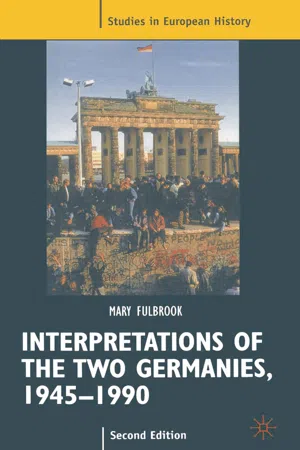
- 128 pages
- English
- ePUB (mobile friendly)
- Available on iOS & Android
eBook - ePub
Interpretations of the Two Germanies, 1945-1990
About this book
Information
1 Introduction
For most of the late twentieth century the Nazi past tended to overshadow perceptions of Germany and the Germans. But now, with the onset of the twenty-first century, even the two successor states – the Federal Republic of Germany and the German Democratic Republic – are beginning to appear more strange, more distant, curious products of and prime exhibits in a Cold War world which dramatically disappeared with the collapse of communism in 1989–90. The increased historical distance has certainly served to enhance access to the sources of the now defunct state, the GDR; it has not necessarily made for greater consensus on interpretations.
The two Germanies, which coexisted in uneasy opposition and mutual competition for forty years after the defeat of Hitler’s Third Reich, represented a remarkable historical experiment. A most unlikely scenario developed in the latter half of the twentieth century: the rump of defeated Nazi Germany was being transformed into two very different entities, capitalist-democratic on the one side and communist on the other. Each appeared, in terms of political stability and economic performance, to be a model example of its type. Moreover the division of Germany (and of Europe and the superpower blocs) seemed an increasingly unquestionable, indeed permanent, feature of the geopolitical landscape. By the late 1980s it was generally recognised that only lip-service need be paid by West Germans to their constitution’s preamble committing them to reunification. But then, with the collapse of Soviet bloc communism, the East German revolution of 1989 inaugurated the end of division and the hurtling towards the uneasy unification, on 3 October 1990, of two Germanies that had by now become very different sorts of sociopolitical entity. With unification a new experiment was embarked upon: that of combining a former communist state with a capitalist democracy, in the context of a radically changed post-Cold War Europe.
This double history poses several sets of substantive explanatory problems. The division of Germany, the character of each state, the reasons for the success of West German democracy (particularly in view of the disastrous demise of its Weimar precursor) and the eventual failure of the communist project in the East have all been the focus of heated controversy.
The Federal Republic of Germany and the German Democratic Republic were founded as conscious attempts to develop new forms of state and society, radically breaking with the Nazi past, and based on explicit political ideologies and theories of society. They were in effect tests in reality of opposing theories of how to create a ‘good’ society. The Federal Republic sought to institutionalise a parliamentary democracy on Anglo-American principles, combined with pre-Nazi German democratic traditions. The GDR, by contrast, was premised on and legitimated by the would-be ‘scientific’ theories of society embodied in Marxism–Leninism – as currently interpreted by those communists in power.
This historical experiment – this test of social and political theories in reality – was in no sense ‘value neutral’. The two Germanies were created by the superpowers as antagonistic, opposing entities: they represented the front line of the Cold War, and the hostile armies of East and West faced each other across the Iron Curtain which ran down the inner frontier of this divided nation.
The two Germanies bristled not only with armaments but also with wholly opposing world views: they painted each other in black and white terms, as friend and foe, as all Good or all Evil; attempts to develop a more differentiated or sympathetic picture of the other camp might be denigrated as a form of fifth columnism. Even the most sober, seemingly objective comparison of the two systems would inevitably raise problems of evaluation in the light of moral–political criteria. For example the formal political democracy and civil liberties of the Federal Republic could easily be favourably contrasted with the obvious political repression of the GDR; but apologists for the latter could point to the real restrictions on freedom for those unable to afford the ‘freedom of choice’ supposedly offered in the West, while emphasising the egalitarian socioeconomic goals of the East. Inherent in the latter view would be a very different conception of historical dynamics and political priorities than in the pro-Western view.
The very concepts used in political debate were also, of course, those of academic discourse. Words such as ‘socialism’ and ‘communism’ are common currency in the cut-and-thrust of contemporary politics – and are not always used with the precision of meaning necessary for scholarly debate. The collapse of neo-Stalinist communist regimes in Eastern Europe in 1989 was often seized upon by Western right-wingers as an opportunity to proclaim the ‘triumph of capitalism’ or the ‘death of socialism’, without any attempt to differentiate between democratic socialist ideals on the one hand and perversions of a Marxist–Leninist dictatorship on the other. Indeed the occasion was specifically used for politically inspired analytical confusion – not only among politicians but also within the academic communities.
Although of course constraints and influences on scholarship were very different in East and West during the period of division, inevitably the political animosities of the Cold War period rubbed off on scholarly analyses, and this not only for those Germans most directly affected by division. Much Anglo-American writing on the two Germanies was also, to a greater or lesser degree, affected by one form or another of political bias. And given the backdrop of Auschwitz, debates about the nature of the present were also in many ways political and moral debates about degrees of responsibility for and the extent of ‘overcoming’ a uniquely reprehensible past.
Although the quantity of factual information available has grown exponentially and the political parameters have changed dramatically, old animosities continue in new forms. Is it possible to interpret the character of the GDR in ways which can be recognised by those who lived through it, or must the interpretations of Besser-Wessis (know-it-all Westerners) be accepted? Is the ‘Ostalgia’ of many East Germans more a reflection of the miseries of what is often experienced as a colonial status in the present than an adequate account of a now idealised past? There is as yet no consensus on interpretations of recent German history.
This book focuses on interpretations of a few thematic areas of interest. First, we must look at the general types of interpretive framework which have been advanced.
There have been major changes in the parameters of debate since unification. Not only has the collapse of the GDR and the opening of the East German archives led to the unprecedented and immediate availability of vast quantities of previously inaccessible material; the collapse of a state and its incorporation by its former Cold War arch enemy has led to a radical change in interpretative perspectives.
In the years before the fall of the Wall, few Westerners were much interested in the GDR. Since unification there has been an explosion of publications on the GDR. These have been partly driven by the need for information on the part of the politicians, civil servants and members of the business community who rushed in to ‘restructure’ the newly incorporated provinces of the Federal Republic; partly by the desire to ‘know the truth’ on the part of those who were, in one way or another, victims of a repressive regime; and partly by a media feeding frenzy, eager for ever new revelations about the compromised past of public figures. Historical research has grown exponentially, with growing numbers of historians scouring the extraordinary richness of the East German archives and reconsidering the intricacies of the workings of a dictatorship at which they could only previously guess. There is as yet no general consensus on interpretations of East German history.
Roughly, one could divide post-unification interpretations into several partially overlapping phases and broad types of analysis. First – particularly in the early 1990s – there was a highly politicised phase characterised by the rapid publication of a great deal of what might be termed ‘heroes, victims and villains’ literature [see summaries in 1]: eye-witness reports and collections of documents about the 1989 revolution; interviews with and memoirs of both former big-wigs and oppositionalists; sensationalist journalistic ‘revelations’; indictments, even by apparently sober academics, of links between state, Stasi and prominent literary figures or supposedly moral institutions such as the Churches [see for example 1, 2, 11, 54, 74, 117, 159, 160, 163]. This wave was then partially subsumed by the publication of supposedly more ‘scientific’ overviews and analyses, which nevertheless often also had a quite explicit moral and political message and were by no means uncontentious in explanatory framework or implications [for example 16, 17]. Some of these emanated from scholars who had been prevented from full careers by their unwillingness to make all the necessary compromises in the GDR; others came from continuing ‘Cold Warriors’ in the West [see for two notable examples 140, 162].
There have also been increasing numbers of specialist monographs, with a marked shift in emphasis towards less condemnatory approaches. Many of these contributions will be taken into account in the chapters which follow. Notable too is a move away from a focus on the structures of power and repression towards more all-encompassing approaches, including an emphasis on social and cultural history. The Zentrum für Zeithistorische Forschung in Potsdam played a major role in stimulating much of this research, and providing for fruitful interaction between Western and Eastern scholars [see for some examples 8, 9, 18, 84, 94, 95, 107, 108].
Once the early excitement over the wave of archival revelations had somewhat subsided, some historians have began to call for an escape from the ‘fetishism of the documents’ (or the rush for the archives, in the assumption that all the inner secrets will thus be revealed) and to adopt a more thoughtful approach to analysis of the GDR. A few have even attempted to reconsider the writings of GDR historians in less condemnatory tones, although on the whole Marxist–Leninist versions of history have been condemned to the historical dustbin along with the state in which they constituted the ‘legitimatory discourse’ [see for some examples in a rapidly growing field, 46, 85, 158]. Even the German parliament made an extensive attempt, through its commission of inquiry (Enquetekommission), to ‘come to terms’ with the history of the GDR in a series of hearings with specialists [40]. This prompted a parallel set of ‘alternative’ interpretations on the part of the communist successor party, the PDS [see for example the first volume, 100]. The field remains a minefield of disagreements and controversies, rooted in part in political differences (which, it should be noted, cross the inner-German divide) and in part in differences of theoretical paradigm and approach.
It cannot be said that this explosion of interest in and reevaluation of the GDR, and of its erstwhile official interpreters, has been accompanied by anything like a comparable re-examination of West German history (not to mention a re-examination of its pre-1990 analysts, who have by and large remained in positions of academic security). However some more subtle changes have taken place, even in the field of West German history. The collapse of the GDR prompted a renewed interest in the implications of, for example, ‘German–German policies’ (was 1990 a vindication of Adenauer’s ‘magnet theory’, delayed by Ostpolitik – or was it only possible as a result of détente?) The peaceful reunification of Germany removed taboos on previous confessions of belief in the nation and permitted a resurgence in the use of this term [see the somewhat overstated indictment in 13]. There was also a more positive interpretation of the achievements of the West German constitution in founding a stable and secure democracy [in English, see for example the essay by Kocka in 60]. At the same time attempts began to be made to explore the possibility of developing a single narrative of the ‘double history of Germany’, integrating the East German past into the history of the Federal Republic, from the vantage point of a unified state [8]. The implicit ‘end of history’ appeared now to have moved from 1945 to 1990, finally prompting even cautious historians to look across the watershed of 1945 and creep through the occupation period into the 1950s, leading to some highly interesting reinterpretations of this formative period of postwar Germany. Thus if not quite on the cataclysmic scale of re-evaluations of the GDR, pre-1990s West Germany was also the focus of some detailed historical re-evaluation.
Marxist approaches have clearly fallen out of fashion since the collapse of communism, and right-wing interpretations are enjoying a new popularity. Many current academic debates, however, have longer roots (particularly when referring to Western interpretations) and not all pre-1989 discussions have become irrelevant. Let us look, very briefly, at what was on offer in the way of interpretations prior to 1989. The Iron Curtain on the ground was reflected, unsurprisingly, by dramatic differences in the character of scholarly interpretations.
Analyses of GDR history and society written by East Germans prior to 1989 may be divided into several groups. First, there were the official published histories, specifically intended as forms of legitimation of the rule of the SED [in English, see for example 76]. As the SED’s self-understanding changed, so too did the emphases in official histories. East German official analyses of West Germany tended to be simple denunciations of capitalist imperialism, intended to foster the ‘friend/foe’ mentality of the Cold War. Given their political intent, such ‘histories’ must be read essentially as ideological documents. This is less true of the second category: the often unpublished analyses carried out by both academic historians and sociologists in various research institutes (such as the Institut für Meinungsforschung, or the Zentralinstitut für Jugendforschung), and also the surveys of public opinion, social problems and so on carried out by organisations such as the FDGB (The League of Free German Trade Unions), the FDJ (Free German Youth), the DFD (The Democratic Women’s League) and, not least, the Stasi (The State Security Service). Although all such analyses have to be read with appropriate caution, it should be borne in mind that such unpublished analyses were driven by a vital political interest in identifying real problems with a degree of accuracy in the interests of effective policy making and political control. A third category is that of dissident analyses. As the writings of dissidents such as Rudolf Bahro, Robert Havemann, Rolf Henrich and Franz Loeser reveal, there was potential for much broader public debate on the nature of the GDR. Imaginative literature was also often a form of social commentary in the GDR.
Given the historical fate of the GDR and the victory of Western theoretical approaches in the world of academia, virtually all such analyses are now generally treated as primary sources rather than as academically significant approaches in their own right. While many ex-GDR authors would readily concede that they had to make concessions to political pressures and constraints, there is nevertheless for many former established GDR scholars a degree of difficulty in declaring one’s previous life’s work to have been essentially worthless, and often also having to take early retirement or unemployment. At the same time there has been considerable resentment among those who refused to conform sufficiently to make any career within the GDR, and now feel doubly excluded from the new, Western-dominated landscape of East German academia. These kinds of resentments certainly play a role in continuing differences of interpretation of the GDR, as well as bitter controversies about who should have an institutional and professional basis for writing GDR history [see particularly 47].
Western analyses (both West German and Anglo-American) of the two Germanies were, and continue to be, characterised by a far greater diversity of approach, given the freer conditions of debate and publication. Nevertheless it is remarkable how even in the pre-1990 West the broad development of approaches correlated not only with changes in the two entities under study, but also with changes in the political climate of study. In the 1950s, for example, the GDR was a visibly repressive regime, encapsulated in the then widely accepted concept of ‘totalitarianism’ – which also served very neatly to establish the similarity of dictatorships of left and right, communism and Nazism, and to establish the ‘democratic’ credentials of post-Nazi West Germany. Both the changing nature of the GDR in the 1960s and a more pluralistic political climate in the West contributed to the diversification of approaches among Western analysts in the 1960s. The emphasis on the supposed powers of science and technology in both Western and communist states gave rise to a new focus on ‘modernisation’ and debates about the possible convergence of ‘industrial societies’, the level of economic development being seen as a more important determining factor than differences in political ideology. The age of technocrats and ‘new’ middle classes seemed to be dawning in both East and West. While theories of totalitarianism for a time fell out of fashion, they were not replaced by a single, universally accepted alternative. Western approaches to the GDR in the 1970s and 1980s were on the whole far less politicised and condemnatory in tone, echoing the changed political climate of the post-Ostpolitik era of détente. Some Western scholars after 1990 have castigated this more open-minded approach as a woolly liberalism serving to sustain an illegitimate dictatorship [72].
As far as Western analyses of West Germany were concerned, views diverged to a considerable degree. Given Germany’s turbulent political past, a lot of research was devoted to analysing the functioning of West Germany’s political institutions, the evolution of the party system and aspects of political culture [33, 34, 48, 101, 182]. West Germans were probably subjected to more public opinion surveys than any other population in the world [134, 147]. Early fears began to give way to the more admiring attempts of certain political scientists to unlock the secrets of what was increasingly perceived as a ‘model state’ [151]. The apparently highly successful record of West German industrial relations and economic policy management came under increasing scrutiny, as did West German federalism, relations with the European Community and international relations [see for a range of analyses and summaries 171, 172, 173].
At the same time, from the late 1960s a variety of neo-Marxist critiques of the supposedly ‘neofascist’ form of ‘late capitalism’ proliferated. Although a minority tried to put theory into ‘praxis’ and turned to violence, most restricted themselves to more arcane, intellectual critiques of the perceived shortcomings of West German bourgeois democracy. Furthermore most Western radicals did not consider the repressive regime in East Germany as in any way representing a model of truly humanist democratic socialism. Although neo-Marxist approaches were very much less fashionable by the 1980s, their unexamined heritage – in terms of, for example, looking behind formal political structures to examine the real distribution of power and the role of important economic interest groups in processes of policy formation – should not be underestimated. And on the right, Cold War approaches smacking more of the flavour of the 1950s than of the period of superpower détente were still appearing at the...
Table of contents
- Cover
- Title
- Copyright
- Contents
- 1 Introduction
- 2 Historical Development
- 3 Politics
- 4 Economy and Society
- 5 Patterns of Culture
- 6 The End of the Two Germanies
- 7 Conclusions
- Select Bibliography
- Index
Trusted by 375,005 students
Access to over 1.5 million titles for a fair monthly price.
Study more efficiently using our study tools.
Frequently asked questions
Yes, you can cancel anytime from the Subscription tab in your account settings on the Perlego website. Your subscription will stay active until the end of your current billing period. Learn how to cancel your subscription
No, books cannot be downloaded as external files, such as PDFs, for use outside of Perlego. However, you can download books within the Perlego app for offline reading on mobile or tablet. Learn how to download books offline
Perlego offers two plans: Essential and Complete
- Essential is ideal for learners and professionals who enjoy exploring a wide range of subjects. Access the Essential Library with 800,000+ trusted titles and best-sellers across business, personal growth, and the humanities. Includes unlimited reading time and Standard Read Aloud voice.
- Complete: Perfect for advanced learners and researchers needing full, unrestricted access. Unlock 1.5M+ books across hundreds of subjects, including academic and specialized titles. The Complete Plan also includes advanced features like Premium Read Aloud and Research Assistant.
We are an online textbook subscription service, where you can get access to an entire online library for less than the price of a single book per month. With over 1.5 million books across 990+ topics, we’ve got you covered! Learn about our mission
Look out for the read-aloud symbol on your next book to see if you can listen to it. The read-aloud tool reads text aloud for you, highlighting the text as it is being read. You can pause it, speed it up and slow it down. Learn more about Read Aloud
Yes! You can use the Perlego app on both iOS and Android devices to read anytime, anywhere — even offline. Perfect for commutes or when you’re on the go.
Please note we cannot support devices running on iOS 13 and Android 7 or earlier. Learn more about using the app
Please note we cannot support devices running on iOS 13 and Android 7 or earlier. Learn more about using the app
Yes, you can access Interpretations of the Two Germanies, 1945-1990 by Mary Fulbrook, Roy Porter in PDF and/or ePUB format, as well as other popular books in History & European History. We have over 1.5 million books available in our catalogue for you to explore.