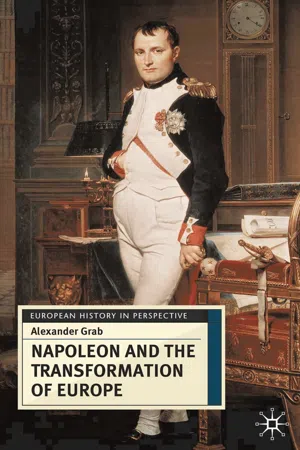
Creating a French Empire and establishing French dominance over Europe constituted Napoleon's most important and consistent aims. In this fascinating book, Alexander Grab explores Napoleon's European policies, as well as the response of the European people to his rule, and demonstrates that Napoleon was as much a part of European history as he was a part of French history.
Napoleon and the Transformation of Europe:
- Examines the formation of Napoleon's Empire, the Emporer's impact throughout Europe, and how the Continent responded to his policies
- Focuses on the principal developments and events in the ten states that comprised Napoleon's Grand Empire: France itself, Belgium, Germany, the Illyrian Provinces, Italy, the Netherlands, Poland, Portugal, Spain, and Switzerland
- Analyses Napoleon's exploitation of occupied Europe
- Discusses the broad reform policies Napoleon launched in Europe, assesses their success, and argues that the French leader was a major reformer and a catalyst of modernity on a European scale
- 249 pages
- English
- ePUB (mobile friendly)
- Available on iOS & Android
eBook - ePub
Napoleon and the Transformation of Europe
About this book
Information
1

THE FORMATION OF THE NAPOLEONIC EMPIRE
France had begun expanding its boundaries before Napoleon seized power in November 1799. Revolutionary France invaded and occupied neighboring countries as early as 1792, soon after the outbreak of the First Coalition War. This war ushered in a period of more than two decades of international conflicts, the so-called Coalition Wars, between France and European alliances consisting of Britain, Austria, Prussia, Russia, and other less powerful countries. The revolutionary governments justified the occupation of foreign lands, using the theory of “natural frontiers” and declaring their intention of liberating oppressed people from tyrannical regimes. In reality, the French armies requisitioned provisions and imposed heavy war contributions on occupied regions, thereby alienating their populations. The Directory annexed Belgium and established several satellite “sister” republics: the Batavian (Dutch), the Helvetic, and four Italian states – the Cisalpine, Ligurian, Roman, and Neapolitan. The French introduced in all of them constitutions and legal and political structures based on the French system, and compelled them to pay for the upkeep of the French armies stationed on their soil.
Following his rise to power, Napoleon Bonaparte intensified French imperial expansion. He annexed Piedmont and the Rhineland to France and transformed the Cisalpine Republic into the Republic of Italy, with himself as President, and the Helvetic Republic into the Swiss Confederation, appointing himself as its “Mediator.” As Geoffrey Ellis points out, it was after his coronation as Emperor in 1804, however, that “the pattern of subjugation changed and so did the nomenclature, a sign that Napoleon’s imperial ambition was evolving from the earlier republican forms into a much larger dynastic system.”1 During the years 1805–10, Napoleon pursued his most aggressive imperial policy, launching numerous military campaigns, subjugating much of Europe, and creating his “Grand Empire.” He annexed new territories to France and established several satellite kingdoms, appointing mostly his relatives as their rulers. The Napoleonic Empire, which constituted the most remarkable French hegemony in Europe, reached the height of its territorial expansion at the end of 1810. Napoleon’s victories cannot be explained, however, solely by his ambitions and military and diplomatic talents. As Martyn Lyons points out, “They reflected the powerful energies released by the French Revolution, and they were made possible by France’s superior resources, both of manpower and agricultural wealth.”2 He inherited from the Revolution a conscription system that he improved and that was instrumental in building the Grande Armée, his principal tool for gaining control over a good part of Europe.
The territories that comprised the Napoleonic “Grand Empire” were divided into three groups: pays réunis (annexed lands), pays conquis (conquered countries), and pays alliés (allied countries).3 The first group consisted of territories that were annexed to France and were directly ruled by Napoleon. Those lands constituted the “formal French Empire.” The second category included satellite states that were entrusted to French rulers. Finally, the pays alliés constituted allied countries whose territory was expanded by Napoleon in some cases, and which continued to be governed by their native rulers. The “Grand Empire” encompassed all three groups of lands and was distinct from the smaller “formal French Empire,” which included only the annexed countries.
This chapter presents a general survey of the formation of the French Empire within the context of the international relations and the Revolutionary and Napoleonic Wars from 1792 to 1810.4 It outlines the principal military and diplomatic events and their territorial and political consequences.5
THE FIRST COALITION WAR
The Revolutionary Wars began in April 1792 when France declared war against Austria, which was soon joined by Prussia.6 The Pilnitz Declaration by Leopold II of Austria and Frederick William II of Prussia, and the presence of émigrés in neighboring countries, aroused suspicion and hostility among many revolutionaries. When the Austrian government rejected a French ultimatum to expel the émigrés from German territory, the French Legislative Assembly declared war on Austria. An initial French thrust into Belgium ended in a total fiasco and soon the Prussian army invaded France. Its commander, the Duke of Brunswick, issued the famous Manifesto, threatening to destroy Paris if the French royal couple were hurt. This helped to trigger the “Second Revolution” (10 August 1792), which established the first French Republic. In September, the French army defeated the Prussians at Valmy and forced them to retreat. Paris was thus saved and French national morale received a much-needed boost. The Revolutionary government carried the war into neighboring countries. In late October 1792, General Custine led a French army into the left bank of the Rhine. General Montesquiou invaded Savoy and Nice and added them to the Republic. The greatest victory, however, was that of General Dumouriez, who defeated the Austrians at Jemappes (6 November) and occupied Belgium. On 19 November, the Convention declared France the protector of liberated nations throughout Europe. France’s occupation of Belgium, the threat that it posed to the Netherlands and the opening of the River Scheldt for commerce alarmed Britain. Following the execution of Louis XVI, Britain, the Netherlands and Spain withdrew their ambassadors from Paris, whereupon the Convention declared war on all these states (February–March 1793). Naples and lesser Italian states also joined the coalition against France. Thus by mid-1793, France faced much of Europe.
The Revolutionary government reacted by ordering the conscription of 300,000 men, thereby provoking counter-Revolutionary revolts in the Vendée and elsewhere. Against such formidable opposition, military reverses were almost unavoidable. In March 1793, Dumouriez not only was defeated by the Austrians at Neerwinden in Belgium but defected to the enemy. The Austrians reoccupied Belgium and invaded France. In the Rhineland, the Prussians beat Custine and occupied Mainz (July). In the south, a Spanish army crossed the Pyrenees into France. Meanwhile, counter-Revolutionary rebels gained control of important cities, including Lyons, Marseilles, and Toulon. The conditions of Revolutionary France seemed desperate. The National Convention responded by issuing the famous levée en masse (August 1793), ordering a national draft and the mobilization of all the resources toward the war effort. Soon, the French began to recover. In October, General Jourdan beat the Austrians at the battle of Wattignies, weakening their hold over Belgium. In the east, Generals Hoche and Pichegru defeated the Prussians in the Palatinate while the British were driven out of Toulon in December. The decisive French victory, however, came on 26 June 1794 when Jourdan defeated the Austrians at Fleurus and forced them to evacuate Belgium. That same month, Pichegru crossed the Dutch border and in January 1795 entered Amsterdam. By May, he had completed the occupation of the Netherlands, and the Dutch Patriots had formed the Batavian “sister” Republic. In October 1795, the Convention annexed Belgium to France. Simultaneously, the French completed their occupation of the left bank of the Rhine. Prussia, whose ruler was more concerned with assuring his fair share of Polish territory in the Third Partition of that country, signed the Treaty of Basle with France (April 1795), recognizing French domination over the left bank of the Rhine in return for territorial compensation for Prussia on the right bank in Germany. Spain also signed a peace treaty with France, leaving Austria as France’s only major adversary on the Continent. The French Directory was thus able to concentrate its efforts on the German front where two large armies under Generals Jourdan and Moreau faced Archduke Charles, brother of the Austrian Emperor. The French armies sought to march along the Danube to Vienna, but a series of setbacks at the hand of Charles forced them to retreat to France.
Meanwhile, France and Austria also faced each other in northern Italy where the Directory had appointed the 26-year-old General Napoleon Bonaparte as commander of the Army of Italy (March 1796). His assignment was to create a diversion and tie up Austrian forces in order to facilitate the main French campaign in Germany. But Bonaparte upset this strategy through a series of rapid victories over the Austrians, which transformed the Italian front into the principal one. In April 1796, he led his poorly equipped army into Italy and within days had defeated the Austro-Piedmontese armies at Montenotte, Millesimo, Dego, and Mondovi. To save his capital, Turin, King Victor Amadeus III signed the Truce of Cherasco. Bonaparte then crossed the River Po into Lombardy, which belonged to the Habsburg Empire. In May 1796, Bonaparte defeated the Austrians at Lodi and entered Milan. After establishing a new administration in Milan and imposing war contributions on the Lombard population, Bonaparte marched eastward, taking Peschiera, Legnano, and Verona, which belonged to the Venetian Republic, and then turned south. To save their states from French invasion, the rulers of the Neapolitan Kingdom, Modena, and Parma signed armistice agreements with Bonaparte. French forces then invaded the Papal State and occupied the Legations of Bologna and Ferrara. To prevent Napoleon from marching on Rome, Pope Pius VI signed the Treaty of Tolentino, where he surrendered his claim to the Legations and agreed to pay the French 21 million francs (February 1797). Another French division occupied Livorno in Tuscany, the main port of British trade in the Italian peninsula.
In July 1796, Bonaparte began besieging Mantua, the main Austrian quadrilateral fortress. For the next seven months Mantua was the focus of hostilities between France and Austria. The Austrians sent several armies in an effort to free Mantua, but Bonaparte defeated each of them (Battles of Lonato, Castiglione, Bassano, Arcole, and Rivoli). On 2 February 1797, the Austrian general Würmser finally surrendered Mantua. Bonaparte next ordered his army to advance toward Vienna. In April, after his unstoppable march had reached Leoben, 100 miles from Vienna, Archduke Charles requested a truce.
Formal peace negotiations with Austria dragged on for several months, during which time Bonaparte consolidated French power in northern Italy. In May, French troops entered Venice and set up a new pro-French republic. Bonaparte then established the Cisalpine Republic, merging Lombardy, the Papal Legations, Modena, and other regions. At the same time, Genoa and its surroundings were transformed into the pro-French Ligurian Republic. Finally, on 17 October 1797, Bonaparte and Count Ludwig von Cobenzl signed the Treaty of Campo Formio, officially ending the War of the First Coalition. Austria recognized France’s possession of Belgium and the left bank of the Rhine, as well as the existence of the Batavian and Cisalpine Republics. The Ionian Islands, which had belonged to Venice but were then occupied by France, remained under French rule. As compensation for its losses, Austria received Venice and the Dalmatian coast. Austria also agreed to support the convening of a congress at Rastatt (Baden) to negotiate peace between France and the Holy Roman Empire. In a secret article, the Emperor agreed to use his influence at Rastatt to gain the approval of the other German states for the cession of the left bank of the Rhine to France. Campo Formio signified a major victory for France and a severe blow for Austria.7 It ratified the emergence of France as the new hegemonic power in Italy, a reality that would last until the collapse of the Napoleonic Empire in 1814. It also confirmed the territorial gains that France had made in Germany and its leading role in the future reorganization of that country. Finally, it gave France a foothold in the eastern Mediterranean by granting it the Ionian Islands. Austria lost its dominant position in Italy and was about to lose it in Germany. By inflicting a humiliating defeat on Austria, Campo Formio made that country an irreconcilable enemy of France, prepared to fight France again at almost any moment to regain its position.
The Italian campaign constituted a personal victory for Bonaparte, making him extremely popular in France and launching his Continental reputation. More than just a military commander, he demonstrated his skills and ambitions as a politician and a diplomat when he created the Cisalpine Republic and negotiated treaties with various Italian rulers and the Austrians.
THE SECOND COALITION WAR
The continental peace established at Campo Formio did not last very long. A mere 14 months later, a second anti-French coalition consisting of Britain, Austria, Russia, the Ottoman Empire, Portugal, and Naples was formed and war broke out again before the end of 1798. Britain had never made peace and its leaders remained convinced that they would have to renew the war on the Continent to defeat France. The other states joined the new anti-French alliance because of continued French aggression, most notably its increasing domination over the Italian Peninsula, its intervention in Switzerland, and Bonaparte’s Egyptian expedition.
In the Peninsula, the Directory used the killing of General Duphot in a riot in Rome as a pretext to invade the Papal State. In February 1798, General Louis Berthier entered Rome and proclaimed the Roman Republic, where he held supreme power, and deported Pope Pius VI. In December 1798, the French occupied Piedmont, forcing its monarch Charles Emmanuel IV to leave for Sardinia. As for Switzerland, its strategic importance for France only increased after Bonaparte conquered northern Italy, since it controlled the passage between Germany and Italy. The Directory also hoped to seize the treasuries of several rich cantons. In early 1798, a French army under General Brune invaded Switzerland and occupied Berne, confiscating its treasury, which was used to finance Bonaparte’s expedition to Egypt. In April, the French annexed Geneva, a center of smuggled English goods, and gave full support to the proclamation of the pro-French Helvetic Republic. French troops remained in Switzerland to protect the new republic, requiring the Swiss to pay for their upkeep. European powers were alarmed by the expansion of French power through the creation of satellite “sister republics,” which they saw as a violation of Campo Formio.
Bonaparte’s expedition to Egypt further convinced European powers of the French Republic’s insatiable territorial appetite. Following his return from Italy, Bonaparte proposed to lead an expedition to Egypt, aiming to hurt English commercial interests in the eastern Mediterranean and cut the route to India. In May 1798 he sailed from Toulon with 200 ships, 35,000 troops, and 170 scholars to explore Egypt, which belonged to the Ottoman Empire. In July, Bonaparte defeated the Mamelukes, who ruled Egypt, in the battle of the Pyramids and occupied Cairo. Shortly thereafter, however, British Admiral Horatio Nelson destroyed almost the entire French fleet at the Battle of Aboukir, causing Bonaparte to be stranded in Egypt. Bonaparte ruled over Egypt for about a year but failed to achieve any of his original plans, and in August 1799 sailed back to France, abandoning the remains of his army. Particularly provoked by this expedition were the Ottoman Empire and Russia, which had its own imperial ambitions in the eastern Mediterranean. The Russian Tsar Paul I, who became the protector of the Knights of St John of Jerusalem, the masters of Malta, was further aggravated by Napoleon’s occupation of that island on his way to Egypt (June 1798).
Italy, Switzerland, and Germany were the main theaters of fighting during the Second Coalition War. The first shots were fired in southern Italy when the Neapolitan army occupied Rome (November 1798). Soon, however, the French drove the Neapolitan army out and invaded the Kingdom of Naples, forcing King Ferdinand IV to flee to Sicily and supporting the formation of the Parthenopean Republic (January 1799). French control of the Italian Peninsula was now complete, except for Venice. Before long, however, French forces and the Italian republics came under attack by coalition forces and popular insurgencies. In northern Italy an Austro-Russian army, led by the veteran Russian general Alexander Suvorov, defeated Moreau’s army at Cassano d’Adda (April 1799) and ended the Cisalpine Republic. Suvorov then restored Charles Emmanuel IV in Piedmont. French forces in Naples withdrew north to aid Moreau’s army but were defeated by Suvorov on the Trebbia River (June 1799). In July, Mantua surrendered to the Allies. Thus, Suvorov conquered northern Italy in less than three months. Widespread popular anti-French revolts, provoked by looting and heavy impositions by the French armies and encouraged by Allies’ victories, erupted in Piedmont, Tuscany, and Umbria. A counter-Revolutionary revolt swept through southern Italy and brought to an end the Neapolitan Republic (June 1799). With the collapse of the Roman Republic in September, the French lost all their Italian “sister republics,” except for the Ligurian.
Simultaneously, the French also suffered setbacks in Germany. In March 1799, General Jourdan was defeated by Archduke Charles at Ostrach and Stockach. Archduke Charles then invaded Switzerland, and after beating the French forces under Masséna outside...
Table of contents
- Cover
- Title
- Copyright
- Contents
- List of Maps
- Acknowledgments
- Introduction
- Dedication
- 1 The Formation of the Napoleonic Empire
- 2 The Janus Face of Napoleon’s Rule: Reform and Exploitation
- 3 France
- 4 The Netherlands
- 5 Belgium
- 6 Germany
- 7 Switzerland
- 8 Spain
- 9 Portugal
- 10 The Italian Peninsula
- 11 The Grand Duchy of Warsaw
- 12 The Illyrian Provinces
- 13 The Collapse of the Napoleonic Empire
- Conclusion: The Legacy of Napoleon
- Notes
- Selected Bibliography
- Index
Trusted by 375,005 students
Access to over 1.5 million titles for a fair monthly price.
Study more efficiently using our study tools.
Frequently asked questions
Yes, you can cancel anytime from the Subscription tab in your account settings on the Perlego website. Your subscription will stay active until the end of your current billing period. Learn how to cancel your subscription
No, books cannot be downloaded as external files, such as PDFs, for use outside of Perlego. However, you can download books within the Perlego app for offline reading on mobile or tablet. Learn how to download books offline
Perlego offers two plans: Essential and Complete
- Essential is ideal for learners and professionals who enjoy exploring a wide range of subjects. Access the Essential Library with 800,000+ trusted titles and best-sellers across business, personal growth, and the humanities. Includes unlimited reading time and Standard Read Aloud voice.
- Complete: Perfect for advanced learners and researchers needing full, unrestricted access. Unlock 1.5M+ books across hundreds of subjects, including academic and specialized titles. The Complete Plan also includes advanced features like Premium Read Aloud and Research Assistant.
We are an online textbook subscription service, where you can get access to an entire online library for less than the price of a single book per month. With over 1.5 million books across 990+ topics, we’ve got you covered! Learn about our mission
Look out for the read-aloud symbol on your next book to see if you can listen to it. The read-aloud tool reads text aloud for you, highlighting the text as it is being read. You can pause it, speed it up and slow it down. Learn more about Read Aloud
Yes! You can use the Perlego app on both iOS and Android devices to read anytime, anywhere — even offline. Perfect for commutes or when you’re on the go.
Please note we cannot support devices running on iOS 13 and Android 7 or earlier. Learn more about using the app
Please note we cannot support devices running on iOS 13 and Android 7 or earlier. Learn more about using the app
Yes, you can access Napoleon and the Transformation of Europe by Alexander Grab in PDF and/or ePUB format, as well as other popular books in History & European History. We have over 1.5 million books available in our catalogue for you to explore.