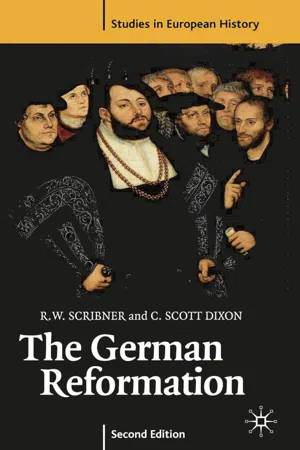
Over the past twenty years, new approaches to the history of the Reformation of the Church have radically altered our understanding of that event within its broadest social and cultural context. In this classic study R. W. Scribner provided a synthesis of the main research, with a special emphasis on the German Reformation, and presented his own interpretation of the period.
Paying particular attention to the social history of the broader religious movements of the German Reformation, Scribner examined those elements of popular culture and belief which are now seen to have played a central role in shaping the development and outcome of the movements for reform in the sixteenth century. Scribner concluded that 'the Reformation', as it came to be known, was only one of a wide range of responses to the problem of religious reform and revival, and suggested that the movement as a whole was less successful than previously claimed.
In the second edition of this invaluable text, C. Scott Dixon's new Introduction, supplementary chapter and bibliography continue Scribner's original lines of inquiry, and provide additional commentary on developments within German Reformation scholarship over the sixteen years since its first publication.
- 136 pages
- English
- ePUB (mobile friendly)
- Available on iOS & Android
eBook - ePub
German Reformation
About this book
Trusted by 375,005 students
Access to over 1.5 million titles for a fair monthly price.
Study more efficiently using our study tools.
Information
1 Some Reformation Myths
For most of us, the Reformation is ‘Luther’s Reformation’, a massive response among the German people to a new faith proclaimed by Martin Luther and centred in Wittenberg. It is common to regard it as having begun in 1517, when Luther allegedly posted his 95 Theses on the door of the Castle Church in Wittenberg. Despite much scholarly debate, it remains uncertain whether the theses were ever posted; the real significance of the alleged incident resides in the fact that much later in the sixteenth century a myth was created that this was how ‘the Reformation’ began. This myth is typical of a number of myths about the Reformation. It involves a teleological view of history, an arrangement from hindsight of the course of events into an inevitable pattern, in which no other outcome is envisaged than ‘the Reformation’ as later ages understood it.
This point was made as long ago as 1965 by the church historian Bernd Moeller, who criticised excessive concentration on Luther and his theology, without proper regard for historical context. ‘To caricature the common description, Luther generally appears as a great sage, a kind of spiritual colossus, who attains his Reformation breakthrough, draws the broad consequences, and then drags people with him as he strides through history handing out his truths right and left’ (14: 13). Thus, as soon as Luther’s ideas are promulgated, ‘the Reformation’ is in existence. It is then only a matter of people being ‘won over to’ or ‘adhering to’ this fully formed phenomenon. Historians then speak of ‘popular support for the Reformation’, without reflecting that ‘the Reformation’ did not yet exist, that it was a long drawn-out process of complex historical interrelations. Other reformers are then assessed against Luther as a standard, as though they should have become (in Moeller’s phrase) ‘little Luthers’. Where they failed to measure up, they were denigrated or dismissed as insignificant.
Many historians have heeded Moeller’s call to situate the Reformation more fully in its ‘vital context’, but the recent celebrations of the quincentenary of Luther’s birth showed that just as many have ignored it. The view that the Reformation was the work of Luther alone, and that he was one of the heroes of history is still strong. This kind of mythological view of history has recently been joined by another, more secular interpretation. This seeks to find in the Reformation the beginnings of ‘modernisation’. Influenced by Max Weber’s idea that the Reformation introduces an ethical-rational approach to religion which had affinities with the ‘spirit of capitalism’, several historians perceive in the religious reform of the sixteenth century the conceptual basis, and sometimes even some practical antecedents, of the industrial societies that grew up from the mid-eighteenth century (see 12 for further discussion). This ‘modernisation’ view is a revived form of the whig interpretation of history, which sees history as part of an inevitable onward march of ‘progress’. It shares much with the older church historical view of Luther, which sees him as ‘the first modern man’ and the forerunner of ‘modern’ freedoms.
How can we escape from this kind of myth-making about the Reformation? One important way is to set aside any kind of teleological perspective, to refuse to read history backwards with the view that the outcome of the religious upheavals of the sixteenth century was inevitable, or that what was successful was somehow better than that which failed. Here we face great difficulty, for the very words we use about the Reformation are the bearers of the myth, especially the term ‘Reformation’. Luther never used it to refer to the events in which he was involved, and contemporary usage of the word was quite different from that of historians now. The term ‘Reformation’ to describe a historical period and a phase in church history did not appear until the seventeenth century, when it was used in polemical debates about whether Luther or Calvin had done more for the ‘restoration of the church’. At the end of the seventeenth century, Veit Ludwig von Seckendorf used it in a history of Lutheranism, but in a very narrow way which ignored other varieties of reformed belief. He meant by it Luther’s criticism of the church, Luther’s activities and Luther’s creation of a new church. He therefore set the period of ‘the Reformation’ as coterminous with Luther’s lifespan (1483–1546). In the eighteenth century, ‘the Reformation’ was given its mythological beginning in 1517, but assigned the political end-date of 1555, the year of the Peace of Augsburg. This settlement recognised only Lutheranism and Catholicism as approved religions within the Holy Roman Empire, but ignored other variants of ‘evangelical Christianity’ (15). ‘The Reformation’ thus became largely identical with Lutheranism, and the usage was finally enshrined by Leopold von Ranke in the 1830s, in a half-idealist, nationalist interpretation which has been normative down to our own day.
Other words have also been pressed into the service of this mythology: Lutheran, Calvinist, Protestant – all of which had different overtones in the sixteenth century. ‘Lutheran’ was first used as a term of abuse intended to smear Luther and his supporters as founders of a new sect. Luther never used it of his followers, and the term they most commonly used of themselves was at first ‘Martinists’, but then increasingly ‘evangelical Christians’. The term ‘Calvinist’ was similarly a term of abuse first used between 1548 and 1553; those so labelled preferred to call themselves ‘evangelical reformed Christians’. Only much later were these words adopted to describe the institutionalised forms of religion we now associate with them (15).
The term ‘Protestant’ had an equally limited frame of reference. It was originally a political term, referring to those estates of the Holy Roman Empire who objected in 1529 to the abrogation of the 1526 Recess of Speyer. This Recess was an ambiguous statement used by many secular authorities to legitimise religious innovation within their territories. When the political and constitutional protest of 1529 was given a doctrinal basis in 1530 by the Confession of Augsburg, it represented neither the full range of those who dissented from orthodox Catholicism, nor was it the result of any popular consensus. The Confession of Augsburg was something of a politico-religious centaur, a theological statement worked out under diplomatic and political pressure to meet the demands of a political situation. It was a statement from which many ‘evangelical Christians’ dissented, and was to cause continuing dissension within their ranks. Whatever it was, ‘the Reformation’ was far broader and more complex than ‘Protestantism’ based on the Confession of Augsburg.
This is no idle quibble about mere words, since words with such specialised meanings are often the shorthand expression of ideology and myth. The notion that ‘the Reformation’ and ‘Protestantism’ sprang fully formed from the head of Luther was an important part of the self-legitimation of confessional churches in the nineteenth and twentieth centuries. To break away from such ideology, it is necessary to situate the religious events of the sixteenth century carefully in their historical context. Let us look at the sixteenth-century understanding of ‘reformation’. The Latin word reformatio had three uses at that time. It meant a new legal code or set of statutes, as in the ‘Reformation of the Imperial City of Nuremberg’ of 1484. It also meant the restructuring of a university study curriculum (the sense in which Luther most commonly used it). Its third usage was religious, meaning internal reform of the church, a usage current throughout the fifteenth century, and best rendered in English by the word ‘reform’.
The contemporary usage of reformatio was laden with overtones of popular belief. It would occur through a decisive intervention of God in human history, bringing about a ‘great change’ in the state of the world. This ‘great change’ had utopian and apocalyptic features, for it would inaugurate either a new age of the world, an ‘age of the Spirit’, or even perhaps the Last Days themselves, as foretold in the Book of Revelation. It would be announced by a reformator, a holy man or prophet sent by God as the instrument of this change. Luther’s central role in the movements of religious reform that arose after 1520 can be traced in great part to the fact that he was identified with this figure. He was not seen just as a man with a remarkable new theology founded on his understanding of St Paul’s notion of ‘justification’. Onto him were also projected very traditional ideas about the expected reformator, the holy man, the prophet, the saint sent by God. This understanding of Luther’s ‘mission’ became a constituent part of Lutheran interpretations of the reform movements until at least the eighteenth century. Luther was a saint and a prophet, sent by God to ‘reveal the Word’ to his own age (23, 34, 35, 35a).
Luther’s contemporaries did not, however, see the whole process of ‘reform’ as dependent on him alone. Many other persons were singled out as sharing in this work: Erasmus, Karlstadt, Ulrich von Hutten, Zwingli, Melanchthon, Eberlin von Günzburg, to name only some of the more prominent. Nor was Wittenberg the only centre of renewal: alongside it contemporaries cited Zwickau, Erfurt, Strasbourg, Nuremberg and Zurich. The beginnings of religious reform were polycentric and many-stranded. Confessional historiography has vastly distorted the full complexity of the ‘age of reform’, as it should more correctly be called (4). The ideological label ‘the Reformation’ has become too embedded as a description of a historical period for us to be able to dispense with it completely, but at least we can begin to mean by it a complex, extended historical process, going well beyond the endeav-ours of one man or one tendency, and involving social, political and wider religious issues.
2 Religion and Reform
Historians have always believed that an understanding of the religious dimensions of the Reformation could be found in the ‘state of religion’ of the age preceding it. Exactly what that ‘state of religion’ was, however, has been a matter of controversy, with at least four different analyses of its nature.
(1) There was a profound religious malaise in the century before the Reformation (22). This view seems to be confirmed by a broad range of fifteenth-century literature criticising religious abuses and failings, as well as by the criticisms of the sixteenth-century reformers. There is also evidence of low levels of church attendance, infrequent practice of the Sacraments and poor knowledge of the faith (20, 27).
(2) There was a strong sense of devotion to the church and a powerful revival of piety for at least two generations before the Reformation (25). In support of this thesis one can point to the growth of interest in mysticism and asceticism, to movements of lay piety such as the Devotio moderna, to the popularity of lay confraternities, to an increase in mass endowments, to a steady stream of devotional literature produced by the new art of printing, to new religious cults such as that of St Anne or the Rosary, and to a considerable revival of preaching.
(3) The problem was not too little religion, but too much (30). The demands of religious observance had become a spiritual burden, creating anxiety where religious comfort was sought. This was certainly the view held by Luther, who spoke of his own repeated attempts to find consolation in the confessional, only to find that its rigours further ensnared his conscience, instead of easing it.
We should be cautious about accepting any of these three assessments as adequate versions of the real state of religion before the Reformation. Those based on the testimony of sixteenth-century reformers are especially suspect, since they could hardly be expected to portray in a favourable light a religious system they had so vehemently rejected. Sometimes historians have concentrated too much on formal standards of religious practice, for example, mass attendance or religious endowments, without asking how they might be related to the role of religion in everyday life. Sometimes they have examined only small segments of society, without asking how representative these were of the population as a whole. Lay confraternities, for example, were common enough in towns, but the vast mass of the rural population seem rarely to have participated in them to the same degree. The Devotio moderna involved only a tiny number of people; it was certainly influential with some intellectuals and churchmen, but it was far from representative of pre-Reformation religion. Nor were Luther’s spiritual struggles typical of the everyday religious experience of ordinary layfolk, who had little cause to find the confessional burdensome, since most attended only once a year in fulfilment of their Easter duty. Luther’s difficulties were more typical of a monastic piety based on spiritual athleticism, something which few layfolk either experienced or aspired to.
(4) ‘Christian Europe’ of the middle ages was hardly christian at all (20). There was not just a low level of practice of Christianity, but a poor understanding of the fundamentals of Christian belief. All that had been achieved among the masses was to lay a thin veneer of Christianity over essentially pagan belief and practice, especially belief in a magical world of animism, spirits and demonic forces. The Reformation was part of a long-term attempt to ‘christianise’ the masses, which began in the fifteenth century, and continued in what became the Reformation and Counter-Reformation. This at least broadens the enquiry beyond the study of small segments of the society, and asks questions about religion as believed and practised by the broadest mass of the population. Although much of the work associated with this approach has been conducted for France rather than Germany, there does seem to be something to be said for it, as we shall see later. However, there is also good evidence that ‘christianisation’ was more deep-rooted than it concedes. This can be seen in the extent to which the Bible permeated all levels of European culture, as well as the importance of Christian liturgy for popular life of the time (33, 136).
All four of these approaches rest on a number of implicit value judgments about what constitutes ‘good’ and ‘bad’ religion, against which the quality of pre-Reformation religious life is then assessed. In what has remained a very influential book, Johan Huizinga wrote in 1924 of late-medieval religion as having a decayed sensibility which reduced the religious to a matter of sense impressions, over-heated emotions and a shallowly visual perception of the sacred (22). Many recent historians follow the same path with a critique of what they regard as the ‘inadequate’ religion of the later middle ages. They contrast ‘external’ religion to ‘true inward piety’, ‘oversimplified’ and ‘vulgarised’ religion to ‘tranquil spirituality’. In this tone, much of pre-Reformation religion is labelled as ‘superstitious’, implying that it was inferior and unacceptable (4, 27, 30). Such views merely accept the value judgments of sixteenth-century religious reformers, that theirs was a ‘superior’ form of religion, while what they attempted to reform was erroneous, indeed diabolically perverse.
How might we gain a better understanding of pre-Reformation religion? First, we should cease viewing it through the eyes of the reformers, and describe it in its own right. We could, for example, treat it as a ‘religious culture’ with different ‘modes of religious experience’, without making too many value judgments about the quality of that experience. We could then seek to pinpoint how it may have been changed or modified by the attempts at religious reform in the sixteenth century. Excellent examples of this approach can be found in recent work by Natalie Davis (5), Euan Cameron (131) and William A. Christian (18–19). Let us sketch out briefly some salient features identified through this approach.
The most fundamental belief was that the natural world was dependent on sacred power for its sustenance and well-being. Christianity asserted that God was the only supernatural being who sustained creation, but people of that age accepted the activity of numerous other beings who could wield supernatural power – the Devil, spirits both angelic and demonic, and numerous ‘holy’ persons who were believed to possess s...
Table of contents
- Cover
- Title Page
- Copyright
- Contents
- Editor’s Preface
- Introduction
- Introduction to the Second Edition
- A Note on References
- 1. Some Reformation Myths
- 2. Religion and Reform
- 3. The Reformation as an Evangelical Movement
- 4. Social Location of the Reformation
- 5. Politics and the Reformation
- 6. Varieties of Reformation
- 7. The Impact of Reform
- 8. Supplementary Chapter
- Select Bibliography
- Supplementary Bibliography
- Index
Frequently asked questions
Yes, you can cancel anytime from the Subscription tab in your account settings on the Perlego website. Your subscription will stay active until the end of your current billing period. Learn how to cancel your subscription
No, books cannot be downloaded as external files, such as PDFs, for use outside of Perlego. However, you can download books within the Perlego app for offline reading on mobile or tablet. Learn how to download books offline
Perlego offers two plans: Essential and Complete
- Essential is ideal for learners and professionals who enjoy exploring a wide range of subjects. Access the Essential Library with 800,000+ trusted titles and best-sellers across business, personal growth, and the humanities. Includes unlimited reading time and Standard Read Aloud voice.
- Complete: Perfect for advanced learners and researchers needing full, unrestricted access. Unlock 1.5M+ books across hundreds of subjects, including academic and specialized titles. The Complete Plan also includes advanced features like Premium Read Aloud and Research Assistant.
We are an online textbook subscription service, where you can get access to an entire online library for less than the price of a single book per month. With over 1.5 million books across 990+ topics, we’ve got you covered! Learn about our mission
Look out for the read-aloud symbol on your next book to see if you can listen to it. The read-aloud tool reads text aloud for you, highlighting the text as it is being read. You can pause it, speed it up and slow it down. Learn more about Read Aloud
Yes! You can use the Perlego app on both iOS and Android devices to read anytime, anywhere — even offline. Perfect for commutes or when you’re on the go.
Please note we cannot support devices running on iOS 13 and Android 7 or earlier. Learn more about using the app
Please note we cannot support devices running on iOS 13 and Android 7 or earlier. Learn more about using the app
Yes, you can access German Reformation by R. W. Scribner in PDF and/or ePUB format, as well as other popular books in History & European History. We have over 1.5 million books available in our catalogue for you to explore.