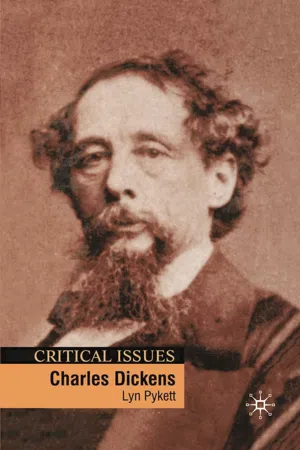
To many of his contemporaries, Charles Dickens was the greatest writer of his age; a one-man fiction industry who produced fourteen massive novels, and numerous sketches, essays and stories, many of which appeared in the two magazines which he founded and edited. Today the work of one of the first and most successful mass-circulation authors continues to enthrall readers around the world.
This wide-ranging book examines the writings of Dickens, not only in his time but also in ours. It looks at the author as a Victorian 'man of letters', and explores his cultural and critical impact both on the definition of the novel in the nineteenth century and the subsequent development of the form in the twentieth. Lyn Pykett focuses on Dickens as journalist, literary entrepreneur, the conductor of magazines, the shaper of the serial novel, the manipulator of the multiple plot, and the creator of eccentric characters. She also assesses the modernity of the writer's alienated protagonists and their social environments, as well as reassessing his representations of the vivid, bleak and at times menacing spectacle of the metropolis, from the late modern/postmodern perspective of the twenty first century.
Each chapter of this text analyses the work of a particular decade in Dickens's career, providing a lively contextual study which places his writings in relation to the worlds that made him, and the literary worlds which he made. It is essential reading for all those with an interest in one of the most popular, and enduring, British novelists of all time.
- 207 pages
- English
- ePUB (mobile friendly)
- Available on iOS & Android
eBook - ePub
Charles Dickens
About this book
Information
1
Introduction: the Dickens Phenomenon and the Dickens Industry
IEverybody’s writer
No words can express the secret agony of my soul as I … felt my early hopes of growing up to be a learned and distinguished man crushed in my breast. The deep remembrance … of the misery it was to my young heart to believe that, day by day, what I had learned and thought, and delighted in, and raised my fancy and emulation up by, was passing away from me … cannot be written.
(Charles Dickens, on his experience of being put to work in
Warren’s Blacking Factory at the age of twelve, in
‘Autobiographical Fragment’, Life, I: 22)
Warren’s Blacking Factory at the age of twelve, in
‘Autobiographical Fragment’, Life, I: 22)
[Dickens’s] graphic and eloquent pages have issued to the world more political and social truths than have been uttered by all the professional politicians, publicists, and moralists put together.
(Karl Marx to Friedrich Engels, quoted in Peter Demetz, Marx,
Engels and the Poets (Chicago: University of Chicago Press,
1967), p. 45
Engels and the Poets (Chicago: University of Chicago Press,
1967), p. 45
The compulsively repeated writing out of an inexpressible private trauma, or a sustained, ‘graphic and eloquent’ engagement with the social, political and moral realities of his day? These are just two of the myriad ways of reading the formidable literary production of Charles Dickens. To many of his contemporaries Dickens was ‘emphatically the novelist of his age’, in whose novels ‘posterity will read, more clearly than in any contemporary records, the character of our nineteenth century life’.1 At the same time he was also ‘the great magician of our time’, whose ‘wand is a book’.2 By the early twentieth century, Virginia Woolf, who sought in her own modernist experimentation to escape from what she saw as the yoke of the form of the novel created by Dickens and his contemporaries, could take Dickens for granted, as ‘everybody’s writer and no one’s in particular’, an ‘institution, a monument, a public thoroughfare trodden dusty by a million feet’.3 Woolf’s contemporary, John Middleton Murry, on the other hand, found Dickens a challengingly ‘baffling figure’, whose ‘chief purpose in writing’ sometimes appears to be ‘to put a spoke in the wheel of our literary aesthetics’, but one whose work has a ‘curious trick of immortality’ despite the fact that it cannot be contained within accepted canons of value.4 One of Dickens’s most recent re-readers has delighted in the challenge that this author’s work poses to our turn-of-the-twenty-first-century aesthetics, and to the ways in which we usually subdivide the cultural field, and understand the human subject and fictional character, and even the processes of history.5
The twenty-first-century critic writing about the nineteenth-century novelist Charles Dickens must inevitably engage with that complex historical phenomenon, the Dickens industry. Dickens, who was quick to exploit the possibilities for the work of literary art in an age of mechanical reproduction, was himself a one-man fiction industry, whose organization of his professional life and whose writings exemplify both a Victorian commitment to ‘self-sufficiency through work’,6 and the anxieties of modern authorship. From the early 1830s until his death in 1870, he produced fourteen massive novels (plus one unfinished at his death), together with numerous sketches, essays, and stories, many of which appeared in the two magazines that he founded and edited – or, as he put it, ‘conducted’. He collaborated with several illustrators, one of whom (Robert Seymour) had the original idea for the ‘sporting sketches’ which developed into the Pickwick Papers, and another (George Cruikshank) who claimed to have had the original idea for Oliver Twist. At the beginning of his career he wrote plays, working closely with actors and musicians such as John Pritt Harley and John Hullah. Later on he contributed to the plays of friends such as Mark Lemon, and to the adaptations of novels for the stage (both his own and those of friends). From around 1856 onwards Dickens also collaborated closely with Wilkie Collins in the production of stories and articles, including the annual Christmas stories. This industrious literary production has in its turn generated an international critical industry whose organization and output, in some cases at least, would no doubt have amused and exasperated the man who thought up the Circumlocution Office. This book will address both branches of the Dickens industry. It will look at Charles Dickens as a (perhaps the) nineteenth-century man of letters, whose work played a central role in the shaping of the English-language novel and a modern fiction industry, in the construction of the figure of the modern author, and even in the making of the modern subject. It will also focus on ‘Charles Dickens’ as a cultural and critical site: a site not only for the formation and definition of the novel in the nineteenth century, but also for twentieth-century theorizations (and contestations) of the novel.
The novels of Charles Dickens, and the Dickens phenomenon more generally, were landmarks of literature in English and of English (even British) culture in the nineteenth century. As Peter Ackroyd writes, in his monumental biography of Dickens, ‘no novelist, no writer had ever achieved such national acclaim’. Patronized by some contemporaries as ‘a little Shakespeare – a Cockney Shakespeare’,7 Dickens has, nevertheless, come to occupy a place in English cultural history as Shakespeare’s equal. Dickens was ‘the Shakespeare of the novel’,8 the people’s Shakespeare, as it were. As his friend and literary collaborator Wilkie Collins put it, Dickens was ‘eminently the people’s author’;9 an author, moreover, whose work was read by ‘[p]eople who never read any other novels’.10
From the point at which he launched himself fully into the profession of letters in 1836 with the publication of The Posthumous Papers of the Pickwick Club and the two series of Sketches by Boz (two collections of his fugitive pieces for the Morning Chronicle, the Evening Chronicle and other journals), Dickens has always been read by – or his work has been mediated in some form to – a very large and diverse audience. His fiction was issued in a wide range of formats: monthly parts (usually in distinctive green paper covers, priced at a shilling each); weekly instalments in magazines; in hard covers in three-volume, and later in the cheaper one-volume form. In Dickens’s lifetime, his novels were often adapted for the cheap press and for the stage, in both cases with scant regard for issues of copyright. Further stage adaptations (including musical versions of Oliver Twist and Nicholas Nickleby) followed in the twentieth century, along with numerous adaptations (including animated cartoon versions) for the cinema and for television. At the same time Dickens’s novels have been incorporated into school and college syllabi throughout the English-speaking world, sometimes in the service of conceptions of education that might have offered a bitterly ironic amusement to the creator of Charley Hexam, Bradley Headstone and Mr M’Choakumchild.
As one of the first, and certainly one of the most successful, mass-circulation authors, Dickens’s central position in British and Anglophone culture derives in large part from his continuing appeal to the general or ‘common’ reader.11 At the same time, Dickens’s cultural centrality has ensured that professional critics and academic institutions have not been able to ignore his work, although some English Departments in British universities succeeded in avoiding the issue by failing to include him on their syllabi until after the Second World War.12 From the 1830s onwards both individual critics and the institutions of criticism have had to find some way of accounting for Dickens’s fiction – if only to dismiss it, or deplore or deny its importance. Indeed, a study of the critical reception of Dickens’s work could also serve as a case study of the main trends in novel criticism and the study of narrative in the last 170 years. A survey of that massive enterprise known as the Dickens industry would serve – among other things – as a survey of the main trends in academic literary studies in the twentieth century, as well as providing an interesting and sometimes amusing guide to the fluctuations of literary taste.
Although, during the last century and a half, there has been considerable variation in the methodological approaches of Dickens criticism and the language or discourse in which it is mediated, several of the critical issues relating to Dickens’s work which have been explored by the highly professionalized disciplines of literary and cultural studies in the twentieth century were first raised in reviews and assessments of his work as it was coming out, and as Dickens was establishing his central position in fiction publishing. These issues include: the aesthetic status of the novel in general and Dickens’s novels in particular; Dickens’s relationship to high art and to the forms of popular culture; the aesthetics and ideology of Dickens’s narrative forms; the complex multiple plot; characterization and caricature; the issue of verisimilitude or ‘truth to life’ of Dickens’s fictions; the significance and shape of Dickens’s career and the relative status of his novels; topicality versus typicality (or, as some nineteenth-century critics might have put it, ‘universality’); the politics of Dickens’s fiction; Dickens’s relationship to modernity; the gender of Dickens’s writing and its representation of gendered subjects; Dickens’s class position and his representation of the various social classes. Several of these issues were addressed in a perspicacious (if not entirely sympathetic) early assessment of his work by Margaret Oliphant:
It is to the fact of class that he owes his speedy elevation to the top of the wave of popular favour. He is a man of very liberal sentiments, an assailer of constituted wrongs and authorities – one of the advocates in the plea of Poor versus Rich. … But he is a class writer, the historian and representative of one circle in the many ranks of our social scale. Despite their descents into the lowest class, and their occasional flights into the less familiar ground of fashion, it is the air and the breath of middle class respectability which fills the books of Mr Dickens. … Home bred and sensitive, much impressed by feminine influences, swayed by the motives, the regards and the laws which were absolute to their childhood, Mr Dickens’s heroes are all young for a necessity. Their courage is of the order of courage which belongs to women.13
For much of the nineteenth century and at least the first half of the twentieth, critical debate about Dickens and the aesthetic evaluation of his work focused on the question of whether his novels were lacking in artistry, perhaps even excluded from the domain of Art, by their proximity to ‘low’ journalistic or popular-culture forms, or whether they were, on the other hand, a vigorous and original contribution to the art of the novel. For every critic who found Dickens’s novels to be energized by the vitality of popular culture, imaginative, linguistically dextrous, resourceful, truthful, passionate, moving, dramatic, and capacious, there was another who found them lacking in unity, defective in organization and control, distorted by the demands of serial publication, full of caricatures, mechanical, formulaic, vulgar, lacking in verisimilitude, sentimental and melodramatic. Moreover, from the 1850s to the present day, commentators on Dickens’s fiction have often divided into two camps: those who think that Dickens’s work is marred or distorted by its topicality and its concern with the social and moral issues of the day, and those who think that these concerns lie at the very heart of Dickens’s achievement. Similarly, there has also been a division between those who think that his talents for fiction, which had produced a series of early comic masterpieces, went into terminal decline on the completion of David Copperfield (1850), and others who regard Dickens’s early fictions as mere apprentice pieces for the major works of social and psychological analysis which began with Dombey and Son (1846–8). The politics of Dickens’s fiction has also divided critics, between those who have seen it as radical or (at least) reforming, and those who have found it nostalgically conservative, suffused in a Pickwickian spirit of old coaching inns and a sentimental Christmas Carol philosophy.
IIDickens in the nineteenth century: some contemporary critical issues
Dickens has proved his power by a popularity almost unexampled, embracing all classes. Surely it is a task for criticism to exhibit the sources of that power.
George Henry Lewes, ‘Dickens in Relation to Criticism’,
Fortnightly Review, February 1872
Fortnightly Review, February 1872
In attempting to ‘exhibit’ or account for the sources of Dickens’s power, ‘Criticism’ has often praised his work with faint versions of the damns used by those who sought to deny or dismiss that power. George Henry Lewes, a well-known nineteenth-century commentator on the state of the art of the novel, is a case in point. In his essay on Dickens’s relationship to criticism of the novel, published some twenty months after the novelist’s death, Lewes managed to convert into weaknesses or faults those very qualities which other readers have seen as Dickens’s strengths. In his assessment of the nature and extent of Dickens’s achievement, Lewes celebrated ‘the glorious energy’ of the novelist’s imagination, but described its vividness as having a quality ‘approaching closely to hallucination’ (Ford, 59), a faculty which he associates with abnormal or insane people. The sanity of Dickens and his writings was also called into question by Hippolyte Taine, who suggested that Dickens’s genius was a form of madness, and that his portraits of ‘eccentricities’ were symptomatic of the repetitive, obsessive behaviour of a mono-maniac.14 Margaret Oliphant also suggested that Dickens’s characters were the product of an overweening and disordered mind when she compared Dickens to the archetypal mad scientist of the early nineteenth century: ‘If it were possible to quicken these curious originals into life, what an odd crowd of ragamuffins and monsters would that be which should pursue this Frankenstein through the world.’15
One of the main problems that Dickens’s fiction presented to nineteenth-century criticism was its failure to conform to the conceptions of aesthetic realism (and particularly fictional realism) which gained ascendancy during his career. One of the clearest formulations of the mismatch between Dickens’s fictional practice and nineteenth-century realist theory was provided by George Eliot, whose own novel Middlemarch (1871–2) later came to be widely regarded as the ...
Table of contents
- Cover
- Title Page
- Copyright
- Contents
- Acknowledgements
- A Note on Editions
- 1. Introduction: the Dickens Phenomenon and the Dickens Industry
- 2. The Making of the Novelist and the Shaping of the Novel, 1835–41
- 3. Travails in Hyper-Reality, 1842–8
- 4. Mid-Victorian Self-Fashionings, 1846–50
- 5. The Novelist as Journalist in Hard Times, 1850–7
- 6. These Times of Ours, 1858–70
- Notes
- Index
Trusted by 375,005 students
Access to over 1.5 million titles for a fair monthly price.
Study more efficiently using our study tools.
Frequently asked questions
Yes, you can cancel anytime from the Subscription tab in your account settings on the Perlego website. Your subscription will stay active until the end of your current billing period. Learn how to cancel your subscription
No, books cannot be downloaded as external files, such as PDFs, for use outside of Perlego. However, you can download books within the Perlego app for offline reading on mobile or tablet. Learn how to download books offline
Perlego offers two plans: Essential and Complete
- Essential is ideal for learners and professionals who enjoy exploring a wide range of subjects. Access the Essential Library with 800,000+ trusted titles and best-sellers across business, personal growth, and the humanities. Includes unlimited reading time and Standard Read Aloud voice.
- Complete: Perfect for advanced learners and researchers needing full, unrestricted access. Unlock 1.5M+ books across hundreds of subjects, including academic and specialized titles. The Complete Plan also includes advanced features like Premium Read Aloud and Research Assistant.
We are an online textbook subscription service, where you can get access to an entire online library for less than the price of a single book per month. With over 1.5 million books across 990+ topics, we’ve got you covered! Learn about our mission
Look out for the read-aloud symbol on your next book to see if you can listen to it. The read-aloud tool reads text aloud for you, highlighting the text as it is being read. You can pause it, speed it up and slow it down. Learn more about Read Aloud
Yes! You can use the Perlego app on both iOS and Android devices to read anytime, anywhere — even offline. Perfect for commutes or when you’re on the go.
Please note we cannot support devices running on iOS 13 and Android 7 or earlier. Learn more about using the app
Please note we cannot support devices running on iOS 13 and Android 7 or earlier. Learn more about using the app
Yes, you can access Charles Dickens by Lyn Pykett in PDF and/or ePUB format, as well as other popular books in Literature & Modern Literary Criticism. We have over 1.5 million books available in our catalogue for you to explore.