- 136 pages
- English
- ePUB (mobile friendly)
- Available on iOS & Android
eBook - ePub
About this book
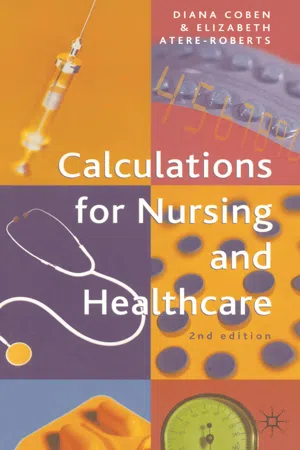
Maths can be an unnecessary source of anxiety for both students and professionals involved in nursing and healthcare. Now the new edition of Coben & Atere-Roberts' classic text tackles this issue head-on, providing valuable support and advice for those who need it. Building on the success of its predecessor, the second edition provides practical help in a user-friendly format, offering refreshers on maths and anchoring suggested strategies to real-life situations. There are new sections on nurse prescribing, care of older patients and the organization of healthcare work - all designed to reflect the changing responsibilities within the nursing and healthcare fields. The result is an indispensable guidebook that leaves nurses and other health professionals free to concentrate on caring for patients safely and effectively.
Information
Part one
Learning and you

This chapter aims to help you to get to know yourself better as a learner in order to tackle the maths you need for healthcare.
Start by reflecting on your past and present experiences with maths. One way to do this is by writing your ‘maths life history’ (see Coben & Thumpston, 1996, for a report on research into adults’ maths life histories).
Take some time to think about the following questions in relation to your past and present experiences with maths in any aspect of your life. Note down your thoughts as you go and use your notes as the basis for writing your own maths life history.
Your maths life history
- How would you describe your feelings about mathematics? In what circumstances do these feelings arise?
- Describe one thing that you enjoy and one thing that you hate that involve maths.
- Thinking back over your past life, what events involving maths stand out in your memory?
- How would you describe your school experiences of maths?
- In what circumstances do you work out something mathematical . . .
- in your head?
- on paper?
- with a calculator?
- another way . . . how?
- When and how do you calculate accurately . . .
- using whole numbers ?
- using fractions, including decimal fractions?
- When and how do you estimate rather than calculate accurately?
- Describe situations in which you measure each of the following: length; weight; capacity.
- What activities do you engage in which involve an appreciation of, or the manipulation of, shape and spatial relationships?
- What effect do you think your experience of maths has had on your opportunities in life?
When you have written your maths life history, put it aside in a safe place; we’ll ask you to look back on it later. You don’t need to show it to anyone else unless you want to.
Writing your maths life history is designed to get you thinking about the maths in your life in ways you may not have done before. It’s a first step towards developing learning strategies and study skills that will stand you in good stead as you progress through this book.
Keeping a maths diary
The next step is to start a ‘maths diary’ in which to record:
- notes on maths as it arises in a healthcare context
- your thoughts and feelings about the maths that you encounter
- any points of information about maths
- any study tips that you want to remember.
Your maths diary may take any form; most people use either an exercise book or a ring binder, but some prefer a ‘proper’ diary with the dates already printed. You’ll need to allow at least a page a day and to allocate time to writing it up – choose a time that suits you and the pattern of your days.
Keeping a maths diary will make you more aware of the maths in your life: you’ll find you notice things that you might previously have missed and you’ll become more aware of yourself as a learner in an aspect of your life which you might previously have ignored.
You will find references to your maths diary throughout this book. As with your maths life history, you don’t need to show it to anyone else unless you want to.
Talking to colleagues
This may not sound like a learning strategy but it can be very effective. Find a colleague or fellow-student who shares some of your own feelings about maths (preferably someone who has also written his or her maths life history) and talk to each other about the maths in your lives. Ask them to be your ‘learning partner’ and agree to help each other, working through this book together.
It’s important to agree ground rules so that you know what you can expect of each other. Here are some ideas:
- Share strategies for working out maths problems – remember there’s nearly always more than one way of doing a mathematical operation and the ‘right’ way is the way that works – it’s also a good idea to double-check your answer using a different method.
- Talk through your feelings about maths – if something doesn’t feel right to you, even if you know it gives the correct answer, talk it over with your partner and you may find that a different way of looking at the problem helps you to see it more clearly.
- Talk over the situations you come across that involve maths, especially those which involve doing maths under pressure, and share strategies for remaining calm and doing the maths.
Getting to know your number-crunching skills
In this section you are going to look at how you tackle a range of calculations, for example:
- What kinds of number-crunching strategies do you use?
- What do you do when things go wrong?
Calculations vary in terms of how difficult they are and different people prefer different ways of tackling them. For all methods you have to do some thinking first, but when you start doing the number-crunching you have a choice: you can do the calculations on paper or in your head, or you can use a calculator. Whichever method you choose, it’s a good idea to use a different method to check your result.

Task 1 Which number-crunching method do you prefer?
Spend about 20 minutes doing this exercise with your learning partner.
The aim of the exercise is for you to observe which number-crunching method you’re inclined to use in different situations.
You don’t have to do the actual calculations at this stage; just observe your reactions and which method you’re inclined to favour. Sometimes you may need to start the problem so that you can decide which number-crunching method you’d prefer to use; but don’t try to finish them.
Read each problem, and record on Table 1 which number-crunching method (with a calculator, in your head, or on paper) you prefer to use. Use the third column in the table to write down your reaction to the problem, for example:
- easy
- made me panic
- this kind of problem always gives me trouble.
Spend about five minutes on this. Then discuss your observations with your learning partner.
Table 1 Which number-crunching method do you prefer?
Problem | Your method | Comments |
1 A 1.8m-tall man weighed 100kg on admission to hospital. He was put on a special diet and is losing weight at a rate of 3kg each week. How long will it take him to reach a target weight in the range 58–83kg? | ||
2 A baby’s birth weight is 4kg. She loses and then regains 10% of her birth weight in her first two weeks of life. How low does her weight go during the first two weeks? | ||
3 A drug dose of 62.5mg is available as 25mg in 1ml.What is the dose in millilitres? | ||
4 Convert 0.075mg to micrograms. |
Task 2 Analysing errors
In this section we ask you to complete some calculations and to think about possible sources of error.
Look back at the problems in Task 1, and this time do the calculations. Then fill in the “how confident . . .” column in Table 2. Check your answers with ours (at the back of the book) and record in the third column whether you got them right or wrong.
Table 2 Analysing errors
How confident I feel | Whether I was right or wrong |
1 | |
2 | |
3 | |
4 |
If you were confident about all of them, and you got them all right, try this exercise with another set of calculations drawn from elsewhere in the book.
If you were not very confident, or if you got some wrong, what do you think might have gone wrong?
You might have:
- misread the numbers in the question
- made an arithmetic slip, e.g., 3.0 + 4.5 = 7
- used the wrong formula
- used the right formula but put in the wrong numbers
- multiplied or divided the wrong numbers.
In your maths diary, note down the kinds of error you made.
Task 3 How do you react to any errors?
Now think about y...
Table of contents
- Cover
- Title Page
- Copyright
- Contents
- List of tables and charts
- Foreword to the first edition
- Foreword to the second edition
- Preface to the second edition
- Note to the reader and acknowledgements
- Introduction
- Part one: Learning and you
- Part two: Calculations in the nursing and healthcare context
- Part three: Maths refreshers
- Answers
- Bibliography
- Index
Trusted by 375,005 students
Access to over 1.5 million titles for a fair monthly price.
Study more efficiently using our study tools.
Frequently asked questions
Yes, you can cancel anytime from the Subscription tab in your account settings on the Perlego website. Your subscription will stay active until the end of your current billing period. Learn how to cancel your subscription
No, books cannot be downloaded as external files, such as PDFs, for use outside of Perlego. However, you can download books within the Perlego app for offline reading on mobile or tablet. Learn how to download books offline
Perlego offers two plans: Essential and Complete
- Essential is ideal for learners and professionals who enjoy exploring a wide range of subjects. Access the Essential Library with 800,000+ trusted titles and best-sellers across business, personal growth, and the humanities. Includes unlimited reading time and Standard Read Aloud voice.
- Complete: Perfect for advanced learners and researchers needing full, unrestricted access. Unlock 1.5M+ books across hundreds of subjects, including academic and specialized titles. The Complete Plan also includes advanced features like Premium Read Aloud and Research Assistant.
We are an online textbook subscription service, where you can get access to an entire online library for less than the price of a single book per month. With over 1.5 million books across 990+ topics, we’ve got you covered! Learn about our mission
Look out for the read-aloud symbol on your next book to see if you can listen to it. The read-aloud tool reads text aloud for you, highlighting the text as it is being read. You can pause it, speed it up and slow it down. Learn more about Read Aloud
Yes! You can use the Perlego app on both iOS and Android devices to read anytime, anywhere — even offline. Perfect for commutes or when you’re on the go.
Please note we cannot support devices running on iOS 13 and Android 7 or earlier. Learn more about using the app
Please note we cannot support devices running on iOS 13 and Android 7 or earlier. Learn more about using the app
Yes, you can access Calculations for Nursing and Healthcare by Diana Coben,Elizabeth Atere-Roberts in PDF and/or ePUB format, as well as other popular books in Médecine & Soins infirmiers. We have over 1.5 million books available in our catalogue for you to explore.