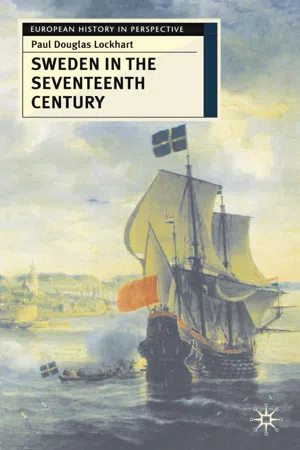
The history of Sweden in the seventeenth century is perhaps one of the most remarkable political success stories of early modern Europe. Little more than a century after achieving independence from Denmark, Sweden - an impoverished and sparsely-populated state - had defeated all of its most fearsome enemies and was ranked amongst the great powers of Europe.
In this book, which incorporates the latest research on the subject, Paul Douglas Lockhart:
- Surveys the political, diplomatic, economic, social and cultural history of the country, from the beginnings of its career as an empire to its decline at the end of the seventeenth century
- Examines the mechanisms that helped Sweden to achieve the status of a great power, and the reasons for its eventual downfall
- Emphasises the interplay between social structure, constitutional development, and military necessity
Clear and well-written, Lockhart's text is essential reading for all those with an interest in the fascinating history of early modern Sweden.
- 178 pages
- English
- ePUB (mobile friendly)
- Available on iOS & Android
eBook - ePub
Sweden in the Seventeenth Century
About this book
Information
Chapter 1:The Sixteenth-Century Inheritance
In 1523, Sweden was a newly autonomous kingdom, poor and devoid of a bureaucratic structure; existing only in the shadow of its more powerful neighbors, its future status as an independent state seemed very unlikely. A century and a quarter later, Sweden was the predominant power in the Baltic and a guarantor of the Peace of Westphalia alongside its ally France. To be sure, it could be argued that the application of the label ‘great power’ to seventeenth-century Sweden is of questionable validity. Certainly Sweden never dominated European politics in the manner of Philip II’s Spain. Yet for nearly three decades it came very close. Its actions in the last half of the Thirty Years’ War, and for twelve years after the war’s close, determined the fate of other nations, and its diplomatic and military reach extended some distance beyond the horizons of its Baltic environs. Any academic distinction between what constitutes a ‘major power’ and what makes a major power ‘great’ is necessarily subjective, but given the weight of Sweden’s international influence between 1632 and 1660 it seems fair to rank Sweden among the great powers of Europe.
That status, however, would not last for long. Within thirty years of Westphalia, Sweden’s career as a major power would decline visibly; in another forty, its empire disintegrated. Sweden’s precipitous rise to, and fall from, great power status in the seventeenth century was an astonishing development to contemporary statesmen, and remains so to more recent scholars. During its brief career as a European state of the first rank – a period that Swedish historians have labeled the stormaktstid, or ‘great power era’ – Sweden would never achieve the heights of literary, artistic, scholarly, or commercial sophistication of states like England, France, Spain, or the Netherlands. But it excelled at something absolutely necessary for success in seventeenth-century Europe: the ability to make war for prolonged periods with limited resources. Indeed, this was the entire raison d’être of the Swedish state. Far more so than in any other European state of the early modern period, all of the institutions of Swedish life were geared towards building up and sustaining Sweden’s military capacity. Sweden was the archetype of what Otto Hintze and later historians would call the ‘military’ or ‘power state’.
From all appearances, Sweden was ill-equipped to be a ‘great power’ at the dawn of the seventeenth century. Compared with the other territorial states along the Baltic rim – Denmark, Poland, and Russia – Sweden was poor, primitive, and dangerously underpopulated. Moreover, Sweden was Europe’s newest monarchy, and as such had been compelled to create ex nihilo its own bureaucratic and administrative machinery. Sweden’s very existence as an autonomous state threatened the territorial interests of its Baltic neighbors, and hence from its beginnings as an independent polity Sweden had powerful enemies. To the larger kingdoms of western Europe, Sweden was as yet a distant non-entity beyond the periphery of mainstream European political intercourse, but within the Baltic region the first two centuries of Sweden’s independent statehood were – at least as seen from Stockholm – nothing short of a struggle for survival.
These two factors – the search for both economic and political security in a hostile environment – shaped the rise of this most unlikely great power of the seventeenth century. Whether its belligerence stemmed from a quest for steady revenues, or from a desire to break free from perceived territorial encirclement, the Vasa state was either at war or preparing for war during the period 1563–1721. More than anything else, war conditioned both the nature and extent of Swedish expansion, and in no other European state was political and social development so closely linked to military institutions and policies. Five different monarchs would rule Sweden during its so-called stormaktstid (‘great power period’ or ‘age of greatness’): four of them actively sought the expansion of Sweden’s Baltic empire through conquest; all of them became involved in large-scale wars on the Continent.
Resources, Demographics, and the Structure of Society
Sixteenth-century Sweden was poor. Like all of the major Baltic states of the early modern period, it comprised a significant expanse of territory, including most of contemporary Sweden and Finland. Nonetheless, its size could be deceiving, for the realm was sparsely populated. The aggregate population of the Vasa territories in 1560 was about 1 million, perhaps growing to 1.25 million by 1620. In comparison with more densely populated states, like England (ca. 4 million inhabitants in 1600) or France (ca. 20 million), this was insignificant. Sweden was roughly equal to Denmark in population, but had no more than one-sixth the population of Poland–Lithuania and perhaps one-tenth of Russia’s population. Most Swedes dwelt within the southern and south-central portions of Sweden and Finland while the northern extremes of the kingdom, on either side of the Arctic Circle, were a deserted wasteland. Even much of central Sweden was heavily forested, uncultivated, and barely inhabited. Throughout this vast expanse of land, there were no towns worthy of mention except the administrative capital at Stockholm. And even Stockholm, with around 6000 inhabitants, would hardly merit a comparison with the major commercial centers of England, France, the Netherlands, or the Hanseatic League.1
Nor were there, prior to the last quarter of the sixteenth century, significant natural resources that had been exploited to any degree. Sweden did possess significant deposits of iron and copper ore, concentrated in southern Dalarna, northeastern Västmanland and southern Närke. Already in the sixteenth century, trade in these metals was lucrative. The early Vasa kings encouraged modernization, and imported foreign entrepreneurs, experts, and capital to help develop the industry; by the early seventeenth century, Sweden was the leading exporter of these metals to northern Europe. In 1637, copper and iron would constitute nearly 63 percent of total national exports, and in 1685 the aggregate would be over 80 percent.2 The vast forests of Finland and central Sweden were also a significant commercial asset, for they provided charcoal and coveted naval stores – primarily mast timbers and pine pitch – that helped make the Baltic trade so attractive to the maritime states of northern Europe. But Sweden’s commercial potential was hampered by its geopolitical position. Through its possession of the three provinces at the southernmost tip of the Scandinavian peninsula – Blekinge, Halland, and Skåne, collectively called the Scanian provinces – Denmark dominated the Sound, the major navigable passageway between the North and the Baltic Seas. Only a single port, that of Älvsborg, gave Sweden direct access to the North Sea, and Älvsborg would remain Sweden’s sole window on the world outside the Baltic. Sweden was especially poor in agricultural production. Poland, northeastern Germany, and Denmark dominated the Baltic grain trade; Sweden’s position on the northern periphery of arable Europe ensured marginal yields of cereal grains and other staple crops.3
Although Sweden did experience an economic upswing late in the sixteenth century, its share in the overall prosperity of post-Reformation Europe was comparatively trivial. Before Sweden’s entrance onto the European stage in 1630, those few foreigners who traveled there described the Vasa state in terms that were hardly glowing. There were no magnificent noble country houses that could compare to those which dominated the French and English landscapes, nor even to the spartan manor houses of the Danish aristocracy. The Swedish nobility, on the contrary, lived but meanly, though its poverty should not be exaggerated, since it was due as much to cultural distance and parochialism as to economic hardship. Still, the lifestyle of the Swedish nobility was bereft of splendor or ostentatious display. Throughout the sixteenth century, the nobility was quite small; it accounted for 0.5 percent of the total population, similar in proportion to the Danish nobility but tiny in comparison to the nobilities of continental Europe. Altogether, the noble estate numbered around 400 adult males in 1600, and collectively owned 16 percent of all farmsteads in the kingdom, and about 50 percent in Finland. It was hardly a homogeneous estate. A small aristocracy of eleven to fifteen elite families possessed around 60 percent of seignorial land; many of these aristocrats held title to several hundred peasant farms. By contrast, the remainder of the nobility enjoyed much more modest wealth. Some 40 percent of all noble landowners did not own more than one or two peasant farms. All noblemen were exempt from ordinary taxation, in return for their obligation to provide heavy cavalry (rusttjänst, or ‘knight service’) to the crown. The Swedish noble estate was remarkably open. The early Vasa kings granted noble status to deserving commoners only infrequently, but it was not unheard-of for members of the lesser or middling nobility to intermarry with prosperous commoners.4
The lack of towns meant that there was as yet no significant mercantile class. The few merchant families that did live in Sweden in 1600 were concentrated in Stockholm and in lesser trade centers, like Söderköping and Kalmar, where they acted as middlemen to Hanseatic and Dutch merchants.5 The vast majority of the population was, as elsewhere in Europe, rural, but in political status and in the distribution of land the Swedish peasantry was unusual. Serfdom as such did not exist in sixteenth-century Sweden; all male peasants, regardless of the nature of their tenancies, were considered freemen. Most peasants were free-holders, called ‘tax peasants’ (skattebönder), who collectively owned nearly 63 percent of the more than 100,000 farmsteads (gårdar) accounted for in 1560. Peasants residing on noble land (frälsebönder) worked another 16 percent of these farmsteads, and the remaining farms (21 percent) were owned by the crown. Frälsebönder had the advantage of partial exemption from ordinary taxes, but on the whole paid higher rents than those residing on crown lands (kronobönder). Economic conditions varied greatly from region to region. Peasants living near forests or in mining districts had considerable opportunities to supplement their incomes. In Närke, a center of iron production and weapons manufacturing near Örebro, peasants who accepted government contracts for weapons were exempt from taxes and conscription, and not infrequently accumulated enough wealth to send their sons to university.6 The ‘average’ Swedish peasant, however, was not so well-off, especially in the last decades of the sixteenth century. Annual mean temperatures and crop yields declined in tandem between 1570 and 1650. There were rare ‘good’ harvests – perhaps one in every eight – but more often there were periods of crushing want, like the great famines of 1570 and 1597. In a way, however, the abject poverty of the ordinary Swedish peasant constituted an advantage. Inured to hardship, the Swedish peasant was unusually tough. In the words of Georg Friedrich von Waldeck, ‘The Swedes are a hungry people, and hence they are dangerous and hard-hearted.’7
The Creation of the Vasa State
Sweden had been a kingdom for some time when the Vasa dynasty took control of the state in 1523, but at the dawn of the early modern period it had been under foreign domination for well over a century. The Kalmar Union of 1397 brought together the Nordic lands – Denmark, Sweden-Finland, and Norway with its fiefdom of Iceland – under a single elective monarchy. It was not a union of equals; Denmark, the most highly developed and centralized of the three kingdoms, dominated the Kalmar Union, though Norway and Sweden maintained some rights of election. Separatist tendencies and a kind of proto-nationalism in Norway and Sweden further compromised the effectiveness of the Union. While it would not be accurate to claim that the population of fifteenth- and sixteenth-century Sweden subscribed to the same species of national consciousness as did their descendants in the nineteenth and twentieth centuries, nonetheless there existed a pervasive feeling that their land was not a mere part of Denmark. The Danish kings, by relying primarily on Danish administrators to rule Sweden, exacerbated this sense of separation. The collective Swedish reaction to foreign rule was the occasional election of popular anti-kings and a sporadic series of uprisings, such as that led by Engelbrekt Engelbrektsson in the 1430s. By the early sixteenth century, noble and popular discontent with Denmark centered around the humbly born Sture family from the rough and fiercely independent province of Dalarna. The brutal centralizing policies of Denmark’s King Christian II (1513–23), which culminated in the summary execution of 82 leading Swedish noblemen in the ‘Stockholm Bloodbath’ of November 1520, broke the leadership of the Sture clan and nearly neutralized the resistance of the nobility as a whole. Leadership of the opposition after the Bloodbath devolved by default to a young nobleman from Dalarna: Gustav Eriksson Vasa.8
Gustav Vasa was a natural leader. He was tied to the Sture clan by blood and marriage; his earlier imprisonment at Kalø Castle in Denmark, in addition to the gruesome fate suffered by several of his family members in the Bloodbath, gave him a personal animus against the Danes. He also possessed considerable skills as an orator and a demagogue. Within a year he had supplanted the Stures. In 1521, the remnants of the native aristocracy hailed him as ‘Protector of the Realm’ (riksföreståndare), a title traditionally held by the Stures. Military assistance from the Hanseatic city of Lübeck enabled Gustav Vasa and his rebel forces to take Stockholm in 1523. Shortly thereafter, on 6 June 1523, a convocation of the Estates at Strängnäs elected Gustav Vasa as king of Sweden.
In part, sheer luck allowed Gustav Vasa to succeed where other would-be Swedish kings had failed. Denmark was in no condition to respond; early in 1523, the Danish nobility had deposed Christian II, and the newly elected King Frederik I (1523–33) evinced little interest in keeping the Union together by force. Gustav’s success in establishing a viable monarchy within Sweden, however, was due primarily to his political acumen. His position as king did not go unchallenged within Sweden. Before 1523, Gustav Vasa had posed as the successor to the Stures, capitalizing on traditional resistance to central authority. Now, however, Gustav Vasa was that central authority, and there were those among his subjects who perceived the king as having betrayed the Sture legacy, especially since the financial burdens of revolt required heavy and regular taxation. Gustav faced the prospect of violent opposition to his rule: no fewer than three peasant uprisings in Dalarna between 1524 and 1531, the formidable revolt led by the Småland peasant Niels Dacke in 1542–43, and a noble insurrection in Västergötland in 1529. Still, Gustav Vasa triumphed. He enjoyed the support of most of the nobility, burghers, and peasants, and managed to suppress – brutally – all of the insurrections of his reign. Employing his skills as a populist and an orator, Gustav made frequent use of the national Diet to carry out royal policies. As a result, the period between 1527 and the king’s death in 1560 witnessed remarkable growth in the efficacy and reach of the central authority. Already harboring Lutheran sympathies, in 1527 the king convinced the Diet at Västerås to agree to royal seizure of church properties and revenues. The king generously remanded much of the property gained at Västerås to the care of his nobility, but the monarchy profitted dramatically: the proportion of farms in Sweden and Finland owned by the crown grew from 3.5 percent to 21.3 percent.
The creation of a primitive but effective bureaucracy accompanied this explosive growth of crown holdings and revenues. Aided by career bureaucrats of German birth, Gustav Vasa built up both a Chancery (Kansliet) and a Treasury (Kammaren). In local administration, crown officers (fogdar) and prominent noblemen who administered royal fiefs (län) represented the interests of the crown. Noble fiefholders enjoyed extensive powers over the tenants on their fiefs, but the crown kept a watchful eye on their activities.9 The constitutional pillars of Vasa kingship, however, were to be found in the traditional organs of medieval governance: the Council (Riksråd) and the Diet.
Sweden and Denmark shared a common political tradition that Scandinavian historians have labeled ‘council-constitutionalism’, and in superficial ways the relationship between king, nobility, and commons was much the same in both monarchies. In Denmark, the Council was the primary governing institution, and through it the aristocracy was able to restrict the royal prerogative; the estates had faded into obscurity by the sixteenth century and would not reappear until the late 1620s. A similar arrangement was established in Sweden’s law code and tacit constitution, the Land Law of Magnus Eriksson (1353). The Land Law stipulated that monarchy in Sweden would be elective, that the king would have to rule by law and not by force, and that the native nobility would work with the king towards this end. From the beginning of the Vasa dynasty, however, it had become clear that the Council’s role was to adv...
Table of contents
- Cover
- Title Page
- Copyright
- Dedication
- Contents
- Map of the Swedish Empire in the Seventeenth Century
- The Vasa and Pfalz-Zweibrücken Dynasties
- Preface
- A Brief Chronology
- Chapter 1: The Sixteenth-Century Inheritance
- Chapter 2: The Reign of Gustav II Adolf
- Chapter 3: Sweden on the World Stage: The Foreign Policy of Gustav II Adolf
- Chapter 4: The Interregnum and Queen Christina, 1632–54
- Chapter 5: The Swedish ‘Power State’: Society, Culture, and the Burden of War
- Chapter 6: Proto-absolutism or ‘Military Monarchy’? The Brief Reign of Karl X Gustav, 1654–59
- Chapter 7: The Swedish Empire in Louis XIV’s Europe, 1660–79
- Chapter 8: The Swedish ‘Absolutist’ State, 1679–97
- Chapter 9: Epilogue
- Notes
- Further Reading
- Index
Trusted by 375,005 students
Access to over 1.5 million titles for a fair monthly price.
Study more efficiently using our study tools.
Frequently asked questions
Yes, you can cancel anytime from the Subscription tab in your account settings on the Perlego website. Your subscription will stay active until the end of your current billing period. Learn how to cancel your subscription
No, books cannot be downloaded as external files, such as PDFs, for use outside of Perlego. However, you can download books within the Perlego app for offline reading on mobile or tablet. Learn how to download books offline
Perlego offers two plans: Essential and Complete
- Essential is ideal for learners and professionals who enjoy exploring a wide range of subjects. Access the Essential Library with 800,000+ trusted titles and best-sellers across business, personal growth, and the humanities. Includes unlimited reading time and Standard Read Aloud voice.
- Complete: Perfect for advanced learners and researchers needing full, unrestricted access. Unlock 1.5M+ books across hundreds of subjects, including academic and specialized titles. The Complete Plan also includes advanced features like Premium Read Aloud and Research Assistant.
We are an online textbook subscription service, where you can get access to an entire online library for less than the price of a single book per month. With over 1.5 million books across 990+ topics, we’ve got you covered! Learn about our mission
Look out for the read-aloud symbol on your next book to see if you can listen to it. The read-aloud tool reads text aloud for you, highlighting the text as it is being read. You can pause it, speed it up and slow it down. Learn more about Read Aloud
Yes! You can use the Perlego app on both iOS and Android devices to read anytime, anywhere — even offline. Perfect for commutes or when you’re on the go.
Please note we cannot support devices running on iOS 13 and Android 7 or earlier. Learn more about using the app
Please note we cannot support devices running on iOS 13 and Android 7 or earlier. Learn more about using the app
Yes, you can access Sweden in the Seventeenth Century by Paul Lockhart in PDF and/or ePUB format, as well as other popular books in History & European History. We have over 1.5 million books available in our catalogue for you to explore.