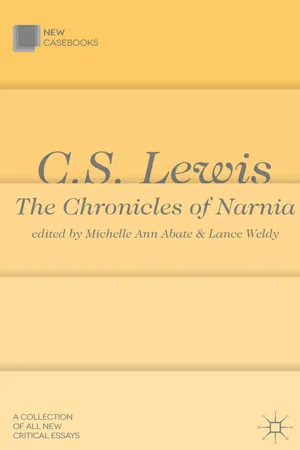
Beginning with the publication of The Lion, the Witch and the Wardrobe in 1950 and concluding with the appearance of The Last Battle in 1956, C. S. Lewis's seven-book series chronicling the adventures of a group of young people in the fictional land of Narnia has become a worldwide classic of children's literature.
This stimulating collection of original essays by critics in a wide range of disciplines explores the past place, present status, and future importance of The Chronicles of Narnia. With essays ranging in focus from textual analysis to film and new media adaptations, to implications of war/trauma and race and gender, this cutting-edge New Casebook encourages readers to think about this much-loved series in fresh and exciting ways.
- 232 pages
- English
- ePUB (mobile friendly)
- Available on iOS & Android
eBook - ePub
C.S. Lewis
About this book
Information
Part I
Text and Contexts
1
“Turkish Delights and Sardines with Tea”: Food as a Framework for Exploring Nationalism, Gender, and Religion in The Lion, the Witch and the Wardrobe
Rachel Towns
Food grabs our attention, right from the beginning of The Lion, the Witch and the Wardrobe. The very first meals in the new land of Narnia provide a contrast through which characters’ identities are constructed. Their meal choices both reveal their personalities and position them as positive or negative. Food transforms from a mere necessity of life to an integral part of the narrative, as characters’ choices about food and involvement with meals shape how they are perceived. Food is presented in such a way as to be connotative of meanings and understandings beyond its own literal reality.
Specific fare is clearly associated with particular nationalities, signposting the identity of the characters who eat that food as connected to that country. Furthermore, the preparation or offering of food brings gender into the construction of identity, as it communicates perceptions of what is acceptable or unacceptable. As characters conform to or subvert gender roles, they are correspondingly identified as good or evil. Food is also used to connect the narrative with Christianity, as the transformation of Narnian characters from human to “meal” echoes the transformation of Jesus revealing important concepts within Christianity.
British is best: British food as a signifier of good character
Jean Anthelme Brillat-Savarin once said, “Tell me what you eat and I will tell you who you are.”1 Although written in 1826, that comment rings true for The Lion, the Witch and the Wardrobe, published in 1950. Food is used as a signifier of identity, demarcating good and evil characters based on the nationality of their food. Countries share meals, ensuring that “the commonality of food is a linchpin of group identification.”2 Normally, this is a kind of “gastro-nationalism,”3 where the national identity of a country is bound up in the food choices that members of this nationality make, thus endowing the food with characteristics of that nationality. However, in Narnia, nationality becomes a food-created concept, as the attributed food nationality is used to create the “national” identity of those who eat it. This “national identity” applied through food is one which is constructed outside of Narnia and then placed upon its landscape. Thus protagonists––the good, main characters––in Narnia are always associated with eating “good” traditional British fare, while antagonists make “foreign” or “other” food choices, correspondingly constructing their characters as “other.”
The four children—Peter, Susan, Edmund, and Lucy—are all British, and therefore their connection to British food makes sense, for “loyalty to familiar food is emphasised in children’s literature,”4 thus consolidating their national identity. Any meals these children eat which have the “hallmark of English cooking,”5 such as “roast meat and vegetables, stews, pies and pasties, … steam puddings”6 or “afternoon tea,”7 only helps to construct their British identity. All the children only eat British food, with the exception of Edmund, and are identified as good characters, beginning the connection between British food and good actions.
Choice of food by the Narnian characters strengthens the connections of food, nationality, and identity, as good Narnian characters are equally constrained to meals of British construction. This appears more unusual, for one would expect a fantasy world with fantastical environments and creatures to have interesting food; however, the food is not “a feast befitting a wondrous kingdom,”8 but rather a reversion to familiar, comforting, and, above all, British food. These good characters are so anglicized by their food choices that they are more British than Narnian. Indeed Mr. and Mrs. Beaver are almost more British than the children, living in a “literally Northernised” environment of “a log cabin with snow shoes, rocking chair, stove, sewing machine and fishing tackle.”9 Even their environment does not escape the connection to food, for on their ceiling is British fare of “hams and strings of onions.”10
British food can even assuage concerns about characters, for when the children first meet Mr. Beaver, they are concerned by questions of “are we to go to it?” based on their fears of following “a guide we know nothing about.”11 It is only when he suggests going to his house for “a real talk and also dinner” that none of them “felt any difficulty about trusting the Beaver now …”12 This potentially dangerous situation of going to a strange location with a stranger is defused by the powerful goodness associated with British food.
In this new world the four children are unable to recognize signs to indicate the internal nature of characters. They even originally fear that some of their strongest allies might really be enemies.13 In their own world they are able to identify dangerous people, based on their experience. In this world, it is characters like Mr. Beaver who are able to identify characters as “good” or “evil” based on their appearance. It is he who identifies Edmund’s connection to the White Witch because “[h]e had the look of one who has been with the Witch.”14 The children, unused to this world, are unable to see the evil in their brother. However, even Mr. Beaver uses food as a guide, for his recognition of Edmund’s nature stems from him having “eaten his food.”15 This food not only changes Edmund’s internal nature, but also begins to alter his external appearance, so that his body shows his internal corruption. Without experience in Narnia, the children are forced to rely on the ingestion of good stolid healthy food as a signifier of goodness in others. It is a powerful signpost to characters’ natures as it helps them to identify allies in the Beavers and even has transformative powers.
Evil impulses can even be overcome by the power of British food. The first meal eaten in Narnia was an afternoon tea for Lucy Pevensie, hosted by Mr. Tumnus the faun. From Lucy’s first meeting with him, there is a contradiction between his external appearance as a foreign and otherworldly faun and his very British umbrella. He is identified as “a very strange person,” whose appearance ranges from the normal, wearing a “red woolen muffler,” to the abnormal: “his legs were shaped like a goat.”16 These features posit him as foreign and threatening. As he invites her into his house, he epitomizes the fears of “don’t trust a stranger.” However, this is contrasted with the food used to entice her; it is not stereotypical lollies, but rather food of more British construction. When he first invites her for “tea,” she protests that she needs to return home, until he mentions the specific food of “toast––and sardines––and a cake,” which allays Lucy’s fears as she appears to regard those food choices as safe.17 The meal itself is an afternoon tea, the quintessential English meal.18 It was a “wonderful tea” full of good hearty food, from a “nice brown egg … [to] sardines on toast … [and even] a sugar topped cake.”19 It is all rich food, but it is also correspondingly British food, an idealization of the traditional English afternoon tea––almost utopian when compared to the restrictions of wartime Britain. The nationality of the food changes the potential paradigm of the meal as enticement of the child, Lucy, to one which transforms the adult, Mr. Tumnus.
As a faun, a strange otherworldly male creature, he engenders ideas of enticement and kidnapping. This is in fact his intended role, since he was recruited by the Witch to bring her any humans he met.20 However, the food itself is what saves Lucy, for it anglicizes Mr. Tumnus. Instead of being some kind of foreign, strange creature, he now “lives in a cave and serves tea,” embodying an Oxbridge don, dispensing knowledge and afternoon tea from his academic “cave,” rather like C. S. Lewis himself: “If a faun could be found living in an English wood his home would certainly be like this,” and also his meals.21 By taking Lucy in and feeding her, he assists in his own redemption through food. Originally, he “pretended to be your [Lucy’s] friend and asked you [Lucy] to tea,”22 but once they ate together “the items ingested sa[id] something meaningful about … themselves”23 so that their relationship changed from pretension to friendship to real friendship. After they eat together he realizes: “I can’t give you up to the Witch, not now I know you.”24 How did he know her so quickly? Above all, he learned her identity—and created his own—when they ate together. Their identities are now clearly connected to both good and Britain. This afternoon tea is so powerful a force for good that it overcomes even the fear of injury, for he risks being maimed or turned into stone if he helps Lucy. 25 The food Mr. Tumnus ingests transforms him into the stereotype of a British gentleman, who would save Lucy from her fate to the detriment of his own.
Characters that provide the good, sustaining British food are therefore connected to stereotypical British qualities and are confirmed as protagonists. The food that they consume is like them: it is plain, but honest and good. The “plain economical food”26 is glorified through the descriptive language used, connecting it to the power of good. Instead of milk, fish, and cake, it is “a jug of creamy milk … a big lump of deep yellow butter, … [and] there’s nothing to beat good freshwater fish.”27 Healthy, life-giving food with beautiful colors and smells sustains the characters and confirms the positive qualities of all who are satisfied with these meals. Edmund, although he apparently eats the British meal with the others, is not satisfied with it, because he focused on his former meal of Turkish Delight, which “spoils the taste of good ordinary food.”28 His lack of satisfaction with English-style meals is a reflection of his morally ambivalent nature at this point.
Foreign foods are not to be trusted: British nationalism and war shape foreigners as “other”
The representation of food in the novel is strongly influenced by the contemporary situation of World War II as present in the “real” world and also as it contributes to the xenophobic views that connect good and bad characters to specific food choices. As Susan Rowland suggests, one cannot divorce the war from Narnia because in many respects this story is an attempt “to contain and rewrite the terrible story of a war.”29 The Pevensie children “‘escape’ to the Professor’s House in the country”30 for safety from the Nazis in a ...
Table of contents
- Cover
- Title page
- Copyright
- Contents
- Series Editor’s Preface
- Preface
- Notes on Contributors
- Introduction
- Part I: Text and Contexts
- Part II: Applications and Implications
- Part III: Adaptations and Mediations
- Part IV: Conflicts and Controversy
- Further Reading
- Index
Trusted by 375,005 students
Access to over 1.5 million titles for a fair monthly price.
Study more efficiently using our study tools.
Frequently asked questions
Yes, you can cancel anytime from the Subscription tab in your account settings on the Perlego website. Your subscription will stay active until the end of your current billing period. Learn how to cancel your subscription
No, books cannot be downloaded as external files, such as PDFs, for use outside of Perlego. However, you can download books within the Perlego app for offline reading on mobile or tablet. Learn how to download books offline
Perlego offers two plans: Essential and Complete
- Essential is ideal for learners and professionals who enjoy exploring a wide range of subjects. Access the Essential Library with 800,000+ trusted titles and best-sellers across business, personal growth, and the humanities. Includes unlimited reading time and Standard Read Aloud voice.
- Complete: Perfect for advanced learners and researchers needing full, unrestricted access. Unlock 1.5M+ books across hundreds of subjects, including academic and specialized titles. The Complete Plan also includes advanced features like Premium Read Aloud and Research Assistant.
We are an online textbook subscription service, where you can get access to an entire online library for less than the price of a single book per month. With over 1.5 million books across 990+ topics, we’ve got you covered! Learn about our mission
Look out for the read-aloud symbol on your next book to see if you can listen to it. The read-aloud tool reads text aloud for you, highlighting the text as it is being read. You can pause it, speed it up and slow it down. Learn more about Read Aloud
Yes! You can use the Perlego app on both iOS and Android devices to read anytime, anywhere — even offline. Perfect for commutes or when you’re on the go.
Please note we cannot support devices running on iOS 13 and Android 7 or earlier. Learn more about using the app
Please note we cannot support devices running on iOS 13 and Android 7 or earlier. Learn more about using the app
Yes, you can access C.S. Lewis by Michelle Ann Abate,Lance Weldy in PDF and/or ePUB format, as well as other popular books in Literature & Literary Criticism. We have over 1.5 million books available in our catalogue for you to explore.