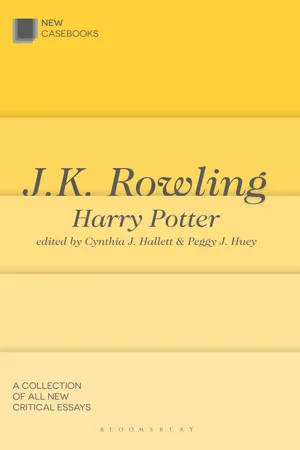
J. K. Rowling's popular series of books about the boy wizard Harry Potter has captivated readers of all ages around the world. Selling more than 400 million copies, and adapted into highly successful feature films, the stories have attracted both critical acclaim and controversy.
In this collection of brand new essays, an international team of contributors examines the complete Harry Potter series from a variety of critical angles and approaches. There are discussions on topics ranging from fairytale, race and gender, through to food, medicine, queer theory and the occult. The volume also includes coverage of the films and the afterlife of the series with the opening of Rowling's 'Pottermore' website.
Essential reading for anyone with an interest in the Harry Potter phenomenon, this exciting resource provides thoughtful new ways of exploring the issues and concepts found within Rowling's world.
- 224 pages
- English
- ePUB (mobile friendly)
- Available on iOS & Android
eBook - ePub
J. K. Rowling
About this book
Information
1
Glorious Food? The Literary and Culinary Heritage of the Harry Potter Series
Food is a central theme throughout children’s literature, as the focus of celebrations, the currency of bribes and rewards, a solitary pleasure and a social ritual. Whether the characters experience the deprivations of famine or rejoice at bounteous feasts, food occupies a site of narrative and thematic significance that should not be overlooked. Food can be a mundane necessity or a deeply sensuous experience; it is an everyday essential as well as a luxury:
[T]he subject of food and eating is full of contradictions and a major cause of social anxiety. In our culture food is, paradoxically, compulsively consumed and obsessively consuming […] Above all, food is never just something to eat: even when it is mundane and everyday it carries meaning.1
Food is an effective vehicle by which to explore the literary heritage and social commentary inherent throughout J. K. Rowling’s Harry Potter series. The starting point of this essay is a consideration of how Rowling uses themes of food and feeding to draw intertextual connections between the Harry Potter books and several canonical works of children’s literature. The Hogwarts’ diet of solid school dinners and illicit dormitory feasts represents a clear continuation of the traditions established in classic boarding-school stories, while the magical sweets available in the wizarding world are instantly evocative of the bizarre confectionary created by Roald Dahl in Charlie and the Chocolate Factory (1964).2 The second section goes on to chart the cultural and political implications of the Hogwarts cuisine, and to question how Rowling uses the theme of food—and, just as importantly, the issue of who does the cooking—to reinforce a socially conservative portrayal of the wizarding world. Notably, the importance of food in emotional terms is a significant factor in the series. Rowling repeatedly uses food as an expression of feelings, a device to strengthen the bonds that exist between family and friends, and as a means of establishing and developing the characters’ relationships, the subject of the third section below. These three perspectives on the significance of food, feeding, cooking and eating provide an intriguing insight into the Harry Potter universe, at once magical but also familiar and mundane.
Culinary connections: food and intertextual value
From the outset, Rowling has been repeatedly and insistently compared to other successful authors of children’s literature—in particular, to Enid Blyton and Roald Dahl. Critics have identified them as “The Famous Three,”3 while a recent Costa Book Awards poll revealed that “Enid Blyton and Roald Dahl have been named the nation’s best-loved writers, beating Harry Potter creator J. K. Rowling into third place and leaving literary giants such as Shakespeare, Jane Austen and Charles Dickens trailing.”4 Through outlining some of the key similarities—and the crucial differences—in how these writers approach the theme of food, this section reveals how Rowling uses intertextual allusions to negotiate with classic works of children’s literature and to establish her own place within its canon.
The basis for the comparison between Rowling and Blyton seems primarily rooted in their popularity, their accessibility, and most importantly, in their use of the boarding-school location. Blyton set over thirty books in boarding schools, including the Malory Towers and St. Clare’s series, while Rowling’s Hogwarts has become one of the most iconic schools in children’s literature. In creating Hogwarts, Rowling participates in a tradition of boarding-school stories that dates back to Thomas Hughes’s semi-autobiographical Tom Brown’s Schooldays (1857), and, as Claire Armitstead has noted, the more fantastical elements of the Harry Potter universe are firmly established upon the conventions of this tradition:
Look closer at this comic, gothic world, where pictures speak and every panel may hide a secret tunnel, and readers find a classic boarding school fantasy, complete with dodgy food, sadistic teachers, bullies, and unshakable loyalties […] fantastical on the one hand, but, on the other, quite conventionally domestic in its depiction of childhood experience.5
Food is an essential component of the boarding-school narrative, as Karen Manners Smith has noted: “food might be the most important—almost obsessive—part of boarding school life and stories.”6 This is especially true when it comes to the classic plot device of the midnight feast. In Upper Fourth at Malory Towers (1949), the girls smuggle an illicit picnic of “hard boiled eggs, cakes, sandwiches and ginger beer” into their dormitory.7 Similarly, in The Prisoner of Azkaban, when Harry’s Gryffindor housemates celebrate their victory at Quidditch, “the party went on all day and well into the night. Fred and George Weasley disappeared for a couple of hours and returned with armfuls of bottles of butterbeer, pumpkin fizz, and several bags full of Honeydukes sweets.”8 Rowling combines these direct echoes with more subtle and humorous revisions of the boarding-school story motifs. At Malory Towers, meals are preceded by a formal blessing or “grace.” At Hogwarts, this formality is usually omitted, or on special occasions, replaced by Dumbledore’s more whimsical approach: “Before we begin our banquet, I would like to say a few words. And here they are: Nitwit! Blubber! Oddment! Tweak! Thank you.”9 Rowling both upholds and subverts the generic traditions, offering a finely balanced combination of wholesome tribute to and ironic pastiche of predecessors such as Blyton. In other words, when it comes to managing the dynamic between the Harry Potter series and the traditional boarding-school story, Rowling manages to incorporate both the old and the new.
Rowling’s intertextual relationship with the work of Roald Dahl is slightly more problematic, in that she has repeatedly denied it, insisting in one interview that “[W]hile I think Dahl is a master at what he did, I do think my books are more moral than his.”10 Nevertheless, there are undeniable similarities between them, especially when thinking in terms of food—and in particular, of sweets. Both authors unleash the full extent of their imaginative powers when it comes to confectionary, conjuring up bizarre, delightful, and occasionally downright dangerous concoctions. A direct comparison is illuminating, as can be demonstrated with the following extracts from The Prisoner of Azkaban and Charlie and the Chocolate Factory:
There were shelves upon shelves of the most succulent-looking sweets imaginable […] the strange, splintery Toothflossing Stringmints, tiny black Pepper Imps (“breathe fire for your friends!”), Ice Mice (“hear your teeth chatter and squeak!”), peppermint creams shaped like toads (“hop realistically in the stomach!”), fragile sugar-spun quills, and exploding bonbons.11
EATABLE MARSHMALLOW PILLOWS […] LICKABLE WALLPAPER FOR NURSERIES […] HOT ICE CREAMS FOR COLD DAYS […] COWS THAT GIVE CHOCOLATE MILK […] FIZZY LIFTING SWEETS […] SQUARE SWEETS THAT LOOK ROUND.12
These creative flourishes constitute a direct, sensory appeal to the young reader, and present a tantalizing vision of their fictional worlds. However, the similarities between Dahl and Rowling are not always so beguiling—despite the sweetness of their imaginative confections, both authors have the clear potential to turn “nasty.”
In Dahl, this is quite blatant. Throughout Charlie and the Chocolate Factory, the ‘bad” children are punished in a variety of gruesome ways, while “good” and meek Charlie survives to inherit the earth (or at least the factory). Rowling is a little more disingenuous, but she nevertheless uses food as a means to punish “bad” characters in the Harry Potter series. In The Chamber of Secrets, Hermione sedates Crabbe and Goyle with drugged cakes, knowing that they are greedy and stupid enough to fall straight into her trap: “Grinning stupidly, they stuffed the cakes whole into their large mouths. For a moment, both of them chewed greedily, looks of triumph on their faces. Then, without the smallest change of expression, they both keeled over backward onto the floor.”13 Dudley Dursley suffers an even more unpleasant fate when he helps himself to one of Fred and George’s enchanted toffees in The Goblet of Fire: “[H]e was gagging and spluttering on a foot-long, purple, slimy thing that was protruding from his mouth. One bewildered second later, Harry realised that the foot-long thing was Dudley’s tongue.”14 These incidents may not fit well with Rowling’s claim to occupy the moral high ground, but they are undeniably vivid and amusing. The intertextual importance of food in the Harry Potter series, therefore, operates on several levels. Primarily, it establishes Rowling as a worthy successor within the realm of children’s literature, drawing connections between her work and that of such canonical figures as Blyton and Dahl. Rowling’s occasionally subversive approach is refreshing, and lends a new imaginative energy to generic conventions. Perhaps most unexpectedly, food provides Rowling with an outlet for a darker, more physical sense of humor, which adds a welcome twist of the grotesque to the Harry Potter universe.
Cultural codes: food and social value
Throughout the Harry Potter series, Rowling presents the wizarding world as a complex and multi-faceted society, with its own particular codes and traditions. The presentation of food is a crucial component in this process, as a means of reinforcing some of the differences between magical and non-magical communities. However, while some of these differences are immediately evident—the contrast between magical and non-magical confectionary being the most obvious example—the majority of the actual food consumed is perfectly recognizable. As Jann Lacoss notes: “Wizard food, with the exception of children’s treats, does not differ considerably from its Muggle counterpart.”15 Rather than create a completely fantastic cuisine, Rowling chooses to signify culinary difference though more subtle and insidious means.
Primarily, the difference is reinforced through superiority. The food available in the wizarding world is consistently tastier and more plentiful than that on offer in the wider world of Muggles. Partly, this reflects Harry’s treatment by the Dursleys, and serves to contrast their neglect with the generous way in which Harry is welcomed back into the magical community. In The Philosopher’s Stone, Uncle Vernon grudgingly allows Harry a “cheap lemon ice lolly,”16 whereas in The Prisoner of Azkaban he receives “free sundaes every half an hour”17 from Florean Fortescue’s ice-cream parlor. With the notable exception of the ghostly banquet in The Chamber of Secrets, Harry never attends a bad meal at Hogwarts, and dinners in the great hall are normally characterized by a plentiful supply of his favorite dishes: “He had never seen so many things he liked to eat on one table: roast beef, roast chicken, pork chops and lamb chops, sausages, bacon and steak, boiled potatoes, roast potatoes, chips, Yorkshire pudding, peas, carrots, gravy, ketchup.”18 Rowling descr...
Table of contents
- Cover
- Title
- Copyright
- Contents
- Publication
- Series Editor’s Preface
- Notes on Contributors
- List of Abbreviations
- Introduction
- 1 Glorious Food? The Literary and Culinary Heritage of the Harry Potter Series
- 2 A Fairy-tale Crew? J. K. Rowling’s Characters under Scrutiny
- 3 The Way of the Wizarding World: Harry Potter and the Magical Bildungsroman
- 4 Bewitching, Abject, Uncanny: Other Spaces in the Harry Potter Films
- 5 Free Will and Determinism: A “Compatibilist” Reading of J. K. Rowling’s Harry Potter Series
- 6 Dumbledore’s Ethos of Love in Harry Potter
- 7 Harry Potter and the Origins of the Occult
- 8 Wizard’s Justice and Elf Liberation: Politics and Political Activism in Harry Potter
- 9 What it Means to Be a Half-Blood: Integrity versus Fragmentation in Biracial Identity
- 10 Magic, Medicine, and Harry Potter
- 11 Harry Potter and the Myriad Mothers: The Maternal Figure as Lioness, Witch, and Wardrobe
- 12 “I Knew a Girl Once, whose Hair…”: Dumbledore and the Closet
- 13 “Neither Can Live while the Other Survives”: Harry Potter and the Extratextual (After)life of J. K. Rowling
- Further Reading
- Index
Trusted by 375,005 students
Access to over 1.5 million titles for a fair monthly price.
Study more efficiently using our study tools.
Frequently asked questions
Yes, you can cancel anytime from the Subscription tab in your account settings on the Perlego website. Your subscription will stay active until the end of your current billing period. Learn how to cancel your subscription
No, books cannot be downloaded as external files, such as PDFs, for use outside of Perlego. However, you can download books within the Perlego app for offline reading on mobile or tablet. Learn how to download books offline
Perlego offers two plans: Essential and Complete
- Essential is ideal for learners and professionals who enjoy exploring a wide range of subjects. Access the Essential Library with 800,000+ trusted titles and best-sellers across business, personal growth, and the humanities. Includes unlimited reading time and Standard Read Aloud voice.
- Complete: Perfect for advanced learners and researchers needing full, unrestricted access. Unlock 1.5M+ books across hundreds of subjects, including academic and specialized titles. The Complete Plan also includes advanced features like Premium Read Aloud and Research Assistant.
We are an online textbook subscription service, where you can get access to an entire online library for less than the price of a single book per month. With over 1.5 million books across 990+ topics, we’ve got you covered! Learn about our mission
Look out for the read-aloud symbol on your next book to see if you can listen to it. The read-aloud tool reads text aloud for you, highlighting the text as it is being read. You can pause it, speed it up and slow it down. Learn more about Read Aloud
Yes! You can use the Perlego app on both iOS and Android devices to read anytime, anywhere — even offline. Perfect for commutes or when you’re on the go.
Please note we cannot support devices running on iOS 13 and Android 7 or earlier. Learn more about using the app
Please note we cannot support devices running on iOS 13 and Android 7 or earlier. Learn more about using the app
Yes, you can access J. K. Rowling by Cynthia Hallett,Peggy Huey in PDF and/or ePUB format, as well as other popular books in Literature & Literary Criticism. We have over 1.5 million books available in our catalogue for you to explore.