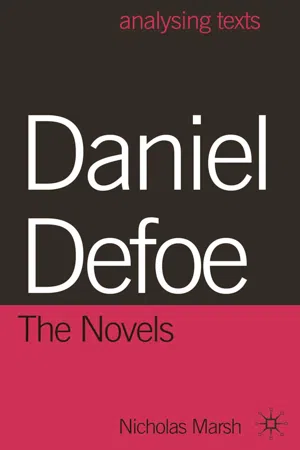
Daniel Defoe's writings have bred controversy since their first appearance in the eighteenth century: 'Robinson Crusoe' fuels virulent disagreements among critics, while Defoe's two scandalous women, 'Moll Flanders' and 'Roxana', can still shock us and challenge the range of our sympathies.
This essential study:
- Takes a fresh look at these intriguing novels and leads the reader into close analysis of Defoe's texts, encouraging an open-minded approach to interpretation
- Features chapters on the novels' openings, conscience and repentance, society and economics, women and patriarchy, and the use of 'outsider' narrators
- Provides useful sections on 'Methods of Analysis' and 'Suggested Work' to aid independent study
- Offers historical and literary background, a sample of critical views, and suggestions for further reading
Equipping students with the critical and analytical skills with which to approach Defoe's work, this inspiring guide helps readers to appreciate the brilliance of the author's writing and to enjoy the complexity of his fictional creations for themselves.
- 240 pages
- English
- ePUB (mobile friendly)
- Available on iOS & Android
eBook - ePub
Daniel Defoe: The Novels
About this book
Information
PART I
ANALYSING DEFOE’S NOVELS
1
Setting the Agenda
The novels we focus on in this book are Robinson Crusoe (1719), Moll Flanders (1722), and Roxana (1724). The stories of all three remind us of how unpredictable life could be. Defoe’s critics are almost equally unpredictable. So Harold Bloom writes that Defoe does not understand Moll; Virginia Woolf writes that Robinson does not believe in nature, God, or death; V. O. Birdsall says the narrators vainly seek ‘a significant selfhood’;1 Rousseau saw Robinson as a pre-industrial ideal while for Marx he was an emblem of industry; for Katherine Clark his story is ‘a sacred drama that involved the redemption of Crusoe and Friday’2 while for Michael McKeon Crusoe justifies ‘material and social ambition’ as ‘the way of nature and the will of God’.3 There is such a wide variety of opinions that it could be hard to maintain our grip on the original experience of reading the novels themselves for the first time.
This book aims to take a fresh look at Defoe’s fictions. We will begin with a close examination of that original reading experience, and hope to build our further insights upon a firm understanding of how these texts work. Without more ado, then, let us turn to the analysis of three extracts, one from each novel. We have chosen passages near the start of each text, which may seem to set an agenda for the work in which they appear.
Analysis: Robinson Crusoe, pp. 6–8
At the beginning of Robinson Crusoe, his father tries to dissuade Robinson from going to sea:
He bid me observe it, and I should always find, that the calamities of life were shared among the upper and lower part of mankind; but that the middle station had the fewest disasters, and was not expos’d to so many vicissitudes as the higher or lower part of mankind; nay, they were not subjected to so many distempers and uneasinesses either of body or mind, as those were who, by vicious living, luxury and extravagancies on one hand, or by hard labour, want of necessities, and mean or insufficient diet on the other hand, bring distempers upon themselves by the natural consequences of their way of living; that the middle station of life was calculated for all kind of vertues and all kinds of enjoyments; that peace and plenty were the handmaids of a middle fortune; that temperance, moderation, quietness, health, society, all agreeable diversions, and all desirable pleasures, were the blessings attending the middle station of life; that this way men went silently and smoothly thro’ the world, and comfortably out of it, not embarass’d with the labours of the hands or of the head, not sold to the life of slavery for daily bread, or harrast with perplex’d circumstances, which rob the soul of peace, and the body of rest; not enrag’d with the passion of envy, or secret burning lust of ambition for great things; but in easy circumstances sliding gently thro’ the world, and sensibly tasting the sweets of living, without the bitter feeling that they are happy, and learning by every day’s experience to know it more sensibly.
After this, he press’d me earnestly, and in the most affectionate manner, not to play the young man, not to precipitate my self into miseries which Nature and the station of life I was born in, seem’d to have provided against; that I was under no necessity of seeking my bread; that he would do well for me, and endeavour to enter me fairly into the station of life which he had been just recommending to me; and that if I was not very easy and happy in the world, it must be my meer fate or fault that must hinder it, and that he should have nothing to answer for, having thus discharg’d his duty in warning me against measures which he knew would be to my hurt: In a word, that as he would do very kind things for me if I would stay and settle at home as he directed, so he would not have so much hand in my misfortunes, as to give me any encouragement to go away: And to close all, he told me I had my elder brother for an example, to whom he had used the same earnest perswasions to keep him from going into the Low Country wars, but could not prevail, his young desires prompting him to run into the army where he was kill’d; and tho’ he said he would not cease to pray for me, yet he would venture to say to me, that if I did take this foolish step, God would not bless me, and I would have leisure hereafter to reflect upon having neglected his counsel when there might be none to assist in my recovery.
I observed in this last part of his discourse, which was truly prophetick, tho’ I suppose my father did not know it to be so himself; I say, I observed the tears run down his face very plentifully, and especially when he spoke of my brother who was kill’d; and that when he spoke of my having leisure to repent, and none to assist me, he was so mov’d, that he broke off the discourse, and told me, his heart was so full he could say no more to me.
I was sincerely affected with this discourse, as indeed who could be otherwise; and I resolv’d not to think of going abroad any more, but to settle at home according to my father’s desire. But alas! a few days wore it all off; and in short, to prevent any of my father’s farther importunities, in a few weeks after, I resolv’d to run quite away from him. However, I did not act so hastily neither as my first heat of resolution prompted, but I took my mother, at a time when I thought her a little pleasanter than ordinary, and told her, that my thoughts were so entirely bent upon seeing the world, that I should never settle to any thing with resolution enough to go through with it, and my father had better give me his consent than force me to go without it; that I was now eighteen years old, which was too late to go apprentice to a trade, or clerk to an attorney; that I was sure if I did, I should never serve out my time, and I should certainly run away from my master before my time was out, and go to sea; and if she would speak to my father to let me go but one voyage abroad, if I came home again and did not like it, I would go no more, and I would promise by a double diligence to recover that time I had lost. (Robinson Crusoe, Ed. John Richetti, Penguin Classics, 2003, pp. 6–8)4
We can begin by looking at the way Defoe structures his narrative into paragraphs. In this extract there are four, and each serves a purpose. The first paragraph provides an extended and argued account of the elder Crusoe’s philosophy, pointing out the disadvantages of extremes and the contentment to be found in the ‘middle station in life’. Paragraph 2 then applies this philosophy to the people concerned: Robinson’s circumstances are described; the dire consequences of ignoring his father’s advice are illustrated by his elder brother’s death; and Robinson is promised every comfort if he settles at home, but no support if he persists in going away. The third paragraph focuses on the senior Crusoe, describing the depth of emotion with which he speaks; and the fourth focuses on Robinson, giving his initial and later reactions. The structure, then, has a pleasing methodical quality: first, the ‘middle station’ philosophy is expounded; then, this is applied to the characters; then, there is a paragraph on each of the participants in the debate. Such a methodical statement of theme, expounded on the second page of the novel, suggests an author setting the agenda: perhaps the ‘middle station’ in life, together with the errors and horrors of life’s higher and lower stations, will prove to be this text’s central theme.
This is our first contact with Defoe’s writing. How can we describe it? We can start by looking at the sentences. The first paragraph of our extract is a single sentence: it is a very long sentence indeed, and it behoves us to pay attention to its construction. We can do this by summarising each major section of the sentence, taking semicolons and colons to be the usual dividers between sections. So, the sentence that is the first paragraph of our extract can be summarised into sections as follows:
1.High and low in society share life’s calamities
2.Those in the middle suffer the least
3.Luxury and poverty bring miseries to the high and the low, respectively
4.Those in the middle live in peace and virtue, comfort, and contentment
5.. . . not made miserable and dissatisfied by want, slavery and hard labour, or envy and ambition
6.. . . but living in increasing happiness day by day
This summary makes clear the argument and the structure of Defoe’s exposition. First, there is a relatively succinct proposition (Sections 1 and 2, from ‘He bid me observe . . . ’ to ‘ . . . lower part of mankind;’). Sections 3 and 4 then repeat the proposition, elaborating each of its two statements. So, from these sections we know, for example, that among the ‘calamities’ that befall the rich and powerful are ‘vicious living, luxury and extravagancies’, while the happiness of those in the middle station consists, among other elements, of ‘peace and plenty . . . temperance, moderation, quietness, health, society, all agreeable diversions’. Sections 5 and 6 are further elaborations of the two statements: prefaced by ‘not’ and ‘but’, respectively. These sections contrast violent passions (‘enrag’d with the passion of envy, or secret burning lust’) against peaceful happiness (‘sensibly tasting the sweets of living’), providing us with a final picture of the calamitous existence of rich and poor, in contrast to the contentment of those in the middle.
Defoe’s single sentence, then, is carefully constructed.5 It consists of six sections organised as three pairs, dealing with the two statements of Mr Crusoe’s proposition three times. The opening two sections state the proposition; the next two elaborate, expanding on the meaning of each statement; and the final two elaborate again, but this time in terms of emotion, providing a persuasive contrast between violent passion and peaceful contentment as the final impression from the paragraph. In other words, Crusoe’s argument is expounded as statement, explanation, and emotion. This is a persuasive order of development, for who could choose violent passion over peaceful happiness, when we know that the former proceeds from so many repugnant aspects of life, while the latter is a consequence of ‘vertues’ and ‘blessings’ and suchlike? The emotional choice, on which the paragraph ends, is already made for us.
The second paragraph is again a single sentence, which can be analysed using our summary technique:
1.If I settle at home, I will be well provided for
2.If I am not happy, it will be my fault, not my father’s
3.He will be kind to me if I stay, but if I go away, he will not help me
4.My elder brother’s death should be an example to me
5.If I go away, God will also abandon me
The subject-matter of this paragraph is twofold: first, the elder Crusoe emphasises the easy life Robinson can expect from settling at home, and the danger and horror to which he will expose himself if he goes abroad; and secondly, he attaches promises and threats – that he will provide or withhold money, and provide or withdraw his blessing, according to Robinson’s decision. The final suggestion is that God will also withdraw his blessing if Robinson rejects the ‘middle station’. However, the alternation of ideas in this paragraph is more rapid than in the first. So, we are thrown about between ‘precipitate my self into miseries’ and that ‘Nature and the station of life I was born in’ which would protect him; or that Mr Crusoe would ‘do very kind things for me’ but would ‘not have so much hand in my misfortunes, as to give me any encouragement’; or, that though he ‘would not cease to pray for me’, ‘God would not bless me’. This paragraph, then, persuades in a more personal manner, and swings from carrot to stick and back again; and is utterly believable as a father’s admonition to his son.
Despite the more natural and flowing effect of this paragraph, a formal structure is still discernible. We can say that the paragraph centres on Section 3, which begins after a colon with ‘In a word . . . ’ and ends with the next colon after ‘ . . . encouragement to go away:’. This is Mr Crusoe’s central and most succinct statement. Sections 1 and 2, leading up to this, maintain a more positive emphasis, with such phrases as ‘easy and happy’, ‘he would do well for me’, and ‘enter me fairly’; while Sections 4 and 5, with the mention of his brother’s death and a picture of desolation, bereft of even God’s love, provide a much more threatening mood. So Mr Crusoe’s central appeal is preceded by carrot and followed by stick – again, a clear persuasive structure.
The third and shortest paragraph is again one sentence, simply emphasising how the elder Crusoe wept about his eldest son who was killed in the war; and about the prospect of Robinson being in misery and far from help. The fourth paragraph consists of three sentences, which can be summarised as follows:
1.Robinson decides to settle at home
2.A few days pass, and he decides to go away
3.Robinson seeks his mother’s aid to obtain his father’s consent to his going
The separation of the first part of this paragraph into two comparatively short sentences, put together with what they narrate, has a complicated effect. Robinson is susceptible to the emotion of the moment (he is moved by his father’s appeal), but only for the moment: such influences die away, whereupon Robinson reverts to his natural, wilful self. This change of heart is confessed with an exclamatory regret which expresses the old narrator Robinson’s retrospective opinion: ‘But alas! a few days wore it all off.’ The Crusoes are involved in a common generational conflict between a cautious father and an adventurous son. We, as readers, both understand their conflict and notice how the lengthy rhetorical build-up of the elder Crusoe’s speech, leading to his tearful climax that leaves Robinson ‘sincerely affected’, is followed by the bathetic ‘a few days wore it all off.’ The third, much longer sentence, reports Robinson’s attempt at enlisting his mother’s support. It is a perfect example of adolescent pleading. Like his father, Robinson uses a carrot and stick strategy, although in his version stick is more apparent than carrot. He will leave home anyway; his father had better consent, or else. And the carrot? Once he has been away and returned, if he does not like the seafaring life, he will work twice as hard, to make up for the time he was not there. We can hear the truculent tone in his way of placing all blame on his father, who ‘had better give me his consent than force me to go without it’; and the hopeful offer at the end, which amounts to: please give me everything I want, and afterwards I promise to be good.
We have looked at sentences, and used our summary method to appreciate...
Table of contents
- Cover
- Title Page
- Copyright
- Dedication
- Contents
- Perface
- Editions
- Part I: Analysing Defoe’s Novels
- Part II: The Context and the Critics
- Further Reading
- Notes
- Index
Trusted by 375,005 students
Access to over 1.5 million titles for a fair monthly price.
Study more efficiently using our study tools.
Frequently asked questions
Yes, you can cancel anytime from the Subscription tab in your account settings on the Perlego website. Your subscription will stay active until the end of your current billing period. Learn how to cancel your subscription
No, books cannot be downloaded as external files, such as PDFs, for use outside of Perlego. However, you can download books within the Perlego app for offline reading on mobile or tablet. Learn how to download books offline
Perlego offers two plans: Essential and Complete
- Essential is ideal for learners and professionals who enjoy exploring a wide range of subjects. Access the Essential Library with 800,000+ trusted titles and best-sellers across business, personal growth, and the humanities. Includes unlimited reading time and Standard Read Aloud voice.
- Complete: Perfect for advanced learners and researchers needing full, unrestricted access. Unlock 1.5M+ books across hundreds of subjects, including academic and specialized titles. The Complete Plan also includes advanced features like Premium Read Aloud and Research Assistant.
We are an online textbook subscription service, where you can get access to an entire online library for less than the price of a single book per month. With over 1.5 million books across 990+ topics, we’ve got you covered! Learn about our mission
Look out for the read-aloud symbol on your next book to see if you can listen to it. The read-aloud tool reads text aloud for you, highlighting the text as it is being read. You can pause it, speed it up and slow it down. Learn more about Read Aloud
Yes! You can use the Perlego app on both iOS and Android devices to read anytime, anywhere — even offline. Perfect for commutes or when you’re on the go.
Please note we cannot support devices running on iOS 13 and Android 7 or earlier. Learn more about using the app
Please note we cannot support devices running on iOS 13 and Android 7 or earlier. Learn more about using the app
Yes, you can access Daniel Defoe: The Novels by Nicholas Marsh in PDF and/or ePUB format, as well as other popular books in Literature & English Literary Criticism. We have over 1.5 million books available in our catalogue for you to explore.