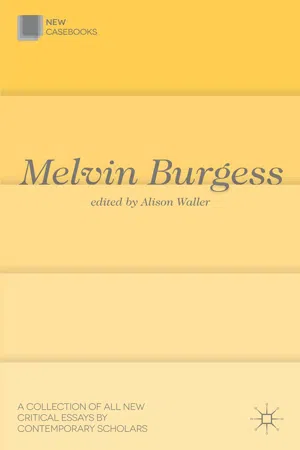
Melvin Burgess has made a powerful name for himself in the world of children's and young adult literature, emerging in the 1990s as the author of over twenty critically acclaimed novels.
This collection of original essays by a team of established and new scholars introduces readers to the key debates surrounding Burgess's most challenging work, including controversial young adult novels Junk and Doing It. Covering a variety of critical and theoretical perspectives, the volume also presents exciting new readings of some of his less familiar fiction for children, and features an interview with the author.
- 232 pages
- English
- ePUB (mobile friendly)
- Available on iOS & Android
eBook - ePub
Melvin Burgess
About this book
Information
Part I
Controversy and the Cultural Context
1
‘One of the Boys’? Writing Sex for Teenagers in Doing It
Chris Richards
Introduction
The emergence of young adult literature has a rather uncertain history in the activities of publishers, libraries and education through the later decades of the twentieth century. Jack Zipes has argued, of both young adult and children’s literature, that such literature is largely an adult matter, negotiated between adult interests in institutions entirely of their making. His essay, provocatively entitled ‘Why Children’s Literature Does Not Exist’,1 follows an argument made by Jacqueline Rose in 1984—on ‘The Impossibility of Children’s Fiction’—and shares some ground with, for example, Roberta Seelinger Trites and Alison Waller, both of whom have pursued a more particular focus on the ‘institutional’ formation of a young adult literature.2 The paradox Zipes highlights is that, on the whole, such literatures are not produced by children or by teenagers, nor are they even necessarily read by them—at least not without extensive adult mediation. So the implication that the texts so designated belong to the young is, for Zipes, thoroughly misleading:
There is always an implied audience or audiences, and the implied audiences of a children’s book are constituted first and foremost by an editor/ agent/publisher, then by a teacher/librarian/parent, and finally by children of a particular age group. Only rarely does an author write expressly for a child or for children, and even then, the writing is likely done on behalf of children, that is, for their welfare, or what the author conceives of as a children’s audience or childhood.3
In the production of texts for children and young people, a central issue must be that of how the ‘child’ or ‘youth’ audience is constructed. Questions about the characteristics, interests, needs and desires of the young circulate between adult participants in the processes of book publishing, marketing and distribution and in the reception and mediation of texts by adults such as parents, librarians and teachers. Ideas about what children are like, and what is appropriate for them, have their history too.4 There is no stable and entirely consensual understanding of what childhood or youth are and where their boundaries can be drawn; ‘childhood’ and ‘youth’ are contested terms.5 In some institutional settings, such as schools, a particular set of psychological themes may reliably inform the way young people are placed and what is expected of them, often in relation to ideas of development, progress and maturation. But, elsewhere—in the domain of the commercial media, for example—those same children and young people will find themselves addressed in rather different ways, not least as consumers and as ‘free’ agents in pursuit of pleasure.6
This chapter will examine Melvin Burgess’s novel Doing It (2003)7 in the context of the author’s career as a writer for children and teenagers. Among writers whose work addresses children and young people, Burgess is perhaps relatively unusual in explicitly engaging with these conflicts between domains of consumption both in articles and in interviews.8 Doing It proved to be particularly controversial and was the occasion for extended commentary and debate. From the standpoint of an adult writer defining his professional career entirely within the field of children’s and young adult fiction, Burgess has offered a commentary on the production of his own novels and the choices he has made. What authors have to say about their own work is always of interest, and his explanations are given considerable attention here, but reading his novels also needs to be further informed by wider debates around the construction of ‘audiences’ or ‘readers’ in contemporary publishing. In particular, it is important to focus on the idea that books for children and young people are a form of provision for their needs by adults skilled in judging what is appropriate and desirable. This has been the priority for publishing and, with occasional exceptions, young people are not themselves expected to represent their own engagement with ‘being young’, either in old or new media (short stories and novels or online writing). Attempts to facilitate young people as writers have been made but these are marginal to the activities of commercial publishing both in the ‘schools market’ and in the wider book trade.9
For publishing, ‘young adult’, by contrast with ‘crossover’, is a category inseparable from education and its division of young people into age phases, with children grouped year by year and relocated institutionally at key moments such as the transfer from primary to secondary school. Indeed, ‘young adult’ is a regulatory category indicating that the texts assigned to it are not for younger children and that some of their characteristics are appropriate to ‘adolescence’— such characteristics typically include some acknowledgement of sexual interests and perhaps heightened tensions and emotional conflicts between teenage characters. Texts labelled in this way are deemed to be for young people, both in the sense that there is an emotional and experiential correspondence between the text and the reader, and because they provide moral guidance, if perhaps only minimally and implicitly, in showing the consequences of some actions. Indeed, ‘moral risk’ may be registered in some novels primarily in the narrative display of outcomes such as pregnancy, addiction and educational failure rather than through a more overt discourse of judgement.10 The emergence of young adult fiction in the latter half of the twentieth century was closely aligned with the history of English teaching in schools and with related developments in school library policy and provision.11 At least in Britain, the category ‘young adult’ really has relatively little currency outside education and the organization of that area of publishing addressing the ‘educational market’. In the wider context of commercial media, ‘teen’ and ‘teenage’ are far more prominent in those discourses that intend to address young people themselves. Teen carries less of the implied admonishment that lingers in the use of ‘young adult’—that implication that those addressed as ‘young adult’ are being reminded to learn the sense of responsibility that is attributed to being a properly mature adult. Texts—films, comics, magazines, computer games, music—located in the non-educational commercial domain and sold directly to young people themselves are not positioned primarily as offering instruction in how to be ‘grown-up’—though particular examples that can be read as doing so are not difficult to find.
However, especially since the later 1990s, the idea of young adult fiction has become a little more complicated. ‘Crossover’ fiction has emerged as a more firmly identifiable category and one that, because it extends the potential market, has been pursued by publishers with some enthusiasm.12 The positioning of new titles as for readers both teenage and adult, and outside the institutional structuring of age phases in education, is one significant strategy. Mark Haddon’s The Curious Incident of the Dog in the Night-Time, published in the same year as Doing It, was launched in two different editions.13 In the United States, Francesca Lia Block’s five Weetzie Bat novels (1989–95) were reissued together in one volume as Dangerous Angels in 1998 and without any of the previous educational and American Library Association endorsements.14 These two examples represent related but distinguishable tendencies. I have discussed Block elsewhere in some detail, and Haddon in an essay where I explicitly contrast his stance with that adopted by Burgess.15 With The Curious Incident of the Dog in the Night-Time, a novel about a teenage boy was presented as sufficiently complex and challenging to attract the attention of adult readers. In some ways, this was consistent with Haddon’s own account of his reasons for writing something very different from his previous work for children.16 Dangerous Angels was offered more as a contribution to the flexible extension of youth as a lifestyle lived across age phases and well into adulthood—in their 1998 relaunch, the novels became a series of ‘magical realist’ reflections on a ‘younger adult’ rather than a more circumscribed ‘teenage’ way of life. Both Haddon and Block were positioned in the ‘crossover’ strategy pursued by publishers but their writing was recruited to an adult readership in rather different terms. Melvin Burgess, whose writing has also been associated with ‘crossover’ fiction, is different again from both Haddon and Block, not least because he has more consistently pursued a professional identification with writing for young people.
Writing for the teenage reader
Burgess has drawn attention to the wider patterns of consumption typical of young people in the past two decades, citing both the variety of media to which they have access and the virtual irrelevance of the boundaries associated, in the United Kingdom, with the work of the British Board of Film Classification.17 The full texts of his articles are archived on his own website—itself indicative of his public self-positioning as an author-celebrity and as a speaker on behalf of young people’s interests. Here, writing in 2000, he enthusiastically embraces the wider media culture both for its pleasures and its financial rewards:
Teenage fiction is an area that has developed out of recognition in recent years. I can’t recall any books written specifically for me when I was that age. Now the range of books increases every year […]
Books occupy a very curious position as far as teenagers are concerned. Although there is no censorship for books for any age group, they have lagged behind the other media in the kind of material they present to young people. The film industry, the music industry, computer games, magazines, comics—they all know very well about the youth market. There is an age group of about fourteen to twenty five that is extremely profitable for everyone.18
In the same year—and perhaps with the recent publication of Bloodtide (1999) in mind, given its arguably cinematic violence—he makes a similar case:
Teenagers as a group consume entertainment—often narrative entertainment—by the barrel load, and the kind of thing they choose for themselves in film, magazines, gaming, music and TV, come largely from that cultural area. Who can blame them? It’s so rich—sexy, loud, violent, ironic and cruel, but also beautiful, dreamy and intense. Schools have an obvious problem with this kind of thing […] one reason why books for teenagers have been so slow to take on the experience of other media.19
The identification of a disjunction between the way in which young people are positioned and addressed in school and by the media has consistently informed the development of his career, at least since the mid 1990s with the publication of Junk (1996).20
To some extent Burgess has been able to contribute to the continuing process of redefining how teachers should engage with the popular media and especially with the representation of sex and drug use, in the late twentieth and early twenty-first centuries. In London, the English and Media Centre published a study guide to support the teaching of Junk and Michael Rosen made the novel central to an article on social realism in children’s literature, ‘Junk and Other Realities’.21 More broadly, media studies teachers, often caught up in the vicissitudes of teaching horror or other apparently transgressive texts, could acknowledge that Burgess was attempting to reanimate an old media form in circumstances where many argued that it was irrelevant to young people’s lives.22 There was a great deal of common ground. Indeed, generationally, Burgess belonged with some of the leading figures in the development of media education—David Buckingham, like Burgess, was born in 1954. A shared generational experience of childhood and youth in the 1950s and 1960s by no means entails any particular stance in relation to youth culture and popular media, but perhaps a sense of frustration and confinement within the narrow constraints of the school curriculum in that period does persist. Burgess ruefully remarks that ‘[w]riting books that schools feel happy with is the sensible option—at least I know the market is there’ but adds ‘[w]riting books that borrow style and imagery from other media isn’t going to make my life any easier […]. But, being mad, I expect I’ll do it anyway’.23 Much more strongly than either Haddon or Block, Burgess thus locates himself as writing for young people of school age but also frequently seeks to disrupt the implicit imperatives of educationally located young adult fiction.
However, the disruptive tactics adopted by Burgess and articulated in his claims about his own work are pursued on ground very different from the mainly ‘poststructuralist’ approaches to language and representation long familiar in media studies and related fields. Chris Barker explains that ‘for poststructuralism there can be no truths, subjects or identities outside of language, a language which does not have stable referents and is therefore unable to represent fixed truths or identities’. Going further he notes that what we say, about ourselves or anything else, is ‘dependent on the prior existence of discursive positions. Truth is not so much found as made and identities are discursive constructions’.24 Discussing young people’s own writing in school, Gemma Moss argues similarly that the ‘truth’ of experience cannot be represented authentically by adopting a realist genre: ‘the reality we seek to disclose […] is just as much a matter of convention as the genres we seek to discard; it is no more natural, no more the product of the direct apprehension of experience than the texts we dislike’.25 In media studies, claims to be able to convey the ‘truth of reality’ are always regarded as, indeed, ‘claims’— rhetorical strategies to secure an aud...
Table of contents
- Cover
- Title Page
- Copyright
- Contents
- Series Editor’s Preface
- Notes on Contributors
- Acknowledgements
- Introduction
- Part I: Controversy and the Cultural Context
- Part II: Form, Style and Genre
- Part III: Human and Animal Identities
- Part IV: Telling Stories
- Further Reading
- Index
Trusted by 375,005 students
Access to over 1.5 million titles for a fair monthly price.
Study more efficiently using our study tools.
Frequently asked questions
Yes, you can cancel anytime from the Subscription tab in your account settings on the Perlego website. Your subscription will stay active until the end of your current billing period. Learn how to cancel your subscription
No, books cannot be downloaded as external files, such as PDFs, for use outside of Perlego. However, you can download books within the Perlego app for offline reading on mobile or tablet. Learn how to download books offline
Perlego offers two plans: Essential and Complete
- Essential is ideal for learners and professionals who enjoy exploring a wide range of subjects. Access the Essential Library with 800,000+ trusted titles and best-sellers across business, personal growth, and the humanities. Includes unlimited reading time and Standard Read Aloud voice.
- Complete: Perfect for advanced learners and researchers needing full, unrestricted access. Unlock 1.5M+ books across hundreds of subjects, including academic and specialized titles. The Complete Plan also includes advanced features like Premium Read Aloud and Research Assistant.
We are an online textbook subscription service, where you can get access to an entire online library for less than the price of a single book per month. With over 1.5 million books across 990+ topics, we’ve got you covered! Learn about our mission
Look out for the read-aloud symbol on your next book to see if you can listen to it. The read-aloud tool reads text aloud for you, highlighting the text as it is being read. You can pause it, speed it up and slow it down. Learn more about Read Aloud
Yes! You can use the Perlego app on both iOS and Android devices to read anytime, anywhere — even offline. Perfect for commutes or when you’re on the go.
Please note we cannot support devices running on iOS 13 and Android 7 or earlier. Learn more about using the app
Please note we cannot support devices running on iOS 13 and Android 7 or earlier. Learn more about using the app
Yes, you can access Melvin Burgess by Alison Waller in PDF and/or ePUB format, as well as other popular books in Literature & Literary Criticism. We have over 1.5 million books available in our catalogue for you to explore.