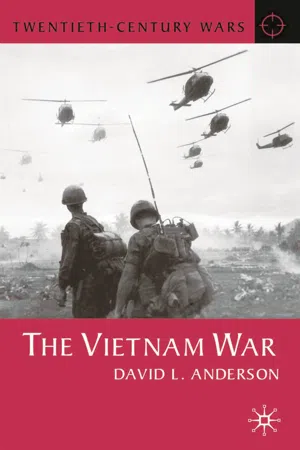
- 168 pages
- English
- ePUB (mobile friendly)
- Available on iOS & Android
eBook - ePub
The Vietnam War
About this book
The Vietnam War endured for thirty years, cost billions of dollars, and resulted in thousands of Vietnamese, French, and American deaths. Massive American military intervention in Vietnam embroiled America in protests, placed enormous strains on the western alliance, and altered U.S. relations with the Soviet Union and China. David L. Anderson's concise overview critiques U.S. errors in magnifying the strategic importance of South-east Asia in the Cold War and in underestimating the strength of the Vietnamese communist movement.
Information
1
Causes: Colonialism and Containment
For centuries the Vietnamese people resisted domination by their powerful Chinese neighbors and struggled to unify their country as an independent state. They ultimately freed themselves from China’s claims of political authority and achieved national unity only to fall victim to French imperialism. France ruled Vietnam and the neighboring kingdoms of Laos and Cambodia as colonies from the late nineteenth century into the twentieth century, until the Japanese occupation of Southeast Asia during the Second World War set the stage for the Vietminh war against the French beginning in l945. Because the charismatic leader of the Vietminh movement, Ho Chi Minh, was a communist closely associated with the Soviet and Chinese Communist Parties, his challenge to France was also a Cold War issue. After the Second World War the United States emerged as the powerful leader of the coalition of Western democracies opposed to any political or military expansion of communism. US policy makers did not condone French colonialism, but they believed that US global security could not allow an ally of Moscow and Beijing to be successful in Southeast Asia against France, an ally of the United States. By the end of the administration of President Harry Truman in 1953, the United States was providing much of the financing for the French War because Paris was losing the political will to continue the conflict that critics termed the ‘dirty war.’ Geopolitical strategy, economics, domestic US politics, and cultural arrogance shaped the growing American involvement in Vietnam.
The origins of Vietnam
Vietnam is a centuries-old nation with a proud cultural and political tradition. During the Vietnam War of the mid-twentieth century, people in the West generally thought of Vietnam as a small and underdeveloped nation. It is, in fact, not a small but an average-sized country with territory and population comparable to Spain, Egypt, or Poland. In 1960 its total population was slightly more than 30 million with about 2 million more people living in North Vietnam, that is, north of the seventeenth parallel, than in South Vietnam. Almost 90 percent of the people were ethnically Vietnamese. The principal minority was Chinese, and there were small numbers of other minorities, most notably the so-called Montagnards or mountain people of the Central Highlands. In territory, Vietnam is about 1000 miles (1600 km) in length from the northern border with China to the southern tip on the South China Sea. It is very narrow in the middle near the seventeenth parallel, about 40 miles (64 km) wide, but its width reaches almost 300 miles (480 km) in the north and 125 miles (200 km) in the south. The total land area of 126,000 square miles (328,000 square km) was almost equally divided between North and South Vietnam, and each half was approximately equivalent in size to England and Wales combined.
The Vietnamese people and culture first appeared in the valley and delta of the Red River in the north. By the middle of the twentieth century, this area, the Mekong River Delta in the south, and the narrow coastal plain along the length of the country contained most of the population. About 80 percent of Vietnam is mountains, forests, marshes, and grasslands that are sparsely populated. Throughout most of Vietnam’s history, the primary economic activity on the habitable land has been rice cultivation, but fishing along the lengthy coastline and in the rivers and canals has also been a primary source of food and income. Most of the country’s minimal mineral resources are in the north. As has been true throughout the world, Vietnam has experienced a major migration from rural to urban areas that began in the early 1950s and has continued ever since. The largest city is Ho Chi Minh City, which was previously called Saigon and was the capital of South Vietnam. The capital of North Vietnam and the national capital since the end of the war is Hanoi, the second largest city. Major port cities are Haiphong and Danang.
There are considerable regional variations in Vietnam that have been significant throughout its history. The long distance in Vietnam from the cradle of its culture along the Red River in the north to areas in the south and contests for possession of territory from rival peoples meant that different areas came under Vietnamese control at different times and in different ways. Variations in land elevations and in rainfall patterns also created different patterns of life. After the entire country became united, its rulers set up three roughly defined administrative regions – Bac Bo in the north, Trung Bo in the central region, and Nam Bo in the south – in an effort to make the new unity effective. When the French colonized Vietnam in the nineteenth century, however, they sought to make these divisions even more complete in order to prevent Vietnamese unity. They designated the area around Hanoi up to the Chinese border as Tonkin, the area from immediately south of the Red River Delta down through the Central Highlands as Annam, and the area around the Mekong River Delta as Cochinchina.1
Centuries before the French presence, however, the principal external threat and influence on the Vietnamese came from China. According to Vietnamese legend, they shared a common origin with the Chinese that dated back into the third millennium BCE, but the earliest historical record of a distinctive Vietnamese people is dated 207 BCE. It is a Chinese account of a conquest of the area around the Red River Delta and its incorporation into a kingdom referred to as Nam Viet or Nan Yue (South Yue) ruled by a Chinese general from a capital near Guangzhou in present-day China. This date marks the beginning of a thousand years of Chinese rule. In a literal sense Nam Viet was a separate kingdom from China, but it had a Chinese ruler who imposed a Chinese-style bureaucratic government and the Chinese system of rice cultivation. In 111 BCE, however, the powerful Han Dynasty, one of China’s strongest ruling families, annexed Nam Viet as a province of China, and it remained a Chinese province until ADE 939.2
During the thousand years that the northern part of what is now Vietnam was under Chinese rule, the Vietnamese absorbed many aspects of Chinese culture. Vietnam’s own culture remained strong, however, and the determination to be free of Chinese control never died. Over this same period, China incorporated many other border peoples and made them essentially Chinese. The Vietnamese retained distinctive elements of their way of living, such as chewing betel nut, practicing totemism, and sustaining a social structure that, especially unlike China, gave a high status to women. The most notable impact of Chinese culture was on the Vietnamese ruling class. The Chinese philosophy of Confucianism, in particular, created a spiritual reverence for the authority of the emperor, the so-called Mandate of Heaven, and extended that model into a social and political hierarchy. Dominant Vietnamese families embraced this concept to legitimize their authority and created, in Chinese fashion, a bureaucracy of gentry officials, or mandarins, schooled in Confucianism through which to exercise power. The vast majority of Vietnamese were peasant farmers and fishermen, however, and for them Confucianism, the more mystical concepts of Taoism, Chinese interpretations of Buddhism, and traditional Vietnamese beliefs blended together. Because the peasants clung more tightly to Vietnamese traditions than did the mandarins, the small villages throughout the country became the strongest and most enduring symbols of Vietnamese identity. This village allegiance was an important part of Vietnamese society into the modern era.3
The degree of actual Chinese control over its Vietnamese province had varied considerably over the centuries, and finally in 938 a Vietnamese force won a decisive naval victory that ended Chinese claims of authority. A Vietnamese state called Dai Viet extended from Tonkin down to about Danang, but its survival and stability were far from secure. In 1076 China’s Sung Dynasty tried unsuccessfully to retake Vietnam, and in the late thirteenth century the Vietnamese repulsed a Mongol invasion. In the early 1400s the mighty Ming Dynasty sent a force that reoccupied Vietnam for about two decades, but it too failed to remove the independence for which the Vietnamese had long struggled.
Even as the Vietnamese were managing to survive against serious external threats, they were engaged in internal contests for political dominance. Several strong families vied for control until the Ly family established a stable central government in the eleventh century. After about two centuries the Tran Dynasty succeeded the Ly in a peaceful transition. Stability came under both of these dynasties through their successful modeling of China’s gentry bureaucracy as a means to conduct civil affairs. The survival of an independent Vietnam, however, brought friction with a powerful neighbor to the south, the Kingdom of Champa. The Vietnamese fought the Chams in a series of wars that brought an end to the Tran Dynasty and tempted the Ming to make its assault on Vietnam. In this crisis, a great hero of Vietnamese history, Le Loi, emerged.
Le Loi’s defeat of the Ming invaders in 1428 forced China to recognize Vietnam’s independence. He then founded the Le Dynasty and began what became known as the ‘March to the South.’ In 1471 the Vietnamese finally conquered Champa and absorbed its territory. Over the next two and a half centuries they proceeded to occupy lands along the coast until they had secured possession of the Mekong Delta from the Khmer Kingdom (Cambodia). By 1701 Vietnam had reached its full extent from the Chinese border in the north to the Cau Mau Peninsula in the south.4
As Vietnam expanded, central control became difficult to maintain. Twice during the March to the South the country divided into northern and southern kingdoms. One of these divisions was from 1540 to 1592, but the second lasted longer from 1673 to 1802. During this later period, the Trinh family ruled Tonkin, although an impotent Le Dynasty nominally remained. The Nguyen family was dominant in the south, claimed the imperial throne of Vietnam belonged to it, and was responsible for the taking of Cochinchina from the Khmers. The dividing line between the areas of Trinh and Nguyen control was at approximately the seventeenth parallel, which coincidentally would mark the boundary between North Vietnam and South Vietnam in 1954. Also, in the early 1500s the first European contact with Vietnam occurred with the appearance of Portuguese traders. By the seventeenth century, Portugal, Spain, Holland, France, and England were carrying on some trade with Vietnam. Portuguese and Spanish Jesuit priests and the French Society of Foreign Missions combined missionary efforts with commerce, but the Vietnamese grew suspicious of these religious activities and curtailed them in the late 1600s.
In 1777 three brothers from the village of Tay Son near Hue led a revolt that overthrew Nguyen rule in the south. This Tay Son Rebellion demonstrated how, throughout the years of territorial expansion, the local villages had remained not only guardians of Vietnamese culture but also centers of rebel resistance to central authority. In 1786 the Trinh in the north fell victim to this same rebellion. As fighting concentrated in Tonkin, however, a prince of the Nguyen family, Nguyen Anh, seized Cochinchina with the help of a French missionary, Pigneau de Behaine. Pigneau tried to arrange for official French assistance for Nguyen Anh in a plan that would have given France possession of the port of Tourane, which the Vietnamese called Danang. Paris rejected the scheme, but Pigneau obtained funds from French merchants to pay for mercenaries and arms for Nguyen Anh with the understanding that the Vietnamese leader would protect French missionaries. With this assistance, Nguyen Anh defeated the Tay Son brothers in 1802 and declared himself Emperor Gia Long, ruler of a united Vietnam.5
The Nguyen Dynasty established by Gia Long made the city of Hue the imperial capital, and this Chinese-style monarchy became Vietnam’s last dynasty. The last emperor of the Nguyen line was Bao Dai, who abdicated the throne in l945. Long before, however, French colonialism and radical nationalist resistance to colonial rule had reduced the emperor to a figurehead. Gia Long recognized that China remained a potential danger to his country and sent tribute missions, emissaries bearing generous gifts, to Beijing to ensure good relations. He also acknowledged Pigneau’s help by tolerating French missionary activities. Subsequent emperors persecuted missionaries, however. In turn, the French government became increasingly aggressive in demanding protection of the missionaries. Like other European nations at the time, France was also searching for markets and raw materials for its increasingly industrialized economy, and Vietnam seemed a good source for both. In 1858 Paris sent a large naval force to Vietnam, the first of a series of events that led by the end of the century to French colonization of Vietnam and the neighboring states of Laos and Cambodia.6
French colonialism
On 1 September 1858, a fleet of 14 French vessels took possession of Tourane. Although heat and disease required the occupiers to withdraw in a few months, a relentless pattern of small and large French military assaults on Vietnam had begun. In 1859 another French force took the village of Saigon in the south in the hope that the Mekong River would prove to be a commercial passageway into China. Exploration of the river found inland transit blocked by falls and rapids, but in 1862 Emperor Tu Duc agreed to transfer much of Cochinchina to France as a colony. The same year France created a protectorate over the royal government of Cambodia. Trying to gain an economic foothold in South China before British commercial interest moved out of Burma into the region, France then began efforts to possess the Red River route. A series of military clashes ensued placing French units against Vietnamese forces and also against southern Chinese armies seeking to block Western imperial expansion into their territory. In 1874 Tu Duc granted further concessions to France in Cochinchina and around Hanoi and Haiphong. Fighting that was quite heavy at times continued. Although the emperor’s court remained in Hue, in 1883 after Tu Duc’s death, Annam and Tonkin became French protectorates, and the Laotian monarchy, too, fell under French control in 1893. China signed a convention in 1885 recognizing French control of the area. In 1897, France formally organized what it called the Indochina Union of Cochinchina, Annam, Tonkin, Cambodia, and Laos. Administered by a governor general in Hanoi, French Indochina was, by whatever name, a fully established French colony.
France’s rule over its colony was incredibly brutal and exploitative. Indeed, the colonial authorities tried to extinguish the identity of the Vietnamese within the five-part colony. The rulers referred to the people of Vietnam as Annamites. The Europeans claimed to be civilizing the local inhabitants. This mission civilisatrice sought to impose Western language, culture, religion, and economic structure. Despite the thin veneer of reform rhetoric, the purpose was to control the territory and resources of Indochina for the benefit of France. The Nguyen monarchy remained in Hue as an effete relic, but real and unlimited authority was in the hands of the governors general in Hanoi, who did not hesitate to imprison or execute anyone who defied their will. Although some of the old elite clung to a hope for a revival of the Confucian order, much of the gentry class was either silenced or came to collaborate with the colonial masters as a way of survival.7
French colonialism deprived the Vietnamese of their political independence, and it impoverished the vast majority of the Vietnamese people. Already a country of farmers and fishermen, colonial Vietnam developed no industries but became a major producer of raw materials, specifically rice, rubber, and coal. Having for centuries lived off the small plots belonging to their families or clans, many villagers lost their lands and became low-paid plantation workers, share croppers, or miners in large operations owned by French companies and absentee landlords or a small class of wealthy Vietnamese collaborators. High taxes, exorbitant rents, and fees charged by banks, moneylenders, and rice-brokers kept the majority in debt and poverty while a minority grew rich. There was virtually no middle class. Colonialism brought economic deprivation, political impotence, weakening of village autonomy, rising illiteracy, and social tension. Not surprisingly, radical anticolonial movements appeared among the Vietnamese. Revolution, not reform, seemed to many Vietnamese to be the only answer to economic exploitation, political repression, and cultural stagnation. There were reformers who looked to China and Japan for ideas of how to respond to Western imperialism while conserving traditional Asian values. In addition, radical ideas of national self-determination, revolutionary class struggle, and party dictatorship appeared in China in the 1920s that had repercussions in Vietnam. The French colonial years were an era of frustration for many Vietnamese, oppressed by the foreign intruders and a native, Francophile upper class.
With no middle class to form a constituent base and French officials quick to silence any dissent from their authority, Vietnamese patriots found it virtually impossible to form modern political parties to represent the interests of the people. Initially, the small strata of Vietnamese intellectuals who had received a traditional education in the Confucian classics had to overcome their own disdain for Western political concepts of social and political progress. By the 1890s, Japan had become a model for reformers in China and Vietnam of what became known as self-strengthening, that is, adapting Western technology and institutions to serve Asian values. In Vietnam, Phan Boi Chau and others created a Modernization Society that advocated the creation of a constitutional monarchy to revitalize the imperial court at Hue. Inspired by Sun Yat-sen’s movement in China that had led to the creation of a republican government there in 1912, the Modernization Society became the Revitalization Society with the same goal for Vietnam. Chau’s movement was not strong enough to break French control, and its efforts to propagandize and agitate for change eventually led to Chau’s arrest in 1925 and confinement for life. Phan Boi Chau is a significant representative of an emerging search among Vietnamese for how to move beyond isolated protests of French and elite mistreatment of the masses toward some form of organized force for social change.8
The French authorities outlawed Vietnamese political parties, except for a token group representing the collaborationist elite, thus compelling nationalist groups opposed to French rule to organize and operate in secret. There were a number of such clandestine cells, but most of them were very small. The Vietnam Quoc Dan Dong (VNQDD) or Vietnam Nationalist Party managed, however, to mount a dramatic if futile challenge to the colonial overlords in February 1930. It had a moderate socialist program and tried to use armed rebellion to ignite a popular uprising aimed at creating a Vietnamese republic, much as the Nationalist Party or Guomindang had accomplished in China. VNQDD bands numbering from 50 to 300 attacked several French military posts and inflicted the heaviest losses, 12 French dead, at Yen Bay. No uprising ensued, and the colonial forces soon captured, imprisoned, and executed many of the rebels, although some escaped to China. French Indochina appeared firmly in the possession of the Europeans.9
Ho Chi Minh and Vietnamese communism
In 1930 as the French squelched the VNQD...
Table of contents
- Cover
- Title
- Copyright
- Contents
- Map: Vietnam After the 1954 Geneva Agreement
- Preface
- 1 Causes: Colonialism and Containment
- 2 Commitments: Dwight D. Eisenhower, John F. Kennedy, and Ngo Dinh Diem
- 3 Credibility: Lyndon Johnson’s War
- 4 Contention: Antiwar Protests, the Tet Offensive, and a Tumultuous Election
- 5 Consequences: Richard Nixon’s War
- 6 Conclusions: Peace at Last and Lasting Legacies
- Notes
- Selective Bibliography
- Index
Trusted by 375,005 students
Access to over 1.5 million titles for a fair monthly price.
Study more efficiently using our study tools.
Frequently asked questions
Yes, you can cancel anytime from the Subscription tab in your account settings on the Perlego website. Your subscription will stay active until the end of your current billing period. Learn how to cancel your subscription
No, books cannot be downloaded as external files, such as PDFs, for use outside of Perlego. However, you can download books within the Perlego app for offline reading on mobile or tablet. Learn how to download books offline
Perlego offers two plans: Essential and Complete
- Essential is ideal for learners and professionals who enjoy exploring a wide range of subjects. Access the Essential Library with 800,000+ trusted titles and best-sellers across business, personal growth, and the humanities. Includes unlimited reading time and Standard Read Aloud voice.
- Complete: Perfect for advanced learners and researchers needing full, unrestricted access. Unlock 1.5M+ books across hundreds of subjects, including academic and specialized titles. The Complete Plan also includes advanced features like Premium Read Aloud and Research Assistant.
We are an online textbook subscription service, where you can get access to an entire online library for less than the price of a single book per month. With over 1.5 million books across 990+ topics, we’ve got you covered! Learn about our mission
Look out for the read-aloud symbol on your next book to see if you can listen to it. The read-aloud tool reads text aloud for you, highlighting the text as it is being read. You can pause it, speed it up and slow it down. Learn more about Read Aloud
Yes! You can use the Perlego app on both iOS and Android devices to read anytime, anywhere — even offline. Perfect for commutes or when you’re on the go.
Please note we cannot support devices running on iOS 13 and Android 7 or earlier. Learn more about using the app
Please note we cannot support devices running on iOS 13 and Android 7 or earlier. Learn more about using the app
Yes, you can access The Vietnam War by David L. Anderson in PDF and/or ePUB format, as well as other popular books in History & Military & Maritime History. We have over 1.5 million books available in our catalogue for you to explore.