- 146 pages
- English
- ePUB (mobile friendly)
- Available on iOS & Android
eBook - ePub
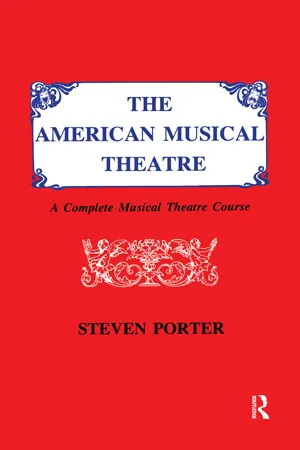
American Musical Theatre
About this book
Split into four parts, this book seeks to inform the reader, teachers, directors and students about American Musical Theatre. Part I is a brief history of the American Musical Theatre, for it is only in the context of history that the material on which you work can be fully judged and mastered. Part II is a brief discussion of the elements of production. Knowing what ought to take place in a well-planned show can go a long way toward counteracting what does not take place in a poorly planned one. Part III is a brief discussion of how to evaluate the elements of craftmanship one expects to find in the writing and performing of a musical. The knowledge here is indispensable to the performer. It is the feel of the plane to the pilot, the touch of the key to the pianist. It is, in fact, the very life blood of the art form. Finally, Part IV provides an opportunity to put into practice what previous study has taught.
Information
PART IA Brief History Of The American Musical
DOI: 10.4324/9781315060927-1
A. FOUNDATIONS AND BEGINNINGS
DOI: 10.4324/9781315060927-2
It is difficult to say exactly where the American musical was born. To claim any one event, any one production, as a definitive starting point would more than likely slight another equally worthy choice. Let us, then, be both egalitarian and non-controversial and say that the American musical had several wellsprings which justify our attention.
The earliest musical production in the American Colonies of which we have more or less precise accounts was an English ballad opera called Flora, presented in Charleston, South Carolina in 1735. It was done with no scenery or costumes and was in reality a spoken play with preexisting popular songs interspersed amid the dialogue. The use of preexisting musical material was by no means unusual. It would be done many more times before the practice of writing plays with original music would come into fashion.
The colonial years, ones of Revolution and political purpose, were not conducive to great theatrical development. There was simply more pressing business on the national agenda. One popular form of the late eighteenth and early nineteen century which did find some recognition, however, was the musical parody. A great play or poem, a noted story or famous performer would become the object of a humorous satire, often performed as a pantomime with songs and dances thrown in to provide both entertainment and variety. Such productions were called “burlesques,” a genre not to be confused with the girly shows of the next century. One of the most successful burlesques of this era was the 1828 parody of Shakespeare’s Hamlet starring the well-known British performer, John Poole.
If the burlesque and imported musical were popular, they also lacked the vital ingredient of any indigenous national musical form—originality. A burgeoning America needed something natively American to complement the influences of Europe and fire its own creative juices. That something was the Minstrel Show.
The Minstrel Show was a product of the black slave culture and its intermingling with a white colonial potpourri. It was the first major contribution of blacks to the American musical mainstream and by no means the last. But the Minstrel Show was also the product of a solitary man who gave it shape, architecture, and notoriety. The man was Dan Emmett. In 1843, Emmett brought his Virginia Minstrels to the Chatham Square Theatre of New York where they performed a show whose format would become a standard theatrical product from one end of the new republic to the other.
Emmett (the composer of such song classics as “Old Dan Tucker” and “The Blue Tail Fly”) divided his show into three parts. Part one was known as the “olio.” Here, the performers—bedecked in black face and wearing blue swallowtail coats, striped shirts, and pantaloons—would troop out and sit in a straight line across the stage. On one end of the line was the character of Mr. Tambo; on the other end, the character of Mr. Bones; in the middle, Mr. Interlocutor. The characters would carry on snappy banter, pausing in their humorous dialogue to allow one or another member of the line to rise and perform some kind of musical offering, a song or dance or entertaining routine. Occasionally, the entire ensemble would do some sort of chorus number.
When the olio was over, part two, the “fantasia,” began. During the fantasia, individual star performers appeared with extended routines. Just who would be highlighted in a fantasia depended upon the make-up of the ensemble. If the company had a prodigious dancer, then dancing would dominate the fantasia; if a prodigious singer, then singing; etc.
Following the fantasia, the entire ensemble would appear in part three, a burlesque (parody) satirizing one or another of the earlier routines.
Emmett’s formula was duplicated by many other minstrel groups, the most famous of which was the Ed Christy Minstrel Show for whom Stephen Foster wrote some of his best-known songs (”The Old Folks at Home” and “My Old Kentucky Home,” to name just two). As Christy and his counterparts toured about, they engrained the Minstrel Show format into the country’s theatrical consciousness, and it would be difficult to underestimate the influence of the format on later musical productions. The olio grew to become the variety or vaudeville show; the fantasia became the Broadway revue. The musical burlesque expanded to the dimension of full satire and gave rise to such later musicals as Stephen Sondheim’s ‘A Funny Thing Happened on the Way to the Forum’ (1962) and Leonard Bernstein’s ‘Candide’ (1956).
Minstrel Shows were staples of the American Musical Theatre as long as the population centers of the nation were rural. Rural populations meant traveling shows, shows which were mobile, which could reach out and find an audience here, an audience there. When the demography began to shift—as it did between 1850 and 1900—the theatrical landscape changed along with it. As cities became larger, they could afford to attract and support permanent theatres and non-traveling entertainment. It is not surprising, therefore, that the second half of the nineteenth century saw other genres join the Minstrel Show in the American musical mainstream.
In 1866 The Black Crook’ opened in New York City. Dramatically, it told in a rather confused and elongated plot of an evildoer who makes a bargain with the devil to deliver one human soul per year. But the contrived drama bothered very few people, for it was merely the literary excuse for the real point of the production, extravagance. For five and one half hours, ‘The Black Crook’ paraded across the stage an array of theatrical effects and sensual pleasures the likes of which Broadway had never before seen. Simulated hurricanes, demonic rituals, extended ballets, angels ascending and descending in chariots of gold, scantily-clad chorus girls singing songs of sexual innuendo like “You Naughty, Naughty Men”—all this and more bedazzled the average theatre-goer. The theatrical extravaganza was born.
‘The Black Crook’ ran for four hundred performances, showed an initial profit of over one million dollars, and in revivals ran for another two thousand performances—figures unheard of at the time. The effect of the show was enormous, not because it catapulted musical theatre into the realm of big business, or because it spawned many imitations in the years which followed, but because it showed producers and investors alike that theatrical frivolity could profitably substitute for dramatic or musical substance.
In our brief historical excursion, we will see this phenomenon occur again and again, as indeed it is occurring on Broadway at the time of this writing. In the absence of well-crafted music, of meaningful characterization or profound thematic plot, it is historically Broadway’s preference to substitute the effects of theatrical technology, the titillations of overt sexuality, the shocks of the bizarre. In the post 1970 era, one can point to shows like ‘Cats, “Little Shop of Horrors, “Sweeney Todd, “La Cage Aux Follies,’ and many more as evidence that the legacy of ‘The Black Crook’ is still with us.
In 1874 ‘Evangeline’ opened in New York City. A burlesque by E.E. Rice on the Longfellow poem, ‘Evangeline’ was the first production for which the entire musical score was newly composed. Previously, while some musical numbers might be written for opening night, most songs were preexisting pieces merely interpolated into the story at hand. Now a new pattern would emerge, the libretto accompanied by entirely original musical material. Not coincidentally, ‘Evangeline’ was billed by its author as a new kind of work, a work he called “musical comedy.”
Now that Broadway had seen the birth of a permanently located extravaganza and an originally composed musical score, it was only fitting that it see an original libretto as the dramatic underpinning of a musical production. The year was 1879; the show, Nate Salisbury’s ‘The Brook. ‘Salisbury set his story at a picnic which has attracted a variety of people, each of whom is followed in a series of plots and subplots united by the common thread of the picnic and the brook which flows along the picnic grounds.
The use of a common event or common locale to interweave the separate stories of different characters has, during the 1980’s, seen something of a theatrical explosion, particularly on television. For years, daytime TV soap operas have used the device, but more recently, nighttime shows like Dallas, Knots Landing, Dynasty, and Falcon Crest have attempted to capitalize on the formula. In the realm of the stage musical, ‘Sunday in the Park with George’ was a recent attempt to unite the separate stories of the various characters in Seurat’s famous pointilistic painting of a park scene.
For the most part, libretti like that of ‘The Brook’ and ‘Sunday in the Park with George’ are condemned by their very nature to remain fragmented and thematically shallow. Trying to weave a unified plot or express a unified theme with characters who are brought together more by superficial ruses than by substantive interaction is nigh on impossible, and in a later chapter we will discuss the weakness of such construction in more detail. For now it is important only to note that Salisbury’s format bears historical significance not only because it was imitated one hundred years later, but because it brought to the American Musical Theatre a concern and desire for a dramatically meaningful story.
That desire continued to express itself during the 1880’s in a series of productions known as the “Mulligan Shows,” perhaps the most famous of which was ‘The Mulligan Guard’ which opened in 1879. Text and lyrics by Ed Harrigan and Tony Hart, original music by David Braham, the show was a burlesque on the common people of New York. An Irish family, the Mulligans, repleat with melting pot neighbors and a Negro maid, were the focal point of the story, and through them, tales of the ordinary were dignified and raised to the level of theatrical centrality. Not so much for their own worth, but rather for their historical contribution, the Mulligan shows bear mention, for in the golden age of the musical theatre to come, the common man would again and again be cast as the central character. Tevye in ‘Fiddler on the Roof’ Liza Doolittle in ‘My Fair Lady,’ Tony and Maria in ‘West Side Story’ all owe a portion of their existence to the Mulligan shows.
Finally, the years between the Civil War and the “Gay ′90’s” saw the advent of a kind of musical theatre which would grow to dominate the scene until 1920 and beyond—the operatta.
Now that populations could support permanent theatres; now that original music, original story, and opulent productions were viable; America was ready for the influences of Europe. From the early Italian masters of 1600 to the genius of Mozart, Verdi, Wagner, and many more, Europe had built an unrivaled legacy of serious grand opera. Now, during the second half of the nineteenth century, it complemented that legacy with a lighter but no less grand form of musical theatre. Through composers like Jacques Offenbach and Johann Strauss, in works like The Tales of Hoffmann and Die Fledermaus, European operetta reached a zenith, and when it played to audiences in the New World, it was an instant success. Particularly popular were the satiric operettas of Gilbert and Sullivan. When The Mikado and H. M. S. Pinafore toured the country, they generated enormous support and spawned many home-grown imitations.
Willard Spencer’s ‘The Little Tycoon’ (1886); John Philip Sousa’s ‘El Capitan’ (1896); and ‘Robin Hood,’ the 1890 production by Reginald de Koven and H.B. Smith which sported the classic wedding song “Oh Promise Me;” each ran extensively as America’s contribution to the world of operetta. But it was one man above all others who would epitomize the new form—epitomize it, and bring the nation into a new era of musical theatre. The man was Victor Herbert.
Suggestions for listening, study and discussion
- Listen to Gilbert and Sullivan’s The Mikado. Compare it to a European grand opera of the same period like Verdi’s Otello or Wagner’s Die Meistersinger. What makes it different? What are some similarities between them? What are some differences and similarities between grand opera, operetta, and a modern American musical?
- Additional European operettas you may profit from hearing are Offenbach’s The Tales of Hoffmann; Johann Strauss’s Die Fledermaus; and both H.M.S. Pinafore and The Yeoman of the Guard by Gilbert and Sullivan.
- Compare the musical style and lyric content of the Stephen Foster Minstrel Show song (”My Old Kentucky Home,” “Camptown Races,” “Old Folks at Home,” etc.) with the style of music and lyrics in operetta, particularly Gilbert and Sullivan.
- The Mulligan shows made dramatic heros of the common man. How do musicals like ‘West Side Story, “My Fair Lady, “Fiddler on the Roof, “Damn Yankees,’ and ‘Porgy and Bess’ continue that theme?
B. THE AGE OF OPERETTA
DOI: 10.4324/9781315060927-3
Victor Herbert was born in 1859 and, having shown considerable gifts in music as a child, was educated in the manner of a classically trained artist. He was a graduate of the Stuttgart Conservatory and an accomplished ‘cellist who played in the major orchestras of Europe and America under such greats as Brahms, Liszt, and Mahler. His wife was a noted soprano of New York’s Metropolitan Opera, and for six years Herbert was the conductor of the Pittsburgh Symphony Orchestra.
Impressive as these credentials are, it was not in the realm of the classical concert hall that he was destined to achieve his greatest fame but rather in the lighter climate of the Broadway operetta. Influenced by the European imports of the 1880’s Herbert turned his hand to operetta composition in the early 1890’s with the work of La Vivandiere, written for the most glamourous songstress of the age, Lillian Russell. Unfortunately, Russell steadfastly refused to perform the work, claiming that Herbert was not well-known enough for a star of her stature. The production was never mounted, and the score was subsequently lost.
Had Russell known she was turning down a man destined to become the giant of his era, she might have thought twice. Indeed, the history of the American Musical Theatre fairly overflows with the misjudgments of people, many of whom were too filled with their own importance or too lacking in artistic ability to recognize works of quality. Whatever Russell’s shortcomings, however, Victor Herbert knew his worth and persevered. In 1894 he produced the operetta Prince Ananias. Its success launched spectacular career.
Over the next thirty years, Herbert wrote an incredible number of works including undying classics like Babes in Toyland (1903), The Red Mill (1906), and Naughty Marietta (1910). In all, he wrote over fifty operettas and gave us such musical gems as “Toyland,” “The March of the Toys,” and “Ah, Sweet Mystery of Life.”
In listening to Herbert’s work today, it is important to bear in mind his strengths and the interaction of those strengths with the demands of operetta. Herbert’s genius was not as a dramatist nor as an architectural composer in the mold of a Beethoven or Brahms. He was essentially a weaver of melodies who did not question the trite lyrics, stock plots, or dimensionless characters presented him by his librettists and lyricists. Indeed, such theatrical sophistications were not the point of the operetta genre.
In his book The Story of America’s Musical Theatre (Philadelphia: Chilton, 1961. pp. 13–14), author David Ewen writes the following of operetta:
It did not matter if the plot was…confused…if a song or dance had little or no relevance…that the ch...
Table of contents
- Cover Page
- Title Page Page
- Copyright Page
- Dedication
- Table of Contents
- Preface
- Part I A Brief History Of The American Musical
- Part II The Elements of Production
- Part III The Elements of Craftsmanship: Evaluating A Musical
- Part IV Trying Your Hand
- Suggested References
- Index
Trusted by 375,005 students
Access to over 1.5 million titles for a fair monthly price.
Study more efficiently using our study tools.
Frequently asked questions
Yes, you can cancel anytime from the Subscription tab in your account settings on the Perlego website. Your subscription will stay active until the end of your current billing period. Learn how to cancel your subscription
No, books cannot be downloaded as external files, such as PDFs, for use outside of Perlego. However, you can download books within the Perlego app for offline reading on mobile or tablet. Learn how to download books offline
Perlego offers two plans: Essential and Complete
- Essential is ideal for learners and professionals who enjoy exploring a wide range of subjects. Access the Essential Library with 800,000+ trusted titles and best-sellers across business, personal growth, and the humanities. Includes unlimited reading time and Standard Read Aloud voice.
- Complete: Perfect for advanced learners and researchers needing full, unrestricted access. Unlock 1.5M+ books across hundreds of subjects, including academic and specialized titles. The Complete Plan also includes advanced features like Premium Read Aloud and Research Assistant.
We are an online textbook subscription service, where you can get access to an entire online library for less than the price of a single book per month. With over 1.5 million books across 990+ topics, we’ve got you covered! Learn about our mission
Look out for the read-aloud symbol on your next book to see if you can listen to it. The read-aloud tool reads text aloud for you, highlighting the text as it is being read. You can pause it, speed it up and slow it down. Learn more about Read Aloud
Yes! You can use the Perlego app on both iOS and Android devices to read anytime, anywhere — even offline. Perfect for commutes or when you’re on the go.
Please note we cannot support devices running on iOS 13 and Android 7 or earlier. Learn more about using the app
Please note we cannot support devices running on iOS 13 and Android 7 or earlier. Learn more about using the app
Yes, you can access American Musical Theatre by Steven Porter in PDF and/or ePUB format, as well as other popular books in Media & Performing Arts & Music. We have over 1.5 million books available in our catalogue for you to explore.