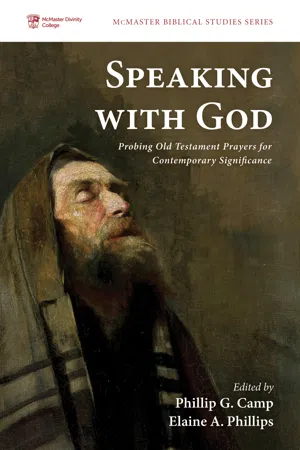
eBook - ePub
Speaking with God
Probing Old Testament Prayers for Contemporary Significance
- 294 pages
- English
- ePUB (mobile friendly)
- Available on iOS & Android
eBook - ePub
Speaking with God
Probing Old Testament Prayers for Contemporary Significance
About this book
"Incline your ear, O Lord, and answer me, for I am poor and needy!" (Ps 86:1). God's people, past and present, know that the Lord of all creation listens to their prayers for mercy, help, forgiveness, and justice. God's people cry out to the heart of their God, sometimes through intense struggle and perplexity, and they expect an answer. There can be no less in a true relationship. They also celebrate their experiences of God's faithfulness. There is no area of life outside the bounds of prayer. The essays in this collection, written by biblical scholars, explore Old Testament prayers in order to enrich our understanding of Israel's beliefs about and relationship with God. Equally important for each of the authors is the following question: Why do these prayers matter for the life of the church today?
Information
Topic
Theology & ReligionSubtopic
Biblical Studies1
Prayers in the Hebrew Bible
Boundaries, Intentions, and Theological Interfaces
Introduction
We are embarking on an exploration of individuals’ prayers as we encounter them in the Hebrew Bible. This venture invites us to pause with familiar biblical figures and listen again. As we do, our initial questions will be: what actually constitutes prayer? Does all second-person address to the God of heaven qualify as prayer, even if there is no perceived response? In addition, in the wealth of biblical narrative and poetry, we find a number of what we might label as failed attempts to communicate with God. What about those? Interwoven with these questions is the rich literary and theological fabric that lies inside whatever boundaries we draw.
Definition and Boundaries—“Are We Ever Not Praying?”
Even with the matter of definition, a number of interrelated issues must be sorted through. The distinctions below are not intended to create discrete categories. They are simply a means of formulating with some degree of order the components of a possible definition.
Verbal
We turn first to the matter of Hebrew prayer vocabulary. In addition to the noun, tefillah (prayer), and its related cognates, we encounter darash (seek, inquire), ‘atar (entreat), sha’al (ask), yadah (thank), and barakh (bless). “Calling upon the Name of the Lord” and “X said to God . . . ” are also signals in narrative portions of Scripture.1 These are not, however, entirely sufficient to cover what happens in conjunction with wide-ranging conversations with God. Often lodged deeply in the brokenness of human experience, prayer bursts forth in emotionally charged circumstances that prompt crying out, summoning, pleading, and seeking God’s face. The supplicant often asked for favor or grace (tekhinnah and cognate forms). Some of these reach a desperation level well beyond “conversation.”
Prayer may also include accusatory questions that emerge from doubt and fear in one’s wretched straits. “How long, O Lord?” is a familiar one, and it demanded a response. The divine Partner was occasionally called upon to “wake up” (Isa 51:9–10) followed by pleas to “protect, keep, guard, or deliver” (Ps 7:1–6 [2–7]). In dire circumstances, oaths and even curses might be uttered. Should these terms be caught in our vocabulary net or do they remain outside?
Beyond Verbal
To the verbal indicators of prayer, add physical involvement—tears, loud inarticulate cries, kneeling, lifting up hands, and falling prostrate to the ground. Those who prayed sometimes turned to music, because music has the capacity to transport the human soul when the vocabulary fails (2 Kgs 3:9–20). There are “sung prayers” beyond the boundaries of the recorded psalms. This foray into prayer vocabulary has already drawn us toward matters of form and motivation.
Form
In the psalms, we find praise and thanksgiving, confession and petition, pleas for deliverance and blessing, complaints, and laments, all of which have recognizable formal features. Does each of these shape our deeper understanding of the sovereign God to whom Israel directed its liturgy? At the least, having liturgical structures, especially for thanksgiving and blessing, is necessary to keep our prayers from being primarily in response to crises.
Among the characteristic forms, laments are worthy of special consideration because they juxtapose two apparently irreconcilable truths—the presumed utter trustworthiness of God alongside the devastating experience(s) of the one grieving. Further, there are those laments that say precious little about God’s faithfulness, and instead describe the heavy hand of God. The classic example is Ps 88, which is a microcosm of Job. The tragedy of human loss resonates through David’s lament over Jonathan (2 Sam 1:17–27). These anguished expressions prompted Goldingay to redefine the prayer of lament as outright protest.2 From there, it is a very short step to the uncertainty, fear, and anger that often underlie vows, oaths, and imprecations. Are these likewise lodged under the umbrella of prayer?
A further matter of form merits our consideration before turning to intentions and motives underlying biblical prayers. Our own prayers do not always arrive fully formulated. In fact, they are often feeble attempts bereft of substantial focus and shape other than self-centered grumbling. This is likewise true of the saints of the Hebrew Bible as they appealed to God in their straits. In sum, we might make a case for a rather wide range of vocabularies and forms.
Just as the section on “vocabulary” included non-verbal expressions, the accoutrements for prayer are noteworthy. Wearing sackcloth is sometimes associated with prayer (e.g., 1 Chr 21:16–17; Ps 35:13; Dan 9:3; Jonah 3:5–8). Prayer and fasting were occasionally conjoined (1 Sam 7:6; Ezra 9:3—10:6). What did these accomplish toward the efficacy of that prayer? Rituals such as pouring out water (1 Sam 7:6) were also part of the solemn gathering. Could it be that more serious circumstances required more liturgical “vestment”?
Intention: Call and Response
God’s people prayed because they were invited, in fact, commanded to do so. Even though the Israelites would be scattered because of their idolatry, God promised that when they returned to God, seeking him with all their heart, they would find him (De...
Table of contents
- Title Page
- Preface
- Abbreviations
- Introduction: Setting the Stage
- Chapter 1: Prayers in the Hebrew Bible
- Section 1: Moses’ Prayers
- Section 2: Prayers of Kings
- Section 3: Prayers of Prophets
- Section 4: Prayers of Others
- Postscript
Trusted by 375,005 students
Access to over 1.5 million titles for a fair monthly price.
Study more efficiently using our study tools.
Frequently asked questions
Yes, you can cancel anytime from the Subscription tab in your account settings on the Perlego website. Your subscription will stay active until the end of your current billing period. Learn how to cancel your subscription
No, books cannot be downloaded as external files, such as PDFs, for use outside of Perlego. However, you can download books within the Perlego app for offline reading on mobile or tablet. Learn how to download books offline
Perlego offers two plans: Essential and Complete
- Essential is ideal for learners and professionals who enjoy exploring a wide range of subjects. Access the Essential Library with 800,000+ trusted titles and best-sellers across business, personal growth, and the humanities. Includes unlimited reading time and Standard Read Aloud voice.
- Complete: Perfect for advanced learners and researchers needing full, unrestricted access. Unlock 1.5M+ books across hundreds of subjects, including academic and specialized titles. The Complete Plan also includes advanced features like Premium Read Aloud and Research Assistant.
We are an online textbook subscription service, where you can get access to an entire online library for less than the price of a single book per month. With over 1.5 million books across 990+ topics, we’ve got you covered! Learn about our mission
Look out for the read-aloud symbol on your next book to see if you can listen to it. The read-aloud tool reads text aloud for you, highlighting the text as it is being read. You can pause it, speed it up and slow it down. Learn more about Read Aloud
Yes! You can use the Perlego app on both iOS and Android devices to read anytime, anywhere — even offline. Perfect for commutes or when you’re on the go.
Please note we cannot support devices running on iOS 13 and Android 7 or earlier. Learn more about using the app
Please note we cannot support devices running on iOS 13 and Android 7 or earlier. Learn more about using the app
Yes, you can access Speaking with God by Phillip G. Camp,Elaine A. Phillips, Phillip G. Camp, Elaine A. Phillips in PDF and/or ePUB format, as well as other popular books in Theology & Religion & Biblical Studies. We have over 1.5 million books available in our catalogue for you to explore.