- 140 pages
- English
- ePUB (mobile friendly)
- Available on iOS & Android
eBook - ePub
About this book
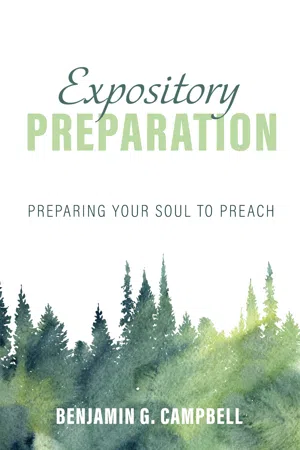
For those in local church ministry, it is often a pressing matter to find the time to take care of their own souls. More often than not, pastors tend to prioritize sermon preparation and delivery as their primary tasks, when actually their first task should be their own spiritual health. It is for this purpose that this book is written--to encourage pastors to soul care before sermon preparation. If pastors will prepare their own hearts, the sermon will fall in line and permeate the hearts of the listeners.
Information
Topic
Theology & ReligionSubtopic
Christian Ministry1
Biblical Authority
A Review
The question of the Bible’s authority deals with two elements: inerrancy and revelation. To prove the truths of Christianity, the most popular method to do so is through the evidence.1 However, is this the most beneficial method of proving God’s existence? Ronald Nash claims otherwise and states, “Many philosophical and theological arguments are rejected, then, not because the person knows or believes that a particular premise is false, but simply because he fails to see something that others regard as obvious.”2 In other words, Nash seems to claim (a view with which I would agree) that certain “proofs” are more subjective than people might realize. For instance, the truthfulness of Christianity demands more from the one aiming to prove such a worldview; Christianity cannot only come from the evidence for God’s existence, it must come from inerrancy and revelation.
Inerrancy and revelation are the two characteristics that aggregate to the authority of the Bible. It is not only that God’s Word must be without error (though it is, because of the consistency and perfection of his personality), but also that what he speaks (or reveals) about himself must always be true because of who he is.
Inerrancy
Biblical inerrancy ultimately decodes itself in these propositions: God cannot err; the Bible is God’s Word; therefore, God’s Word cannot contain error.3 Biblical inerrancy denotes itself by the character of God and the consistency of his nature; “All Scripture,” Paul writes, “is breathed out by God” (2 Tim. 3:16).4 Leroy Forlines exclaims that this is the only time in Scripture the Greek word theopneustos is used.5 The testimony Paul makes to the nature of the Bible comes from the fact that the Scriptures (both Old and New Testaments) are God’s literal words from his mouth—it is divinely breathed.6 Hence, there is a propositional reality to the nature of inerrancy and revelation because God’s truths are found through propositions in his Word. So, being that the Bible is God’s inerrant words, one must assume, then, that what it contains within it is true and right by affirming propositional revelation.
Propositional Revelation
Propositional Revelation claims that the Bible is authoritative by its propositions contained within. However, the Bible is much more than only propositions—it is language, commands, exclamations, and more. Yet, all of these are made manifest through propositions.7 In essence, propositional revelation does not claim that every jot and tittle is “inspired,” but instead proposes the idea that Scripture is true and is coherent with reality because of the rational and truthful nature of Creator God. So, then, propositional revelation deals more with the idea of the elements of the Bible’s truth and how it applies to the life of a believer. This, again, is a direct correlation with inerrancy and infallibility.
The Chicago Statement and Its Effects
However, the discourse regarding the Bible’s truth took a turn in the middle of the twentieth century when conservative, evangelical Christianity began to take progressive stances upon the inerrancy of Scripture, claiming that Scripture was not completely inerrant.8 The summary of the statement extends the claim that Scripture is God’s witness to himself.9 However, the effects of the Chicago statement are more than mere questions about the Bible, but deal with how people (those claiming Christianity and not) deal with the questions of God’s existence, God’s authority, God’s person, and God’s character.
If the Bible is God’s Word (which will be discussed further), then it must succeed that the Bible is coherent with reality. Therefore, a correct view of biblical inerrancy must be rooted in propositional revelation that applies to the theological method of believers in the Lord Jesus Christ.
Biblical Inerrancy in Light of Propositional Revelation
As noted earlier, biblical inerrancy necessitates itself in propositional revelation because the Bible is full of propositions through different elements of language and words. Carl Henry defines propositional revelation helpfully by stating propositional revelation is the idea “that God supernaturally communicated his revelation to chosen spokesmen in the express form of cognitive truths, and that the inspired prophetic-apostolic proclamation reliably articulates these truths in sentences that are not internally contradictory.”10
So, propositional revelation is not necessarily the fact that the Bible is inerrant because God is without error. God is, in his very nature, truth. It is not simply that God possesses truth, but he is Truth.11 In other words, propositional revelation is dependent upon the nature and character of God,12 and to do this, truth must be affirmed and believed also.
The Correspondence Theory ...
Table of contents
- Title Page
- Acknowledgements
- Introduction
- Chapter 1: Biblical Authority
- Chapter 2: The Pastor and the Spiritual Disciplines
- Chapter 3: Preparation and the Pastor’s Personal Life
- Chapter 4: The Disciplines of Expository Preparation
- Chapter 5: The Disciplines of Expository Preparation
- Chapter 6: Preparation as Worship
- Chapter 7: Basis for Worship
- Chapter 8: Why Expository Preparation?
- Appendix 1: “The Role of Spirituality for Sermon Preparation and Delivery”
- Appendix 2: “Addressing Cultural Issues in the Pulpit
- Bibliography
Trusted by 375,005 students
Access to over 1.5 million titles for a fair monthly price.
Study more efficiently using our study tools.
Frequently asked questions
Yes, you can cancel anytime from the Subscription tab in your account settings on the Perlego website. Your subscription will stay active until the end of your current billing period. Learn how to cancel your subscription
No, books cannot be downloaded as external files, such as PDFs, for use outside of Perlego. However, you can download books within the Perlego app for offline reading on mobile or tablet. Learn how to download books offline
Perlego offers two plans: Essential and Complete
- Essential is ideal for learners and professionals who enjoy exploring a wide range of subjects. Access the Essential Library with 800,000+ trusted titles and best-sellers across business, personal growth, and the humanities. Includes unlimited reading time and Standard Read Aloud voice.
- Complete: Perfect for advanced learners and researchers needing full, unrestricted access. Unlock 1.5M+ books across hundreds of subjects, including academic and specialized titles. The Complete Plan also includes advanced features like Premium Read Aloud and Research Assistant.
We are an online textbook subscription service, where you can get access to an entire online library for less than the price of a single book per month. With over 1.5 million books across 990+ topics, we’ve got you covered! Learn about our mission
Look out for the read-aloud symbol on your next book to see if you can listen to it. The read-aloud tool reads text aloud for you, highlighting the text as it is being read. You can pause it, speed it up and slow it down. Learn more about Read Aloud
Yes! You can use the Perlego app on both iOS and Android devices to read anytime, anywhere — even offline. Perfect for commutes or when you’re on the go.
Please note we cannot support devices running on iOS 13 and Android 7 or earlier. Learn more about using the app
Please note we cannot support devices running on iOS 13 and Android 7 or earlier. Learn more about using the app
Yes, you can access Expository Preparation by Benjamin G. Campbell in PDF and/or ePUB format, as well as other popular books in Theology & Religion & Christian Ministry. We have over 1.5 million books available in our catalogue for you to explore.