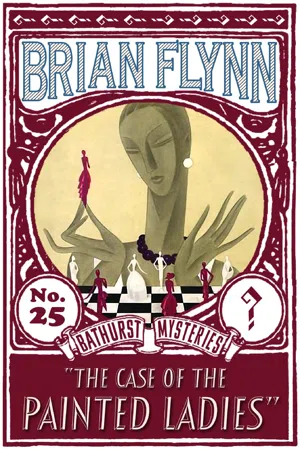
- English
- ePUB (mobile friendly)
- Available on iOS & Android
eBook - ePub
Information
CHAPTER I
THE THREE INCIDENTS
Aubrey Coventry frowned heavily and turned somewhat impatiently at the noise of the ringing telephone. “See who that is, Rayner, will you? Unless it’s something terribly important, say that I’m out. I’m not in the mood for sour somethings with anybody.”
“Very good, Mr. Coventry.” The secretary answered the ring. Almost against his will, and despite his protestation of a moment ago, Coventry found himself listening intently to the conversation as he heard it from his end.
“Mr. Coventry’s secretary speaking,” said Rayner. “Well . . . I’m not altogether sure with regard to that . . . I can find out for you, of course . . . if it’s important. What is the name, please? Montgomery? Mr. Silas Montgomery?”
Coventry saw Rayner furrow his brows. A completely puzzled look took possession of the secretary’s face. He nodded his head two or three times in answer evidently to what was being said to him by the caller. “If you’ll hang on for a moment or two, sir . . . I’ll see what I can do for you. Thank you.”
Rayner placed his hand over the telephone’s mouthpiece and, still wearing his puzzled look, turned towards his employer.
“A Mr. Silas Montgomery, sir . . . from New York . . . wishes to speak to you on what he describes as a most important matter. If you are in, he says, he would like to speak to you ‘at all costs.’ They were his very words, Mr. Coventry. . . . A rather extraordinary procedure, don’t you think?”
Aubrey Coventry frowned for the second time. As he had previously indicated to Rayner, he was not in the mood that morning for interruptions of any kind. He repeated the name that his secretary had mentioned to him.
“Silas Montgomery did you say . . . of New York . . . just a minute, Rayner . . . let me think . . . it must be the Silas Montgomery, I should imagine . . . one of the biggest operators on Wall Street for many years. Head of the Transatlantic Oil Trust. I suppose I had better speak to him—though for the life of me I can’t think what he can have to say to me.”
Rayner handed the telephone receiver to his chief without speaking. Still frowning, Coventry took it.
“This is Aubrey Coventry speaking. What is it, please?” There came a long silence as Coventry listened. “But this is most extraordinary,” Rayner heard him say, “and . . . er . . . altogether without precedent. I don’t know what I can really say to you. Besides being . . . er . . . extremely inconvenient.” The harsh and strident voice of the American came to him again after an appreciable wait. “Well . . . you can please yourself, of course, Mr. Coventry, but if you refuse to see me it will be the worst day’s work you’ve ever done in your life. Big money’s big money . . . and whether it’s you or I that’s primarily concerned . . . you can’t alter that fact.”
Coventry hesitated and glanced towards Rayner. He knew the reputation of Silas Montgomery on Wall Street when big deals and daring ventures were being put through, and was loth to throw away anything in the nature of a golden opportunity. Such an action was in direct contrast to his principles. He attempted, therefore, to compromise. “But I’m not refusing to see you,” he urged. “I’m simply telling you that two a.m.’s the most inconvenient time to expect anybody to see a complete stranger on business! Why, damn it all, man, it’s a most unusual request! Surely you yourself can see that?”
Coventry had to wait again for the reply. But it came.
“Stranger—say, I like that! I should have thought that the name of Silas Montgomery would have been good enough for anybody! Should have thought it would have crashed into Buckingham Palace itself, if needs be! Very well—have it your way, Mr. Coventry. I dare say I can find somebody else in your big city who’ll be ready and willing to listen to Silas Montgomery when he’s ready to spill his mouthful and put a few court cards on the table.”
Coventry’s frown deepened. He was beginning to feel just a little uneasy. This man had touched him on the raw. After all, Silas Montgomery was a man of powerful interests and subtle influences. It would be an appalling mistake to offend him. Perhaps he had been a trifle too . . . He collected his thoughts and came to a quick decision. “Look here, Mr. Montgomery,” he said hastily, “I’ve changed my mind. Your arguments have convinced me. I’ll expect you at two o’clock to-morrow morning. Here, as you request, in my study. I’m sorry if I appeared a little discourteous to you just now . . . but you’ll admit that the arrangement isn’t one that you’d make every day of the week.”
“Silas Montgomery isn’t in London every day of the week either, Mr. Coventry . . . so we can cry quits on that. Very well, then. Two o’clock to-morrow morning at your place. I’ll be there on the dot. Good-bye till then.”
Aubrey Coventry was left holding the receiver. He smiled cynically at Rayner. “Well, you heard most of that, Rayner. Mr. Montgomery calls here at two Ack Emma to-morrow. Though what he wants of me at that absurd time the good Lord alone knows.”
Rayner looked appropriately dubious. He sounded a warning note. “Do you consider it altogether wise of you, sir, to take this man for granted, as you appear to be doing? He may, for all we know, be an impostor. Why not make a few discreet inquiries before you definitely decide on this course of action?”
Coventry bore all his remonstrances good-humouredly. “Silas Montgomery should be good enough in himself, Rayner. The man’s name alone spells money—money in capital letters at that. Besides, I can take care of myself in most circumstances. I suppose that even you, Rayner, would admit the truth of that?” Coventry’s mood of irritation seemed to have passed and been replaced by one of good-humoured geniality.
But the secretary shook his head. “Even if I do admit that, Mr. Coventry, it doesn’t alter my opinion about this appointment. Why should a man in your position take unnecessary risks?”
“I’m not going out, Rayner. Don’t forget that. I shall be here in my own place when he comes. Surely that condition alone makes all the difference? It isn’t as though I’m being inveigled to a low den somewhere to be knocked on the head and robbed. If that were going to happen, I might agree with you as to the risk. No. Don’t you worry about me, Rayner. I shall be all right.”
Rayner shrugged his shoulders with a hopeless gesture, and surrendered his position. “Very well, Mr. Coventry, if you say so. I must, of course, abide by your decision. All the same, I shall feel very thankful when I hear that the affair is over and that no evil consequences have resulted from it.”
Aubrey Coventry laughed again at his secretary’s persistence and turned away. “You’re the faithful retainer, Rayner, I must say. All right.”
This was the first of the three remarkable incidents that were due to occur to him on that particular day.
The second of these extraordinary incidents of which mention has been made happened in a tent at a garden-party held in the Vicarage grounds of the village of Leyland in the county of Essex. The Vicar of Leyland at that time was the Rev. Noel Duff—known to his intimates, naturally, as ‘Christmas Pudding.’ Mrs. Coventry had been Susanna Duff in her maiden state, and was to-day fulfilling a long outstanding promise to her brother to open a Bazaar in the grounds of his Vicarage on behalf of the Church Building Fund. Aubrey Coventry had come to Leyland on that particular afternoon in support of his wife (verbally) and in support of the Building Fund (financially). The opening speeches had all been made, and, in addition, certain other people had contributed a few remarks. Gradually the more impatient people who were present drifted away with pilots, and without pilots, to patronize the various stalls and sideshows that had been erected by individual enthusiasm for the good of the cause, Seeing that his wife was very well looked after by her brother and a number of ecclesiastical luminaries, who had ranged themselves in her attendance, Aubrey Coventry wandered off on his own bent and eventually found himself beside a tent which exhibited the notice ‘Madame Zylphara, Palmist and Clairvoyante.’ ‘The wonderful woman who reads the Future for you.’ Aubrey Coventry smiled cynically to himself as he read the announcement. As he did so, he suddenly thought of the strange telephone message he had received that morning from Silas Montgomery, and the appointment he had arranged for two o’clock on the following morning. He thought of these matters, too, in terms of Madame Zylphara. The wonderful woman in the tent but a few yards away from him, who claimed to be able to read the future. Yielding to an insistent whim which was strangely unlike the normal Coventry, and which he would have been entirely unable to explain had he been asked to, he strode across the grass strip and nailed open the canvas of the tent in front of him. A brown-eyed girl with a yellow bandeau round her hair was sitting at the entrance. She was evidently of the lineage of St. Matthew judging by the question she put to him. Coventry laughed at the challenge and plunged his hand into his pocket.
“Oh—in that case, I’ll lash out and have the full five bob’s worth,” he answered.
The girl laughed at his reply, took the two half-crowns he handed to her, and jingled them into a bowl which stood on the table at which she sat. “If you will kindly pass behind the screen, sir, you will find that Madame Zylphara is disengaged and ready to see you at once.”
“Thank you,” said Aubrey Coventry curtly. She handed him a pink ticket and he did as he had been instructed. Beyond me screen he saw the usual appointments of the commonplace palmist. Madame Zylphara sat at a square table upon which stood the inevitable globe of crystal. She was short and stout. Her hair was black. Her eyes were blacker.
“Good afternoon,” she said. The foreign accent was unmistakable.
“Good afternoon,” responded Aubrey Coventry.
The woman had dignity, he concluded, despite the garish conditions in which she was framed. He handed over the pink ticket which the girl at the tent entrance had given to him. Madame Zylphara accepted it and nodded. It occurred to Coventry as he stood there that vouchers worth five shillings to her, came but very occasionally.
“Sit down,” she said.
He took the chair indicated.
“You desire the full reading . . . so . . . so?”
“If you will be so kind.” The woman interested and, in a way, fascinated him.
“Give me your hand . . . no, the other one, if you please.” She looked at the palm of his hand. “And your birth date . . . if you will please tell me.”
“May the twenty-ninth.”
“Ah,” she muttered . . . “So . . . so . . . a son of Gemini, of course.” She rattled off a few of the stock phrases of her trade. Coventry bore patiently with her for some little time. He remembered that he had heard most of them before at odd times and in odd places. Then he put forward a gentle remonstrance.
“This is all very interesting . . . and I must candidly admit almost all true . . . but I am really much more concerned with the future than with what has gone. Your claim is that you can foretell the future.”
“I make no claim that I cannot substantiate,” she answered almost haughtily . . . “because you find me at a Church Bazaar at an obscure village in the country, that makes no difference to my powers, even though it may to your judgment. Don’t judge me by my circumstances. If you do, you will be making a very great mistake. I am Bianca Zylphara. Let me look at your hand . . . so . . .” She bent his palm back and peered into it. Her black brows puckered into a frown. Coventry smiled at her encouragingly.
“Well?” he asked, “and what have the Gods of Chance to tell you about that?”
She put his hand away from her with a sharp exclamation and turned towards the table.
“Look into the crystal with me . . . so . . . will you, please?”
Coventry, urbane as ever, obeyed the request. The woman was seated opposite to him, but he knew instinctively that her attitude was tense and rigid. There came a silence. At length Madame Zylphara broke it. Her voice was harsh and highly charged, as it were, with emotion. “That will do. It is not necessary for you to gaze into the crystal any more. I have seen enough.”
Coventry relaxed. The woman relaxed with him. “Well?” he asked again. “I am still waiting for your prediction, you know. As a matter of fact that was the only reason which brought me here. I wasn’t at all interested in the possibilities of either blondes or brunettes.”
Madame Zylphara shook her head at him. The gesture held no hint of dubiety. Much more certainly it betokened duality. Coventry, undismayed, rallied her again. “Come on. If you aren’t sure of anything—take a chance. I won’t come back and reproach you if your prophecies go all to blazes. I promise you that.”
She flashed a look of withering scorn at him which checked effectively his tendency to flippancy. “There is no need for you to make that promise. I know that you will not come back. But ask me no more questions. I can tell you nothing.”
“You mean that you won’t. Isn’t that more like the truth?”
“Not at all. I can tell you nothing—because there is nothing to tell. How can I say more than that?”
Coventry seemed uncertain as to her meaning. He interrogated her more closely. “What do you mean exactly by that cryptic statement? It leaves me so much in the air, doesn’t it?”
Madame Zylphara gazed at him stoically. “I do not understand what you mean by that expression ‘in the air.’ But what I mean is this. I cannot tell you of your future—because there is no future for you. That is all. Please do not ask me any more.”
Coventry expostulated. “But if you’ll pardon my saying so—that’s wholly absurd. Look at it for yourself. There must be some future. It stands to reason. This present moment when I am talking to you was a future moment but a moment ago. It must be so. Past, present, and future are changing all the time. I’m not a scientific chap by any manner of means, but that’s a simple matter for anybody to understand.”
Madame Zylphara, however, remained adamant. “I know nothing of the things you talk about. But I know this. The past time was yesterday. The present is to-day. To-morrow and the days to come beyond to-morrow are the future. For you there is no future. I cannot say any more than that. Will you please go?” Madame Zylphara rose from her chair in an effort to indicate finality. Coventry shrugged his shoulders at her. If the woman wouldn’t talk—well then, she wouldn’t, and that was all there was to it. He accepted the inevitable with the best grace that he could muster. “In that case, then, I will wish you a very good afternoon and apologize for having troubled you.”
The woman inclined her head as she dismissed him. Aubrey Coventry made his way slowly out of the tent. His principal emotion was one of confused bewilderment. A few minutes afterwards he met his wife surrounded by a cluster of laughing friends and carrying a bouquet of flowers. Everybody in the company seemed to be in the highest spirits.
“Wherever have you been, Aubrey?” she demanded of him. “We’ve been looking for you everywhere.”
A second or so passed before he replied to her. He felt that it was incumbent upon him to pull himself together.
“We’ve been looking for you everywhere,” repeated Mrs. Coventry. “Noel said that you must have got off with one of his Sunday school teachers. I defended you tooth and nail almost. Now you assure me and all these others that my confidence in you was justified.” There was a general laugh at her demand. Coventry shuddered at his wife’s suggestion.
“As a matter of fact I’ve been on a much more romantic expedition than that. I’ve been having my fortune told. It was all for the good of the cause.”
Mrs. Coventry and her companions laughed boisterously. “How perfectly thrilling! You must tell us all about it. Who’s my successor? A blonde or a brunette?”
Aubrey Coventry shook his head at her. “That’s the peculiar part about it all. I’m afraid I haven’t anything to tell you. So you must resign yourselves to disappointment.”
As he spoke, the similarity of his second sentence to that of expression used by Madame Zylphara in the tent struck forcibly.
“Oh—what a terrible pity,” responded his wife. “I was bracing myself to hearing the most sensational revelations and then you go and let me down like that. Still, never mind—take me over to the refreshment tent and buy me an ice. I think it will have to be a strawberry ice. And you can whisper in my ear all that did happen. Come along now.”
She linked her arm in his rather imperiously and led him away—waving light-heartedly to the group of people she left behind. Coventry said nothing. He suffered himself to be led away. This, as has already been stated, was the second remarkable incident of the day’s happenings.
Aubrey Coventry was expecting three men to arrive at his London house at half-past seven. He was attending with them a fancy dress ball at Dorset House half an hour later. The three men whom he expected to accompany him were his only son, Philip, his niece’s fiancé, Peter Crayle, and Philip’s bosom crony, Hubert Palmer. They were all frequently together under his roof. It was to be a stag party as far as they themselves were concerned, as neither his wife nor Valerie Moffatt, his niece, was going. Since leaving the Bazaar in the Vicarage grounds at Leyland, he had been the creature of many conflicting moods and emotions. Strive as he might to retain his normality, he was unable to put away from him the remembrance of the interview in the...
Table of contents
- Cover
- Title Page/About the Book
- Contents
- Introduction by Steve Barge
- CHAPTER I THE THREE INCIDENTS
- CHAPTER II THE BALL AT DORSET HOUSE
- CHAPTER III ENTER SILAS MONTGOMERY
- CHAPTER IV MURDER
- CHAPTER V CERTAIN STRANGENESSES
- CHAPTER VI SUSANNA COVENTRY
- CHAPTER VII CLAIRVOYANTE
- CHAPTER VIII MACMORRAN DRAWS BLOOD
- CHAPTER IX ALIBIS
- CHAPTER X MESSAGES BY PROXY
- CHAPTER XI DETECTION BY DISSECTION
- CHAPTER XII MR. BATHURST PERSEVERES
- CHAPTER XIII UNDER THE SEAT
- CHAPTER XIV ANOTHER SENSATION
- CHAPTER XV RAYNER AS ESCORT
- CHAPTER XVI CROSS TRAILS
- CHAPTER XVII ANTIQUES
- CHAPTER XVIII MUCH ARGUMENT
- CHAPTER XIX MR. BATHURST STARTS AGAIN
- CHAPTER XX THE PROFESSIONAL TOUCH
- CHAPTER XXI RAYNER TALKS
- CHAPTER XXII THE YARD AT GLOUCESTER ROAD
- CHAPTER XXIII DIRECT ATTACK
- CHAPTER XXIV THE NEAREST OF NEAR THINGS
- CHAPTER XXV SERE AND YELLOW
- CHAPTER XXVI EXPERT
- CHAPTER XXVII THE LOSER PAYS
- CHAPTER XXVIII THE NEAREST PART
- CHAPTER XXIX LET GO THE PAINTER
- CHAPTER XXX VALERIE PLAYS THE GAME
- CHAPTER XXXI REACTIONS (SABBATH)
- CHAPTER XXXII REACTIONS. (POST-SABBATH)
- CHAPTER XXXIII MR. BATHURST SUMS UP
- About The Author
- Titles by Brian Flynn
- Copyright
Trusted by 375,005 students
Access to over 1.5 million titles for a fair monthly price.
Study more efficiently using our study tools.
Frequently asked questions
Yes, you can cancel anytime from the Subscription tab in your account settings on the Perlego website. Your subscription will stay active until the end of your current billing period. Learn how to cancel your subscription
No, books cannot be downloaded as external files, such as PDFs, for use outside of Perlego. However, you can download books within the Perlego app for offline reading on mobile or tablet. Learn how to download books offline
Perlego offers two plans: Essential and Complete
- Essential is ideal for learners and professionals who enjoy exploring a wide range of subjects. Access the Essential Library with 800,000+ trusted titles and best-sellers across business, personal growth, and the humanities. Includes unlimited reading time and Standard Read Aloud voice.
- Complete: Perfect for advanced learners and researchers needing full, unrestricted access. Unlock 1.5M+ books across hundreds of subjects, including academic and specialized titles. The Complete Plan also includes advanced features like Premium Read Aloud and Research Assistant.
We are an online textbook subscription service, where you can get access to an entire online library for less than the price of a single book per month. With over 1.5 million books across 990+ topics, we’ve got you covered! Learn about our mission
Look out for the read-aloud symbol on your next book to see if you can listen to it. The read-aloud tool reads text aloud for you, highlighting the text as it is being read. You can pause it, speed it up and slow it down. Learn more about Read Aloud
Yes! You can use the Perlego app on both iOS and Android devices to read anytime, anywhere — even offline. Perfect for commutes or when you’re on the go.
Please note we cannot support devices running on iOS 13 and Android 7 or earlier. Learn more about using the app
Please note we cannot support devices running on iOS 13 and Android 7 or earlier. Learn more about using the app
Yes, you can access The Case of the Painted Ladies by Brian Flynn in PDF and/or ePUB format, as well as other popular books in Literature & Crime & Mystery Literature. We have over 1.5 million books available in our catalogue for you to explore.