- English
- ePUB (mobile friendly)
- Available on iOS & Android
eBook - ePub
Information
Topic
LittératureCHAPTER I
I
A March evening was at its wildest and wettest. Wind and rain vied with each other in violence. Most of the roads were empty, dead and dark. Save for an occasional car which made its quickest way homeward, there was no life in road or street. And there were absurdly long intervals of time between these occasional cars. P.C. Percy Wragg hunched his shoulders for the umpteenth time and stared out solemnly from his coign of vantage in a convenient doorway into the wet, dim silence. Then, in an effort of protection, he attempted to bury his chin in the upturned collar of his uniform overcoat.
“Might be Sodom and Gomorrah,” he muttered to himself. “Looks like it and, what’s more, feels like it.”
Wragg’s spirits, low as they were, sank still further. Many hours of the evening and of the night to follow, loomed heavily and horribly in front of him. To add to his intense discomfort, the rain was increasing in severity. Whipped by the merciless wind, it now blew into his doorway and beat in his eyes and on his cheeks. Again he criticised the lamentable error of judgment on his part as a result of which he had entered the Police force. The sound of an approaching car made him look up and he glanced with little interest, it must be admitted, across the dark surface of the road which faced him. It glistened almost savagely with the rain that lay on it. The car towards which Constable Wragg looked was travelling fast. Considerably faster than any of the other cars which during the evening had arrested Wragg’s attention. As the car passed Wragg, its horn blared twice. Wragg looked across the road. As he did so, a yellow light shone suddenly from a window in a tall house. The car swept on and Wragg turned his head idly and watched it. The watching lasted a matter of five or six seconds. Then the sight of the car was lost in the distance and Constable Wragg slumped again into his harbouring doorway. He shook the gathered drops of rain from the surface of his cape and his dismal spirits fell to their lowest ebb. Wragg shivered. But the shiver died on the instant almost that it had been born. For as the constable shivered, a far-away scream tore in two the wet curtain of the night.
II
Wragg started to run. To run hard. Towards the place from which the scream had come. As he ran, he found himself wondering what distance away his nearest colleague was. Too far for him to be comfortable, he considered. After Wragg had sprinted a hundred yards, he began to lose his breath. His heart began to beat fast, with heavy, disordered thumps. His mouth got dry, but he ran on. More efficiently now, for he ran with long, loping strides. He must have been running, he thought to himself, for several minutes. He had forgotten the wind and the rain. He was cold and he was wet. He knew that! In addition, he was frightened. Because he knew for a certainty, through the operation of a sixth sense, which he hadn’t known before that he even possessed, that he was about to encounter something terrible.
Wragg continued to run towards the place from which he judged the scream had come. Suddenly, as he ran, he turned a corner and saw a car standing almost at right angles to the road upon which it stood. Wragg knew at once that this was the car which he had noticed a few moments previously. What had happened to it? There was no obvious sign of collision or accident, but despite this Constable Wragg knew beyond the shadow of a doubt that something was terribly wrong with this car and also with the people who were in it.
Wragg raced up to the car and turned the handle of the door on the near side. As he opened the door, Wragg caught his breath. The body of a man lay slumped over the steering wheel. The constable let the light of his torch play over the man’s face. What he saw there made him more fearful than ever. For on the man’s face there was a look of convulsed, contorted horror. The features were twisted into a spasm of pain which had creased the lines round the nose and mouth and turned them into an appalling leer.
“Struth!” muttered Wragg. “I’d like to know what got him—that I would.”
Then he raised his nostrils to the air above him and sniffed. “Something burning,” he muttered, “and in here too. I wonder where the—”
Wragg broke off abruptly and flashed the light of his torch round the interior of the car. But he was unable to trace where the smell was coming from. He came away from the car and looked in both directions, up and down the road. There was no sign of any life whatever. The road led from the town of Mallett to the adjoining villages of Fell and Forge, but the night was bad and there would be few cars travelling in that direction before the morning came. Wragg scratched his head and, that action failing to produce inspiration, rubbed his chin. He felt that he was in a quandary. He went back to the car and put his hand against the man’s heart. He felt convinced that he could feel it beating. Yes . . . the man was still alive. The realisation of this stung Wragg into more definite action. He knew that there was a Police box some little distance on the road to Fell. To get there and to ask for help would be the best course that he could possibly take. Wragg began to run again. Towards the Police box on the road to Fell. He made it in a matter of some three minutes and telephoned to the Police headquarters at Mallett.
“Police-Constable Wragg speaking . . .”
III
The necessary car left the Police-station at Mallett with the least possible delay. It carried two people. Inspector Venables and Dr. Pegram. The latter was in a bad temper. That is to say in a worse temper than usual. He knew, he argued to himself, at least twenty-two better ways of spending an evening than this particular one which had been so recently forced on him. He surveyed the weather from the window of the car with moody disfavour and found words of trenchant criticism.
“Without this poisonous weather, Venables, it would have been bad enough. As it is—”
Dr. Pegram shrugged his shoulders. Inspector Venables brushed his top lip with the back of his hand. But he was a man of few words. He made no comment on the doctor’s statement. Pegram continued in his previous vein.
“Which constable did you say it was who ’phoned through?”
“Wragg.”
“Good man?”
“Yes. All right—as far as he goes. Nothing particularly brilliant about him.”
“Well—he’s gone far enough to-night. I’ll say that for him.”
Venables said nothing to this. He contented himself with nodding. Doctor Pegram, sore and annoyed, came again.
“Reliable man? Or given to being fanciful?”
“Oh—reliable. Certainly not the latter. Minus imagination much more than plus.”
Pegram grunted at Venables’s assessment. “Where is he exactly did you say?”
“Out towards the western boundary of the town. Out towards Fell. He spoke from the Police box on the Fell road. Take us another ten minutes at least.” Venables slumped into his seat.
The doctor looked out of the window again. “What a night,” he moaned. “Makes me think of Macbeth’s witches and people like King Lear. They’d be having the time of their lives.”
The car swept on. Venables glanced at his watch. “Not so long now. We ought to be on the Fell road in a minute or so.”
“In the fell clutch,” rejoined Pegram disconsolately; “that would be a more apt description.”
He thrust his hands deeply into the pockets of his Burberry and pushed his back hard against the upholstery of the car. The next few minutes passed in silence. Suddenly Venables leant forward and spoke to the driver through the speaking tube.
“Just ahead, I fancy. Keep your eyes open, Foster. It’s wretchedly dark along here.”
The chauffeur gave the sign that he had heard and understood. Dr. Pegram took his hands from his pockets and tried to rub some of the mist and moisture from the glass of the window. As he did so the pace of the car began to diminish.
“Here we are, Doctor,” said the Inspector; “you’ll be on the job now in a brace of shakes.”
“You sound as though you regard it as a pleasant prospect,” growled Pegram. “Are you aware, my dear chap, that I might have been playing bridge at this blessed moment.”
The car stopped and the two men got out. Constable Wragg emerged from the shadows and advanced to meet them.
“Now, Constable Wragg,” said the Inspector, “what’s all this about?”
Wragg amplified the report that he had already supplied on the telephone. Dr. Pegram had gone to the big black car, the bonnet of which was pointing almost straight to the near side of the road. Still talking, Venables and Wragg went nearer to where the doctor was standing. They could hear him muttering and mumbling to himself as his hands worked on the body of the man by the steering-wheel. Suddenly he jerked his head back and called to the Inspector. There was an unusual note in his voice.
“Venables! Come here, man, will you?”
Venables pushed his head and a portion of his body into the interior of the car. Dr. Pegram half-turned from his task to speak to him.
“This fellow’s dead, Inspector. But he hasn’t been dead for over long.”
Pegram took his hat off, tossed it on to the seat at the back of the car and then scratched his head.
“What’s the matter, Doctor?” inquired the Inspector.
“Well—I’m damned if I know quite what’s killed him. Frankly, Venables—I’m puzzled.”
“Why—what’s the trouble exactly?”
Pegram shook his head. “Wish I could tell you. But I can’t. It’s death from shock of some kind, though what the shock was, I’m still wondering.”
Then as Police-Constable Wragg had done before him, he lifted his nose and sniffed. “Can you smell something burning, Inspector? In the car somewhere? I’ll swear that I can.”
Venables did an exercise in sniffing. “I agree, Doctor. I get it distinctly.”
Wragg, who had heard the conversation, coughed discreetly. “I noticed it too, sir. When I first came along. I attempted to trace where it was, but I was unsuccessful.”
Dr. Pegram sniffed again. “It may sound ridiculous, but it seems to me—here, give me a hand with this fellow. I’ll soon settle the matter. Take him out and we’ll lay him on the grass part of the path here. I can run the rule over him better down there than stuck inside as he is now.”
The Inspector and Wragg helped the doctor to move the body from the car on to the path. Pegram went on one knee and busied himself with the man’s clothing. The others saw him push his hands under the body.
“More light,” he said curtly. “Shine your torches right on my hands.”
The light flooded the prostrate body. Pegram heaved it over on to its face. By the light of the torches Inspector Venables saw a puzzled look come over the doctor’s face.
“Something here, Inspector! Can’t make it out. Extraordinary business. Between his clothes and his flesh.”
Suddenly a look of understanding showed and he thrust his nose in the direction of the man’s back. “What I smelt and what you smelt, Constable Wragg, was burning flesh! Neither more nor less. The clothes are burnt as well. But what the hell it all means—”
Pegram glanced up to the Inspector. “I’m going to take this chap back to Mallett. In my car. It’s impossible for me to examine him properly here—especially in this foul weather. Wragg can stay and ’phone for help with the first car. We’ll put this fellow on the back seat in our own car. There’s quite a lot about this business that I don’t like at all. O.K., Venables?”
The Inspector nodded his agreement with the suggestion. Wragg helped them to lift the dead body and place it in the car as Dr. Pegram had indicated. Foster, the chauffeur, who had remained in the driving-seat, started on the journey back to Mallett.
IV
Inspector Venables examined certain entries in Police-Constable Wragg’s note-book which he had taken from the latter before they parted company. For some time he sat silent and in deep thought. Dr. Pegram was content to sit by the side of the chauffeur with his head half-inclined towards Venables at the back of the car. Suddenly Venables looked up from Wragg’s note-book and spoke to the doctor.
“There’s one thing. Dr. Pegram: it’s a local car all right. XXX555—it’s a Mallett registration mark and number. So we shan’t be long in establishing the dead man’s identity. That means a saving of time, if nothing else. It’s a stroke of luck I hadn’t anticipated. I was expecting something infinitely more troublesome.”
Pegram grunted. His mind was occupied in turning over, again and again, the circumstances of the death of the man whose body lay in the car. It was true that he hadn’t been able to give the body an adequate examination under the conditions in which he had seen it, but even allowing for this defection, he was still puzzled by what he had actually seen. And until he would be in a position to carry out a thorough examination in conditions entirely to his liking, he knew that these emotions which now possessed him would remain with him. When the police car entered the main street of Mallett, Pegram gave an order to Foster, the chauffeur.
“When we get to the station, Foster, I shall want you to help me carry that body into the mortuary chamber. We’ve gained time by bringing it in the car. To have sent for the ambulance would have meant wasting at least another half-hour. So look slippy directly you pull up the car—will you?”
“Very good, sir.”
Foster was quick and precise when the moment came to carry out his instructions. With the body ...
Table of contents
- Cover
- Title Page/About the Book
- Contents
- Introduction by Steve Barge
- CHAPTER I
- CHAPTER II
- CHAPTER III
- CHAPTER IV
- CHAPTER V
- CHAPTER VI
- CHAPTER VII
- CHAPTER VIII
- About The Author
- Titles by Brian Flynn
- Copyright
Trusted by 375,005 students
Access to over 1.5 million titles for a fair monthly price.
Study more efficiently using our study tools.
Frequently asked questions
Yes, you can cancel anytime from the Subscription tab in your account settings on the Perlego website. Your subscription will stay active until the end of your current billing period. Learn how to cancel your subscription
No, books cannot be downloaded as external files, such as PDFs, for use outside of Perlego. However, you can download books within the Perlego app for offline reading on mobile or tablet. Learn how to download books offline
Perlego offers two plans: Essential and Complete
- Essential is ideal for learners and professionals who enjoy exploring a wide range of subjects. Access the Essential Library with 800,000+ trusted titles and best-sellers across business, personal growth, and the humanities. Includes unlimited reading time and Standard Read Aloud voice.
- Complete: Perfect for advanced learners and researchers needing full, unrestricted access. Unlock 1.5M+ books across hundreds of subjects, including academic and specialized titles. The Complete Plan also includes advanced features like Premium Read Aloud and Research Assistant.
We are an online textbook subscription service, where you can get access to an entire online library for less than the price of a single book per month. With over 1.5 million books across 990+ topics, we’ve got you covered! Learn about our mission
Look out for the read-aloud symbol on your next book to see if you can listen to it. The read-aloud tool reads text aloud for you, highlighting the text as it is being read. You can pause it, speed it up and slow it down. Learn more about Read Aloud
Yes! You can use the Perlego app on both iOS and Android devices to read anytime, anywhere — even offline. Perfect for commutes or when you’re on the go.
Please note we cannot support devices running on iOS 13 and Android 7 or earlier. Learn more about using the app
Please note we cannot support devices running on iOS 13 and Android 7 or earlier. Learn more about using the app
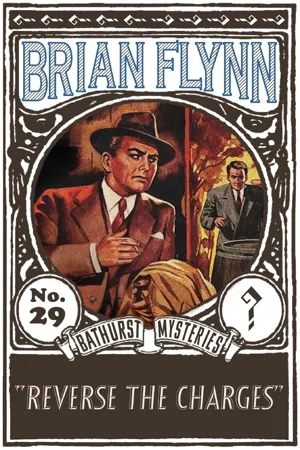
Yes, you can access Reverse the Charges by Brian Flynn in PDF and/or ePUB format, as well as other popular books in Littérature & Littérature policière et sur le mystère. We have over 1.5 million books available in our catalogue for you to explore.