eBook - ePub
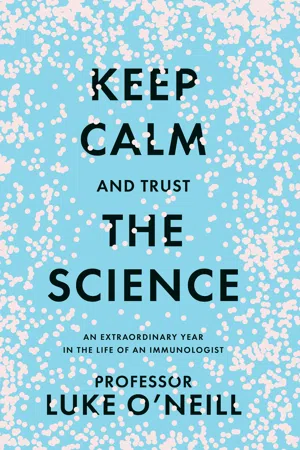
Keep Calm and Trust the Science
An extraordinary year in the life of an immunologist
- 368 pages
- English
- ePUB (mobile friendly)
- Available on iOS & Android
eBook - ePub
About this book
Professor Luke O'Neill has become one of the most well-known and trusted voices of Ireland's COVID-19 pandemic, thrust into the spotlight as we struggled to make sense of a crisis that saw the country grind to a halt. In these personal diaries, Luke reveals what life was like behind the scenes as he endeavoured to keep calm and trust that the science would save us.
Luke's lockdown diaries show the highs and lows of work at the cutting edge in his Trinity College lab, as well as his experience of the disappointments and the breakthroughs in science around the world, and ultimately the contribution scientists made to the health outcomes of millions globally.
Shot through with the natural positivity and humour that have made Luke a home-grown hero, Keep Calm and Trust the Science is a compelling account of a dramatic year in Irish history from one of its key players.
Information
NOVEMBER 2020
MONDAY 2 NOVEMBER
Great interview with Nadine O’Regan for the Sunday Business Post about Never Mind. She had read the book in detail and especially liked the chapter on racism, which was a relief. Such a sensitive topic, especially given the situation in the US. I described racism against the Irish to show that we could relate to others. I wonder will it resonate with others?
TUESDAY 3 NOVEMBER
Today I felt fully charged, like the Duracell bunny. I counted it – 11 hours of productive work, not including breaks. Gave a talk to around 200 Google engineers and coders. We discussed mental health issues. Some had read the chapter in Never Mind on depression and it had resonated. This is what I wanted to happen with the book.
A key concern was the mental-health effects of working from home. Imagine this virus had come along years ago – home working would not have been possible. People would have had to go to work, increasing the rate of infection. I told them that Zoom has saved lives. So yet again, this pandemic is one for the technological age. I gave them some tips. Take regular breaks. Have a ‘commute’ before and after the working day, like a walk around the block. This gets your head ready. Something else I read was that working on screens makes things ‘transactional’, which is not good. We are human beings, after all. It’s a poor replacement for physical contact. Many are wondering what this will mean for people, and also for how companies operate. Will it mean a decrease in productivity? We had a lively discussion with lots of questions, so it’s very much in people’s minds. A lot asking what will happen when the pandemic ends. I said it would probably mean blended working – sometimes from home, sometimes in the office.
Got a phone call just before 6 p.m. Alva from SFI rang to say I’d won the Science Communicator of the Year Award! This made me feel really good. It’s great to get feedback that what I do is seen as worthwhile. And the dreaded imposter syndrome is kept at bay. The awards ceremony will all be virtual with no possibility for an in-person celebration. Another example of what COVID-19 has done. No live awards and no need to get up and make a speech. Strange.
WEDNESDAY 4 NOVEMBER
Loved doing the podcast about laughter with Doireann Garrihy – The Laughs of Your Life. She asked for my favourite joke. I told her the one about three nuns who tragically died in a car crash. They arrive at the pearly gates and St Peter says, ‘Welcome, sisters! You have all lead a blameless life of serving others. But I need to ask you one question before I let you into heaven.’ He turns to the first nun and says, ‘Who was the first man?’ The nun says, ‘Oh that’s easy. It was Adam!’ ‘Correct! Please enter,’ says Peter. He turns to the second nun and says, ‘Who was the first woman?’ And she says, ‘Oh that’s easy. It was Eve!’ ‘Correct. Please enter.’ He then turns to the third nun and says, ‘Now, because you are the Mother Superior, I have to make your question a little more difficult. When Eve met Adam for the first time, what did she say to him?’ ‘Oh,’ says the nun. ‘That’s a hard one.’ And St Peter says, ‘Correct answer! Welcome!’ Doireann laughed and laughed. Can’t beat a smutty joke.
THURSDAY 5 NOVEMBER
Did long COVID with Pat, as a report has concluded that it affects one in five. Serious. And a Leipzig study revealed that people shouldn’t hang around food vendors. No shit, Sherlock.
Interview in the Science Gallery about Never Mind. Eleven years ago, we ran an exhibition there called ‘Infectious’. We took saliva from people who attended the exhibition. My lab tested them for a variant in a gene we had found for a protein called MAL, which Adrian Hill’s lab had shown might decrease the risk of catching malaria. Little did I think back then that Adrian would be part of the team that would develop the Oxford/AstraZeneca vaccine programme. Imagine how he must feel – making a vaccine that will have a huge impact on millions of people. That’s been his big goal for several infectious diseases. He’d plugged away for years on malaria and didn’t make much progress, but all that effort wasn’t wasted, as he and his team, led by Sarah Gilbert, have done fantastic work. We’ll have to put up a statue to Adrian in the Science Gallery.
Today though, the Science Gallery was a bit sad. We did the interview in the PACCAR theatre. I’ve so many memories of events there, packed full of people. It will come back. The interviewers were really good.
And then in the afternoon – the big Roche talk! No nerves of any kind. It would have been a different story if I’d been there in person. Gave my 20 minutes. Very satisfying to tell the story of Inflazome. I went back to 1986, when I went to a talk by Charles Dinarello (one of my heroes) on IL-1 in London. I began working on IL-1 then. It was clearly involved in so many diseases, so the hope was always there that blocking it would work somewhere. I spoke about a conference I went to in 2001 when Jürg Tschopp first described NLRP3, the key driver of IL-1. And then how we found a drug made by Pfizer (which was pointed out to me by a colleague in Trinity – Tim Mantle) that was able to block IL-1. We showed it worked by blocking NLRP3, and how our paper on that was called a ‘game-changer’ by Novartis. And then how my co-founder of Inflazome, Matt Cooper, drove it all hard to find compounds better than the Pfizer one, and which were then bought by Roche. I reminded Roche that way back in 1984, they were the first to clone the gene for IL-1alpha, so they’ve had a long interest in it too. And now we go forward into the clinic. Oh, please let the drugs work in diseases! I can’t wait to see the results of the trials.
Finished the day with two more events. The charity GOAL wanted to give their staff an update on COVID-19. GOAL will be involved in the vaccine roll-out to the developing world. And then in the evening, a lively Zoom call with the UCC Student Society.
Went to bed in a daze – and slept like a top.
FRIDAY 6 NOVEMBER
Morning discussion with the graduate students in Athlone Institute of Technology. Then a lab meeting. Tristram presented. Excitement! He has seen that our wonderful (ha!) potential new drug itaconate might block coagulation in vivo and could well have the makings of a new medicine. This could be big. We are aiming for COVID-19, as the evidence that this disease is caused by blood clotting in the lungs gets stronger all the time. Let’s see what happens next.
We also found that a related drug called dimethyl fumarate (DMF), which is already used in humans to treat the inflammation in multiple sclerosis, might work too. Another example of drug repurposing? It’s happening all the time in COVID-19 trials. There are efforts to block the cytokine IL-6 with a drug that is used for rheumatoid arthritis. So why not a drug for MS being redeployed against COVID-19? Early days, don’t get too excited. But Tris’s data got us all going, and fair play to him.
MONDAY 9 NOVEMBER
Top of the agenda with Pat today was how long immune memory might last against COVID-19. Then onto mink, and how they might have been infected. Of all the creatures … This is leading to culling of millions of mink – such a shame. A friend of mine with dark humour sent me a message: ‘Satan is summoning the mink!’ And an analysis of mental health issues on Twitter has shown a 14 per cent increase in people looking for help – from 40 million in 2019 up to 60 million in 2020. So tough for so many.
And then – pure magic. Magic that might change everything! Pfizer/BioNTech issued a press release saying their vaccine trial had revealed that the vaccine is 90 per cent efficacious. I nearly fell off my seat. This is what we’ve been waiting for. The number 90 becomes the best number ever. There was always a risk that the vaccine would not work or might have some side effect. I really thought it would take until March or April to reach this point and yet here we are!
It’s an RNA vaccine, which is brand-new technology. An RNA vaccine has never been approved before. And now we have efficacy, and at a remarkable level. A flurry of media uptake. Rory came to the lab to film for Newstalk. Drivetime and Six One want a slot. Claire Byrne Live also. Such excitement. What bothers me slightly though is we haven’t seen any data. It’s science by press release. But still, huge optimism. This is definitely the beginning of the end. There’s a good chance that the Moderna vaccine will work, as that is also an RNA vaccine. A number of vaccines, including AstraZeneca/ Oxford and Johnson & Johnson, are DNA and not RNA vaccines, but they also make the spike protein, like the Pfizer vaccine. The immune response to the spike protein, coming from RNA or DNA, is strong.
Looked up a bit of the history for the media. BioNTech are a German company founded by Özlem Türeci and Uğur Şahin. Şahin is a medical doctor with a PhD in immunology. He had worked in the lab of Rolf Zinkernagel, who won the Nobel Prize for his work on immunology in 1996. Türeci is his wife and the Chief Medical Officer of BioNTech. They have been pursuing RNA vaccines for years, initially against cancer. They began making the vaccine back in February, and now, nine months later, the world has a vaccine that is 90 per cent efficacious against COVID-19. A number of things were needed. First the RNA had to be modified to make it safe, and that was done using technology discovered in the University of Pennsylvania by Katalin Karikó. And importantly, a way to deliver it, which involves liposomes, made from specific fat molecules. That had to be invented too. This was achieved in the University of British Columbia. If ever you needed evidence for the importance of universities, this is it. An awful lot of science had to be done to get to this vaccine – and in 20 years or more.
RTÉ Six One came in to interview me live in the Explorium – a big science centre where I was already doing some filming for the RTÉ science show Future Island. Great to be able to tell people – a real hope at last. I hope I conveyed the excitement, which is actually difficult to contain! I’m still smiling. I really thought it would be March before we got to this point, and even that was uncertain, with maybe low efficacy.
I feel like a kid on Christmas morning. I sense a kind of magic in the air. The colour of life will change from now on, away from black and white and eventually back into brilliant Technicolor. A long way to go, and many bumps likely, but there is hope …
TUESDAY 10 NOVEMBER
Zoom call with the Association of Community and Comprehensive Schools: 96 schools are in the group, and a load of principals and deputies. It’s been tough for school management. Gave them an update and banged on and on about the Pfizer/BioNTech vaccine. Hope I didn’t bore them.
Then out to the Explorium again. We go live tonight! I have a lovely room of my own there with a nice heater. Essential, as today was so murky and cold. There’s catering too, so every so often I get brought a nice cup of coffee or some lunch or dinner. I could get used to this.
Liz Bonnin and I did a rehearsal of the opening section and the big parts in tonight’s show. We changed it a bit, leaving some topics out and adding in others. We also worked on a maths piece on the Fibonacci sequence. This is a sequence of numbers that can generate a ratio seen throughout nature. Did we invent maths or see something that was already there? Towards the end, I quipped, ‘So this guy Fibonacci and all his numbers. Was he the original Count in Sesame Street?’ I was proud of this line – the maths was tricky enough!
And then we went live. Eek! But it was fine. Interviewed P.J. Gallagher, who had driven a driverless car. I pointed out that I couldn’t drive. ‘Well,’ he replied, ‘at least that’s something I can do better than you!’
Had to stay late as I took part in the COVID Citizens’ Assembly, which is a real-time online event sponsored by SFI and happening every night after each show. It went well, though a couple of anti-vaxxers sent in comments. If you were tired and cranky you might get cross with them, but I didn’t. I did, though, manage to spill a full cup of coffee on my trousers, but that wasn’t because of them. It was because I am an eejit sometimes.
At least five people said to me that either they or their relatives – usually their mothers – were fans. Good Lord.
Got home about ten and put the TV on. Watched some movie, can’t even remember what, and fell asleep on the couch.
WEDNESDAY 11 NOVEMBER
Interview with the Irish Strategic Investment Fund at Treasury Dock, North Wall, about Inflazome. They are also beneficiaries from the deal, which means the Irish exchequer benefits too. I got off the Dart at Grand Canal Quay and walked over the Beckett Bridge. It was lashing rain and windy, so it was a struggle. My umbrella was pushed inside out as I crossed the Liffey. You know that kind of day when the weather is against you? A nice hot cup of coffee sorted me out.
Over to Trinity for an in-person lecture. Imagine! It was to the MSc students in immunotherapeutics. Now there’s something relevant. About five of them were in the lecture room, all wearing masks. The rest on Zoom. I really enjoyed it. I love lecturing, and it has been such a long time.
Con sent me another poem today. Has he nothing else to be doing?! It’s a really nice one – about a priest he met in St Finbarr’s church:
But there is this fellow
Luke O’Neill
Seems to know
What to say
Even wrote a book
‘Never mind the –’
Oh! but –
Can’t say the title now
Available I’m sure
In Bantry bookshop
Bantry Bay
THURSDAY 12 NOVEMBER
Today is my 27th wedding anniversary. I always buy the g...
Table of contents
- Cover
- Title Page
- Dedication
- Contents
- Introduction
- January 2020
- February 2020
- March 2020
- April 2020
- May 2020
- June 2020
- July 2020
- August 2020
- September 2020
- October 2020
- November 2020
- December 2020
- January 2021
- February 2021
- March 2021
- April 2021
- Epilogue
- Acknowledgements
- Copyright
- About the Author
- About Gill Books
Trusted by 375,005 students
Access to over 1.5 million titles for a fair monthly price.
Study more efficiently using our study tools.
Frequently asked questions
Yes, you can cancel anytime from the Subscription tab in your account settings on the Perlego website. Your subscription will stay active until the end of your current billing period. Learn how to cancel your subscription
No, books cannot be downloaded as external files, such as PDFs, for use outside of Perlego. However, you can download books within the Perlego app for offline reading on mobile or tablet. Learn how to download books offline
Perlego offers two plans: Essential and Complete
- Essential is ideal for learners and professionals who enjoy exploring a wide range of subjects. Access the Essential Library with 800,000+ trusted titles and best-sellers across business, personal growth, and the humanities. Includes unlimited reading time and Standard Read Aloud voice.
- Complete: Perfect for advanced learners and researchers needing full, unrestricted access. Unlock 1.5M+ books across hundreds of subjects, including academic and specialized titles. The Complete Plan also includes advanced features like Premium Read Aloud and Research Assistant.
We are an online textbook subscription service, where you can get access to an entire online library for less than the price of a single book per month. With over 1.5 million books across 990+ topics, we’ve got you covered! Learn about our mission
Look out for the read-aloud symbol on your next book to see if you can listen to it. The read-aloud tool reads text aloud for you, highlighting the text as it is being read. You can pause it, speed it up and slow it down. Learn more about Read Aloud
Yes! You can use the Perlego app on both iOS and Android devices to read anytime, anywhere — even offline. Perfect for commutes or when you’re on the go.
Please note we cannot support devices running on iOS 13 and Android 7 or earlier. Learn more about using the app
Please note we cannot support devices running on iOS 13 and Android 7 or earlier. Learn more about using the app
Yes, you can access Keep Calm and Trust the Science by Luke O'Neill in PDF and/or ePUB format, as well as other popular books in Biological Sciences & Biostatistics. We have over 1.5 million books available in our catalogue for you to explore.