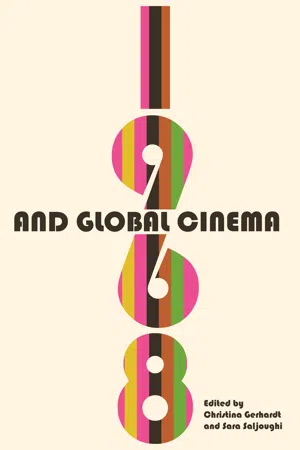
1968 and Global Cinema addresses a notable gap in film studies. Although scholarship exists on the late 1950s and 1960s New Wave films, research that puts cinemas on 1968 into dialogue with one another across national boundaries is surprisingly lacking. Only in recent years have histories of 1968 begun to consider the interplay among social movements globally. The essays in this volume, edited by Christina Gerhardt and Sara Saljoughi, cover a breadth of cinematic movements that were part of the era's radical politics and independence movements. Focusing on history, aesthetics, and politics, each contribution illuminates conventional understandings of the relationship of cinema to the events of 1968, or "the long Sixties." The volume is organized chronologically, highlighting the shifts and developments in ideology in different geographic contexts. The first section, "The Long Sixties: Cinematic New Waves, " examines both the visuals of new cinemas, as well as new readings of the period's politics in various geopolitical iterations. This half of the book begins with an argument that while the impact of Italian Neorealism and the French New Wave on subsequent global new waves is undeniable, the influence of cinemas of the so-called Global South is pivotal for the era's cinema as well. The second section, "Aftershocks, " considers the lasting impact of 1968 and related cinematic new waves into the 1970s. The essays in this section range from China's Cultural Revolution in cinema to militancy and industrial struggle in 1970s worker's films in Spain. In these ways, the volume provides fresh takes and allows for new discoveries of the cinemas of the long 1968. 1968 and Global Cinema aims to achieve balance between new readings of well-known films, filmmakers, and movements, as well as new research that engages lesser-known bodies of films and film texts. The volume is ideal for graduate and undergraduate courses on the long sixties, political cinema, 1968, and new waves in art history, cultural studies, and film and media studies.
- 384 pages
- English
- ePUB (mobile friendly)
- Available on iOS & Android
eBook - ePub
1968 and Global Cinema
About this book
Information
Subtopic
Film et vidéoII
Aftershocks
11
RE-PRESENTING THE “JUST IMAGE”
Godard-Gorin’s Vent d’est and the Radical Thwartedness of Maoist Solidarity after May 1968
Man-tat Terence Leung
In the wake of the political watershed of the May ’68 movements in France, renowned French-Swiss filmmaker Jean-Luc Godard realized that the proper direction in political cinema was not simply to “make political films” but to “make films politically” as a militant group.1 Established in the winter of 1968 by Godard, Jean-Pierre Gorin, and an ensemble of young French Maoists, the Groupe Dziga Vertov (Dziga Vertov Group, or DVG) was one of the first pioneering film collectives to practice and experiment with Maoist politics and group authorship in cinema during the long sixties.2 Unlike another famous film collective during that time, Société pour la lancement des oeuvres nouvelles (Society for the Creation of New Works, or SLON), established by Chris Marker and his Groupe Medvedkine, the DVG endeavored to adopt a formalist approach to cinema with “claims for self-reflexivity, collectivity, and class consciousness.”3
Although the aesthetic orientation of this rather elusive Maoist period of Godard seems to be radically at odds with his early auteur years and his later metaphysical and metahistorical explorations, it is equally important to keep in mind that his works made between 1968 and 1972 are often unfairly misconstrued and dismissed as either an egalitarian failure or a didactic exercise. Taking one of the most representative works of the DVG, Vent d’est/The Wind from the East (1969), as the point of departure, this essay seeks to rehistoricize the Mao-leaning years of Godard in the political aftermath of French May ’68, which continues the intense debates over the Sino-Soviet split of the 1950s with certain new and unexpected philosophical twists. In particular, it will show how this collective film produced shortly after May ’68, despite carrying a certain irreducible error of its own, may have actually advanced a new kind of dialectical thinking in political filmmaking that radically complicates the classic antidoctrinal aesthetic paradigm of what Peter Wollen called “counter-cinema” a few decades ago. Moreover, this essay will also point out that a critical rereading of Vent d’est in relation to the highly heterogeneous and dividing interpretations of “Maoist solidarity” during the European leftist heyday not only is constitutive in helping to resurface many unrealized revolutionary potentialities pertaining to Godard’s cinematic radicalism of the 1960s as such but also sheds new light on the continuous problematization of the reigning global capitalist discourse and its allying neoliberal ideology today. Although the discursive construct of neoliberal capitalism becomes increasingly obligatory and predominating in the current scene, there remains much room for our perpetual imaginations of various kinds of utopian possibilities in relation to the profound emancipatory spirit of global 1968 at large.
The Flawed Revolutionary Alliances after May ’68
Of all the DVG films, Vent d’est is thought to be the most radical experiment in reworking the established relationship between image and sound that characterizes Godard’s auteur period. Although Godard’s cinema is long distinguished for its deconstructive traits among his other Nouvelle Vague fellows, the filmmaker believed that his works produced prior to 1968 fell radically short of true Marxist-Leninist elements and revolutionary dialectics. Contrary to his early auteur films such as À bout de soufflé/Breathless (1960) and Masculin féminin/Masculine Feminine (1966), which predominantly relied on the experimentations of jump cuts and other new visual cues, Godard’s Vent d’est instead makes use of voice-overs, especially female commentaries, to present a dense political discourse and self-criticism on May ’68 and its aftermath. Yet no single reading strategy offers a correct or universal formula for the characters’ actions. The film presents its political and philosophical concepts in a very lenient and eclectic fashion, thus forcing the audience to evaluate them if they are to “understand” the film at all.
Reducing the storyline to a bare minimum, Vent d’est uses typical characters taken from the Western genre, both nominally and visually, to symbolize the essential figures during the uprisings in May ’68. A cavalryman symbolically represents “the ruling class” or “a capitalist,” while an Indian represents the “working class” or “proletariat”; a pretty young lady and a handsome young man are the equivalents of the “bourgeois student protestors,” while a union delegate portrays the “revisionist trade union” in France; finally, an elusive figure named Miss Althusser symbolizes the abject position French Marxist philosopher Louis Althusser experienced shortly after May ’68. Divided into several chapters—namely “The Strike,” “The Delegate,” “The Active Minorities,” “The General Assembly,” “Repression,” “The Active Strike,” and “The Police State,” Vent d’est addresses issues like the various ideological conflicts and debates experienced in May ’68, the post-1968 political currents in France, Lenin’s commentary on left-wing infantilism, socialist self-management in Yugoslavia during the 1960s, egalitarian medical welfare in Maoist China, the necessity of revolutionary violence, and the relationships and contradictions between European political cinema and Third World cinema.
The opening shot of Vent d’est is perhaps the most revealing example of how the DVG’s philosophy of image-sound dissociation has found its specific discursive position. In this eight-minute static long take, a young bourgeois couple is lying in a field without any apparent actions or dialogues. While the on-screen images seem to be rather motionless, the parallel soundtrack features mixed opinions from the different perspectives of a manager’s family, trade union delegates, and working-class proletariats, who are all commenting on a (fictional) miner’s strike that is taking place in France in 1968.4 Interestingly, the intrusion of the voice-over commentary on the nascent scene can be seen as something like a “strike” that aims at disrupting the apparent visual status quo. The voice-over does not seek to explain the on-screen images; instead, it challenges the stability and consistency of them. James Roy MacBean comments that “in fact, when the voice-over ‘commentary’ finally breaks in, what we get is not dialogue but a critique of dialogue.”5
According to the dominant historiography about May ’68, the profound failure of the student-worker alliances during the events simply resulted from the fact that the two protesting groups lacked true dialogues and mutual understanding throughout the course of their revolutionary development. For example, with regard to the failed alliance between the students and the workers during May ’68, Marxist philosopher Louis Althusser, one of several left-leaning academic pioneers who introduced systematic Maoist thinking to the European leftist scene during the mid-1960s, argues that “the truth is that the entire working class, and not just its leadership, was not, in general, at all disposed to ‘follow’ the suggestions of the students, which were based more on a dream-experience than on an understanding of reality.”6 Althusser believes that the students were far too indulged in their spontaneous actions during the “Night of the Barricades” on May 13, 1968, and hence they bypassed the crucial moment of the worker-led insurrections that came afterward. Recuperating Lenin’s critique of left-wing infantilism during the early twentieth century, Althusser laments that the bourgeois French students somehow misrecognized themselves as the revolutionary vanguard where “in May it was the working class, and not the students, who, in the final analysis, played the determining role.”7 The so-called student-worker marriage in 1968 became, according to Althusser, a mere “historic encounter” rather than an “organic fusion” insofar as there were no concrete demands and sensible agendas made during the alliance. He succinctly points out that “an encounter may occur or not occur. It can [be] a ‘brief encounter,’ relatively accidental, in which case it will not lead to any fusion or forces.”8
What the film Vent d’est may have wanted to highlight, however, is that the revolutionary demands between the students and the workers were never preontologically opposed. Rather, the loss of the true revolutionary alliance between these two protesting groups was largely attributed to the idiosyncratic mediation of another left-leaning body—the trade union delegate. In Vent d’est, the trade union delegates always speak two languages—French and Italian.9 On the one hand, this dual linguistic advantage gives them a sort of extra privilege with which to smooth the conflicts between both the insurrectionary class and the ruling authorities, but, on the other hand, this exceptional position also allows the union delegate to manipulate the class interests of the proletariats. As such, the “Italian” language in Vent d’est has a highly negative meaning of “promiscuity” and “obscenity,” specifically emphasized in a scene featuring the seductive, womanizing “charm” of a handsome young Italian man.10 The two directors point out that the trade union officials, who are sent from the French Communist Party as a kind of political “translator,” not only fail to facilitate concrete dialogues between the students and the workers but also intensify the gulf of misunderstanding between the protestors. Consequently, the trade union does not truly ally with the proletarian subjects but actually stands for the interests of the reigning bourgeoisie. The ideological function of trade-unionism has rendered the true antagonistic edges of the working-class and the proletarian subjects rather obsolete and invisible, thus indirectly facilitating the existing power in maintaining its social status quo.11
In order to truly “make films politically,” Godard and Gorin realize that it is both important and necessary to make a film that cannot be easily comprehended and translated by typical bourgeois language and its linguistic conventions. Julia Lesage points out that Vent d’est is one of the first films from which the educated Western audiences and bourgeoisies can learn nothing except about the fundamental poverty of the language of bourgeois cinema.12 After the profound political awakening of May ’68, renowned critic Peter Wollen argued that Godard-Gorin’s Vent d’est had actually demonstrated and put forward a new form of counteraesthetics—namely, “counter-cinema” that aims at radically thwarting the cultural taste of the dominant class and bourgeois audiences.13 The main argument of Wollen’s counter-cinema is that Godard and Gorin seek to defamiliarize and estrange the usual conception of Western narrative cinema by means of constant disruptions, digressions, and interventions throughout the process of image building in the film.14
Although such counteraesthetics may have upset the bourgeois cinematic paradigm to a certain extent, there is also a highly important aspect of Wollen’s argument that has usually been overlooked:
The cinema cannot show the truth, or reveal it, because the truth is not out there in the real world, waiting to be photographed. What the cinema can do is produce me...
Table of contents
- Cover
- Title Page
- Copyright
- Contents
- Acknowledgments
- Introduction. Looking Back: Global Cinema and the Legacy of New Waves around 1968
- I. The Long Sixties: Cinematic New Waves
- II. Aftershocks
- List of Contributors
- Index
Trusted by 375,005 students
Access to over 1.5 million titles for a fair monthly price.
Study more efficiently using our study tools.
Frequently asked questions
Yes, you can cancel anytime from the Subscription tab in your account settings on the Perlego website. Your subscription will stay active until the end of your current billing period. Learn how to cancel your subscription
No, books cannot be downloaded as external files, such as PDFs, for use outside of Perlego. However, you can download books within the Perlego app for offline reading on mobile or tablet. Learn how to download books offline
Perlego offers two plans: Essential and Complete
- Essential is ideal for learners and professionals who enjoy exploring a wide range of subjects. Access the Essential Library with 800,000+ trusted titles and best-sellers across business, personal growth, and the humanities. Includes unlimited reading time and Standard Read Aloud voice.
- Complete: Perfect for advanced learners and researchers needing full, unrestricted access. Unlock 1.5M+ books across hundreds of subjects, including academic and specialized titles. The Complete Plan also includes advanced features like Premium Read Aloud and Research Assistant.
We are an online textbook subscription service, where you can get access to an entire online library for less than the price of a single book per month. With over 1.5 million books across 990+ topics, we’ve got you covered! Learn about our mission
Look out for the read-aloud symbol on your next book to see if you can listen to it. The read-aloud tool reads text aloud for you, highlighting the text as it is being read. You can pause it, speed it up and slow it down. Learn more about Read Aloud
Yes! You can use the Perlego app on both iOS and Android devices to read anytime, anywhere — even offline. Perfect for commutes or when you’re on the go.
Please note we cannot support devices running on iOS 13 and Android 7 or earlier. Learn more about using the app
Please note we cannot support devices running on iOS 13 and Android 7 or earlier. Learn more about using the app
Yes, you can access 1968 and Global Cinema by Sara Saljoughi, Christina Gerhardt, Sara Saljoughi in PDF and/or ePUB format, as well as other popular books in Médias et arts de la scène & Film et vidéo. We have over 1.5 million books available in our catalogue for you to explore.