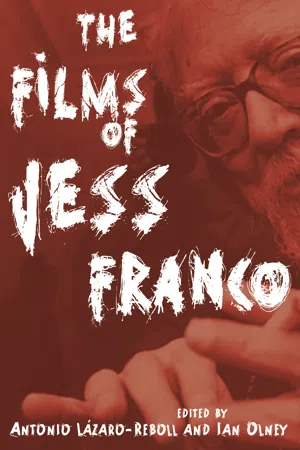
The Films of Jess Francolooks at the work of Jesús "Jess" Franco (1930–2013), one of the most prolific and madly inventive filmmakers in the history of cinema. He is best known as the director of jazzy, erotically charged horror movies featuring mad scientists, lesbian vampires, and women in prison, but he also dabbled in a multitude of genres from comedy to science fiction to pornography. Although he built his career in the ghetto of low-budget exploitation cinema, he managed to create a body of work that is deeply personal, frequently political, and surprisingly poetic. Editors Antonio Lázaro-Reboll and Ian Olney have assembled a team of scholars to examine Franco's offbeat films, which command an international cult following and have developed a more mainstream audience in recent years. Arguing that his multifaceted, paradoxical cinema cannot be pinned down by any one single approach, this edited volume features twelve original essays on Franco's movies written from a variety of different perspectives. The Films of Jess Franco does not avoid the methodologies most commonly used in the past to analyze Franco's work—auteur criticism, genre criticism, and cult film criticism—yet it does show how Franco's films complicate these critical approaches. This volume opens up fresh avenues for academic inquiry by considering his oeuvre from a range of viewpoints, including transnational film studies, cinephilia studies, and star studies. The book effectively meets the challenge of Franco's multidimensional cinema with multifaceted criticism—attentive to the shifting historical contexts, modes of production and consumption, and formats of Franco's work—that supplements current Franco scholarship and suggests exciting new directions for its further development. The Films of Jess Franco seeks to address the scholarly neglect of this legendary cult director and to broaden the conversation around the director's work in ways that will be of interest to fans and academics alike.
eBook - ePub
The Films of Jess Franco
- 372 pages
- English
- ePUB (mobile friendly)
- Available on iOS & Android
eBook - ePub
The Films of Jess Franco
About this book
Information
Subtopic
Film & VideoI
FRANCO IN CONTEXT
1
BEFORE AND AFTER THE AWFUL DR. ORLOF
Constructing a “Respectable” Jess Franco
Andy Willis
The films that make up the majority of Jess Franco’s enormous directorial output, many of which were made on what can only be described as microbudgets, and many of which exist in multiple international versions, are often distinguished by their high level of explicit sexual content, leading them to be dismissed out of hand as cheap pornography. His work has appeared in a variety of genres that accommodate such overt material—the women-in-prison film, the lesbian vampire movie—and in exhibition contexts, such as the grind-house exploitation circuit of the 1970s and 1980s and the VHS boom in the early 1980s, that are known for their associations with explicit content. The dominant perception of Franco’s work is confirmed by the 2013 on-set documentary A ritmo de Jess (Naxo Fiol), which shows the then eighty-two-year-old director shooting a series of loosely connected sex scenes with a skeleton crew in and around a large hotel near Málaga in Southern Spain.1 The improvisatory nature of the shoot, the ultralow budget, and the seeming lack of a finalized script all contribute to the legend of Jess Franco as an unstoppable, quality-averse, and unapologetic purveyor of Euro-sleaze. One scene even shows the director encouraging his young cameraman to “zoom in on the actress’s pussy.” After decades behind the camera, Franco remained as willing as ever when it came to utilizing one of the trademarks of his visual style, the zoom lens, another trait of his work used to dismiss him as something of an incompetent technician. It is these aspects of his work that have led to Franco being regarded as a director of poorly executed trash cinema. At the same time, however, others revere these idiosyncrasies, seeing them as factors contributing to his status as a renegade, underground auteur. But such binaries are all too neat. This chapter argues that Jess Franco was not always so easy to pigeonhole, whether as an exploitation auteur or as a filmmaker so mired in sleaze that his reputation cannot escape the stench.
In opposition to the marginalization that both poles might suggest, I want to make a case for an early-career, “respectable” Jess Franco, and in doing so reveal a filmmaker who was associated with a number of figures who would become the backbone of progressive Spanish cinema in the 1960s, and a director whose work was in dialogue with, and would have a profound influence on, developments within Spanish (and European) popular cinema during the 1960s and 1970s. Franco remains one of the most widely known directors associated with Spanish horror cinema, and his first foray into the genre, Gritos en la noche (The Awful Dr. Orlof, 1962), would predate the wider revival of the genre in Spain by a number of years. The film laid important foundations for other filmmakers to later build upon, establishing a number of tropes that would become staples of the Spanish horror boom of the early to mid-1970s. Following this genre debut, Franco later made numerous horror films—within and outside Spain—that established him as one of Europe’s most productive exploitation filmmakers. However, the decade that concerns us reveals a director forging a flourishing career during a period when the division between “respectability” and “sleaze” was far from clear-cut.
FRANCO ON THE MARGINS
For many commentators on the horror genre, Franco remains a rather vexing persona. For example, Jim Morton, writing in the Incredibly Strange Films edition of Re/Search, states that Franco is “known for his prolific output and deviant sensibility” (152). He goes on to argue that he is “one of the most prolific and controversial directors working in exploitation today,” one who “makes his films quickly and seemingly with little regard to production values,” and whose films are “usually heavily dosed with sex, though most of his films are in the horror genre” (193–94). The clear frustration many mainstream observers feel when faced with Franco’s films is further reflected in the Aurum Film Encyclopaedia: Horror, edited by Phil Hardy, where his work is described, in a discussion of The Awful Dr. Orlof, as “lazily filmed” (148). It would seem then that there is a widely held assumption that Franco is unquestionably a low-grade filmmaker. Alongside these often ill-informed critical dismissals there are those writers, often emerging from fan cultures, such as Video Watchdog editor Tim Lucas, who have argued that the director be reclaimed as significant through the application of auteurist approaches to his work (73–101). For Lucas, the very reasons that others dismiss Franco’s films are part of the reason for celebrating them. He puts it thus: “For many years, I was unable to see past the hasty surface of Franco’s work and hated it. Today, in a climate of insultingly mild horror product tailored to fit the MPAA straitjacket, I can’t get enough of it. Franco’s defiantly uncommercial, acutely revealing, taboo-busting stance is like a breath of fresh scare, even when his movies are clumsy, which is (let’s be honest) most of the time” (74). Lucas, and Franco’s other defenders, such as Stephen Thrower (Murderous Passions: The Delirious Cinema of Jesús Franco) and Carlos Aguilar (Jesús Franco), passionately engage in extensive, very well informed, debates about the minutiae of the director’s output, often championing films others have forgotten or dismissed. Indeed, until recently, it had been left to the world of fan publications and internet websites to identify, study, and explore, as well as simply celebrate, Franco’s work.
While Franco has some of his staunchest defenders in fan culture, the director’s reputation in mainstream academic writing about Spanish film has been, for the most part, rather more negative—if he is mentioned at all. For some of the most influential writers of the history of Spanish cinema, Jess Franco’s filmography is seemingly not worthy of consideration. Important studies that encompass the 1960s—one of Franco’s key periods—such as those by Peter Besas, John Hopewell, Núria Triana Toribio, and Sally Faulkner, find no need to discuss the director. Meanwhile, Barry Jordan and Rikki Morgan-Tamosunas, in a book focusing on the period of the 1980s onward, one of Franco’s most prolific periods, limit him and his work to a brief mention of Killer Barbys (misspelled as “Killer Barbies”), which they refer to simply as a “trash movie” (109). Refreshingly, more recently studies focused on Spanish genre cinema have found space to discuss Franco’s output seriously. Within this body of work, one might argue that the initial fan-generated reconsiderations of Franco have now fruitfully begun to slowly bleed into academic writing. For example, Joan Hawkins significantly draws on the groundbreaking work of Cathal Tohill and Pete Tombs for her exploration of the work of Franco and Georges Franju (87–113). More recently, Tatjana Pavlović has analyzed the use of the body in Franco’s work, relating it to wider social and political transformations within Spain, while Antonio Lázaro-Reboll discusses the director’s work systematically throughout his Spanish Horror Film.
RETHINKING THE EARLY FRANCO
In Despotic Bodies and Transgressive Bodies, Pavlović argues that Franco was a director somewhat out of step with the dominant trends within Spanish cinema of the 1950s and early 1960s. In suggesting the filmmaker was something of an outsider, she states that:
In Spain of the 1950s, when Jesús Franco started his career, there was, on the one hand, saturation by historical epics, musicals, and melodramas intended to inculcate traditional moral and religious values, sponsored officially by the Francoist government. On the other hand, there was the dissident cinema, grounded in the neorealist tradition, that dealt with social problems that the “official” cinema would never acknowledge. The uniqueness of Jesús Franco is that he did not make either type of film even though his career began in those turbulent years. He was an anomaly not fitting in any of these camps. (108)
While it might be tempting to see Franco as something of a renegade outsider from the outset, if one looks closely at his initial forays into the film industry, this reading of the director as an anomaly, something of an anarchic maverick, becomes questionable. This is particularly so when one looks at the formative years of his career. In this early period, Franco, rather than existing outside the binary opposition that Pavlović sets up within Spanish cinema, can be identified as a figure who straddled it.
I would argue that, focusing on the period immediately before and after Franco directed his most famous early work, The Awful Dr. Orlof, it is possible to trace the career of a filmmaker with a perfectly respectable reputation, and one with a string of creative associations with film personnel who would become very much a part of a critically acclaimed, oppositional Spanish cinema of the late 1950s. As with many directors who progressed to feature film directing in Spain during the late 1950s, Franco had attended the national film school, the Instituto de Investigaciones y Experiencias Cinematográficas (IIEC), although, like a number of others before him, he did not graduate. Significantly, this period at film school meant that, as Pavlović notes, Franco had connections “with a group that would produce the film magazine Objetivo, whose debates on film culminated in the Salamanca Congress but whose political and aesthetic preoccupations he never shared” (109). While Franco is often dismissed as having always been merely a commercial director, and even then something of a hack, these links begin to suggest a rather different and more nuanced picture. Franco was concerned with and involved in the contemporary debates around film culture within Spain, and as such was an associate of key figures such as Juan Antonio Bardem and Fernando Fernán Gómez. Furthermore, instead of being an outsider, or an anomaly as Pavlović suggests, Franco was an acquaintance of those involved in producing the type of “dissident cinema” she mentions.
One of his acquaintances, the writer and director Juan Antonio Bardem, had, like Franco, failed to complete his degree at the IIEC. But he had gone on to be one of the most high-profile figures involved in setting up the magazine Objetivo in 1952. Bardem also contributed heavily to the Salamanca Conversations that took place over four days at the city’s university in May 1955. This event brought together a range of perspectives from both right and left regarding cinema and culture and was to have a significant impact on subsequent developments and government policy regarding film in Spain. As Besas notes:
Despite the moderate tone of the Conversations, a hue and cry was raised by conservative circles who denounced them as “Communist infiltrations” in Salamanca. The magazine Objetivo was banned, but the Conversations had been successful. They had formulated and expressed the concerns and aspirations of a whole new generation of filmmakers, so much so that after the four days were over there was talk of the “spirit of Salamanca.” (42)
Whatever one’s reading of the events at Salamanca, Jess Franco’s connections with those heavily involved suggest someone closer to the key debates within Spanish film culture than both Pavlović and his later reputation might suggest. Indeed, his connection with both Bardem and those around him had already been solidified in 1953 when Franco worked as an assistant on the production of the director’s feature Cómicos, which was selected for the Cannes Film Festival in 1954. In fact, Franco’s work on the film even went so far as a contribution to elements of the score. His close association with the Bardem family during this period would extend to his casting Rafael, Juan Antonio’s father, in his first feature, Tenemos 18 años (1961). These links clearly suggest that Franco was very much part of the aesthetic and political changes that were beginning to stir within Spanish cinema in the 1950s, something supported by his working relationship with one of its major dissident figures, Bardem. It is difficult, then, to sustain a picture of Jess Franco during this period as isolated from these facets of Spanish film culture.
Franco’s initial work as a director also intersected with this period of Spanish film history. His directorial debut, Tenemos 18 años, which was produced by Auster Films and credits Bardem’s close associate and another key oppositional filmmaker of the period, Luis García Berlanga, as associate producer, was made in 1959. While it begins as a light comedy about two young women who, turning eighteen, embark on a fantasy-inspired road trip around Andalusia, it eventually turns into something much graver and more in line with the veiled critique inscribed in the oppositional films of the period. Tenemos 18 años opens with colorful animated credits accompanied by a traditional jazz score by Don Parker and his Jazz Orchestra with piano solos by Franco himself, no less. This sequence suggests a light-hearted, modish, youth-focused film typical of those made across Europe in the late 1950s and early 1960s. This impression is enhanced by Franco’s use of direct address to the camera in the opening sequence, where María José (Isana Medel) writes in her a diary and introduces the viewer to Pili (Terele Pávez), her cousin and best friend, and her other cousin Mariano (Antonio Ozores). María José is presented as a romantic dreamer who longs for the kind of love she reads about in romantic novels and who has a tendency to embellish the truth. These early scenes mock youthful types of the period. For example, early on Pili says she likes a young man named Castro whom she compares to Kirk Douglas and whom the film shows as a rather ridiculous, angst-obsessed youngster dressed in a black roll-neck sweater who tells another girl, “If I wasn’t so troubled I’d love you.” What follows is a series of adventures around Andalusia in a broken-down old car that are related with a romantic tinge by the girls. What marks Tenemos 18 años as a film closer to other oppositional works of the period is the attempt to offer an element of social criticism amid its more popular and modish trappings. The key sequence in this regard occurs toward the end of the film and involves María José retelling the story of how the young women found a man who had collapsed outside their tent one morning. When he comes round, they realize he is armed, and when, exhausted and hungry, he falls down again, they prepare to make their escape. Crucially, just as they are about to leave, their humanity comes to the fore and they decide they must help him. When he regains consciousness, he explains that he is a bank robber on the run. On the surface—and as far as genre convention is concerned—he would seem to be the type of character from whom the protagonists need to free themselves. However, the scenes that follow show the man explaining sympathetically why he is as he is due to particular historical and social circumstances. He explains that he grew up during the Spanish Civil War (1936–39), and the trauma of that experience meant he could not easily fit into postwar society. During this period, he says, he got used to guns, violence, and death and had no choice but to turn to crime. His antisocial behavior, therefore, is reframed as his attempt to survive in a post–Civil War context. Affected by his story and the reasons for his actions, ...
Table of contents
- Cover
- Title Page
- Copyright
- Contents
- An Editorial Note on Film Titles and Dates
- Introduction: The Many Faces of Jess Franco
- Part I: Franco in Context
- Part II: Horror and Eroticism in Franco
- Part III: The Cult Reception of Franco
- Conclusion: Finding Franco: A Quixotic Filmography
- Acknowledgments
- Contributors
- Index
Trusted by 375,005 students
Access to over 1.5 million titles for a fair monthly price.
Study more efficiently using our study tools.
Frequently asked questions
Yes, you can cancel anytime from the Subscription tab in your account settings on the Perlego website. Your subscription will stay active until the end of your current billing period. Learn how to cancel your subscription
No, books cannot be downloaded as external files, such as PDFs, for use outside of Perlego. However, you can download books within the Perlego app for offline reading on mobile or tablet. Learn how to download books offline
Perlego offers two plans: Essential and Complete
- Essential is ideal for learners and professionals who enjoy exploring a wide range of subjects. Access the Essential Library with 800,000+ trusted titles and best-sellers across business, personal growth, and the humanities. Includes unlimited reading time and Standard Read Aloud voice.
- Complete: Perfect for advanced learners and researchers needing full, unrestricted access. Unlock 1.5M+ books across hundreds of subjects, including academic and specialized titles. The Complete Plan also includes advanced features like Premium Read Aloud and Research Assistant.
We are an online textbook subscription service, where you can get access to an entire online library for less than the price of a single book per month. With over 1.5 million books across 990+ topics, we’ve got you covered! Learn about our mission
Look out for the read-aloud symbol on your next book to see if you can listen to it. The read-aloud tool reads text aloud for you, highlighting the text as it is being read. You can pause it, speed it up and slow it down. Learn more about Read Aloud
Yes! You can use the Perlego app on both iOS and Android devices to read anytime, anywhere — even offline. Perfect for commutes or when you’re on the go.
Please note we cannot support devices running on iOS 13 and Android 7 or earlier. Learn more about using the app
Please note we cannot support devices running on iOS 13 and Android 7 or earlier. Learn more about using the app
Yes, you can access The Films of Jess Franco by Antonio Lázaro-Reboll,Ian Olney, Antonio Lázaro-Reboll, Ian Olney in PDF and/or ePUB format, as well as other popular books in Media & Performing Arts & Film & Video. We have over 1.5 million books available in our catalogue for you to explore.