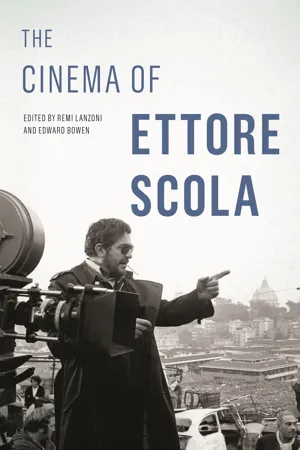
The Cinema of Ettore Scola offers contemporary perspectives on Ettore Scola (1931–2016), one of the premier filmmakers of Italian cinema. Scola was a crucial figure in postwar Italy as a screenwriter of comedies in the 1950s and 1960s who later became one of the country's most beloved directors in the 1970s and 1980s with his bittersweet comedies and dramas on history, politics, and social customs. While Scola has received extensive attention from scholars based in Italy and France, Rémi Lanzoni and Edward Bowen's edited volume is the first English-language book on Scola's cinematographic career. The volume (containing fourteen chapters) is organized in four parts, the first two of which focus both on Scola's contributions to Comedy Italian Style—as a screenwriter and director—and his commentaries on the history of Italy, Rome, and the film industry. The second half of the book is divided into sections on Scola's relationship to and use of place, politics, and legacy. Mariapia Comand's chapter begins the volume with an exploration of the development of Scola's narrative methods by examining his early work as an illustrator, ghostwriter, and screenwriter. Later, Brian Tholl approaches one of Scola's best-known and most frequently studied films, Una giornata particolare, from a less-explored perspective, namely its commentary on surveillance and internal exile, or confino, during the fascist period. At the close of the volume is a broad-sweeping tribute to and reflection on Scola's filmmaking by Gian Piero Brunetta, a leading historian of Italian cinema who developed a close relationship with Scola over the years, who reveals the varied narrative strategies linked to food that the director utilized for character development and social commentary. The Cinema of Ettore Scola makes Scola accessible to English-reading audiences and helps readers better understand his film style, the major themes of his work, and the representations of twentieth-century Italian history in his films.
- 368 pages
- English
- ePUB (mobile friendly)
- Available on iOS & Android
eBook - ePub
The Cinema of Ettore Scola
About this book
Information
Subtopic
Film & VideoPart 1
Scola as Screenwriter and Director of Comedy Italian Style
Thinking with His Hands
Ettore Scola’s Narrative Intelligence as a Screenwriter and Compulsive Illustrator
Mariapia Comand
This chapter explores the screenwriting activity of Ettore Scola during the 1950s and 1960s (in particular for Antonio Pietrangeli), with the hypothesis that this experience could have molded or may reveal the formation of his narrative thought, artistic method, or poetic world. The study is based on original materials (subjects, screenplays, treatments, notes and correspondence) kept in the Antonio Pietrangeli Archive at the Centro Cinema Città in Cesena and on documents from Ettore Scola’s personal archive (currently being assembled at the Centro Sperimentale di Cinematografia in Rome). The analysis takes into consideration the sketches that Scola compulsively drew not just on his scripts but on paper napkins, scraps of papers, or the edges of notebooks. Following a neuroscientific, neuroaesthetic, and empirical aesthetic approach, these sketches are interpreted as indicating and resulting from his mental and creative process. The structuring idea of this chapter is that screenwriting—which requires a series of specific skills that Ettore Scola himself singles out—calls into play exactly the same cognitive abilities that neuroscience and cognitive science have identified as the building blocks on which we base our understanding of the world and how we interact with it.
Between the 1950s and 1960s: Cartoonist, Gagman, and Lastly Screenwriter
In his piece “Qualche parentesi sul disporre in scene,” Ettore Scola describes—as if it were the scene in a script—the reaction of his parents to the news that their second-born child, Ettore, had become a screenwriter. Naturally, he does so through an image, that of his father who, not knowing what a sceneggiatore (screenwriter) is, looks for the meaning of this mysterious word in the dictionary but cannot find it. Scola ironically comments:
The fact that I was devoting myself to an activity ignored—or rather faintly contemplated—by the greatest dictionaries of the Italian language, for many years left my parents suspended in a limbo of uncertainty and alarm for the future of their second-born child. . . . I must also add that the apprehensions entertained by my parents were confirmed by the fact that for a couple of years my name did not appear in the opening credits of the films I claimed I was working on. Indeed, that day . . . when my father consulted his Petrocchi, I had in part lied. I wasn’t embarking on being a screenwriter but a ghostwriter: a profession usually reserved for young writers and covered by anonymity, which consisted of providing jokes, gags, and comic situations to established screenwriters who would then include them in their scripts.1
As Scola himself recounts in the documentary film Che strano chiamarsi Federico (How Strange to Be Named Federico, 2013), he entered the culture industry thanks to his work as an illustrator for the humoristic magazine Marc’Aurelio,2 for which Steno, Ruggero Maccari, Vittorio Metz, Marcello Marchesi, Mario Monicelli, Federico Fellini, and many others set for future glory already worked. The transition from cartoon strips to screenplays happened thanks to the two famous humorists, Metz and Marchesi, who enrolled the young Scola as a “workshop assistant” (the two had their headquarters in a Roman hotel, Hotel Moderno, where they had set up a sort of writers’ room, distributing blocks of scripts to their collaborators to develop). In their first meeting, in 1950, Marchesi looked through the many scripts spread on the bed for one that was not ready for delivery. In the end, he chose Totòtarzan (Totò Tarzan; directed by Mario Mattoli and released in the same year). As Scola leafed through the first pages, he shyly made a joke. Marchesi liked it, so he offered him a down payment and an appointment for the next day. The words with which the director concludes the tale—“The wretched boy replied. And he became a screenwriter forever”3—deserve some attention because they are a perfect example of Scola’s favorite form of linguistic pastiche, combining irony and wisdom in a literary and lexical mixture that blends japery with a cultured quotation (in this case, drawing from Alessandro Manzoni’s The Betrothed). Moreover, these words are also an example of Scola’s tendency to look at reality from a fresh angle by twisting the first and most expected meaning and to transform drama into comedy through “mode shifting.”4 Finally, these words suggest a research hypothesis that I intend to verify here, namely that screenwriting can be seen as a key to accessing and understanding all of Scola’s cinema.5 As a consequence, the 1950s and 1960s would be the conceptual and technical embryo in the formation of his narrative intelligence (meaning a particular cognitive ability employed to illuminate the human, cultural and symbolic world).6
A first reason for my assertion that screenwriting is the master and matrix of Scola’s cinema is this: while these days the screenwriting profession may be sidelined in Italian cinema, this was even more so the case in the 1950s. It could be said this situation has always been the plight of screenwriters in Italy and even more so in Hollywood, so it would be helpful to have an explanation (beyond the quotes from Villa and Moravia) for why it was special in Italy in this time period. According to Federica Villa, “At no other time had Italian screenwriting felt its transience to be a value”; indeed at this point “it was having to deal with a cinema undergoing profound transformations . . . in search of its own identity.”7 It was in this same period that Alberto Moravia defined screenwriting as “rape of the intelligence.”8 For Scola, this marginalized working condition became an ideological stance and poetic choice, which gave him a view of things outside the mainstream. The characters penned by Scola in this period would indeed be misfits, eccentrics, belonging “outside the social and political field”: women in the case of Pietrangeli’s films—Nata di marzo (March’s Child, 1958); Adua e le compagne (Adua and Her Friends, 1960); La parmigiana (The Girl from Parma, 1963); La visita (The Visit, 1963)—and outcasts as lead characters in the case of films scripted for Risi, such as Il mattatore (Love and Larceny, 1960), Il sorpasso (The Easy Life, 1962), La marcia su Roma (March on Rome, 1962), and Il gaucho (The Gaucho, 1964). In the works bearing his name as director, the stories would concern the anonymous, uncomfortable or secondary figures of official history: the repressed homosexual and the frustrated housewife in Una giornata particolare (A Special Day, 1977); the anonymous professor and dithering patriarch in La famiglia (The Family, 1987); the marginalized poor of Rome’s periphery in Brutti, sporchi e cattivi (Down and Dirty, 1976); the builder Oreste and the florist Adelaide in Dramma della gelosia—tutti i particolari in cronaca (The Pizza Triangle, 1970), to mention just some of Scola’s most memorable characters. Therefore, women, losers, and screenwriters were in a certain sense on the same level: forgotten by History (la Storia) or the forgotten creators of stories (le storie).
In Scola’s professional and artistic career, the 1950s were therefore a fundamental period of growth. He was constantly in touch with the big screen, thanks to attending the Circoli del Cinema (cinematographic societies which were becoming popular in Italy at this time) and Pro-Deo, the Catholic university directed by Dominican film essayist Padre Morlion.9 Scola’s love for the cinema, expressed in the 1950s in the “Potito, il cinepatito” column of Marc’Aurelio, would be a distinct feature of his films. Dotted with various types of quotations, they demonstrated his encyclopedic and eclectic film culture which ranged, for example, from Marcel L’Herbier’s Histoire de rire (Foolish Husbands, 1941), which is mentioned in Pietrangeli’s Lo scapolo (The Bachelor, 1955), to Robert Wise’s The Day the Earth Stood Still (1951), which is remembered in Nata di marzo. This passion for cinema would find full expression in the metacinematographic offerings of his older years, such as Splendor (1988) or the short ’43–’97 (1997), praising cinema as a saving grace. Screenwriting was the common thread linking together the early years of his career and the decades of his maturity as a director. His snooty and pretentious screenwriter in Risi’s Il gaucho and his neurotic character who writes laughs for money in La terrazza (The Terrace, 1980) are self-ironic portraits that nevertheless set out to cast attention on this key figure in cinema.10
Going back to the beginning of his career, when cinema formed the center of his passions, Scola was nevertheless busily engaged in various other media as well. In 1950, he entered Radio Rai and worked on the texts of radio comedian Tino Scotti. Thanks to Scotti, Scola wrote the screenplay for Fermi tutti arrivo io! (Sergio Grieco 1953),11 an important script because it marked the debut of the Scola and Maccari scriptwriting pair, indestructible right up to the death of Maccari in 1989. Also fundamental for the future development of his career was his meeting Alberto Sordi, whom he accompanied first of all in writing the radio program Il teatrino di Alberto Sordi (on air as of 1952) and then as author of the screenplays for Canzoni, canzoni, canzoni (Domenico Paolella, 1953), Accadde al commissariato (A Day at the Police Station, Giorgio Simonelli, 1954), Un americano a Roma (An American in Rome, Steno, 1954) and Accadde al penitenziario (Giorgio Bianchi, 1955).12
When looking at this phase, we can say that his role as cartoonist and battutista (writer of short comical exchanges) was complementary to that of screenwriter. While Scola’s experience at Marc’Aurelio was decisive in refining his technical skills in quick comic timing, his screenwriting activity forced him to deal with the horizontal narrative structure of longer episodes. In this phase, his scriptwriting took two main directions. First of all, he worked on rhythm. Necessary for writing song movies (Canzoni, canzoni, canzoni), it was an activity that required him to practice harmonization—that is, connecting parts and identifying how to fit them together. Second, he tested out noncanonical narrative structures (different from the classic three-act structure13) with narrative segments that radiated from a central core, as in the Accadde films (namely, Accadde al commissariato, Un americano a Roma, and Accadde al penitenziario).
His exploration of possible storytelling methods went hand in hand with his reasoning on diegetic time, as seen in his liberal use of flashbacks in this period. ...
Table of contents
- Cover
- Title Page
- Copyright Page
- Dedication
- Contents
- Foreword
- Acknowledgments
- Introduction
- Part 1. Scola as Screenwriter and Director of Comedy Italian Style
- Part 2. History, Memory, and Critique of the Present
- Part 3. Space and Place
- Part 4. Scola and Politics
- Coda
- Bibliography
- Contributors
- Index
Trusted by 375,005 students
Access to over 1.5 million titles for a fair monthly price.
Study more efficiently using our study tools.
Frequently asked questions
Yes, you can cancel anytime from the Subscription tab in your account settings on the Perlego website. Your subscription will stay active until the end of your current billing period. Learn how to cancel your subscription
No, books cannot be downloaded as external files, such as PDFs, for use outside of Perlego. However, you can download books within the Perlego app for offline reading on mobile or tablet. Learn how to download books offline
Perlego offers two plans: Essential and Complete
- Essential is ideal for learners and professionals who enjoy exploring a wide range of subjects. Access the Essential Library with 800,000+ trusted titles and best-sellers across business, personal growth, and the humanities. Includes unlimited reading time and Standard Read Aloud voice.
- Complete: Perfect for advanced learners and researchers needing full, unrestricted access. Unlock 1.5M+ books across hundreds of subjects, including academic and specialized titles. The Complete Plan also includes advanced features like Premium Read Aloud and Research Assistant.
We are an online textbook subscription service, where you can get access to an entire online library for less than the price of a single book per month. With over 1.5 million books across 990+ topics, we’ve got you covered! Learn about our mission
Look out for the read-aloud symbol on your next book to see if you can listen to it. The read-aloud tool reads text aloud for you, highlighting the text as it is being read. You can pause it, speed it up and slow it down. Learn more about Read Aloud
Yes! You can use the Perlego app on both iOS and Android devices to read anytime, anywhere — even offline. Perfect for commutes or when you’re on the go.
Please note we cannot support devices running on iOS 13 and Android 7 or earlier. Learn more about using the app
Please note we cannot support devices running on iOS 13 and Android 7 or earlier. Learn more about using the app
Yes, you can access The Cinema of Ettore Scola by Rémi Lanzoni,Edward Bowen, Rémi Lanzoni, Edward Bowen in PDF and/or ePUB format, as well as other popular books in Media & Performing Arts & Film & Video. We have over 1.5 million books available in our catalogue for you to explore.