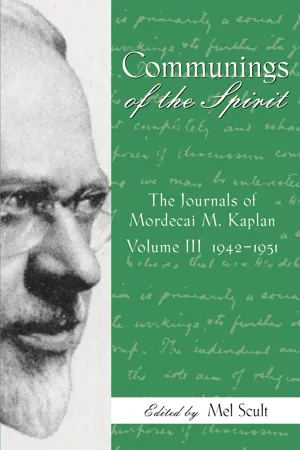
Mordecai M. Kaplan (1881–1983), founder of Reconstructionism and the rabbi who initiated the first Bat Mitzvah, also produced the longest Jewish diary on record. In twenty-seven volumes, written between 1913 and 1978, Kaplan shares not only his reaction to the great events of his time but also his very personal thoughts on religion and Jewish life. In Communings of the Spirit: The Journals of Mordecai M. Kaplan Volume III, 1942–1951, readers experience his horror at the persecution of the European Jews, as well as his joy in the founding of the State of Israel. Above all else, Kaplan was concerned with the survival and welfare of the Jewish people. And yet he also believed that the well-being of the Jewish people was tied to the safety and security of all people. In his own words, "Such is the mutuality of human life that none can be saved, unless all are saved." In the first volume of Communings of the Spirit, editor Mel Scult covers Kaplan's early years as a rabbi, teacher of rabbis, and community leader. In the second volume, readers experience the economic problems of the 1930s and their shattering impact on the Jewish community. The third volume chronicles Kaplan's spiritual and intellectual journey in the 1940s. With candor and vivid detail, Kaplan explores his evolving beliefs concerning a democratic Judaism; religious naturalism; and the conflicts, uncertainties, and self-doubts he faced in the first half of the twentieth century, including his excommunication by the ultra-Orthodox in 1945 for taking a more progressive approach to the liturgy. In his publications, Kaplan eliminated the time-honored declarations of Jewish chosen-ness as well as the outdated doctrines concerning the resurrection of the dead. He wanted a prayer book that Jews could feel reflected their beliefs and experiences; he believed that people must mean what they say when they pray. Kaplan was a man of contradictions, but because of that, all the more interesting and significant. Scholars of Judaica and rabbinical studies will value this honest look at the preeminent American Jewish thinker and rabbi of our times.
eBook - ePub
Communings of the Spirit, Volume III
The Journals of Mordecai M. Kaplan, 1942-1951
- 456 pages
- English
- ePUB (mobile friendly)
- Available on iOS & Android
eBook - ePub
About this book
Information
Topic
Theology & ReligionSubtopic
Jewish Theology1
January 4, 1942–April 24, 1942
The Will to Salvation as Proof of God’s Existence
Sunday, January 4, 1942
. . . The quintessence of all sin is pride, whether it manifest itself as pride of power, of knowledge, of self-righteousness. Pride consists in the human tendency to deny any limits to what one can do or should do, can attain or should attain. The denial of such limits is due to the denial of one’s subordination to a higher law and power than one’s self. The failure to recognize that the urge to make the most of one’s life, the opportunities and the ability to fulfill that urge, or to approximate such fulfillment emanate from a source that transcends one’s self is at the bottom of human pride. Hence instead of defining God as was done in the Middle Ages by means of negative attributes which merely stated what God was not, we should define God in terms which negate man, or which state what man is not. Man is not the center of his own being; a Power that transcends man is the center of his being. Man is not self-sufficient, because only God is self-sufficient. Man cannot possess absolute knowledge. Man cannot be absolutely righteous, because his righteousness is conditioned or vitiated by self-interest. This knowledge which man must have about himself is essential to his salvation. Insofar as that is true, this very knowledge implies that the source of his salvation, as of his life in general, is a power not [of] himself, or God. This is, indeed, the most fundamental proof for the existence of God, a proof based upon man’s incontestable need to make the most of his life. It is because man strives for salvation that we can be sure there is a God.
Teaching Judaism to Young People—a Conversation with Rabbi Roland Gittelsohn
Tuesday, January 6, 1942
Some time ago I received a mimeographed copy of a book by Rabbi Roland B. Gittelsohn1 called Modern Jewish Problems. It is to be published in book form by the Union of American Hebrew Congregations and is intended for young people’s discussion groups. In a separate letter, Gittelsohn asked me to give him my opinion of the book. When I read it I realized that I could not very well convey to him in writing what was wrong with its entire getup and to make any adequate constructive suggestions. I therefore replied that he should come to see me. We finally got together this afternoon.
I pointed out to him that the book was weakest in that which it should be its main function—namely, to get the young people to think in an integrated fashion. This involves getting them to realize the implications of the terms they think with. The Socratic method consists not merely in the insistence on definitions of the terms used in speech but on such definitions as lead to reckoning with correct and important implications. In fact, it would be well for a course on Jewish problems to be utilized for the purpose of getting young people to think in straight and organic fashion and for them to realize that it is being so utilized. The art of integrated thinking is something they don’t teach either in the elementary or in the higher institutions of learning.
Not being a Talmudist or near Talmudist, Gittelsohn saw the point at once and did not try to vindicate his own treatment of Jewish problems. In fact, he admitted that I articulated clearly for him what he himself had vaguely felt.
In the course of the conversation, he told me of a curious incident in connection with his book. At one of the sessions of the recent annual convention of the CCAR [Central Conference of American Rabbis],2 he read excerpts of his book. In the course of his reading, he happened to mention my name and some of the things I had to say about Judaism. At once a number of the “old guard” objected to the inclusion of anything I said in a book intended for Reform congregations. He met their objections by quoting passages from Judaism as a Civilization.3 Although the objectors were silenced, he felt that it would be wiser not to make too many references to me or to Reconstructionism in his forthcoming book.
Gittelsohn is a rabbi in Rockville Centre, Long Island. His congregation consists mostly of young people, but they are much younger in Judaism than they are in age. Their interest in Judaism dates from about 1936.
* * * * *
The Function of Prayer4
January 8, 1942
The place of prayer in the soterical approach to life is, of course, like everything else connected with that approach, determined by the way we conceive salvation. Since we must needs conceive salvation in such a way as to relate it to the impersonal working of the forces in nature, we have to dissociate from the conception of prayer anything that borders on theurgy, or magic. To do that we have to realize that prayer belongs neither to the domain of functional values, nor to that of the rational values, but to that of the spiritual values. There its function is to bring the soul or personality into rapport with God, i.e., to effect the state of mind known as godliness or holiness. The recital of a religious benediction or of grace after meals is intended to awaken an attitude of godliness in reference to some particular situation or enjoyment and to remind us of the need of utilizing that situation or enjoyment as a means of salvation.
The Distinction between Conservatism and Reconstructionism
January 8, 1942
I discussed with Ira [Eisenstein]5 this afternoon the conference which [Louis] Finkelstein6 has called for next Wednesday afternoon and in which both of us are to take part. The question I raised was: What are the specific objections which the Conservatives raise against us Reconstructionists? We arrived at the following: They object to (1) our conception of God as [?] because we negate the element of personality as traditionally understood; (2) our conception of Judaism as an evolving civilization, thus doing away with the acceptance of rabbinism as normative; (3) our attitude toward ritual practices as no longer coming under the category of law; and (4) our refusal to accept the present organization of the synagogue as justifying it to occupy the position of centrality in communal life and our insistence that the community be the main social unit of Jewish life.
* * * * *
Happiness, Gratitude, Beatitude
Saturday, January 10, 1942
We might identify the actual attainment of salvation by certain states of mind which correspond to the three groups of spiritual values. Happiness corresponds to the fulfillment of selfhood or personality, gratitude to human brotherhood, and beatitude to godhood.
Unions—a Jewish Value?7
January 20, 1942
Finkelstein is having his hands full with his office workers. They have decided to unionize and to demand of the Seminary both union recognition and a collective contract. The particular union to which they want to belong is an affiliate of the CIO and is said to be dominated by communist influence. F. [Finkelstein] is torn between the Seminary Board, which consists of some of the worst reactionaries, and this group of office workers who insist on having their union recognized. He is trying to tell those people that the Seminary as a religious organization cannot treat with a communist-dominated union. Moreover, as an institution of that kind, it is ready to submit all questions of salaries and conditions of work to an arbitration board on which all the parties concerned as well as impartial arbitrators should be represented. The office workers simply refuse to understand why they should be expected to rely on the goodwill or sense of justice of such a board now that the right of labor to organize is a sacred principle for which they are willing to make the greatest sacrifices. F. talks to them about Jewish ethics and fair treatment of the worker as an integral part of the Jewish religion, and his words fall on deaf ears, even though most of these office workers come from intensely “religious” homes.
This incident is illustrative [of] how totally blind a man of F.’s type is to the revolutionary change that has taken place in people’s lives, and especially in the lives of our Jewish youth. He is completely obtuse to the significance of their regarding the union as representative of a principle for which they are prepared to go to any lengths, whereas they expect nothing from Judaism except a system of taboos dealing with the Sabbath and Kashrut. Had Jews possessed some form of communal organization and had that organization concerned itself with the vital interests of the individual Jew, they might have had something analogous to the Catholic provisions for the organization of labor. Jewish affiliation would then have been in a position to come to his assistance in matters that touch him vitally. Judaism would then have had a claim on his loyalty. But as it is it only interferes with other affiliations which do the very thing that Jewish affiliation fails in most. Is it a wonder Jews see no reason for maintaining a loyalty that does nothing for them?
Seminary Students Consider Ritual
January 23, 1942
The Seminary students have been discussing excitedly the four articles on the “Guide for Jewish Ritual Practice”8 and finally decided to hold a symposium on that subject next Wednesday with [Louis] Finkelstein, [Robert] Gordis,9 and [Milton] Steinberg10 as speakers. The students gave me a copy of the questions which they want to have both Gordis and Steinberg answer.
The following are the questions they want Gordis to answer:
- 1. Wherein does your rationale for Jewish law differ from that of the Orthodox?
- 2. Who constitutes Catholic11 Israel? How does the concept function in Jewish law?
- 3. Where are we to find the norm for Conservative Judaism?
- (a) In the Seminary faculty? (b) In the Rabbinical Assembly? (c) In the practices of those who make up the Conservative congregations?
- 4. What authority does the Shulhan Arukh12 have in determining religious observance today?
- 5. Wherein do you depart from the Shulhan Arukh and what are the criteria for such departures?
- 6. Would you accept the dicta of the Rabbinical Assembly as binding on American Jewry?
- 7. What do the words divine, revelation, divine revelation, and revealed religion mean to you?
- 8. How does Conservative Judaism propose to deal with the tremendous disparity between belief and practice?
- 9. What importance do you give self-fulfillment as a criterion of change in Jewish law?
The following are the questions they want Steinberg to answer:
- 1. How can Reconstructionism hope to prevent [?] a loosening (a reduction) of all observances to the absolute minimum?
- 2. To what extent is Reconstructionism a “philosophy of convenience”?
- 3. Can Reconstructionism be properly called the “Left Wing of the Conservative Movement”?
- 4. How can Reconstructionism hope to avoid (prevent) a separate and distinct Judaism from evolving in each cultural area and in each generation?
- 5. To what ends can Reconstructionism properly evoke the sacrifices which traditional Judaism received for its ritual?
- 6. What function (part) does the concept of “unity of purpose” play in integrating world Judaism?
- 7. How may ritual observance be maintained once it loses the status of law, notwithstanding the lack of coercive power which enforces Jewish law today?
The third question of those which Steinberg has to answer has been troubling me for some time. I have been holding out against Reconstructionism becoming a fourth movement parallel with and competitive to Orthodox, Reform, and Conservatism. Perhaps that danger might best be guarded against by identifying Reconstructionism as a left-wing movement of Conservatism with which it certainly has more in common than with Orthodoxy and Reform. A few days ago Golub,13 of his own accord, suggested that relationship as one to be accepted, on the ground that it would enable Reconstructionism to capitalize on the natural tendency of people to compromise and on the goodwill which the Conservative movement enjoys by reason of that fact. However, when I repeated this argument of Golub’s to Ira [Eisenstein] and Eugene Kohn,14 they rightly pointed out that we would, on the other hand, be losing the opportunity of influencing the Reform and nationalist groups if we were to become fully identified with and limited to the Conservative movement.
I called up Steinberg and suggested to him that he answer the third question in the negative, for the reason stated above.
Kaplan Speaks to an Orth...
Table of contents
- Cover
- Title Page
- Copyright Page
- Dedication
- Contents
- Foreword
- Preface
- Introduction
- Chapter 1. January 4, 1942–April 24, 1942
- Chapter 2. April 30, 1942–July 31, 1942
- Chapter 3. August 6, 1942–October 23, 1942
- Chapter 4. October 24, 1942–March 21, 1943
- Chapter 5. March 22, 1943–August 17, 1943
- Chapter 6. August 23, 1943–August 7, 1944
- Chapter 7. September 14, 1944–April 17, 1945
- Chapter 8. April 18, 1945–September 4, 1946
- Chapter 9. October 13, 1946–March 16, 1948
- Chapter 10. March 17, 1948–April 10, 1950
- Chapter 11. May 19, 1950–June 10, 1951
- Time Line of Kaplan’s Life
- Glossary
- Index
- About the Authors
Trusted by 375,005 students
Access to over 1.5 million titles for a fair monthly price.
Study more efficiently using our study tools.
Frequently asked questions
Yes, you can cancel anytime from the Subscription tab in your account settings on the Perlego website. Your subscription will stay active until the end of your current billing period. Learn how to cancel your subscription
No, books cannot be downloaded as external files, such as PDFs, for use outside of Perlego. However, you can download books within the Perlego app for offline reading on mobile or tablet. Learn how to download books offline
Perlego offers two plans: Essential and Complete
- Essential is ideal for learners and professionals who enjoy exploring a wide range of subjects. Access the Essential Library with 800,000+ trusted titles and best-sellers across business, personal growth, and the humanities. Includes unlimited reading time and Standard Read Aloud voice.
- Complete: Perfect for advanced learners and researchers needing full, unrestricted access. Unlock 1.5M+ books across hundreds of subjects, including academic and specialized titles. The Complete Plan also includes advanced features like Premium Read Aloud and Research Assistant.
We are an online textbook subscription service, where you can get access to an entire online library for less than the price of a single book per month. With over 1.5 million books across 990+ topics, we’ve got you covered! Learn about our mission
Look out for the read-aloud symbol on your next book to see if you can listen to it. The read-aloud tool reads text aloud for you, highlighting the text as it is being read. You can pause it, speed it up and slow it down. Learn more about Read Aloud
Yes! You can use the Perlego app on both iOS and Android devices to read anytime, anywhere — even offline. Perfect for commutes or when you’re on the go.
Please note we cannot support devices running on iOS 13 and Android 7 or earlier. Learn more about using the app
Please note we cannot support devices running on iOS 13 and Android 7 or earlier. Learn more about using the app
Yes, you can access Communings of the Spirit, Volume III by Mel Scult in PDF and/or ePUB format, as well as other popular books in Theology & Religion & Jewish Theology. We have over 1.5 million books available in our catalogue for you to explore.