eBook - ePub
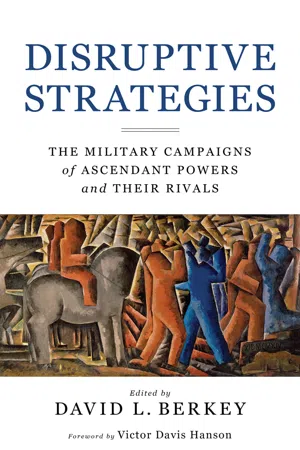
Disruptive Strategies
The Military Campaigns of Ascendant Powers and Their Rivals
- 212 pages
- English
- ePUB (mobile friendly)
- Available on iOS & Android
eBook - ePub
About this book
Since ancient times, there have been military operations that attempted to produce tectonic shifts in the balance of power. In this volume, historians demonstrate how knowledge of past military operations can inform current policy discussions by analyzing conflicts between dominant states and the rising powers who seeks to contest their hegemony. What might a conflict between the United States and its main rival, China, look like in the years ahead? What factors are important for strategists to consider?Paul A. Rahe considers the rival ambitions between Sparta and Athens. Barry Strauss explores the Punic Wars fought by Carthage and Rome. Edward N. Luttwak examines a decisive military campaign between the Byzantine empire and its nemesis, the Sasanians. Peter R. Mansoor describes the emergence of Sweden as a military might under the leadership of Gustavus Adolphus. Andrew Roberts studies the expansion of French power during Napoleon's Italian campaign. Michael R. Auslin formulates a hypothetical conflict between China and the United States in the year 2025. Each of these conflicts offers important lessons about the behaviors of ascendant powers and the responses they provoke.
Information
1
SPARTA ASCENDANT, ATHENS RISING: ALLIANCE, AMBIVALENCE, RIVALRY, AND WAR IN A TRIPOLAR WORLD
Paul A. Rahe
Great quarrels, it has been said, often arise from small occasions but never from small causes.
—Winston S. Churchill1
When an invasion, constituting an existential threat, is turned back, the victors celebrate, as they have every right to do. Then, however, when the euphoria wears off, they begin to rethink their situation and to reconsider their options—as also do those who lost and those who kept their distance from the fray. Moreover, when the victorious party is made up of a coalition of more or less equal partners, the coalition itself soon comes into question—especially when the threat posed by the defeated party has vanished or receded. Only rarely do coalitions of this sort long outlast the danger that inspired their formation and provided the adhesive holding them together.
The Hellenic League is a case in point. It was formed against Persia in or shortly before 481 BCE by Sparta, Athens, and various lesser powers already to one degree or another within the orbit of the two dominant partners. In 480, thanks in large part to the canniness of Themistocles and the size of the Athenian fleet, this coalition achieved a decisive naval victory at Salamis over Xerxes, the Achaemenid monarch of Persia’s vast empire. Then, in 479, thanks in large part to the cunning and courage of the Spartans, it annihilated that Great King’s army at Plataea. The victory that this alliance won on that same day at Mycale, opposite Samos on the western coast of Anatolia, served to confirm the results secured at Salamis and Plataea and guaranteed that the ruler whom the Greeks sometimes called “the Mede” would not in the immediate future return.2

Initially, as one would expect, there was a burst of camaraderie. But it did not take long for the two main powers in the league to begin eyeing one another warily. The size of the fleet that Athens had managed to deploy and the skill displayed at Salamis by the crews who manned its triremes had in 480 been a consolation to its Aeginetan and Corinthian neighbors and allies. But after Plataea and Mycale, when Persia ceased to be an immediate threat, this force came to be seen as a source of concern. In consequence, emissaries from Aegina and almost certainly Corinth as well were dispatched to the Spartans at Lacedaemon in the late summer or fall of 479 to urge that it step in to prevent their Athenian allies from rebuilding the city walls that the Achaemenid king’s Persians had torn down. It was, they thought, essential that, if Athens was to be supreme at sea, it remain vulnerable on land.3
The Lacedaemonians, who were landlubbers, may well have been less sensitive to the threat posed by Athens’s maritime supremacy than were the Aeginetans and Corinthians. But they saw the point, and they were quite responsive to the concerns of their allies within and close by the Peloponnese. They had need of these communities, and this was not apt to change. The little empire that they governed in the southern two-fifths of that great peninsula was fragile. The Spartans, who formed this empire’s ruling order, were greatly outnumbered by the servile class of Helots who farmed the allotments from which they drew their sustenance; and a great mountain range divided the Eurotas River valley in Laconia to the east, where this master class resided, from the Pamisos River valley in Messenia to the west, where the land was more fertile and the Helots far more numerous. To sustain control they needed support not only from the perioeci—the free but politically subordinate population that resided in villages on the margins of their territory within these two river valleys—but also from their allies further afield. Otherwise, should there be a Helot revolt (as there had been on more than one occasion in the past), the Argives, their ancestral foe within the Peloponnese, might well seize upon the occasion as an opportunity to reassert within that peninsula the hegemony that the Lacedaemonians had wrested from them in the not-too-distant past.4
In consequence, upon learning that the Athenians were assiduously rebuilding their walls, the Spartans sent an embassy to Athens to suggest that, to prevent the Persians from returning and using as a base the fortifications of a Greek city, no pólıs outside the Peloponnese should be walled. Needless to say, this request caused consternation in Athens. As everyone understood at the time, the rationale presented by the Spartan ambassadors made no strategic sense. There were insuperable logistical obstacles to the Persians’ return solely by land. To invade Hellas a second time they would have to be able once again to deploy a merchant fleet sufficient to convey the foodstuffs required by a great army on the march—and this they could not effectively do until and unless they had recovered by military means the supremacy at sea that they had enjoyed at the time of the abortive invasion mounted by Xerxes.5
In response, then, to the Spartan recommendation, the Athenians resorted to subterfuge, sending Themistocles to Lacedaemon to obfuscate and delay all proceedings while they worked day and night to raise their walls to a level enabling them to defend the town. Although this bit of diplomatic legerdemain succeeded, the Spartans could still have rallied the forces of the alliance that modern scholars call the Peloponnesian League, and then they could have conducted an unstoppable invasion. Moreover, at the time, Athens was not in a condition to outlast a siege. But the Lacedaemonians did not on this occasion have the heart to stage such an assault. They had only recently fought the Mede alongside the Athenians. Panhellenic sentiment was at a high, and the Spartans were a hesitant lot prone to caution. They could not turn on a dime. In any case, they needed Athens’s triremes. In their absence, should Xerxes build a new fleet and attempt a comeback, the Hellenes would not be able to fend off the Mede.6
In the aftermath, at Themistocles’s instigation, the Athenians fortified the Piraeus peninsula and turned its three harbors into a commercial emporium and a naval base, and they initiated an ongoing trireme-building program designed to guarantee that they would have twenty new galleys available every year. The Lacedaemonians were told that these initiatives were aimed at fending off the Mede, which was no doubt true enough. But Themistocles also had another danger in mind, and he pointedly suggested to his compatriots that, if they were ever attacked by land, they could retreat to the Piraeus and defy all comers with their fleet. Although he did not specify which potential antagonists he had in mind, everyone understood the eventuality that he feared. A quarter of a century prior to the battle of Salamis, the Spartans had on four distinct occasions staged invasions of Attica—aimed at turning Athens into a Lacedaemonian satellite.7
THE DELIAN LEAGUE
Lacedaemon had for some decades been the leading power in Greece, and its appointees commanded the forces of the Hellenic League not only on land but also at sea. The latter arrangement, however, soon ceased to be the case. Hereby hangs a tale.
In ordinary circumstances, the Spartans looked for military leadership to their dual monarchy. In keeping with this practice, Leotychidas, the king supplied by the Eurypontid branch of the city’s Heraclid royal family, had commanded the coalition navy at Mycale. After the battle, however, he had displayed a decided reluctance to commit the alliance to the defense of the island communities situated near the Anatolian coast that had responded to the arrival of his fleet by casting off the Persian yoke and petitioning for acceptance into the Hellenic League. Instead, he had suggested that their populations be moved to the Greek mainland where they could be resettled in the Argolid, in Boeotia, and in Thessaly—where cities had ostentatiously flirted with or openly backed the Mede.
Leotychidas’s proposal was folly, suggesting strategic idiocy on his part. The defeat inflicted on Xerxes’s forces was for the Persians only a setback. It did not seriously weaken the Achaemenid realm. The Great King controlled three of the world’s four great river valley civilizations. His kingdom’s resources—its manpower and wealth—beggared the imagination. It would not be hard for Xerxes to mount another invasion. To cede Ionia to the Mede would be to accord the Hellenes’ greatest antagonist a staging ground within the Aegean from which to make another attempt to conquer Greece. Xerxes could only be kept at bay if the Hellenes retained firm control of this corner of the Mediterranean. It is this fact that explains why Leotychidas was forced to give way when the Athenians came to the defense of the interests of their Ionian kinsmen.8
The following year, the Spartans dispatched Pausanias to lead the Hellenic forces at sea. This man—who was the regent for Leotychidas’s Agiad counterpart, the deceased Leonidas’s young son Pleistarchus—had distinguished himself for intelligence, vigor, and courage when he had led the Hellenic forces on land at Plataea, and he was no less resolute and effective as a blue-water commander. In the south, he wrested control of Cyprus from the Persians. In the north, he seized Byzantium. But although his vigorous prosecution of the ongoing war against the Mede must have been a welcome contrast to the lack of enterprise and the deep-seated reluctance displayed by Leotychidas, Pausanias also evidenced an arrogance and an insolence in his dealings with the Greeks of the east and Sparta’s other allies that gave rise both to complaints registered with the authorities at Lacedaemon and to fury in the fleet. The commanders sent out by Lacedaemon were either behindhand and very nearly useless or so offensive that they were deemed intolerable.9
Lacedaemon’s defects proved to be Athens’s opportunity. When the islanders turned to the chief Athenian commander Aristides, asking that his compatriots take over the leadership of the Hellenic forces at sea, the old fox indicated Athens’s willingness to do so. But, at the same time, he insisted that the islanders first demonstrate to the Spartans that they were no longer willing to serve under Sparta’s nominees.
This they did; and, in 477, the islanders and the Athenians formed a new alliance under Athens’s leadership, which was slated to function as a substitute for the naval force hitherto fielded by the Hellenic League.10 About this development, the Spartans were ambivalent. Many regarded it as an affront, and some of these advocated launching a war against Athens. Others regarded the founding of what modern scholars call the Delian League as a great relief.
The Lacedaemonians were for the most part homebodies—wary of wandering far from their fastness in the southern Peloponnese. They were not numerous. At this time, the adult males numbered something like eight thousand. The Helot threat was a constant worry, forcing them to do everything within their ability to conserve manpower and to concentrate it at home, where it was most apt to be needed. They also worried that the extreme discipline and public-spiritedness for which they were famous was a hothouse flower that would wither if they were dispersed abroad, and they knew that without these qualities they could neither sustain their way of life nor maintain their dominion over the Helots.
Pausanias’s misconduct was as much a matter of concern at Lacedaemon as it was an offense abroad, and there was reason to suspect that, while at Byzantium, he had begun an intrigue with the Mede. Spartan nervousness in this regard was further heightened a year or two thereafter when Leotychidas was caught taking a bribe while commanding an army sent to Thessaly against Persia’s local collaborators, the “Medizers” of that fertile, well-watered region. The war at sea needed prosecution. This the Spartans understood. It and only it stood in the way of a Persian resurgence. But it was, many a Lacedaemonian concluded, best left to the Athenians—who were better situated and more than eager to take it on.11 Therein, however, danger loomed.
If, in the aftermath of Plataea and Mycale, the Spartans were of two minds, so were the Athenians. Shortly after these battles, Themistocles had come to the conclusion that in the Aegean Persia was a spent force. All that the Athenians had to do was to keep up their fleet and sustain the alliance they were in the process of forging with the islanders. In his estimation, Lacedaemon was now the only remaining substantial threat to Athens—and everything that he did in and after 476 was aimed at weakening Sparta and strengthening Athens’s position within Hellas.
Cimon, son of the Miltiades who had le...
Table of contents
- Cover
- Advance Praise for Disruptive Strategies
- Series Page
- Title Page
- Copyright
- Contents
- Foreword
- Acknowledgements
- Introduction
- 1. Sparta Ascendant, Athens Rising: Alliance, Ambivalence, Rivalry, and War in a Tripolar World
- 2. The Punic Wars
- 3. A Strategic Campaign: The Byzantine Emperor Herakleios Destroys Sasanian Persia
- 4. Gustavus Adolphus and the Rise of Sweden
- 5. Napoleon’s Italian Campaign
- 6. The Sino-American Littoral War of 2025: A Future History
- About the Authors
- About the Hoover Institution’s Working Group on the Role of Military History in Contemporary Conflict
- Index
Trusted by 375,005 students
Access to over 1.5 million titles for a fair monthly price.
Study more efficiently using our study tools.
Frequently asked questions
Yes, you can cancel anytime from the Subscription tab in your account settings on the Perlego website. Your subscription will stay active until the end of your current billing period. Learn how to cancel your subscription
No, books cannot be downloaded as external files, such as PDFs, for use outside of Perlego. However, you can download books within the Perlego app for offline reading on mobile or tablet. Learn how to download books offline
Perlego offers two plans: Essential and Complete
- Essential is ideal for learners and professionals who enjoy exploring a wide range of subjects. Access the Essential Library with 800,000+ trusted titles and best-sellers across business, personal growth, and the humanities. Includes unlimited reading time and Standard Read Aloud voice.
- Complete: Perfect for advanced learners and researchers needing full, unrestricted access. Unlock 1.5M+ books across hundreds of subjects, including academic and specialized titles. The Complete Plan also includes advanced features like Premium Read Aloud and Research Assistant.
We are an online textbook subscription service, where you can get access to an entire online library for less than the price of a single book per month. With over 1.5 million books across 990+ topics, we’ve got you covered! Learn about our mission
Look out for the read-aloud symbol on your next book to see if you can listen to it. The read-aloud tool reads text aloud for you, highlighting the text as it is being read. You can pause it, speed it up and slow it down. Learn more about Read Aloud
Yes! You can use the Perlego app on both iOS and Android devices to read anytime, anywhere — even offline. Perfect for commutes or when you’re on the go.
Please note we cannot support devices running on iOS 13 and Android 7 or earlier. Learn more about using the app
Please note we cannot support devices running on iOS 13 and Android 7 or earlier. Learn more about using the app
Yes, you can access Disruptive Strategies by David L. Berkey in PDF and/or ePUB format, as well as other popular books in History & Military & Maritime History. We have over 1.5 million books available in our catalogue for you to explore.