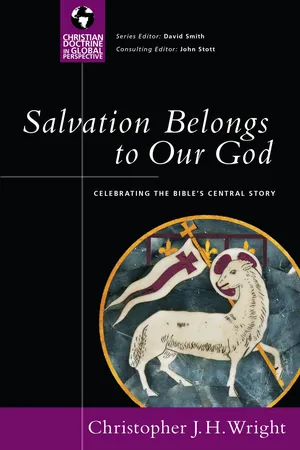
A great multitude that no one could count . . . cried out in a loud voice: "Salvation belongs to our God, who sits on the throne, and to the Lamb."Every phrase in Revelation 7:10 resonates with significant themes in the Old and New Testaments. Christopher Wright views the story of God's salvation through the lens of this verse to show the great breadth of God's saving work: the character and purposes of God, the death and resurrection of Jesus Christ, the redemption of all creation,the joy of Christian experience, and the responsibility of Christian mission. This clear, deep and warm-hearted exposition enriches our grasp of the Bible's multifaceted teaching about salvation.
eBook - ePub
Salvation Belongs to Our God
Celebrating the Bible's Central Story
- 208 pages
- English
- ePUB (mobile friendly)
- Available on iOS & Android
eBook - ePub
Salvation Belongs to Our God
Celebrating the Bible's Central Story
About this book
Information
Topic
Theology & ReligionSubtopic
Christian Theology1
Salvation and Human Need
The grand finale of any great work of music is usually very moving, like an opera or the great music and dance sequences of traditional cultures. The closing song, or climactic chorus, or final dance of great musical dramas usually ends in thunderous applause as the audience feels that the performance has delivered the message of the whole work. As you leave the concert hall, theatre, or village square, you will hear people humming those last tunes. Sometimes you cannot get it out of your head for days. Even in cultures where music and drama take the form of local village art forms, without the need for concert halls and theatres, there is emotional power in the combination of words and music that express the grand themes of life and death, struggle, victory and hope. Human beings in cultures all over the world turn to music, movement, song and drama whenever they wrestle with the real big things that go beyond merely rational analysis.
The Bible ends with a climactic final chorus. The whole of creation will sing it, and it sums up the message of the whole Bible story. It is the theme song for this book and we will be looking carefully at the hidden depths of every phrase in it in the chapters that follow. It is not a long song, but it sums up a very long story. It is a song we will not want to get out of our heads, or our hearts, for all eternity. Here it is, from John’s vision in Revelation 7:9–10.
After this I looked and there before me was a great multitude that no-one could count, from every nation, tribe, people and language, standing before the throne and in front of the Lamb. They were wearing white robes and were holding palm branches in their hands. And they cried out in a loud voice:‘Salvation belongs to our God,
who sits on the throne,
and to the Lamb.’
All through this book we will be asking what the Bible means when it uses such phrases. And we begin with the very first word. What would have been in the mind of someone who wrote and sang, ‘Salvation belongs to our God...’? What we discover when we track the vocabulary through the Bible is that it has a very broad and comprehensive range of significance – in both Old and New Testaments. The statement ‘God saves’ covers a huge range of realities, situations and experiences. And the reason for this is the immense variety of circumstances in which God’s saving engagement with people takes place through the great sweep of biblical history. The fact is, we human beings need a lot of saving. And God does a lot of saving in the Bible.
Human beings, living as mortal, weak and fallen creatures, have an almost limitless range of needs, in which, or out of which, we constantly call for some form of deliverance or another. We just keep on needing to be rescued, it seems. This is not said in order to demean human worth or dignity. On the contrary, God acts to save us in so many different ways precisely because he believes we are worth saving. God created us in his own image. God loves and cares for us. God is moved to grief and anger by our sin, and moved to compassion by our weakness. And so, God saves us. And the Bible shows so many ways in which God does exactly that.
A glimpse at our modern world underlines the continuing relevance of the biblical message about our need of salvation across a very broad front. We can marvel at the amazing progress of the human race in combating disease, improving living conditions for some, raising standards of justice and equality of opportunity in some cultures, and spreading the benefits of education and literacy. Yet any self-congratulation about such patchy progress is outweighed by the crushing poverty of millions, the scourge of HIV-AIDS along with the resurgence of some older diseases, the appalling brutality and violence that blights the lives of millions in wars great and small, the endless misery of long-term refugees. And to all this we must add the reality of two-thirds of the world’s population who have little or no access to any understanding of the salvation that Jesus accomplished through his death and resurrection, and who thus live and die in spiritual ignorance of the gospel. For behind all the manifestations and symptoms of our dire human condition lies the fundamental reality of our sin, our deliberate rebellion against God, and all the consequences that it has brought upon us, including what the Bible clearly and repeatedly calls the wrath or anger of God. We need to be saved, or else there is simply no hope at any level in the present or the future, in this life or for eternity.
The range of contexts in which the Bible speaks about God’s salvation is very wide indeed. We ought to resist the temptation immediately to discount and set aside what we might regard as ‘ordinary’, ‘material’, or ‘earthly’ instances of the biblical language of salvation and then to isolate only those we might deem ‘theological’, ‘transcendent’, or ‘eternal’. That is a form of unbiblical dualism into which Christians very quickly fall.
Now, of course we must discern the Bible’s own priorities within its broad salvation agenda. Some things are certainly more important than others. Certain human needs matter more than others in the end. There are things that we need to be saved from that are more ultimately fatal and destructive than other things. The Bible itself shows that being saved from the wrath of God matters a lot more in the end than being saved from illness or injustice. But the Bible also talks emphatically about both as being parts of the saving work of God. We cannot confine the vocabulary of salvation to only one part of what the Bible means by it.
So, yes, we will need to understand those different levels and priorities. But we also need to see the scope of the Bible’s salvation agenda as a whole. We need to let the whole biblical witness speak for itself. Biblical salvation involves the whole Bible story, and is not just a set of theological doctrines or spiritual experiences. And the Bible’s description of God acting in salvation includes the whole of human life in every dimension, and is not merely an insurance policy for our souls after death. We need, in other words, to have a holistic understanding of salvation. And that too will be a concern of this book all the way through.
Salvation in general
In the Old Testament
In the Old Testament, the verb yaša‘ (to save) and its derivative nouns (especially yěšû‘â, salvation), along with the verb hiṣîl (to deliver), are used in all sorts of contexts. Here are some of them, with examples. In each case I have put in italics the relevant verbs or nouns of salvation, so that we can quickly see the point of each reference.
- Deliverance from oppressors or enemies. This is probably the commonest use of all, since the history of Israel is littered with such situations and matching acts of God’s deliverance. The exodus was the greatest and the prototype of all the others.The LORD said, ‘I have indeed seen the misery of my people in Egypt. I have heard them crying out because of their slave drivers, and I am concerned about their suffering. So I have come down to rescue them from the hand of the Egyptians and to bring them up out of that land into a good and spacious land.(Exod. 3:7–8)Whenever Israel went out to fight, the hand of the LORD was against them to defeat them, just as he had sworn to them. They were in great distress.Then the LORD raised up judges, who saved them out of the hands of these raiders...Whenever the LORD raised up a judge for them, he was with the judge and saved them out of the hands of their enemies as long as the judge lived; for the LORD had compassion on them as they groaned under those who oppressed and afflicted them.(Judg. 2:15–16, 18)
- Victory in battle. Typically, when Israel prayed for God’s help in battle, or prayed for the king in that situation, they appealed to God’s power to save.Now I know that the LORD saves his anointed;
he answers him from his holy heaven
with the saving power of his right hand.Some trust in chariots and some in horses,
but we trust in the name of the LORD our God.They are brought to their knees and fall,
but we rise up and stand firm.O LORD, save the king!
Answer us when we call!(Ps. 20:6–9; see also Ps. 33:16–19) - The healing of sickness. Isaiah 38 records the story of Hezekiah’s illness which had brought him to the point of death. In response to his prayers and tears, God restores his health (and promises to deliver his city into the bargain – v. 6). Hezekiah’s song of thanksgiving makes much of the importance of being kept alive in order to praise God among the living. For Hezekiah, to be spared physical death was God’s salvation at that point in his life.The LORD will save me,
and we will sing with stringed instrumentsall the days of our lives
in the temple of the LORD.(Isa. 38:20) - Rescue from personal enemies, persecutors or detractors. Many of the psalms were born in the stress of personal attack. This may have been slander, unjust accusation in court, or outright physical threats and persecution. In such circumstances, David and other psalmists did not have recourse to vengeance, taking the law into their own hands, but entrusted themselves to God. God would save them. That is, they looked to God to vindicate and defend them from such assaults, whatever they were. The language of salvation is commonly used to express this appeal. God himself used it in responding to Jeremiah when he cried out to God against those who made his life such a misery.O LORD my God, I take refuge in you;
save and deliver me from all who pursue me,or they will tear me like a lion
and rip me to pieces with no-one to rescue me...My shield is God Most High,
who saves the upright in heart.(Ps. 7:1–2, 10)‘I will make you [Jeremiah] a wall to this people,
a fortified wall of bronze;they will fight against you
but will not overcome you,for I am with you
to rescue and save you,’ declares the LORD.‘I will save you from the hands of the wicked
and redeem you from the grasp of the cruel.’(Jer. 15:20–21) - Vindication in court. The experience of being wrongly accused not only is painful, but can be life-threatening, depending on the seriousness of the false accusation. Or, if one appeals to the judges in order to receive justice in a situation of oppression or exploitation, only to be denied that justice and be further marginalized, then that too is deeply destructive – individually and socially. In such situations, Israelites directed their appeal to God for salvation – to be saved from injustice in the most literal way.One way in which God would exercise his saving power in society would be by ensuring that the appointed king – the head of the judicial system – would himself act justly. Accordingly, Psalm 72 prays that God would endow the king with his own justice and righteousness. Only then would the human king act as the saviour of the poor and needy. So, in these verses, the king is seen as the agent of God’s salvation, in the social and economic realm. God is the source of the salvation (understood as being rescued from injustice), even though a human being (the king, or government) is the agent of it.He will defend the afflicted among the people
and save the children of the needy;
he will crush the oppressor...He will take pity on the weak and the needy
and save the needy from death.(Ps. 72:4, 13)In other cases, God is simply said to act directly as judge in order to save the needy.From heaven you pronounced judgment,
and the land feared and was quiet –when you, O God, rose up to judge,
to save all the afflicted of the land.(Ps. 76:8–9)
So then, to speak of God saving a person or people in the Old Testament can refer to many different ways in which he brings them out of dangerous or negative circumstances into freedom or security.
In the New Testament
In the New Testament, the Greek verb sōzō (to save) and its associated noun sōtēria (salvation) can be used in a similarly broad sense. And this can be the case even when it is used with God as subject. That is, God can save people in the same kind of general way that we saw above in Old Testament texts. It is a false distinction to say that in the Old Testament salvation was national or physical, whereas in the New it becomes only spiritual and individual. Again, that kind of dualism is foreign to the Bible. Both Testaments speak of salvation in these broad and general terms. Here again are some examples.
- Rescue from drowning. Twice Jesus responded to people in danger of drowning who cried out to him to save them. In the second case, involving Peter in particular, the story has undoubtedly been told with some metaphorical and spiritual parallels in mind – as many sermons have discerned. But just as undoubtedly, it was from literal drowning in physical water that Peter wanted physical salvation! He was not asking to be saved so that he could go to he...
Table of contents
- Salvation Belongs To Our God
- Contents
- Preface
- 1 Salvation and Human Need
- 2 Salvation and God’s Unique Identity
- 3 Salvation and God’s Covenant Blessing
- 4 Salvation and God’s Covenant Story
- 5 Salvation and Our Experience
- 6 Salvation and the Sovereignty of God
- 7 Salvation and the Lamb of God
- Notes
- About the Author
Trusted by 375,005 students
Access to over 1.5 million titles for a fair monthly price.
Study more efficiently using our study tools.
Frequently asked questions
Yes, you can cancel anytime from the Subscription tab in your account settings on the Perlego website. Your subscription will stay active until the end of your current billing period. Learn how to cancel your subscription
No, books cannot be downloaded as external files, such as PDFs, for use outside of Perlego. However, you can download books within the Perlego app for offline reading on mobile or tablet. Learn how to download books offline
Perlego offers two plans: Essential and Complete
- Essential is ideal for learners and professionals who enjoy exploring a wide range of subjects. Access the Essential Library with 800,000+ trusted titles and best-sellers across business, personal growth, and the humanities. Includes unlimited reading time and Standard Read Aloud voice.
- Complete: Perfect for advanced learners and researchers needing full, unrestricted access. Unlock 1.5M+ books across hundreds of subjects, including academic and specialized titles. The Complete Plan also includes advanced features like Premium Read Aloud and Research Assistant.
We are an online textbook subscription service, where you can get access to an entire online library for less than the price of a single book per month. With over 1.5 million books across 990+ topics, we’ve got you covered! Learn about our mission
Look out for the read-aloud symbol on your next book to see if you can listen to it. The read-aloud tool reads text aloud for you, highlighting the text as it is being read. You can pause it, speed it up and slow it down. Learn more about Read Aloud
Yes! You can use the Perlego app on both iOS and Android devices to read anytime, anywhere — even offline. Perfect for commutes or when you’re on the go.
Please note we cannot support devices running on iOS 13 and Android 7 or earlier. Learn more about using the app
Please note we cannot support devices running on iOS 13 and Android 7 or earlier. Learn more about using the app
Yes, you can access Salvation Belongs to Our God by Christopher J.H. Wright,Christopher J. H. Wright in PDF and/or ePUB format, as well as other popular books in Theology & Religion & Christian Theology. We have over 1.5 million books available in our catalogue for you to explore.