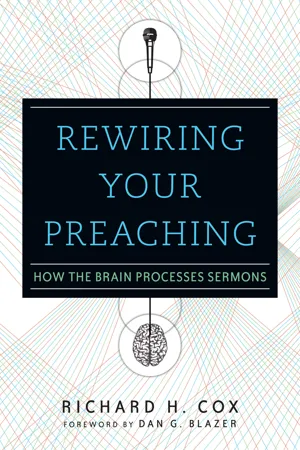
What preachers preach is not necessarily what hearers hear. Have you ever wondered why some hearers are affected by a sermon but not others? The issue may not necessarily be the content or delivery of the message. It may be how your hearers' brains process what you say. Modern neuroscience illuminates how our brains understand and hear sermons. Verbal stimuli can be accepted or rejected depending on the context of how they are received. The brain processes new information differently than information that reinforces already-held beliefs. To have long-term effect, new information must connect with previous memory. Psychologist, physician and preacher Richard Cox shows that better understanding of the brain can help preachers be more effective in their preaching. Intentional, purposeful preaching can actually produce new neural pathways that change how the brain thinks and how its owner acts. Our brains are intimately connected with how our bodies work, especially in how brain stimuliproduce behavioral responses and how people experience comfort and healing in times of pain.God is at work in our brains to enable his people to hear him. Preach with the brain in mind, and help your hearers grow in mental, physical and spiritual health.
The results of preaching are predicated and dependent on the worshiper’s neural (brain) ability to pay attention, integrate current thought with experiences and knowledge, and utilize memory. When vibrations hit the eardrum, they are not words, but only sounds. The brain can enter into either confusion or synthesis, depending on the ability of the speaker to religare—that is, attach new learning to old. Otherwise, information has no meaning and the human brain enters into a process of rejection.
It’s imperative to understand how the brain “hears,” then “translates,” then decides what to do with new information. A later chapter will discuss the brain and mechanism of hearing in detail, but here it’s important to understand the psychological ramifications of what we hear.
The brain, without any conscious intent, determines very early in a sermon whether the mind’s lights will come on or will short out and turn off. The choice of words, the syntax, the pronunciation, the inflexion of the voice and much more will determine whether the brain decides to tune out or tune in. Although a brain is very different from a light switch, the result is the same. It takes only a nanosecond for a compromised light switch to short out and stop working. The same is true with those who listen to preachers, lecturers and teachers. A small child was asked, “What is the person called who continues to talk when the listener has stopped listening?” The child replied, “A teacher.” An adult might have said, “A preacher.”
Listeners either turn the lights off or keep them on, and they don’t always consciously know that they’re doing so. External stimuli often make this decision for us. Some people are capable of consciously using a kind of brain rheostat that brightens and lowers the light (attention mechanism), which doesn’t allow enough illumination for them to see the picture correctly. This kind of intentionality is related to interest in the topic at hand, and at times in one’s motivation to remember information being given. Others are unaware of the external forces acting upon them. Sometimes this is worse than no attention at all, since the listener has partial knowledge that may be misinterpreted and misapplied. A congregation that is half asleep may be worse than none at all. Although many factors affect the listener in the process of paying attention, the minister can control some, such as sermon structure, vocabulary and method of preaching.
The average Christian’s belief about preaching is largely ethereal, meaning they believe that somehow people automatically decide what to do with what they hear. Others believe that there is no need to worry about the style of preaching, since all results are simply what “God wants to happen.” There’s no doubt that the ultimate results of preaching depend on the working of the Holy Spirit. The Scriptures are emphatic that God’s word accomplishes his purposes: “So shall my word be that goes out from my mouth; it shall not return to me empty, but it shall accomplish that which I purpose, and succeed in the thing for which I sent it” (Is 55:11).
But because God is capable of blessing poor sermons is no excuse to preach poorly. Knowledge and tools now available from the neurosciences can assist us in more powerful and productive preaching, and they in no way diminish belief in the power of the Holy Spirit, but rather magnify our ability to understand how God works through the physiology of the human brain. In medicine, we don’t diminish God by further understanding the disease mechanism, nor do we lessen his power of healing. The same is true in understanding how the mind works and how preaching becomes effective.
Simply because a person hears does not mean that her or his brain is listening. We hear sounds all the time in traffic, on elevators and in restaurants but don’t listen to them. Often we recognize their presence only when they are called to our attention. The same is true of the spoken word, whether in casual conversation or in sermons. Therefore, there may be many hearers present but few or no listeners.
The human learning process is one of listening, memory and integration. We receive information within the context of previous knowledge and process it through the filter of memory; then we decide what to do with it.
Listening uses memory to experience the past in the present and to bring the future into the present before its time. Memory coupled with new information, based on perceived need, is the engine that drives the brain to change. Preaching must build on past knowledge by bringing that knowledge into the present, coupling it with new information, and making it meaningful for our future need before we need it. Since we keep only core memory in our immediate consciousness (what is required for essential human function), all other memory is recalled and reconstructed with the additions and subtractions of newly configured information. Some of this recall takes nanoseconds, and some requires more time and additional cues to bring it into consciousness. New material may be considered “associated learning,” because it is always added to previous knowledge that has been stored in various parts of the brain.
Neurochemical and neurophysiological activity determine whether new information will be given short-term status or will be cataloged for long-term storage. An area in the brain called the hippocampus is responsible for storing memory. Neural activity in the prefrontal cortex, striatum, limbic system and association cortex, along with many other brain structures, determine what information is stored, how it is integrated and whether or not it is worth dealing with at all.
The brain can’t possibly remember every bit of information it receives. If it did, it would become overloaded very early in life. Some information is seen as extraneous and unnecessary. Other information is considered unnecessary at the time but can be revisited in the future, so it’s cataloged and stored. And other information is considered important for immediate growth or survival.
Dr. Andrew Newberg, an acclaimed neuroscientist, and his associates at the University of Pennsylvania came to the following conclusions regarding religious ideation and the brain:
Each part of the brain constructs a different perception of God.
Every human brain assembles its perceptions of God in uniquely different ways, thus giving God different qualities of meaning and value.
Spiritual practices, even when stripped of religious beliefs, enhance the neural functioning of the brain in ways that improve physical and emotional health.
Intense, long-term contemplation of God and other spiritual values appears to permanently change the structure of those parts of the brain that control our moods, give rise to our conscious notions of self and shape our sensory perceptions of the world.
Contemplative practices strengthen a specific neurological circuit that generates peacefulness, social awareness and compassion for others.[1]
Recent studies utilizing fMRI (functional magnetic resonance imaging) are very close to pinpointing specific anatomical locations for various kinds of thinking—even the location of various virtues. If this is accomplished, science will have invaded the very soul of the human—our inextricably interwoven mind and body. The implications for teaching and preaching are staggering. Preachers will continue to have the same duties, but accountability for reaching the mind will greatly increase when we know the mechanism causing words to become decisions. Institutions of higher learning with substantial academic credibility, such as Emory University, University of Florida, University of Illinois and California Institute of Technology, are among those on the forefront of these studies. The studies are preliminarily showing compassion to be located in the insula, along with sociability. Empathy and morality are believed to be in the amygdala, along with anger and rage. Meditation is likely in the angular gyrus.[2]
Newberg reports that there are “God circuits” in our brains. He credits the parietal-frontal circuit as establishing the “you and God” relationship and the frontal lobe as creating and integrating ideas about God. He believes the thalamus gives emotional meaning to concepts of God, and he credits an overstimulated amygdala for potentially causing frightening, authoritative, punitive ideas of God and suppressing the frontal lobe’s ability to think logically about God. The striatum may allow a person to feel safe in the presence of God.[3]
As speculative as this may sound, there is enough solid evidence to attract many of our brightest neuroscientists. These scientists are spending countless hours and budgets to help us understand our spiritual selves. Preachers do not need this kind of proof, but it’s great that modern science is testifying to biblical concepts that have been known for centuries.
How It Works Is Still a Mystery
Even though neuroscientific knowledge helps us to better understand the human thinking process, we need to be reminded that when (and if) pinpoint locations in the brain for spirituality are proven, we still will not know how it all works. We will know that we are “fearfully and wonderfully made” (Ps 139:14). It will still remind us that the “wind blows where it chooses, and you hear the sound of it, but you do not know where it comes from or where it goes. So it is with everyone who is born of the Spirit” (Jn 3:8-9). It was the Spirit of God that moved on the waters to create physical life (Gen 1:2), and it is the Spirit of God that continues to move on human minds to create spiritual life.
The mystery of how things work is necessary for faith and for the inherent dependence of humans on God. The apostle Paul wrote, “We speak of God’s wisdom, secret and hidden, which God decreed before the ages for our glory . . . as it is written, ‘What no eye has seen, nor ear heard, nor the human heart conceived’” (1 Cor 2:7, 9). It is not immoral to investigate the mystery, because in the investigation we discover the soul, depth and impenetrability of it, knowing that it is beyond our complete understanding. We do, however, gain limited understanding. Again, Paul seemed to understand this complexity of life: “For now we see in a mirror, dimly, but then we will see face to face. Now I know only in part; then I will know fully, even as I have been fully known” (1 Cor 13:12). The mystery is essential.
The Mind Is Easily Tricked
An observation will help to illustrate just how easily the mind can fall prey to illusion and magic. There was a fireplace glowing in a hotel, with several people standing in front of it, warming their hands by the heat of a gas log emitting an imperceptible flame. In front of the fireplace was a stack of oak logs, fireplace tongs, a shovel, a poker and an ash bucket filled with old newspapers and pinecones. The tongs would not be used, the wood would not be burned, and the ash bucket would remain without ashes. But the ambience was not fake; the glow and the tiny flame were all real and gave a cozy feeling to the otherwise cold hotel lobby. The flame was imperceptible, but the ambience was real.
The brain is known for exchanging ambience for reality and vice versa. When this occurs, the body responds to the brain message in real time. In this instance, the small flame, fireplace tools and pile of wood connected the brain to previously embedded “truth” that “fireplace and flame” mean “warm.” Although there was a small bit of warmth, the amount was not equal to one’s perception. Exaggerated perception greatly modified the “truth.” The ambience was indeed real, but something was missing—the truth.
The ambience was used to trick the mind into believing something that was not real and responding accordingly. So, thinking human beings responded in reality even when the environment was presented to them in fiction. Ambience brings us to accept something to be more than it actually is. It becomes a mental mirage; we “see” the wet road ahead and slow down, only to discover when arriving at the “sight” that it no longer exists, but has moved ahead by the same distance as when it was first “seen.”
Perception is everything to the brain. A child who has been burned by a hot stove may avoid the stove even when it is cold, because the brain has been conditioned to believe that stoves are hot and burn. That child may also perceive that his or her knee is broken when it’s only scraped in a fall. Perception is a combination of fact and feeling.
What does this have to do with preaching? Everything. Productive preaching requires both fact and feeling. The more “educated” churches tend to emphasize fact without feeling, and others are often just the opposite. For instance, many charismatic assemblies appear to operate primarily on feeling, while “university” churches may assiduously strive to avoid any appearance of being “feely.” Of importance is the motivation behind these extremes. It appears that many believe that feeling always contaminates fact and that fact always contaminates feeling. When put into action, both philosophies lull people into adulterated truth or half-truth, spinning the gospel to fit the perceived need of the day and accommodating their biases. In these cases, we can be certain that the mind will become conditioned to whatever is preached and act accordingly. Ambience can be substituted for reality in theology too.
2
Linking Brain and Sermon
The thinking part of the body is the brain. It is filled with millions of special neural pathways that allow the hearer to accept or reject verbal stimuli. Preachers must utilize the knowledge of those brain-wired processes if they are to be “heard.” They do not need to fully understand how the processes work, but must understand the methods of activating them.
Although we don’t fully understand how the brain works and undoubtedly will never figure it out completely, this doesn’t excuse us from utilizing every ounce of human knowledge for preaching the glory of God. Preachers, among all professionals, are persuaders of the mind by calling, training and professional identity. To ignore what we know that could make the task more efficient and productive would be to squander part of our modern stewardship—the stewardship of neuroscientific knowledge.
Have you ever wondered just what is going on inside the heads of your congregants while you’re preaching? It’s encouraging to know that it’s impossible for sermons to go in one ear and out the other. The brain is incapable of ignoring external stimuli. It must deal with all stimuli in some way. Parishioners may appear to be just sitting there, but their brains are working diligently either attempting to dismiss or processing what is going on (it must even process stimuli to ignore it).
All brain activity requires brain energy. We must then ask, “How does the ear hear words, then translate them into ideas, then move ideas into decisions and decisions into actions?” It may be something like the age-old question “How does a brown cow eat green grass and produce white milk?” Neuroscience gives us some knowledge as to how the ear turns sound waves into brain thoughts that produce mental and physical action.
The brain mechanism is very much like the old-fashioned telephone switchboard. A person could call in on a line and be connected to many trunk lines at the same time—somewhat like a modern conference call. It was also possible to be on a party line in which many callers could listen in on a conversation—often uninvited. The spoken word comes to the “switchboard” (thalamus) and is connected to many “trunk lines” (striatum, limbic system, association cortex, motor cortex and so on) simultaneously. The incoming call must be acknowledged even to be ignored. The switchboard operator (in this case the brain’s owner) must decide wh...
Table of contents
Cover
Copyright
Contents
Foreword
Chapter Synopses
Preface
1 A Brainstorm Versus a Short Circuit
2 Linking Brain and Sermon
3 The Brain Sees Preaching as Unique
4 The Brain Uses Preaching for Healing
5 The Core Process of Preaching is Brain Work
6 Preaching Provides Brain Energy
7 Brain Stimuli Produce Behavioral Responses
8 Preaching and Pastoring Are Different
9 Getting to the Brain with Theology
10 Preaching and the Brain in Pain
11 Brain Healing and the Soul
12 Brain Healing and the Mind
13 Brain Healing and the Body
14 Brain Healing and the Community
Dénouement and Benediction
Acknowledgments
Appendix
Notes
About the Author
Trusted by 375,005 students
Access to over 1.5 million titles for a fair monthly price.
Study more efficiently using our study tools.
Frequently asked questions
Yes, you can cancel anytime from the Subscription tab in your account settings on the Perlego website. Your subscription will stay active until the end of your current billing period. Learn how to cancel your subscription
No, books cannot be downloaded as external files, such as PDFs, for use outside of Perlego. However, you can download books within the Perlego app for offline reading on mobile or tablet. Learn how to download books offline
Perlego offers two plans: Essential and Complete
Essential is ideal for learners and professionals who enjoy exploring a wide range of subjects. Access the Essential Library with 800,000+ trusted titles and best-sellers across business, personal growth, and the humanities. Includes unlimited reading time and Standard Read Aloud voice.
Complete: Perfect for advanced learners and researchers needing full, unrestricted access. Unlock 1.5M+ books across hundreds of subjects, including academic and specialized titles. The Complete Plan also includes advanced features like Premium Read Aloud and Research Assistant.
Both plans are available with monthly, semester, or annual billing cycles.
We are an online textbook subscription service, where you can get access to an entire online library for less than the price of a single book per month. With over 1.5 million books across 990+ topics, we’ve got you covered! Learn about our mission
Look out for the read-aloud symbol on your next book to see if you can listen to it. The read-aloud tool reads text aloud for you, highlighting the text as it is being read. You can pause it, speed it up and slow it down. Learn more about Read Aloud
Yes! You can use the Perlego app on both iOS and Android devices to read anytime, anywhere — even offline. Perfect for commutes or when you’re on the go. Please note we cannot support devices running on iOS 13 and Android 7 or earlier. Learn more about using the app
Yes, you can access Rewiring Your Preaching by Richard H. Cox in PDF and/or ePUB format, as well as other popular books in Theology & Religion & Christian Ministry. We have over 1.5 million books available in our catalogue for you to explore.