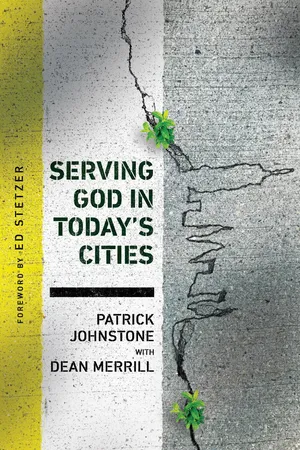
Welcome to the world's first urban century. How will you respond?For the first time ever, more people now live in cities than outside them. Cities offer both big headaches and vast opportunities, and agencies that once focused onrural work are increasingly turning their attention to urban centers. Join veteran researcher and missiologist Patrick Johnstone as he explores the fastest growing cities and megacities in the world, showing how Christian workers are addressing people's spiritual, physical, and social needs.In 1962 Patrick Johnstone left England's countryside to serve the bustling townships of apartheid-era South Africa. His pioneering of urban ministries changed his life. Journey with Patrick and Dean Merrill as they share God's heart for the city and introduce pastors, missionaries, and community workers who are addressing urbanization's key challenges.God has a heart for today's cities. See how you can join this urgent mission.
- 125 pages
- English
- ePUB (mobile friendly)
- Available on iOS & Android
eBook - ePub
About this book
Information
Topic
Theology & ReligionSubtopic
Christian Ministry
CHAPTER 4
ACTION 1:
PRAY TOGETHER
You may be tempted to skip this chapter so you can get on to newer, fresher, more innovative ideas for urban ministry.
Please don’t.
Of course, we all believe in praying; we talk about it all the time. No Christian would ever breathe the heresy that prayer is unimportant or peripheral.
But actually doing the work of prayer (by ourselves or with others) is a different matter. It is not hard to say, “Let’s open this meeting with a word of prayer,” or “Yes, my friend, I’ll pray for you.” However, actually investing time in talking with God is not something that happens as often as our words might indicate.
Kingdom work in the metacities (today’s largest cities, far larger than megacities) of the 21st century is more dependent upon prayer than any sophisticated strategy or formula. The words of Psalm 127:1 echo at the edges of our conference rooms: “Unless the LORD builds the house, the builders labor in vain. Unless the LORD watches over the city, the guards stand watch in vain.”
The best-laid campaigns and charts will fall short without divine empowerment. Samuel Chadwick (1860-1932), a Methodist leader and college president, said it well: “The work of God is not by might of men or by the power of men but by his Spirit. It is by Him the truth convicts and converts, sanctifies and saves. The philosophies of men fail, but the Word of God in the demonstration of the Spirit prevails.”10
Therefore, it is vital that Christian leaders from all ethnic and denominational backgrounds come together to pray for their cities and for one another. As they plead with God for an effective witness in their setting, breakthroughs start to happen.
WHY URBAN MINISTRY DEMANDS PRAYER
There are at least three reasons for calling upon God together.
1) IT CAN BE TOUGH IN THE CITY
Anyone who has worked in city ministry for very long knows that cities can be tough environments. The powers of evil are arrayed on all sides, from hostile civic authorities to people’s personal bondages to the literal forces of hell. This is no easy road.
Pastor Jim Cymbala tells in his book Fresh Wind, Fresh Fire about a desperate afternoon early in his ministry at a tiny, dysfunctional church called the Brooklyn Tabernacle, when he bemoaned to God:
“Lord, I have no idea how to be a successful pastor. . . . I haven’t been trained. All I know is that Carol [his wife] and I are working in the middle of New York City, with people dying on every side, overdosing from heroin, consumed by materialism, and all the rest. If the gospel is so powerful . . .”
I couldn’t finish the sentence. Tears choked me. . . .
Then quietly but forcefully, in words heard not with my ear but deep within my spirit, I sensed God speaking:
If you and your wife will lead my people to pray and call upon my name, you will never lack for something fresh to preach. I will supply all the money that’s needed, both for the church and for your family, and you will never have a building large enough to contain the crowds I will send in response.
I was overwhelmed. My tears intensified. . . . I knew I had heard from God.11
He returned to his pulpit the next Sunday and made the shocking announcement that, as of that moment, the Tuesday night prayer meeting would be “the barometer of our church. What happens on Tuesday night will be the gauge by which we will judge success or failure, because that will be the measure by which God blesses us.”
Today, if you visit this 3,400-seat church in downtown Brooklyn on a Tuesday night, you will find several thousand people fervently calling out to God for His help. They intercede for desperately needed jobs, for unsaved relatives, for wayward children, for physical healing, for safety in the perilous streets and subways, for outreaches to the needy. There is little preaching, no formalities, and no music from the award-winning Brooklyn Tabernacle Choir (which sings on Sundays). Instead, it is all about prayer.
The family of God, in nearly every city, is notoriously divided by history, doctrinal interpretations, ethnic diversity, and even individual personalities.
In the Gospel of Mark, when nine of Jesus’ disciples faced a particularly difficult stronghold of Satan at the foot of the mountain—a pitiful boy tormented by seizures—they tried to cast out the demon but failed. Later, they asked their Master why. His answer: “This kind can come out only by prayer” (Mark 9:29).
Be warned: the various demons we face in modern cities are just as hard to dislodge.
2) BREAKING DOWN THE WALLS
A second reason we need to pray to God about the cities of our world is because we need to break down the walls of division between us. The family of God in nearly every city is notoriously divided by history, doctrinal interpretations, ethnic diversity, and even individual personalities. Working together to advance the Kingdom does not come naturally. Too often, we are preoccupied with our own labels.
The unbelievers, of course, could not care less about our denominational or theological labels. In fact, they find them rather mystifying. For us to lift up Christ and Christ alone will require a change in our mindset. This change is best accomplished on our knees—together.
In recent years, the Council of Pastors in Buenos Aires, Argentina (metro population 13.6 million in 2017), has been giving us a worthy example. “Each time the New Testament speaks of the church in a city such as Ephesus, it is always singular, never plural,” a Baptist pastor named Carlos Mraida told Christianity Today magazine. “Yet when the New Testament speaks of leadership in a city, it is always plural. The church is singular, but the leadership is plural.”
One of his fellow pastors, Norberto Saracco of Good News Church, continued with a poignant observation. “When we go to the U.S., we cannot understand the division of the church. You can have one pastor on one [street] corner and another on another corner, and they don’t know each other. Here we are friends.”12
As a result, this council of some 180 pastors meets regularly to support each other, share resources (even money), plan joint projects, and pray together. In 2008 they organized 40 days of prayer, ending with an outdoor vigil for three nights in front of the nation’s Congress. This entire capital is taking notice of the gospel—and responding to it.
The pastors speak of their efforts as long-term, not just an event. “Unity of the city is a process,” says Mraida.
We across the Body of Christ may never agree on such doctrinal matters as predestination or the timing of the Second Coming. We may not preach from the same lectionary or with the same style. We probably don’t worship with the same music. But at least we can pray together. And when we do, the God and Father of us all is listening.
3) TUNING IN TO GOD
A third reason we need to pray is because we need to tune ourselves to the will of God. Prayer gets us beyond “what I think” and “what strategy I propose” and tunes our ear to what God is thinking and directing. It reminds us that there is, indeed, a “Lord of the harvest” (Matthew 9:38)—and it’s not us. The workers He seeks to employ must be aligned with Him.
In Ghana, when the “New Life for All” movement was just starting, in the mid-1970s, to seek to evangelize the entire country on a planned basis, one of the first things missionary Ross Campbell and his colleagues did was to hold three-day retreats for pastors and other church leaders. More than 120 of these events were conducted. One result, not entirely expected, was that the gatherings helped many pastors return to a living faith! They had been nominal Christians, of course, but they were hardly energized by the power of the gospel. Now, after praying with others for three days, their whole perspective was changed.
Campbell firmly believed that trying to enthuse unconverted ministers with largely unconverted congregations to go out and bring the unconverted to Christ would be doomed to failure. The act of praying together dealt with that issue at the front; then true evangelism could begin.
All kinds of strategies followed in the wake of these prayer retreats for leaders. Prayer cells in local churches were begun; Bible study outlines and witnessing aids were circulated; pastors selected key lay leaders to equip and involve congregational members in lifestyle evangelism; measurable goals were enacted. The entire Ghanaian church seemed energized.
And what was the result? “The number of Protestant churches [at the start was] 10,105 in 1976. In the decade 1977-86, a further 8,575 new congregations were established—a growth of 85 percent.”13 The power of prayer had activated remarkable progress for the Kingdom in a relatively short amount of time.
HOW LARGE? HOW SMALL?
The formats for praying together may vary widely. Some gatherings may be huge, drawing public attention. On one occasion, in Cape Town, South Africa, more than 45,000 Christians packed into Newlands Rugby Stadium for...
Table of contents
- Cover
- Title Page
- Contents
- Foreword by Ed Stetzer
- Introduction
- PART ONE: Eyes to See
- PART TWO: Eight Critical Responses
- Conclusion: Greater Things Are Still to Come
- Notes
- Featured Ministries
- Also Available
- Praise for Serving God in Today’s Cities
- About the Contributors
- More Titles from InterVarsity Press
- Copyright
Trusted by 375,005 students
Access to over 1.5 million titles for a fair monthly price.
Study more efficiently using our study tools.
Frequently asked questions
Yes, you can cancel anytime from the Subscription tab in your account settings on the Perlego website. Your subscription will stay active until the end of your current billing period. Learn how to cancel your subscription
No, books cannot be downloaded as external files, such as PDFs, for use outside of Perlego. However, you can download books within the Perlego app for offline reading on mobile or tablet. Learn how to download books offline
Perlego offers two plans: Essential and Complete
- Essential is ideal for learners and professionals who enjoy exploring a wide range of subjects. Access the Essential Library with 800,000+ trusted titles and best-sellers across business, personal growth, and the humanities. Includes unlimited reading time and Standard Read Aloud voice.
- Complete: Perfect for advanced learners and researchers needing full, unrestricted access. Unlock 1.5M+ books across hundreds of subjects, including academic and specialized titles. The Complete Plan also includes advanced features like Premium Read Aloud and Research Assistant.
We are an online textbook subscription service, where you can get access to an entire online library for less than the price of a single book per month. With over 1.5 million books across 990+ topics, we’ve got you covered! Learn about our mission
Look out for the read-aloud symbol on your next book to see if you can listen to it. The read-aloud tool reads text aloud for you, highlighting the text as it is being read. You can pause it, speed it up and slow it down. Learn more about Read Aloud
Yes! You can use the Perlego app on both iOS and Android devices to read anytime, anywhere — even offline. Perfect for commutes or when you’re on the go.
Please note we cannot support devices running on iOS 13 and Android 7 or earlier. Learn more about using the app
Please note we cannot support devices running on iOS 13 and Android 7 or earlier. Learn more about using the app
Yes, you can access Serving God in Today's Cities by Patrick Johnstone in PDF and/or ePUB format, as well as other popular books in Theology & Religion & Christian Ministry. We have over 1.5 million books available in our catalogue for you to explore.