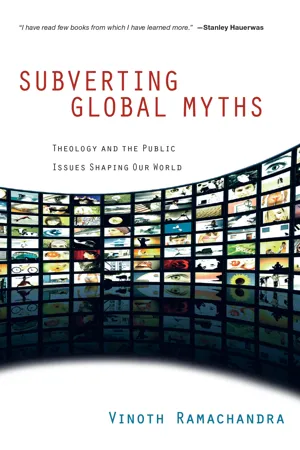
It is a myth that only the uninformed masses believe in myths and that power brokers, media moguls, leading scientists, financial tycoons, political luminaries and intellectual elites don't. The myths that the ruling classes believe may be more sophisticated, but they are myths nonetheless.These public, large-scale narratives engage our imaginations and shape the way we experience the world. They are the stories that tell us what is important to know and how to live.
Subverting Global Myths takes up six areas of contemporary global discourse--terrorism, religious violence, human rights, multiculturalism, science and postcolonialism. Here powerful myths energize and mobilize considerable public funding as well as academic production. This book is not addressed primarily to theological specialists, but to all thoughtful readers who are concerned about the public issues that shape our increasingly interconnected and interdependent world.Vinoth Ramachandra draws at length on his own experience working among university students and professors against a backdrop of militant religious and secular ideologies in Sri Lanka, a country that has suffered from "terrorism" and a "war on terror" that has claimed over sixty thousand lives since the late 1970s and shows no signs of abating. Reflected as well is his experience of living and traveling extensively not only in the West but in several of the trouble spots of Asia today.Thoughtful critical readers who care to explore reality rather than flip from one reality show to another will appreciate this invitation to subvert present reality in order to make way for another.
“Alas the Afghanistan of our youth is long dead. Kindness is gone from the land and you cannot escape the killings. Always the killings. In Kabul, fear is everywhere, in the streets, in the stadium, in the markets, it is a part of our lives here.”
a character in Khaled Hosseini’s The Kite Runner
Reaping the Whirlwind
The U.S. Central Intelligence Agency coined a term for it: Blowback. The explosive boomerang that governments throw when, either by propaganda or through covert military operations, they deliberately stoke up the flames of ethnic, religious or nationalist rivalries for political gain. Faustian monsters are created who then threaten to overwhelm the very governments that gave them birth. Blowback was first used by the CIA to describe the unintended consequences of their covert activities in Iran in 1954. The agency warned of the possible repercussions of the coup d’etat it had engineered to overthrow the elected government of Mohammed Mossadeq a year earlier. The joint operation with Britain’s MI6 was undertaken in order to prevent the nationalization of Iran’s oil reserves. For the next twenty-five years a despotic Shah was armed and protected by the United States and Britain so that their oil companies could have a free hand. The blowback was a long time in coming, but when it did the results were catastrophic: the creation of a Shia Islamic Republic that became an implacable enemy of the United States and inspired Muslims all over the world to confront the West.
The Soviet Union made its fatal move into Afghanistan on Christmas Eve 1979, not long after the Shah had fled Iran, two events that redefined geopolitics for generations to come. The Afghan communist party (the Peoples’ Democratic Party of Afghanistan) had participated, along with the Afghan army, in a bloodless revolution in 1973 against feudal rule. It took power directly in April 1978 and pushed through progressive reforms. It introduced free medical care in the poorest areas, educated women, recognized the rights of ethnic minorities and freedom of religion. (By the late 1980s half the university students in the country were women, and women made up 40 percent of Afghanistan’s doctors and 30 percent of its civil servants.) The reforms were opposed by Islamic parties and tribal warlords collectively known as the mujahedin. The Soviet Union sent its army to help the PDP government fight off the warlords, but before they did so the CIA had already begun a covert action program in support of the mujahedin.[1] Ironically, the Soviets justified their incursion into Afghanistan in the same terms that the American government used to justify their invasion in November 2001: they were combating “religious fundamentalism” and “terrorism.”
Afghanistan has been a battleground for rival global powers for many centuries. While it boasts of having never been colonized, its feuding warlords have sustained their personal fiefdoms by becoming stooges of foreign powers, provided the price was right. The outside world has been willing to pay because of the importance of Afghanistan’s location as a strategic gateway between the Middle East, India and Central Asia. When Ronald Reagan was elected President of the United States in 1980, the U.S. intelligence community informed him that the Soviet Union could be seriously weakened by a protracted war in Afghanistan. The president enthusiastically supported a plan to provide more funds and military training to mujahedin fighters and the militant Arabs (later to be known as Afghanis) who were flying in from North Africa and the Middle East to join the mujahedin in the war against the PDP government and the Soviets.
My first of several visits to Pakistan was in 1988, the year that saw the beginning of the death throes of the Soviet empire. The war in Afghanistan had drained its failing economy, and it was in no position to claim military parity with the United States. The dusty, chaotic town of Peshawar in northwest Pakistan had been home not only to hundreds of Christian, Muslim and secular relief agencies that worked among the massive tide of Afghan refugees, but also to hundreds of foreign journalists and spooks from the CIA, MI6 and the Pakistani intelligence services, the ISI. Its narrow lanes and alleys were congested with rickshaws, horse-drawn carts and cyclists. The seven main mujahedin parties had their offices in the city. Mujahedin fighters and Afghanis would drive recklessly through these lanes in their overcrowded Land Cruisers, waving their gleaming automatic rifles and shouting to passersby “Allah-u-akhbar!” (God is great).
I learned from local Pakistanis that the U.S. government’s support for the mujahedin and Afghanis went beyond the provision of sophisticated weapons and military training. The American taxpayer was also funding the vigorous program of Islamization by Pakistani Islamists among the millions of refugees in Peshawar and the tribal trust territories.[2] Pamphlets with Qur’anic texts were distributed in the madrasas (religious schools), reviving the interpretation of jihad as holy war against the enemies of Islam, an idea that had largely lain dormant for centuries.
The best known among the mujahedin leaders was the brutal Gulbuddin Hekmatyar, the biggest opium trafficker in the region. His fanaticism extended to throwing acid on women who refused to wear the veil. British Prime Minister Margaret Thatcher invited him to London in 1986 and hailed him as a freedom fighter. The West’s closest ally in South Asia was the Islamist dictator General Zia ul-Haq of Pakistan, who enforced shari’a law in Pakistan and supported the recruitment of jihadi fighters from all over the Arab world. Zia’s enthusiasm for Hekmatyar meant that the bulk of armaments and cash flowing into the anti-Soviet cause were diverted to the latter’s militant party (Hizb-I-Islami). Such was the overpowering influence of Hizb-I-Islami both in the refugee camps and aid distribution network that incoming refugees soon realized that joining Hekmatyr’s party was the fast track to receiving relief.[3]
Little did I understand at the time that what was being forged in Peshawar and beyond the Khyber Pass was a new ideology that would inspire a pan-Islamic army of “holy warriors” and eventually strike terror in the cities of the United States and Europe. Nor did I realize that one of the most influential people in Peshawar at the time was a lanky, gaunt Saudi billionaire by the name of Osama bin Laden, who had set up an office in the city in 1984. Al-Qa’ida (The Base) began as a private recruitment agency for Arabs wanting to fight in Afghanistan alongside the mujahedin. It was financed by the nephew of King Faisal and head of the Saudi external intelligence service, the Mukhabarat. Bin Laden, the scion of a family construction business close to the Saud dynasty, administered the agency. He brought lavish funds for arms and drilling equipment to the mujahedin, and later joined them as commander of an armed unit. Bin Laden broke irrevocably with the Saudi regime and eventually became their most wanted enemy. When Saudi Arabia suspended its support to the Arab “Afghani” cause after the withdrawal of Soviet forces, bin Laden went rogue, setting up a private base near Jalalabad and activating links with Saudi exiles in Iran and Syria. His lieutenant, Ayman Zahawir, an Egyptian surgeon from an eminent medical family in Cairo, was the mastermind behind the carnage in Manhattan on September 11, 2001.
In 1988 an international agreement was reached in Geneva under which the Soviet Union agreed on a phased withdrawal of its troops from Afghanistan. After the final withdrawal a year later, the Reagan administration continued its support of the mujahedin struggle against the PDP government. The fall of the government, however, in 1992 only led to further savage bloodletting as the tribal warlords fought for control of the country. By the time the Soviets withdrew, Afghanistan was awash with weapons. In addition to MiG jetfighters, helicopter gunships, tanks and rocket launchers supplied to the Afghan army by the Russians, the United States and Saudi Arabia had channeled an estimated $6 billion in weapons and cash to the mujahedin warlords during the war. The U.S. provision of Stinger heat-seeking missiles after 1985 turned the tide of the war by destroying Soviet air superiority. The CIA sought to buy back these missiles after 1989, but much of the weaponry ended up in the arms bazaars in the tribal trust territories along the Pakistani border.[4]
The unremitting internecine violence among the mujahedin reduced Kabul, which had largely been protected during the Soviet occupation, to rubble. The freelance journalist Michael Griffin, who also served briefly with UNICEF in Afghanistan, has written:
No city since the end of the Second World War—except Sarajevo—had suffered the same ferocity of jugular violence as Kabul from 1992 to 1996. Sarajevo was almost a side-show by comparison and, at least, it wasn’t forgotten. An official of the International Committee of the Red Cross, one of only three foreign organizations to remain after the rocketing of January 1994, said: “Afghanistan seems to have disappeared off the face of the earth.” This was true both figuratively and literally, as first 50 percent—rising to 80 percent in 1996—of the built up areas of Kabul were turned into a rubble resembling Dresden after the fire-bombing.[5]
The Taliban (the word means “religious students”) movement originated among the southern Pashtun clans, the largest tribalized society in the world, and had its initial political base in Kandahar. Pakistan and Saudi Arabia financed the Taliban and supported their drive to power in 1994-1996, an act later condoned by the United States and other Western states. By the middle of 1995 it had taken control of one-third of the country, disarming local populations and imposing on them the harsh Pashtun customary law combined with an idiosyncratic interpretation of what constituted Islamic propriety. Their misogyny made the Iranian Ayatollahs look like feminists. Not only did they demand that women must wear the all-enveloping burqa, which covers the body from head to foot and leaves only a narrow lace grill to look through, but their first act in taking power in Kabul (a year later) was to evict tens of thousands of women from their places of work, paralyzing a government administration in which 25 percent of the staff were female. Girls were denied education, and the eight thousand women undergraduates of the recently rebuilt Kabul University were sent home. Those who defied the regime were publicly beaten or escaped abroad. While women bore the brunt of the repression, men were also forced to conform: growing long beards, replacing Western clothing with the salwar kameez, and being forced to go to mosques five times a day.
Here, in the particular brand of militarized Islam represented by the Taliban and Osama bin Laden’s al-Qa’ida network we see a new fusion of radical movements based in the Arab world and those influenced by South Asian Islamism. Initially, the “religious fundamentalism” of the Arabs and the Afghans were very different: the former were adherents of the austere Islam promoted in the eighteenth-century by the Wahhabi movement, whose political power increased with the creation of Saudi Arabia and the elevation of the House of Saud by British colonialism in 1926. The Afghans were influenced by a conservative strand of Indian Islam, called Deobandi, after the town in which this movement had its training school. The Deobandis were initially weak in Afghanistan, but through a Pakistani group that promoted their ideas, Jamiat-ul-Ulema-I Pakistan, they came to have significant influence over young Afghans, especially those in the refugee camps of Pakistan. A climate of militancy and intellectual obscurantism among these young men, taught only by mullahs from an early age and without contact with family or women, bred the recruits for what was to become the Taliban.
Once the Cold War ended, the West lost interest in the internecine bloodshed in Afghanistan. Public attention focus shifted to Iraq and the eruption of war in Europe as Yugoslavia unraveled. The leaders of the mujahedin were forgotten until September 2001. But ever since the Taliban took power in Kabul, with the support of Pakistan and Saudi Arabia, they were wooed by the American oil lobby. Taliban leaders were flown to Texas, then governed by George W. Bush, and entertained by senior executives of the oil giant Unocal in Houston. The lack of democracy and the persecution of women and minorities mattered as little for most Americans as they did in Saudi Arabia, America’s closest ally in the Middle East next to Israel. The Wall Street Journal hailed the Taliban as “the players most capable of achieving peace in Afghanistan” and declared that their success was crucial in securing Afghanistan’s status as a “prime trans-shipment route for the export of Central Asia’s vast oil, gas and other natural resources.”[6]
The oil and gas of the Caspian region are worthless without the means to carry them to deep-water ports. In 1998 Dick Cheney, then a consultant on oil pipelines to several Central Asian republics, told a conference of oil industry executives, “I cannot think of a time when we have had a region emerge suddenly to become as strategically significant as the Caspian.”[7] President Clinton’s Energy Secretary, Bill Richardson, candidly described the former Soviet Asian republics as “all about America’s future energy security,” and added, “We would like to see them reliant on Western commercial and political interests rather than going another way. We’ve made substantial political investment in the Caspian, and it’s very important to us that both the pipeline map and the politics comes out right.”[8] A trans-Afghanistan route would preserve the boycott of Iran and weaken the Russian oil and gas monopolies. “It was ideal for the United States and Saudi Arabia,” comments Michael Griffin, “the two countries with the easiest access to oil industry finance and the greatest interest in the continued isolation of Iran. A trans-Afghanistan route could shift the region’s center of gravity well out of the Russian orbit, while remaining far from the attractions of Iran’s developed system of pipelines and ports.”[9]
When Unocal eventually signed a memorandum of understanding with the Taliban to build the pipeline from Turkmenistan to Pakistan via Afghanistan, it did so on behalf of a consortium of Amoco, British Petroleum, Chevron, Exxon and Mobil. Those who forged the deal were Dick Cheney, James Baker (the former Secretary of State) and Brent Scowcroft (former National Security Advisor). All had served in the cabinet of George H. W. Bush (the “oil man’s president”). Another party to the pipeline negotiations was Enron, the notoriously bankrupt energy trader. Enron’s disgraced chairman, Ken Lay, a former Pentagon economist, was one of the biggest single investors in George W. Bush’s campaign for president. In return, Lay was able to appoint White House regulators, shape energy policies and block the regulation of offshore tax havens. The Unocal deal fell through a few months after the U.S. embassies in Nairobi and Dar es Salaam were bombed in August 1998 and bin Laden (who was a guest of the Taliban) was blamed. But as late as the summer of 2001 representatives of the Taliban were still being invited to Texas.
After the withdrawal of the Soviets from Afghanistan, the demobilized international brigades spread to other countries, eager to find new jihads against ...
Table of contents
Cover
Copyright
Contents
Prologue
1. Myths of Terrorism
2. Myths of Religious Violenc
3. Myths of Human Rights
4. Myths of Multiculturalism
5. Myths of Science
6. Myths of Postcolonialism
Notes
Name Index
Subject Index
About the Author
Trusted by 375,005 students
Access to over 1.5 million titles for a fair monthly price.
Study more efficiently using our study tools.
Frequently asked questions
Yes, you can cancel anytime from the Subscription tab in your account settings on the Perlego website. Your subscription will stay active until the end of your current billing period. Learn how to cancel your subscription
No, books cannot be downloaded as external files, such as PDFs, for use outside of Perlego. However, you can download books within the Perlego app for offline reading on mobile or tablet. Learn how to download books offline
Perlego offers two plans: Essential and Complete
Essential is ideal for learners and professionals who enjoy exploring a wide range of subjects. Access the Essential Library with 800,000+ trusted titles and best-sellers across business, personal growth, and the humanities. Includes unlimited reading time and Standard Read Aloud voice.
Complete: Perfect for advanced learners and researchers needing full, unrestricted access. Unlock 1.5M+ books across hundreds of subjects, including academic and specialized titles. The Complete Plan also includes advanced features like Premium Read Aloud and Research Assistant.
Both plans are available with monthly, semester, or annual billing cycles.
We are an online textbook subscription service, where you can get access to an entire online library for less than the price of a single book per month. With over 1.5 million books across 990+ topics, we’ve got you covered! Learn about our mission
Look out for the read-aloud symbol on your next book to see if you can listen to it. The read-aloud tool reads text aloud for you, highlighting the text as it is being read. You can pause it, speed it up and slow it down. Learn more about Read Aloud
Yes! You can use the Perlego app on both iOS and Android devices to read anytime, anywhere — even offline. Perfect for commutes or when you’re on the go. Please note we cannot support devices running on iOS 13 and Android 7 or earlier. Learn more about using the app
Yes, you can access Subverting Global Myths by Vinoth Ramachandra in PDF and/or ePUB format, as well as other popular books in Teología y religión & Teología cristiana. We have over 1.5 million books available in our catalogue for you to explore.