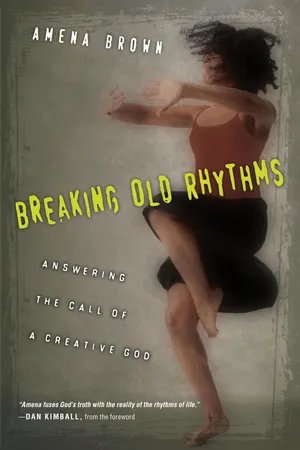
"When two fighters of equal ability and speed are matched . . . there is a greater advantage to the one who knows how to break the rhythm."-Bruce LeeRhythm is a blessing. By rhythm we dance, sing, clap, walk and breathe.Beyond the blessing is the Giver of Rhythm, who sometimes calls us past the patterns and habits we have established for ourselves into new understanding, new risk, new faith, hope and love.In those moments we have to decide where to place our trust: in God or in our preciousrhythms.Spoken word poet Amena Brown has made rhythm her life's work. In Breaking Old Rhythms she explores how we discover by rhythm both our God-given limitations and potential, and the ways we limit God's work in our lives. Read this bookand be reminded, and encouraged, that while God has rhythm, God is love, and God's love carries us beyond our rhythms into a fuller, more fulfilling life.
- 144 pages
- English
- ePUB (mobile friendly)
- Available on iOS & Android
eBook - ePub
About this book
Information
Topic
Theology & ReligionSubtopic
ReligionSix
Break Dancing

He puts his hand in the small of my back
Two fingers pressed into the center of my palm
Pulls me close and steps with his left
My right I focus on his eyes and try to ignore my feet as they clumsily count 1, 2, 3
I’m trying to trust him
He knows this dance better than me
Two fingers pressed into the center of my palm
Pulls me close and steps with his left
My right I focus on his eyes and try to ignore my feet as they clumsily count 1, 2, 3
I’m trying to trust him
He knows this dance better than me
Amena Brown,Dance with Him
Early in my life I discovered I had a slight case of chorophobia, fear of dancing. All cultures, ancient and modern, make a practice of dancing—in formal settings from religious ceremonies, worship, weddings and mating rituals to informal settings at house parties, on cardboard in front of a DJ table, and in the privacy of our own homes in our pajamas to our favorite song. Most of us at some point have found ourselves afraid to boogie because of stage fright, two left feet, a complicated beat or the thought of completely embarrassing ourselves.
When I was seven years old, my dad had just returned to the United States from being stationed in Okinawa, Japan, in the military. As a surprise, he flew in to his and my mom’s hometown, where I’d been living with my grandma. There was a Brownie Girl Scouts talent show coming up, and I was at the beginning of what would be a few years’ fascination with Janet Jackson’s music. I had her third album, Control, on cassette. I chose “What Have You Done for Me Lately” as the soundtrack to my dance routine. Prior to my dad’s arrival I had planned some sassy seven-year-old dance moves to dazzle my fellow Brownie sisters.
I stood in front of my grandma’s clunky silver sound system, complete with glasstic-cover record player and a cassette deck with large picture buttons for rewind, forward, play/pause and stop. My dad was on the couch reading the paper. I turned the song on and was embarrassed to tears. I couldn’t let loose and dance in front of my dad. I had suddenly caught a terrible case of discomfort, shyness and withdrawal.
My dad put his arms around my shoulders and asked me what was wrong. I couldn’t tell him; I was choked by a swell of emotions. “You don’t want to do the talent show? You don’t have to,” he said. I nodded and gave myself permission to forget my hard-earned dance moves.
I’m still a lot like my seven-year-old self. Every time I dance it reminds me of my life and how scared I am to jump out there. Dancing brings out the worst fears in me: fear of looking clumsy, messing up, not having it all together, falling or failing.
Sometimes I live as if I’m standing in front of a session of double-dutch on my elementary school playground. I’m staring at the ropes, trying to find where my own rhythm and the rhythm of the rope intersect; scared I’ll ruin the whole thing if I jump in on the wrong beat. The two girls turning rope are popping gum, twisting their pigtails, blowing bubbles, doing cheers and never missing a beat with their arms swinging the rope to its proper snatch as it hits the ground, creating its own percussive sound. All I can do is jump in, right? Jump in and try. These pigtail girls are professional. They can probably pop gum, tie their shoes, tell a tale and swing that rope in proper time. They won’t be ruined if I jump in all wrong. They’ll chew a fresh piece of gum and start over, which is all I can ask myself to do.
As I got older, I slowly grew out of my fear of grooving in public. From break dance crews, party scenes in music videos, Spike Lee’s School Daze step routines to Michael and Janet Jackson’s intricate choreography, I was learning you didn’t have to get down alone.
Dance with Me
I went to my first school dance when I was eleven years old, in sixth grade. Picture it: my hair in curly braids with extensions, ponytail up and to the side, with some braids hanging down in the back. Oversized purple Gap sweater, floral-print pants, and a pair of British Knights. It was my first year of junior high. In a matter of a year I went from snacks and a cubbyhole to wood shop and a locker, from thinking boys were gross to finding them slightly cute and very interesting.
My mom dropped me off at school that night. Our cafeteria had been transformed into a dance floor, with requisite cheesy disco lighting and DJ. The somewhat-cute-but-still-kind-of-gross boys were on one side of the room and all of us girls were on the other side, chewing gum, twirling hair, giggling, not knowing why all of a sudden gross boys were making our hearts beat so fast. The only thing that interrupted the awkwardness was music.
It was 1991, the year of the Teenage Mutant Ninja Turtles, the Super Soaker and the Fly Girls from In Living Color. Yeah, I wanted to be one of them. They wore baggy pants and fly boots and danced to all the latest hits—and they looked cute doing it. Music videos and movies taught us all the latest footwork. School Daze had introduced “Da Butt,” a song with a go-go beat that invited you to shake your derrière any way you felt like it.
This, plus the “Hammer” dance I practiced in my living room while watching MTV and BET, made for a great evening. This was when dancing until you were sweating was cool. You could groove by yourself or with your crew. My prepubescent friends and I did “Da Butt,” “the MC Hammer” and “the Roger Rabbit” all night long. Hip hop music led me to the dance floor and wrapped its beat around my waist. It taught me I could freestyle a little and find my own rhythm.
In high school I went to my first house party. By now it was the late 1990s. We weren’t in junior high anymore. We were moving away from the dance crews entertaining the party and getting more interested in guys and girls dancing together. The boys were outrageously cute, and any thought of them being gross had left my mind years ago. Boys and girls were swaying together to the music instead of leaning on the walls on opposite sides of the room.
My friend Latanya was turning sixteen, and her parents loved her enough to let twenty or so teenagers invade their home for a few hours. The adults were downstairs, watching TV, making food and playing cards. A guest room upstairs had been converted into the dance floor, complete with boom box and strobe light. So far high school had been good to me. I had traded in my Coke-bottle glasses for contacts, abandoned my ponytail for a shorter curl-layered haircut.
A young man—I’ll call him Dalvin—was one of the smoothest guys and best dancers in our high school. He showed up at the party in a fresh white T-shirt, crisp jeans and clean sneakers. I immediately reverted to my junior high ways and leaned against the wall with the other nervous girls. A slow song came on by the R&B group Jodeci. I turned my head to talk to the girl next to me, and when I turned back to face forward, Dalvin was standing in front of me.
“Would you like to dance?” he asked, even though one of his hands was already on my waist.
He led me to the center of the room and pulled me close. All sorts of sirens and alarms and shouts of joy galloped between my thoughts and my skin. I heard all my grandmother’s warnings in my head about not being fast, about not getting close to a boy, about not getting pregnant, about not wearing red lipstick, about not wearing my clothes too tight. But I couldn’t think very clearly. I was dancing chest-to-chest and hip-to-pelvis with a boy—a handsome, older, slick-talking boy.
When the song was over, he slowly let go of my waist and hands until he was walking all the way across the room. A fast song came on, and soon after that my mom came to get me. When I got home that night and shut my bedroom door, I could still smell Dalvin’s Cool Water cologne on my shirt.
I learned then that dance could be innocent and fun, but it could also be steamy and feel dangerous, that maybe I was right to have been afraid in the first place. By the time I got to college, I gave up dancing hip-to-pelvis, refused to go to the club or to date—not because I was by any means holy but mostly because I was afraid. I felt pretty certain that if I went to a club I would love it way too much to stop going three days a week; I would never do my schoolwork. So I gave up on dancing altogether, outside of a safe two-step at church and school functions.
Fas-Suh-Nay-Shun
I never danced formally until my sophomore year of college when, at my mother’s behest, I agreed to be a debutante. My friend Eric agreed to be my escort.
An elderly woman with a salt-and-pepper Farrah Fawcett hairdo that stuck to her head like a helmet taught us to waltz. We were dancing to “Fascination,” a song I would be happy never to hear again. Each time she instructed us on the count she would say, “Fas-suh-nay-shun I know, two, three.” Eric and I would laugh, our hands awkwardly placed on shoulder and at waist, trying not to look at our feet.
My dad flew in on the weekend of the event, so he did not have the luxury of weeks of “Fas-suh-nay-shun I know, two, three.” He had to endure the waltz crash course, complete with turns and bow. On day two of our lesson, he said, “Did you know that when we’re turning, you squeeze my shoulder and turn it in the direction of the way you think we’re supposed to be going?”
“What?!” I said, aghast, then stared at my death grip on his shoulder, my fingerprints burning through his sweater. That was my first lesson that I may have learned how to waltz but didn’t know how to follow.
In a formal dance, the man is the lead. He controls the turns; he keeps an eye out on the dance floor so that the two of you don’t run into other couples. He makes sure you step in your space wisely. In a formal dance, the woman’s job is to relax her arms, fingers, back and shoulders, to stand strong and straight but fluid enough to be directed, to keep good rhythm and be ready for any turn. A good male dancer can make a woman who is a novice look like she knows what she’s doing, if he leads her well.
Learning how to waltz for my debutante ball made me see for the first time the beauty of the metaphor of Jesus as groom and the church as his bride. If faith is a dance, Jesus is always the lead. He controls the turns; he teaches us to turn in the space he’s given us. This requires us to surrender to him, to trust that he knows what he’s doing and where we’re going.
Learning How to Follow
i was raised in a house where the men were absent stolen by death and divorce leaving only a lonely fedora hanging on old coat rack and their last names as reminders of where they’d been i was raised by women who were trained to survive who couldn’t take the time it took to lick wounds who must be modern Hagars, pack child and past on their back and travel roads far from home
Amena Brown, House Full of Women

It’s one thing to swing to the bass beat of your own DJ; it’s something altogether different to share your rhythm with someone else, letting them lead the turns. I come from a line of strong women who for better or worse had not had much opportunity in their lives to be led. My grandma and my mom were both single parents most of their lives, which means that whether they wanted to or not, they didn’t have the luxury of submitting to a man as head of the household. They were mom, coach, encourager, breadwinner and hard worker.
I learned from these women how to lead, how to make things happen for myself and how not to depend too heavily on anyone in case disappointment lurked in the shadows of the future. This made me a leader. I’m still learning how to follow.
Having a relationship with Jesus presses all of my “Do not want to be vulnerable” buttons. Knowing him requires learning to follow him, depend on him, surrender to him, submit to him, trust that he knows better than I do and believe that he knows what’s best for me even when I can’t see my way.
God and I, from Father to daughter, are still having the same moment I had in my heart when I was learning to dance with my dad. It’s that moment when I try to take care of things myself, refusing to trust God or his intentions, assuming he is just too busy for me, doesn’t find my requests important, has other things he’d rather attend to. Not true.
I think I’m afraid of being let down, discovering this whole thing between me and God is a farce, that he really doesn’t love me like he says he does, that he views my incessant prayers as whining and can’t wait for me to grow up, stop crying and stand on my own two feet. Woman up. I think it hurts God’s heart when I get stuck believing this—because he loves me and he’s never too busy for anyone he loves. He wants me to see him as he really is, not for who my hurtful experiences have made him out to be. It hurts his heart because he knows when I believe that God who is love doesn’t really love me, I will continue to build my life on something that just isn’t true. Where in the world did I get that thinking? Not from the God who wants me to cast all my cares at his feet. Not from the God who knows my intimate details down to the follicles of my hair.
Eric, my dad and I survived the waltz, the turns and bows, and an evening in dresses and tuxedos that were too tight and shoes that hurt our feet. After that, dance and I grew apart again, until a couple of years ago when I ...
Table of contents
- Cover
- Copyright
- Dedication
- Contents
- Foreword
- A Word to the Reader
- One Finding Your Rhythm
- Two The Blessing of Irritation
- Three The Rhythm of Fighting
- Four If God Is a DJ
- Five Broken Heart
- Six Break Dancing
- Seven Breathing Room
- Eight Beat Box
- Nine Baggage Check
- Ten Finding the Break Beat
- Referenced Works
- Acknowledgments
- Soundtrack
- About the Author
- Endorsements
Trusted by 375,005 students
Access to over 1.5 million titles for a fair monthly price.
Study more efficiently using our study tools.
Frequently asked questions
Yes, you can cancel anytime from the Subscription tab in your account settings on the Perlego website. Your subscription will stay active until the end of your current billing period. Learn how to cancel your subscription
No, books cannot be downloaded as external files, such as PDFs, for use outside of Perlego. However, you can download books within the Perlego app for offline reading on mobile or tablet. Learn how to download books offline
Perlego offers two plans: Essential and Complete
- Essential is ideal for learners and professionals who enjoy exploring a wide range of subjects. Access the Essential Library with 800,000+ trusted titles and best-sellers across business, personal growth, and the humanities. Includes unlimited reading time and Standard Read Aloud voice.
- Complete: Perfect for advanced learners and researchers needing full, unrestricted access. Unlock 1.5M+ books across hundreds of subjects, including academic and specialized titles. The Complete Plan also includes advanced features like Premium Read Aloud and Research Assistant.
We are an online textbook subscription service, where you can get access to an entire online library for less than the price of a single book per month. With over 1.5 million books across 990+ topics, we’ve got you covered! Learn about our mission
Look out for the read-aloud symbol on your next book to see if you can listen to it. The read-aloud tool reads text aloud for you, highlighting the text as it is being read. You can pause it, speed it up and slow it down. Learn more about Read Aloud
Yes! You can use the Perlego app on both iOS and Android devices to read anytime, anywhere — even offline. Perfect for commutes or when you’re on the go.
Please note we cannot support devices running on iOS 13 and Android 7 or earlier. Learn more about using the app
Please note we cannot support devices running on iOS 13 and Android 7 or earlier. Learn more about using the app
Yes, you can access Breaking Old Rhythms by Amena Brown in PDF and/or ePUB format, as well as other popular books in Theology & Religion & Religion. We have over 1.5 million books available in our catalogue for you to explore.