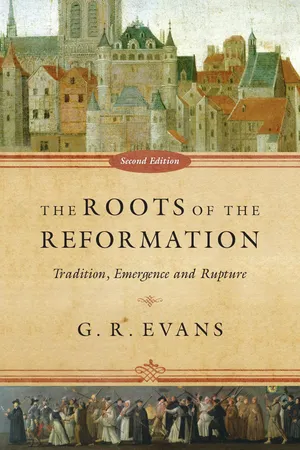
Renowned historian G. R. Evans revisits the question of what happened at the Reformation. Contravening traditional paradigms of interpretation, Evans charts the controversies and challenges that roiled the era of the Reformation and argues that these are really part of a much longer history of discussion and disputation. Evans takes up several issues, such as Scripture, ecclesiology, authority, sacraments and ecclesio-political relations, and traces the shape of the charged discussions that orbited around these through the patristic, medieval and Reformation eras. In this, she demonstrates that in many ways the Reformation was in considerable continuity with the periods that preceded it, though the consequential outcome of the debates inthe sixteenth century was dramatically different.
The poet known as William Langland (c. 1332-1386) had a vision of a “fair field of folk,” which he used as a motif in a hard-hitting analysis of the society of his day.[1] Medieval poets were fond of using pretend dreams as a literary device. This particular image of the “field of folk” may have been prompted by the real view from the Malvern Hills near the Welsh border, down into the Severn Valley, where Worcestershire and Warwickshire and Gloucestershire still lie spread for miles before the observer of the English scene today. In Piers Plowman Langland sketches the contemporary world in all its variety from his vantage point on these hills.
Despite its rural setting, most of Langland’s poem is about the behavior and attitudes of an urban community. He describes London’s people, the way they lived and the way they thought, at about the time when Geoffrey Chaucer (c. 1343-1400) wrote The Canterbury Tales, with its similarly sharp social satire and digs at the misbehavior of the clergy.[2] This urban way of life was a relatively new medieval phenomenon in Europe, except in Italy, where some of the towns of the ancient Roman Empire had persisted. There citizenship had remained a vivid reality, at least for those lucky enough to be well-born (and male).
Elsewhere in Europe the opportunity of active participation in public affairs by a good proportion of the population had given way to a top-down way of running things. In most of northern Europe the last few centuries had been feudal. This was a hereditary aristocratic system and highly military in character. In the feudal system kings and emperors owned the lands of their realms and allowed the great nobles to hold and use them during their lifetimes as vassals, in return for an oath of fealty (loyalty or faithfulness) and the provision of a certain number of days of military service (“knight days”) a year. The nobility ran their estates by farming the land with the aid of their peasants, some of whom were freemen but many of whom were serfs bound to the land in slavery. From the same aristocratic families were drawn the senior churchmen, whose elevation to bishoprics also involved holding land from the monarch, in the form of the estates of the diocese. Bishops too had to provide their quota of knight days. Church and state were intimately bound together in a power structure in which baron and bishop were often brothers.
So the emergence in twelfth-century northern Europe of towns full of tradespeople with marketable skills created a new class of articulate and inquiring people, the sort of people who ran businesses and behaved like entrepreneurs. There was even the beginning of a new middling gentry as they aspired to a social mobility which had not been possible for many centuries. They asked searching questions about social arrangements and conventional religious teaching, and wanted to have their say when they heard the answers. Langland’s prospective readership in this new middle class was evidently quite considerable, to judge from the number of manuscripts of his poem which survive, so we can assume that the grudges he expresses struck a chord at least with the literate. And more of them, of both sexes, were becoming literate.[3]
A good deal of fourteenth-century England of all social classes was spread out before the poet for inspection:
All manner of men / the rich and the poor,
Working and wandering / as the world asketh.
“Barons and burgesses and bondmen also I saw in this crowd”; “bakers and brewers and butchers a-many”; “woollen-websters and weavers of linen”; “tailors and tinkers toll-takers in markets”; “masons and miners and men of all crafts.” He contrasts the hardworking laboring classes with the greedy “wasters.” There are the fashionable, leading lives of conspicuous luxury, and there are those “such as anchorites and hermits” who out of sight in their “cells” quietly lead lives of self-denial, “in hope for to have heavenly bliss.” There are retailers, who seem to do rather well (“such men thrive”). Then there are entertainers, some who just “make mirth” (“as minstrels know how”) and earn an honest living that way, but others defraud the public. Some are “tramps and beggars” who make a good living begging for their food and then create disturbances by getting drunk at inns, “the thieving knaves!”
Langland is particularly shocked by the corruption and fraudulent activities going on in the name of religion. “Pretend” pilgrims and “palmers” (pilgrims who carried a palm to show they had visited the Holy Land) told tall tales in order to get money from the gullible. “Hermits, a heap of them with hooked staves, were going to Walsingham and their wenches too.” Langland sees them as work shy:
Big loafers and tall / that loth were to work,
Dressed up in capes / to be known from others
And so clad as hermits / their ease to have.
He is equally disgusted by the friars of every kind “preaching to the people for profit to themselves”:
Explaining the Gospel / just as they liked,
To get clothes for themselves / they construed it as they would.
The friars who belonged to the Dominicans, Franciscans and other mendicant orders founded since the early thirteenth century were professional itinerant preachers, but they had also gained an entrance to the courts of Europe as personal confessors, the “life coaches” of their time. They behave like “chapmen,” or tradesmen, says Langland, and make a nice living from the invitation “to shrive lords.” The friars and the professional peddlers of penitential aids will feature prominently in the medieval story told in part two.
The ordinary clergy come in for Langland’s criticism too. Since the “pestilence time” of the Black Death (with its climax in Europe in 1348-1350), they complain that they cannot live on the income from their parishes and they ask “leave and licence in London to dwell.” There they “sing requiems for stipends[,] for silver is sweet.” They neglect their pastoral duties: to hear their parishioners’ confessions, grant them absolution and “preach and pray for them and feed the poor.”
Langland was evidently confident that his descriptions would strike a chord. What did the general population know of the tides of opinion and discussion which are now apparent to us as we look at the records of these events and the theological controversies they prompted? The truth seems to be that the ordinary faithful were involved, to a greater degree than they perhaps realized, in setting those tides running and putting pressure on theologians to make theological sense of their pastoral demands. Langland could see the effect of this popular pressure clearly enough as he wrote his sketch. But the routes by which they could exchange views and gain up-to-date information were naturally limited by the very restricted means of communication then available, even for the literate. Satirical verses were distributed by traveling ballad sellers like the one in Shakespeare’s A Winter’s Tale, Act 4, Scene 4:
Servant:
O master, if you did but hear the pedlar at the door, you would never dance again after a tabour and pipe; no, the bagpipe could not move you: he sings several tunes faster than you’ll tell money; he utters them as he had eaten ballads and all men’s ears grew to his tunes.
Clown:
He could never come better; he shall come in. I love a ballad but even too well, if it be doleful matter merrily set down, or a very pleasant thing indeed and sung lamentably.
Shakespeare’s examples in this play are ribald and poke simple fun, but some of the surviving medieval ones were highly political and socially aware.
If an inquiring population was beginning to ask awkward questions about the way the institutional church was running religious affairs, could it turn for answers to the Bible? Practical impediments stood in the way for the “fair field of folk” if they wanted to know what the Bible said about the matters which concerned them. Copies were expensive in the centuries before the invention of printing. In any case, even if they could have afforded Bibles, the medieval laity were mostly illiterate. And even if some learned to read or had someone to read the Bible to them, most of them could not read for themselves what the Bible actually said, because it was not widely available in any language except Latin until attempts were made in the late Middle Ages and the early Reformation to produce vernacular versions.
These impediments to Bible study were accidents of history, not deliberate attempts to keep Scripture from the ordinary Christian. It was, however, natural for the church authorities to become protective about the Bible, since the educated who could read it in Latin also had the knowledge to read the body of respected commentary which survived from the early Christian centuries, for example the work of Augustine of Hippo (354-430), Gregory the Great (c. 540-604) and Bede (672/3-735). The educated could be expected to understand the theology too. The laity lacked this background and context, and there were fears that without the necessary educational preparation they might misinterpret the Bible and be led astray in their faith. These barriers between the inquiring layperson and the Bible lasted until the late Middle Ages, when one by one they began to be resolved. But those who called for the changes that took place were looked at askance and made themselves objectionable to the authorities of church and state alike. It all became something of a power struggle for ownership and control of the Bible.
Other great themes emerged, which we shall see as recurring problems again and again throughout this book. One was the relationship of spiritual and secular, church and state, as they affected the people in their daily lives. Another was the way in which people’s lives were shaped by the teaching of the institutional church, its claim to hold the keys to heaven through the ministry of the sacraments, and its demands about behavior.
The story that follows traces these themes and their subthemes, and seeks to point to the patterns as they reappeared in the Reformation debates. Parts one and two tell the story of the way in which key Christian doctrines were formed and gave rise to concerns about various topics as they appeared to reformers in the sixteenth century. The way reformers and others tackled these concerns is explored in part three. At the end of the book is a “map,” in the form of a “Handlist of Reformation Concerns and Their History.”
Part One:
Bible and Church
The Questions Begin
2
The Idea of Church
A New Idea
How the story began. To the Reformers of the sixteenth century, “church” was an idea only too familiar; it connoted a monolithic institution corrupt and oppressive and urgently in need of reform. But at the outset it was a novelty. There had been nothing like it until the early Christians began to form themselves into communities for worship and “fellowship,” expressed by the Greek word koinōnia.
The New Testament was written within this early community of Christians, and in the same community the discussions took place which would decide which Old Testament writings were to be included in the collection that became the Bible. This forming of what is sometimes called the “canon”—which came to mean the authentic Scriptures—took place among a body of people who were also busy forming a community and organizing the life of that community. The two processes were interconnected and reciprocal. The emerging Scriptures were searched for guidance about the life of the church. The church decided which books were to be received as scriptural.
“Church” was something without exact precedent.[1] The word ekklēsia (Latin ecclesia) itself came from a Greek verb meaning to “call out”; the ancient Greeks used it for a political assembly of the sort used to govern Greek city-states. That was a bare starting point. A good deal of thought and experiment were going to be needed to create a Christian “church.”
The first question may well have been why a church was needed at all. One key answer, of course, was that Jesus had declared his intention to found one, when he said that Peter was the rock on which he would build his church (ekklēsia, Mt 16:18). That naturally led to the question what the church should be like.
One, holy, catholic and apostolic Church (Niceno-Constantinopolitan Creed of 325/381)
The holy catholic Church (Apostles’ Creed)
These descriptions in the creeds (later sometimes called the “notes” or marks of the church) tell us what Christians of the first centuries took to be the defining characteristics of the church, and also emphasize the significance attached from the first to maintain its unity.
In this list of “notes,” catholic (from the Greek katholikos) meant “universal.” One stressed the importance of maintaining unity throughout this universal church. The emphasis from the beginning was on the need to keep the church together as one single great community with one faith, for it was obvious early on that quarrels were tending to tear it apart.
There ...
Table of contents
Cover
Title Page
Copyright
Contents
Preface
Acknowledgments
Abbreviations
1: Setting the Scene
Part One: Bible and Church
Part Two: Continuity and Change in the Middle Ages
Part Three: Continuity and Change from the Reformation
Conclusion
Handlist of Reformation Concerns and Their History
Select Bibliography
Author Index
Subject Index
Scripture Index
Notes
About the Author
More Titles from InterVarsity Press
Trusted by 375,005 students
Access to over 1.5 million titles for a fair monthly price.
Study more efficiently using our study tools.
Frequently asked questions
Yes, you can cancel anytime from the Subscription tab in your account settings on the Perlego website. Your subscription will stay active until the end of your current billing period. Learn how to cancel your subscription
No, books cannot be downloaded as external files, such as PDFs, for use outside of Perlego. However, you can download books within the Perlego app for offline reading on mobile or tablet. Learn how to download books offline
Perlego offers two plans: Essential and Complete
Essential is ideal for learners and professionals who enjoy exploring a wide range of subjects. Access the Essential Library with 800,000+ trusted titles and best-sellers across business, personal growth, and the humanities. Includes unlimited reading time and Standard Read Aloud voice.
Complete: Perfect for advanced learners and researchers needing full, unrestricted access. Unlock 1.5M+ books across hundreds of subjects, including academic and specialized titles. The Complete Plan also includes advanced features like Premium Read Aloud and Research Assistant.
Both plans are available with monthly, semester, or annual billing cycles.
We are an online textbook subscription service, where you can get access to an entire online library for less than the price of a single book per month. With over 1.5 million books across 990+ topics, we’ve got you covered! Learn about our mission
Look out for the read-aloud symbol on your next book to see if you can listen to it. The read-aloud tool reads text aloud for you, highlighting the text as it is being read. You can pause it, speed it up and slow it down. Learn more about Read Aloud
Yes! You can use the Perlego app on both iOS and Android devices to read anytime, anywhere — even offline. Perfect for commutes or when you’re on the go. Please note we cannot support devices running on iOS 13 and Android 7 or earlier. Learn more about using the app
Yes, you can access The Roots of the Reformation by G. R. Evans in PDF and/or ePUB format, as well as other popular books in Theology & Religion & Christian Theology. We have over 1.5 million books available in our catalogue for you to explore.