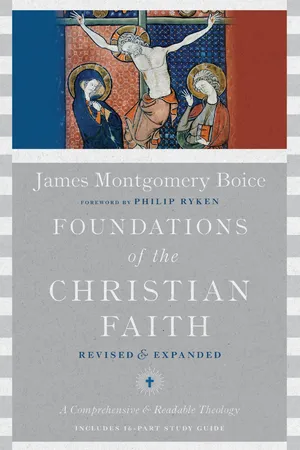
In one systematic volume, James Montgomery Boice provides a readable overview of Christian theology. Both students and pastors will benefit from this rich source that covers all the major doctrines of Christianity.With scholarly rigor and a pastor's heart, Boice carefully opens the topics of the nature of God, the character of his natural and special revelation, the fall, and the person and work of Christ. He then goes on to consider the work of the Holy Spirit in justification and sanctification. The book closes with careful discussion of ecclesiology and eschatology.This updated edition includes a foreword by Philip Ryken and a section-by-section study guide. Both those long familiar with Boice and those newly introduced to him will benefit from his remarkable practicality and thoroughness, which will continue to make this a standard reference for years to come.
eBook - ePub
Foundations of the Christian Faith
A Comprehensive & Readable Theology
- 811 pages
- English
- ePUB (mobile friendly)
- Available on iOS & Android
eBook - ePub
About this book
Information
Topic
Theology & ReligionSubtopic
Christian TheologyBOOK 1
The
SOVEREIGN
GOD
BOOK 1~THE SOVEREIGN GOD
PART I
THE
KNOWLEDGE
OF GOD
The fear of the LORD is the beginning of wisdom, and the knowledge of the Holy One is insight.
PROVERBS 9:10
And this is eternal life, that they know you the only true God, and Jesus Christ whom you have sent.
JOHN 17:3
For the wrath of God is revealed from heaven against all ungodliness and unrighteousness of men, who by their unrighteousness suppress the truth. For what can be known about God is plain to them, because God has shown it to them. For his invisible attributes, namely, his eternal power and divine nature, have been clearly perceived, ever since the creation of the world, in the things that have been made. So they are without excuse. For although they knew God, they did not honor him as God or give thanks to him, but they became futile in their thinking, and their foolish hearts were darkened. Claiming to be wise, they became fools, and exchanged the glory of the immortal God for images resembling mortal man and birds and animals and creeping things.
ROMANS 1:18-23
BOOK 1~PART I
CHAPTER 1
ON KNOWING GOD

One hot night in the early years of the Christian era a sophisticated and highly educated man named Nicodemus came to see a young rabbi, Jesus of Nazareth. The man wanted to discuss reality. So he began the conversation with a statement of where his own personal search for truth had taken him. He said, “Rabbi, we know that you are a teacher come from God, for no one can do these signs that you do unless God is with him” (Jn 3:2).
With the exception of the word Rabbi, which was merely a polite form of address, the first words were a claim to considerable knowledge. Nicodemus said, “We know.” Then he began to rehearse the things he knew (or thought he knew) and with which he wanted to begin the discussion: (1) that Jesus was continuing to do many miracles; (2) that these miracles were intended to authenticate him as a teacher sent from God; and that, therefore, (3) Jesus was one to whom he should listen. Unfortunately for Nicodemus, Jesus replied that such an approach to knowledge was wrong and that Nicodemus could therefore know nothing until he had first experienced an inward, spiritual transformation. “You must be born again,” Jesus told him (Jn 3:7).
Nicodemus’s subsequent remarks showed at least an implicit recognition of his lack of knowledge in important things. For he began to ask questions: “How can a man be born when he is old? . . . How can these things be?” (Jn 3:4, 9). Jesus taught him that true knowledge begins with spiritual knowledge, knowledge of God, and that this is to be found in God’s revelation of himself in the Bible and in Jesus’ own life and work, the work of the Savior.
CONTEMPORARY CRISIS
This ancient conversation is relevant to our day. For the problems and frustrations that Nicodemus faced nearly two thousand years ago are with us in our time also. Nicodemus possessed knowledge, but he lacked the key to that knowledge, the element that would put it all together. He knew certain things, but his search for truth had brought him to the point of personal crisis. In the same way, much is also known in our time. In the sense of information or technical knowledge, more is known today than at any previous time in history. Yet the kind of knowledge that integrates information and thereby gives meaning to life is strangely absent.
The nature of the problem can be seen by examining the two almost exclusive approaches to knowledge today. On the one hand there is the idea that reality can be known by reason alone. That approach is not new, of course. It is the approach developed by Plato and therefore assumed by much of the Greek and Roman thought after him. In Plato’s philosophy, true knowledge is knowledge of the eternal and unalterable essence of things, not merely knowledge of changeable phenomena. That is, it is a knowledge of forms, ideas, or ideals. Our nearest equivalent would be the so-called laws of science.
On the surface, this approach to knowledge through the exercise of supposedly impartial reason seems desirable, for it is productive—as the technical advances of our day often indicate. But it is not without problems. For one thing, it is highly impersonal knowledge and, as some would say, highly depersonalizing. In this approach reality becomes a thing (an equation, law, or, worse yet, mere data), and men and women become things also, with the inevitable result that they may therefore be manipulated like any other raw material for whatever ends.
An example is the manipulation of poorer nations by rich nations for the sake of the rich nations’ expanding economy, that is, the injustice analyzed and rightly condemned by Karl Marx in The Communist Manifesto, Capital, and other writings. Another example is that of communism itself, which, in spite of its desire to better the lot of the masses, actually manipulates them for ideological ends. On the personal level there is the science of behavioral technology and the frightening teaching of a man like B. F. Skinner of Harvard University who claims that individuals must be conditioned scientifically for the good of society.
There is also another problem with the attempt to know reality through reason alone. The approach does not give an adequate basis for ethics. It can tell us what is, but it cannot tell us what ought to be. Consequently, the extraordinary technical advances of our time are accompanied by an extreme and debilitating moral permissiveness that promises in time to break down even the values and system that made both the advances and the permissiveness possible. Interestingly, the same thing was also true of the Greek philosophers, who, although they were men of great intellect, on occasion led depraved lives.
In recent years the failures of the rationalistic system have impressed themselves on a new generation, with the result that many in the Western world have abandoned reason in order to seek reality through emotional experience. In the ancient world, in reaction to the impersonality of Greek philosophy, this was done through intense participation in the rites of the mystery religions. These promised an emotional union with some god, induced by lighting, music, incense, or perhaps by drugs. In our time the same approach has surfaced through the drug cult, rediscovery of the Eastern religions, Transcendental Meditation, the human potential movement, and other supposedly “mind-expanding” practices.
This modern approach also has several problems. First, the experience does not last. It is transient. Each attempt to achieve reality through emotional experience promises some sort of “high.” But the “high” is inevitably followed by a “low,” with the additional problem that increasingly intense stimuli seem to be necessary to repeat the experience. Eventually this ends either in self-destruction or acute disillusionment. A second problem is that the approach to reality through emotion does not satisfy the mind. Promoters of these experiences, particularly drug experiences, speak of a more intense perception of reality that results from them. But their experience has no rational content. The part of the human being that wants to think about such things and understand them is unsatisfied.
The result of this situation is a crisis in the area of knowledge today, as in ancient times. Many thinking people quite honestly do not know where to turn. The rationalistic approach is impersonal and amoral. The emotionalistic approach is without content, transient and also often immoral. “Is this the end?” many are asking. “Are there no other possibilities? Is there not a third way?”
A THIRD WAY
At this point Christianity comes forward with the claim that there is a third way and that this way is strong at precisely those points where the other approaches are lacking. The basis of this third approach is that there is a God who has created all things and who himself gives his creation meaning. Further, we can know him. This is an exciting and satisfying possibility. It is exciting because it involves the possibility of contact between the individual and God, however insignificant the individual may appear in his or her own eyes or in the eyes of others. It is satisfying because it is knowledge not of an idea or thing but of a supremely personal Being, and because it issues in a profound change of conduct.
This is what the Bible means when it says, “The fear of the LORD is the beginning of knowledge” (Prov 1:7). And, “The fear of the LORD is the beginning of wisdom, and the knowledge of the Holy One is insight” (Prov 9:10).
Here, however, we must be clear about what we mean when we speak of “knowing God,” for many common uses of the word know are inadequate to convey the biblical understanding. There is a use of the word know by which we mean “awareness.” In this sense we say that we know where somebody lives or that we know that certain events are transpiring somewhere in the world. It is a kind of knowledge, but it does not involve us personally. It has little bearing on our lives. This is not what the Bible means when it speaks of knowing God.
Another use of the word know means “knowing about” something or someone. It is knowledge by description. For instance, we may say that we know New York City or London or Moscow. By that we mean that we are aware of the geographic layout of the city; we know the names of the streets, where the major stores are, and other facts. We may have gained our knowledge of the city by actually living there. But it is also possible that we may have gained our knowledge by reading books. In the religious realm, this type of knowledge would apply to theology that, although important, is not the whole or even the heart of religion. The Bible tells us much about God that we should know. (In fact, much of what follows in this book is directed to our need for such knowledge.) But this is not enough. Even the greatest theologians can be confused and can find life meaningless.
True knowledge of God is also more than knowledge by experience. To go back to the earlier example, it would be possible for someone who has lived in a particular city to say, “But my knowledge is not book knowledge. I have actually lived there. I have walked the streets, shopped in the stores, attended the theaters. I have experienced the city. I really know it.” To this we would have to reply that the knowledge involved is certainly a step beyond anything we have talked about thus far, but still it is not the full idea of knowledge in the Christian sense.
Suppose, for instance, that a person should go out into a starlit field in the cool of a summer evening and gaze up into the twinkling heavens and come away with the claim that in that field he has come to know God. What do we say to such a person? The Christian does not have to deny the validity of that experience, up to a point. It is certainly a richer knowledge than mere awareness of God (“There is a God”) or mere knowledge about him (“God is powerful and is the Creator of all that we see and know”). Still, the Christian insists, this is less than what the Bible means by true knowledge. For when the Bible speaks of knowing God it means being made alive by God in a new sense (being “born again”), conversing with God (so that he becomes more than some great “Something” out there, so that he becomes a friend), and being profoundly changed in the process.
All this is leading us, step by step, to a better understanding of the word knowledge. But still another qualification is needed. According to the Bible, even when the highest possible meaning is given to the word know, knowing God is still not merely knowing God. For it is never knowing God in isolation. It is always knowing God in...
Table of contents
- Cover
- Title Page
- Dedication Page
- Contents
- Foreword by Philip Ryken
- Preface
- BOOK 1~The SOVEREIGN GOD
- BOOK 2~GOD the REDEEMER
- BOOK 3 - AWAKENING to GOD
- BOOK 4~GOD and HISTORY
- Study Guide
- General Index
- Scripture Index
- Notes
- Praise for Foundations of the Christian Faith
- About the Author
- More Titles from InterVarsity Press
- Copyright
Trusted by 375,005 students
Access to over 1.5 million titles for a fair monthly price.
Study more efficiently using our study tools.
Frequently asked questions
Yes, you can cancel anytime from the Subscription tab in your account settings on the Perlego website. Your subscription will stay active until the end of your current billing period. Learn how to cancel your subscription
No, books cannot be downloaded as external files, such as PDFs, for use outside of Perlego. However, you can download books within the Perlego app for offline reading on mobile or tablet. Learn how to download books offline
We are an online textbook subscription service, where you can get access to an entire online library for less than the price of a single book per month. With over 1.5 million books across 990+ topics, we’ve got you covered! Learn about our mission
Look out for the read-aloud symbol on your next book to see if you can listen to it. The read-aloud tool reads text aloud for you, highlighting the text as it is being read. You can pause it, speed it up and slow it down. Learn more about Read Aloud
Yes! You can use the Perlego app on both iOS and Android devices to read anytime, anywhere — even offline. Perfect for commutes or when you’re on the go.
Please note we cannot support devices running on iOS 13 and Android 7 or earlier. Learn more about using the app
Please note we cannot support devices running on iOS 13 and Android 7 or earlier. Learn more about using the app
Yes, you can access Foundations of the Christian Faith by James Montgomery Boice in PDF and/or ePUB format, as well as other popular books in Theology & Religion & Christian Theology. We have over 1.5 million books available in our catalogue for you to explore.