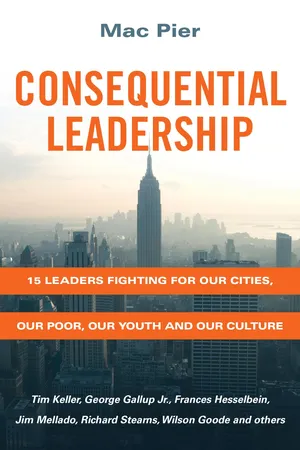
Are we living in challenging times? Yes. But people can and do make a difference.Here are the stories of fifteen entrepreneurial leaders doing just that. Drawn from church, business, government and non-profit sectors, these world-class visionariesand activists offer examples that motivate and principles to imitate.Their stories show that mature networks of leaders and organizations can offer opportunities to a new generation of young people, change communities ravaged by HIV/AIDS, reach newgroups of people with the message of hope--and more.If you see a need and want to contribute your own consequential leadership, this book is for you.
The most exalted idea applied to God is not infinite wisdom, infinite power, but infinite concern.
Abraham Heschel, The Prophets
On September 11, 2001, I was sitting on the fifteenth floor of the Empire State Building preparing for the annual board meeting of Concerts of Prayer Greater New York when board member Tom Mahairas stuck his head in the door at 8:50 a.m. He had just gotten a phone call from his daughter, who said that a plane had crashed into a tower of the World Trade Center and that people were jumping out the windows of the one hundredth floor. We assumed that the pilot of a small plane had accidentally flown into the building. Thirty minutes later we got news of the second attack. Within minutes we were sitting in the tallest building in New York City. We scrambled down to Fifth Avenue, two miles north of the World Trade Center. Smoke and dust billowed across the avenue. Thousands of dazed and disoriented New Yorkers wandered the streets.
My children had gone to school that morning with one parent in Manhattan and another in Washington, D.C., where my wife, Marya, was attending a cardiology conference with Dr. William Tenet, the twin brother of CIA director George Tenet. Phone service was unavailable for several hours, so none of us knew whether or not other family members were alive. For a time, Marya thought she might be spending the night at George’s home. I was able to get home that night because I had driven into Manhattan (which was unusual for me to do). But even there, in the weeks ahead, the schools my two older children attended received bomb threats. Terrorism hit very close to home.
September 11 became a defining moment in U.S. history. No other single day saw as much death on U.S. soil—three thousand lives were lost. Some were eviscerated by the explosion. Some leapt to their deaths to escape the flames. Claudia Roux, a colleague with Alpha, and her coworkers couldn’t return to their downtown offices for weeks due to bio dust from human remains. Weeks later, cars parked below ground level in the World Trade Center were still smoldering at one thousand degrees.
The paradox of September 11 is the number of Americans who were spared. The courageous work of the New York City Fire Department, the New York City Police Department and the Metropolitan Transportation Authority saved thousands of lives. Men and women ran into burning, collapsing buildings to rescue as many people as possible. One woman being escorted out of a building asked a fireman why he was going inside. The fireman responded simply, “This is what I do.” Courage made the difference.
In addition, for many weeks emergency workers and volunteers scoured the remains of buildings at Ground Zero hoping to find one more lost loved one. Nonprofit leaders and agencies sprang into action providing food, relief and resources to victims. On September 13, I was sitting in the parking lot of a Connecticut diner when I received a phone call from World Vision asking if Concerts of Prayer Greater New York would cocreate a relief fund for the victims. Together we started the American Families Assistance Fund; by the end of 2011, we had raised six million dollars, which was distributed to victims of 9/11 largely through the efforts of New York City churches.
Churches were actively involved from the day of the attacks. One Chinatown church, Oversea Chinese Mission, for example, fed five hundred people every day for months. Primitive Christian Church, under the leadership of pastor Marc Rivera, provided round-the-clock assistance to people who needed rest, food and counseling. Pastor Rivera said, “If the Twin Towers had tipped rather than imploded straight down, they would have reached all the way to the doorstep of my church.” The follow-up initiatives in the church community after September 11 awakened a desire to revive New York City. Leaders came to plant churches, start careers and give themselves to serve a city that was broken.
On a personal level, September 11 left me with three life-changing impressions. First was the immediacy of eternity. Three thousand people went to work that day with no idea that they would not return home. In the time it takes a heart to beat, they went from an ordinary day in the office to the door of eternity. Cantor Fitzgerald, whose offices were on floors 101 to 105 of the World Trade Center, lost more than six hundred employees. When CEO Howard Lutnick participated in a memorial service one month later at the Christian Cultural Center in Brooklyn, he spoke about the devastation of the attack and confessed that he had no idea how to rebuild his life or his company.
Second, I was struck by the power of agreement. Nineteen terrorists changed the world by agreeing with their superiors to commandeer airplanes and fly them into the greatest symbols of American democracy and capitalism. Now, no one travels by plane or takes a ride into Manhattan without thinking about September 11. Rebuilding the economy is taking years, and it is likely that our sense of national security will never be restored.
Third, I saw the importance of global cities. New York City wasn’t a random choice. It was chosen specifically because an attack on the media and financial center of the world was a way of attacking the entire Western world.
Standing in the bleachers at the Urbana Student Missions Conference on December 30, 1979, with my beloved Marya, whom I would marry one year later, was an unforgettable experience. For three days we had been listening to John Stott’s heart-gripping exposition of Romans. Now Billy Graham was challenging us to go anywhere in the world God called us. Marya and I stood to say yes to God.
Since that night God has used various mentors and catalytic events to guide us to New York City:
David Bryant’s writing and speaking provided for me a global worldview and a deepening understanding of the supremacy of Christ.
Ray Bakke’s teaching on the centrality of cities in fifteen years of urban consultations and doctoral courses involved showing, not just telling. During a fifteen-year period he took me on trips to Johannesburg, Manila and Vancouver and on many excursions in New York City.
John Clause from World Vision opened my eyes to the world of the HIV pandemic. As a result I have taken ten trips to East Africa.
Bill Hybels and his Willow Creek Association team introduced me to the centrality of leadership in effecting measurable change in difficult contexts from a biblical perspective, and the idea that “leaders do what leadership requires.” That concept was the seed of the New York City Leadership Center. I founded the New York City Leadership Center along with my staff team and board in 2007. After twenty years of journeying with New York City pastors and mission leaders, we saw the urgent need to provide training resources and collaborative opportunities to transform our city.
The pastoral community of New York City (Bob Johansson, Roderick Caesar, Ron Bailey, Luciano Padilla) and scores of other leaders immersed me in the beauty and challenges of local church life in the inner city.
A 1983 trip to India taught me the power of extended, united, corporate prayer as I gathered with other believers every Friday for three to nine hours of prayer.
Selling our possessions to move to New York City in 1984 was the most radical faith step we have taken, but God transcended our risk with his provision.
Three spheres—campus, city and church—form the crucible in which I have attempted to become more Christlike. I served for seventeen years with InterVarsity on campus as a student leader and staff member. I was shaped by the godly supervision of Clayton Lindgren, Janet Luhrs Balajthy and Bobby Gross. I was deeply impacted by the Bible teaching of Barbara Boyd and the Urbana Student Missions Conferences. The promise of Psalm 23:3 has proven true: God has guided me into paths of righteousness for his name’s sake.
In his book Perspectives on the World Christian Movement, Ralph Winter suggests that every four hundred years a global event radically changes the trajectory of the church. Beginning with the crucifixion (a.d. 33), followed by the invasion of the Barbarians of Rome (a.d. 410), the invasion of the Vikings and the capture of Dublin (a.d. 834), the Crusades (a.d. 1095-1291), the missionary work of William Carey to the Indian coast (a.d. 1793) and Hudson Taylor to inland China (a.d. 1853), each four-hundred-year epoch represents the geographic progression of the gospel. Winter surmises that God grew the church during each period, dark as some of them were.[1]
Is it possible that September 11 marked the beginning of one of those four-hundred-year periods? Only history will tell. But a cosmic conflict between Western culture and an ideology of terror rooted in religious extremism does not seem coincidental.
This book is about leading consequentially. A consequential leader fully enters with their spiritual community into the concerns of God and the suffering of Christ for the world. Consequential leaders act to address the greatest spiritual, social and humanitarian concerns on the heart of God. This book is about those kinds of leaders and helping us to aspire toward being more consequential in our leadership.
Consequential Realities
There are three demographics today that represent a majority, or near majority, of the world’s population: people living in metropolitan areas (urban), people under twenty-five years of age (young) and people living on less than two dollars a day (poor). Consequential times require leaders who can address these major demographic groups.
Global cities. In 2002, Ray Bakke, retired chancellor of Bakke Graduate University, wrote:
The astonishing new fact of our time is that the majority of the world’s six billion people now live and work in sizeable cities. Moreover, we live at the time of the greatest migration in human history. The southern hemisphere is moving north, East is coming West, and everyone is coming to New York! I remember well the day several years ago when, sitting in Manhattan, I read a New York Times report that 133 nations had been found living together in one Queens zip code.[2]
Bakke describes the trend in American cities, in particular: “In the first hundred years after colonization people moved west to farms. In the second hundred years people moved north to cities. Now in the third century we are seeing the internationalization of American cities with people from all over the globe.”[3] The U.S. now has the largest Jewish population, with more Jews than Tel Aviv. It also has more Spanish speakers than Spain, the largest Irish population and one of the largest Scandinavian populations in the world. These immigrant communities are concentrated in many U.S. cities and New York City in particular. In one decade, more than one million immigrants moved into New York City. New York City is the largest Jewish city outside Israel and one of the largest Muslim cities outside the Islamic world.
However, though the U.S. has a high concentration of immigrants, other countries have many more highly populated cities than it does. Of the five hundred cities with a population of more than one million people, the majority are in Asia, Africa and Latin America. China, for example, is experiencing an annual influx of more than sixteen million people—roughly the population of Canada—into its cities from rural areas. It is not a coincidence, then, that the rapid growth of Christianity corresponds to the rapid growth of cities on those three continents. The rapid growth of Christianity is happening right now. Between 1900 and 2050, the percentage of Christians globally from Africa, Asia and Latin America is forecast to grow from 22 percent to 71 percent, according to Bob Doll in his Lausanne 2010 seminar at Cape Town, South Africa. China has the fastest-growing church in the world, according to Ray Bakke in a 2008 lecture at Faith Bible College in Flushing, New York.
The posture of the United States toward the world has changed. With the opening of Ellis Island in 1891 the United States faced east to Europe, allowing in people of Protestant, Catholic and Jewish faith. Today the country faces west toward Asia, as 60 percent of the world lives in the Pacific Rim. Together, India and China contain 40 percent of the world’s population. In his same seminar at Cape Town, Bob Doll noted tha...
Table of contents
Cover
Copyright
Contents
Foreword
In Appreciation
1 Introduction
2 Tim Keller
3 Luis Palau
4 A. R. Bernard
5 Glen Smith
6 Richard Stearns
7 Ajith Fernando
8 Frances Hesselbein
9 W. Wilson Good Sr.
10 George Gallup Jr.
11 Brenda Salter McNeil
12 Alan and Katherine Barnhart
13 Bob Doll
14 Jim Mellado and Steve Bell
15 Conclusion
Afterword
Notes
Image Credits
About the Author
Trusted by 375,005 students
Access to over 1.5 million titles for a fair monthly price.
Study more efficiently using our study tools.
Frequently asked questions
Yes, you can cancel anytime from the Subscription tab in your account settings on the Perlego website. Your subscription will stay active until the end of your current billing period. Learn how to cancel your subscription
No, books cannot be downloaded as external files, such as PDFs, for use outside of Perlego. However, you can download books within the Perlego app for offline reading on mobile or tablet. Learn how to download books offline
Perlego offers two plans: Essential and Complete
Essential is ideal for learners and professionals who enjoy exploring a wide range of subjects. Access the Essential Library with 800,000+ trusted titles and best-sellers across business, personal growth, and the humanities. Includes unlimited reading time and Standard Read Aloud voice.
Complete: Perfect for advanced learners and researchers needing full, unrestricted access. Unlock 1.5M+ books across hundreds of subjects, including academic and specialized titles. The Complete Plan also includes advanced features like Premium Read Aloud and Research Assistant.
Both plans are available with monthly, semester, or annual billing cycles.
We are an online textbook subscription service, where you can get access to an entire online library for less than the price of a single book per month. With over 1.5 million books across 990+ topics, we’ve got you covered! Learn about our mission
Look out for the read-aloud symbol on your next book to see if you can listen to it. The read-aloud tool reads text aloud for you, highlighting the text as it is being read. You can pause it, speed it up and slow it down. Learn more about Read Aloud
Yes! You can use the Perlego app on both iOS and Android devices to read anytime, anywhere — even offline. Perfect for commutes or when you’re on the go. Please note we cannot support devices running on iOS 13 and Android 7 or earlier. Learn more about using the app
Yes, you can access Consequential Leadership by Mac Pier in PDF and/or ePUB format, as well as other popular books in Theology & Religion & Christian Church. We have over 1.5 million books available in our catalogue for you to explore.