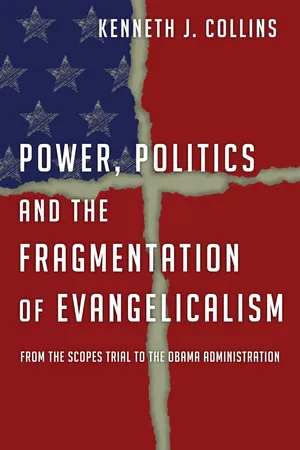
Kenneth J. Collins tells the narrative history of the political and cultural fortunes of American evangelicalism from the late nineteenth century through the contemporary era.He traces the establishment of the evangelical enterprise in American culture and its influences on the political and social values of the American landscape throughout the twentieth century, as well as its fragmentation into competing ideological camps. Underlining how both sides of the liberal-conservative divide havediluted their message through political idioms, Collins suggests a way forward for evangelical political identity that avoids the pitfalls of fundamentalism and liberalism.Will American evangelicalism outlive its partisan history? As Kenneth Collinstells the story, there is reason to think so.
Cultural Shifts, the Rise of Fundamentalism and the Great Reversal
Though the church in the United States had been officially disestablished in the First Amendment to the Constitution in 1791, Protestants, many of them evangelicals, almost immediately set out to create a de facto establishment.[1] The earlier evangelical revivalism of the 1730s and 1740s, informed by a Puritan heritage that sought to dedicate all of the New World in service to God, pointed the way for nineteenth-century preachers, who employed similar methods in a Second Great Awakening. Wave after wave of revivalism flowing from Cane Ridge, Kentucky, in 1801 to the businessmen’s revival of 1857, to the holiness camp meetings beginning at Vineland New Jersey in 1867, and into the pointed preaching of Dwight Moody (1837-1899) during the latter part of the century, all helped to foster a genuine Christian culture. The various means of this establishment, however, were not legal or coercive, but voluntary and persuasive. Revivalism, with its emphasis on the in-breaking of the power of God, now was at the heart of the methods that had so captivated the nation.
A Cultural Legacy
Revivalists of the period, such as Charles Grandison Finney (1792-1875), who had left a legal career for preaching, took great pains to proclaim a full-orbed gospel: one that offered hope not simply to individuals but also to society. Indeed, Finney remarked on one occasion to the effect that everywhere the gospel is preached there must also be reform. Likeminded reformist evangelicals helped to establish several voluntary societies to meet both the personal and social needs of the nation, such as the American Bible Society (1816), the American Education Society (1816), the American Sunday School Union (1824), the American Tract Society (1825), the American Temperance Society (1826), the American Peace Society (1828) and the American Antislavery Society (1833) among other groups. These societies, which were not only created to ease the plight of the poor but also to enhance the cultural fingerprint of American Protestants, were marked by generous interdenominational cooperation. The whole cluster of these societies interlaced throughout the nation constituted nothing less than a veritable benevolent empire.
So great was the religious and cultural power of evangelical Protestants in the nineteenth century that by 1870 as George Marsden puts it “almost all American Protestants thought of America as a Christian nation.”[2] For example, by 1892 Supreme Court Justice Brewer delivered the opinion of the court (Church of the Holy Trinity v. the United States) in declaring that the United States was a Christian nation. Not surprisingly, many Protestants saw their own faith at the heart of the American enterprise, though Roman Catholics, Jews and skeptics naturally objected.[3] Josiah Strong (1847-1916) demonstrated in 1885 with the publication of his best-selling book Our Country how quickly the evangelical faith of American Protestants could become amalgamated with the alloys of both ethnicity and race. Mistaking Anglo-Saxon culture for the genius of the gospel itself, Strong declared that “the world’s destiny lay with the Anglo-Saxon race.”[4] Andre Siegfried continued this tribal theme early into the next century in his book America Comes of Age (1927), in which he raised the question “Will America remain Protestant and Anglo Saxon?”[5] In other words, original stock Protestants, some of whose ancestry went back to the founding of the nation and even earlier, enjoyed and touted their cultural advantages, some of which were reflected in the religious preferences of America.
The Progressive Movement and the Great War
Many evangelicals brought their religious idealism and moral judgments to the progressive movement that spanned the presidencies of Theodore Roosevelt, William Howard Taft and Woodrow Wilson. In a real sense progressivism, as a political movement, was a response to some of the more troubling aspects of industrialization and urbanization. It therefore sought to bring about a new balance between “Protestant moral values, capitalistic competition, and democratic processes.”[6] Among their many reforms progressives helped to pass child labor laws, they developed the notion that charity and welfare should be undertaken by professionals, that is, by social workers, and they supported many of the goals of organized labor.
Voluntary societies to promote social order likewise flourished in the nineteenth century. The Women’s Christian Temperance Union, for example, was founded in 1874 and Frances Willard, a Methodist evangelical, provided pivotal leadership from 1879 to 1898. To be sure, many reformers believed that alcohol was destroying the social fabric of the nation, the family in particular. However, what began as a temperance movement (drinking in moderation) soon became a total abstinence crusade, and progressives viewed the alcohol issue in an ultraist way: that is, it was seen as the moral issue that if properly addressed would result in numerous social benefits, everything from stable family relationships to increased productivity at work. Class and ethnic issues, however, were also caught up in a prohibition coalition that sought to protect the interests of old stock Americans who felt threatened by the unchurched (largely lower class) and by Catholic, Jewish and Lutheran (drinking) immigrants.[7] The Eighteenth Amendment to the Constitution, which banned the manufacture and sale of intoxicating beverages, was ratified by the states in October 1919, and it went into effect on January 16, 1920. It represented the social and cultural power of Protestants who yet remained in earnest to establish a Christian America, one very much in their own image.
One of the greatest reforms undertaken by progressives was undoubtedly women’s suffrage. That women did not have the right to vote seemed to belie the democratic principles that grounded the nation. And many Christians reasoned that such a failure detracted from the truth that women, as with men, were created in nothing less than the image and likeness of God. Harkening back to a 1848 founding convention in a Wesleyan church at Seneca Falls, New York, women’s suffrage was yet another key success of the progressive movement with the passage of the Nineteenth Amendment by Congress in 1919, an amendment that was ratified by the states the following year.
Despite its many achievements, one of the glaring faults of the progressive era was that its social and cultural vision was largely restricted to white Americans. Indeed, prejudices against African Americans were not only extensive but they were also built into the very social mores of the period. For example, Jim Crow laws that were on the books since the 1880s gave legal and social force to the physical separation of the races. Moreover, demonstrating that the Supreme Court itself was not above the social prejudices of the day, it ruled in Plessy v. Ferguson in 1896 that “separate but equal” policies with respect to African Americans were in fact justified. In addition, some of the worst executive acts against blacks took place during the presidency of Woodrow Wilson (1856-1924), who brought several “southern white stereotypes” to the White House.[8] It would take decades before this blind spot of the reformers was even addressed.
As a reforming Democrat who had earlier cleaned up corruption in New Jersey as governor, Wilson readily weaved together the narrative of an American liberal democracy with that of the gospel. According to Mark Noll this energetic president believed that the American experience “witnessed the fullest manifestation of public Christian values in human history.”[9] Remembering the Civil War and the disruption it had brought to American society, and with both his father and grandfather having had careers as ministers, Wilson reluctantly entered the Great War as late as 1917 in order to defeat German militarism and to “make the world safe for democracy.”[10] William Jennings Bryan (1860-1925), his popular secretary of state, discerned the drift toward war early on and resigned in 1915 on the basis of pacifist principles.
Evangelicals from a number of different social and theological perspectives eventually embraced the war and viewed it, at least to some extent, through the well-worked lens of reform. For example, Columbia University administrators dismissed tenured faculty “for opposing American intervention in the war.”[11] And Shailer Mathews (1863-1941), the dean of the divinity school at the University of Chicago, declared that for an American “to refuse to share in the present war . . . is not Christian.”[12] Conservative evangelicals, like their liberal theological cousins, conflated patriotism and Christianity as well. Billy Sunday (1862-1935), for example, the slapdash preacher who knew how to captivate an audience, bellowed from the pulpit on occasion that “Christianity and patriotism are synonymous . . . and hell and traitors are synonymous.”[13] This was a heady period, to be sure, filled with the all the rhetoric of patriotism, and the American flag was even brought into the churches—and in most cases it remained there.
After the war was over in 1918, the gruesome reality of the carnage (15 million dead) as well as a vision of the vast destruction of resources set in and dispelled the naiveté and optimism that had characterized many of war’s supporters, religious leaders among them. The social consequences of the war were also considerable and were evident not only in a loosing of moral strictures that characterized the rise of the jazz age but also in strengthening the forces of secularization, especially among cultural elites, who were by now weary of all idealism, whatever form it took.
Cultural Challenges to the American Protestant Empire
The cultural establishment that Protestants had created in the nineteenth century, largely through the enormous success of revivalism in offering many Americans a common vision and purpose, was challenged by a number of shifting social and cultural realities. Precisely because it is made up of so many diverse elements (intellectual, economic, moral, religious and social), cultural power for any particular group in the life of a nation is at best fleeting. Clearly, culturally privileged groups like to focus on a snapshot, so to speak, of the heights of their power, not realizing of course that the photo will age, no longer depicting the present very accurately. In the same way, American Protestants, though remarkably successful in the nineteenth century, were nevertheless a part of a larger cultural complex that contained any number of factors well beyond their control. What cultural power and influence they had amassed could be viewed as either fortuitous or in a more comforting way as the benevolent providence of God. At any rate, it would not last.
Immigration
One of the best and most reliable indicators of the religious life of a nation (both present and future) is none other than immigration statistics. In a real sense America has imported its religious makeup. The period between 1870 and 1920, for instance, marks one of the most significant influxes of immigrants in the history of the nation. According to some of the best statistics available, over twenty million people, largely European, passed through the gates of Castle Garden and, after 1892, Ellis Island.[14] Immigrants came from Germany, Ireland, Italy, Russia, Poland and elsewhere. At the turn of the century the numbers swelled from Eastern Europe, which included many Ashkenazi Jews. America was now both more Roman Catholic (Germany, Ireland and Italy) and Jewish (Russia and Poland).
Nativist sentiment quickly emerged among the “old guard” Protestants who felt challenged by the shifting religious composition of the nation. Josiah Strong, for example, maintained that Catholicism threatens many of America’s basic liberties, such as free speech and a free press. “Manifestly there is an irreconcilable difference,” he declared, “between papal principles and the fundamental principles of our free institutions.”[15] And when the Democratic Party in 1928 nominated the Roman Catholic Alfred E. Smith to be president of the United States, many Protestants warned that he would sell out America to the pope. So great was the concern that even the authors of the Christian Century argued that “Catholic teachings and practices clashed with America’s democratic principles.”[16] And evangelical Protestants, for their part, wondered if the fruit of revivalism and the cultural power it had afforded them could be so easily undone by American bureaucratic policy in the form of mass immigration.
Fearing the wrath of its constituencies, Congress began to pass legislation after the war to restrict immigration. A bill that would exclude migrants who failed a literacy test became law in 1917 over the objections—and veto!—of President Wilson.[17] A few years later Congress passed the Johnson Act (1921) and the Johnson Reid Act (1924), both of which restricted immigration along the lines of “national-origins quotas.”[18] The open door of immigration was beginning to close. The World War itself, of course, had interrupted the flow, and with the restrictive legislation of the 1920s followed by the Great Depression of the 1930s transmigration to the United States virtually ceased—at least for a time. And it would not be until much later, that is, during the 1960s, that the country would revamp its immigration policies under the banner of fairness and balance.
Intellectual Challenges to the American Protestant Empire
One element of the larger Protestant cultural fingerprint had been the life of the mind that resonated in many respects with American cultural trends throughout a good portion of the nineteenth century. So then in order to appreciate the nature and extent of the intellectual challenges that the higher criticism of the Bible and the teaching of evol...
Table of contents
Cover
Copyright
Contents
Acknowledgments
Introduction
1 Cultural Shifts, the Rise of Fundamentalismand the Great Reversal
2 Fundamentalism, Neo-Evangelicalism and the Search for Power
3 Evangelicals, the Religious Right and the Moral Life of the Nation
4 Evolution, Intelligent Design and the Transformation of Culture?
5 The Resurgence of the Evangelical Left
6 Beyond Ideology
Conclusion
Select Bibliography
Subject Index
Notes
About the Author
Endorsements
Trusted by 375,005 students
Access to over 1.5 million titles for a fair monthly price.
Study more efficiently using our study tools.
Frequently asked questions
Yes, you can cancel anytime from the Subscription tab in your account settings on the Perlego website. Your subscription will stay active until the end of your current billing period. Learn how to cancel your subscription
No, books cannot be downloaded as external files, such as PDFs, for use outside of Perlego. However, you can download books within the Perlego app for offline reading on mobile or tablet. Learn how to download books offline
Perlego offers two plans: Essential and Complete
Essential is ideal for learners and professionals who enjoy exploring a wide range of subjects. Access the Essential Library with 800,000+ trusted titles and best-sellers across business, personal growth, and the humanities. Includes unlimited reading time and Standard Read Aloud voice.
Complete: Perfect for advanced learners and researchers needing full, unrestricted access. Unlock 1.5M+ books across hundreds of subjects, including academic and specialized titles. The Complete Plan also includes advanced features like Premium Read Aloud and Research Assistant.
Both plans are available with monthly, semester, or annual billing cycles.
We are an online textbook subscription service, where you can get access to an entire online library for less than the price of a single book per month. With over 1.5 million books across 990+ topics, we’ve got you covered! Learn about our mission
Look out for the read-aloud symbol on your next book to see if you can listen to it. The read-aloud tool reads text aloud for you, highlighting the text as it is being read. You can pause it, speed it up and slow it down. Learn more about Read Aloud
Yes! You can use the Perlego app on both iOS and Android devices to read anytime, anywhere — even offline. Perfect for commutes or when you’re on the go. Please note we cannot support devices running on iOS 13 and Android 7 or earlier. Learn more about using the app
Yes, you can access Power, Politics and the Fragmentation of Evangelicalism by Kenneth J. Collins in PDF and/or ePUB format, as well as other popular books in Theology & Religion & Religion. We have over 1.5 million books available in our catalogue for you to explore.