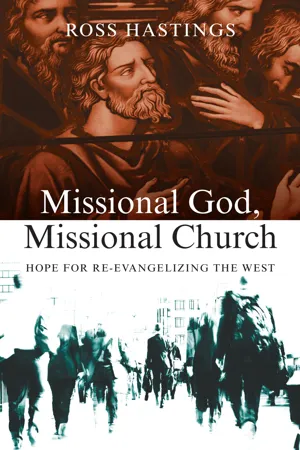
"As the Father has sent me, I am sending you" (John 20:21).With the reality of broad-scale secularization in the West and the attendant cloud of insignificance hanging over the church, is there any hope for the re-evangelization of the West? In this comprehensive theology of mission, Ross Hastings directs the fretful gaze of the church to the trinitarian commission of John 20. There we find Jesus granting peace to his disciples by breathing his Spirit on them. He formed them into his community of shalom. Leaving their locked room, these "sent ones" went out to participate in God's own ongoing mission to the world.Hastings also tackles the dual challenges of isolation from and accommodation to the surrounding culture. Building on the works of David Bosch, Lesslie Newbigin, Christopher Wright and Darrell Guder, the author corrects numerous dichotomies that hinder the church. In the power of the Spirit the gathered church is spiritually transformed and also scattered as it proclaims God's forgiveness and freedom.This comprehensive theology of mission opens possibilities for renewal of faithful effort as we join in Christ's mission to the world.
- 355 pages
- English
- ePUB (mobile friendly)
- Available on iOS & Android
eBook - ePub
About this book
Information
Topic
Theology & ReligionSubtopic
Christian Ministry1
The Greatest Commission

On the evening of that first day of the week, when the disciples were together, with the doors locked for fear of the Jewish leaders, Jesus came and stood among them and said, “Peace be with you!” After he said this, he showed them his hands and side. The disciples were overjoyed when they saw the Lord.
Again Jesus said, “Peace be with you! As the Father has sent me, I am sending you.” And with that he breathed on them and said, “Receive the Holy Spirit. If you forgive the sins of anyone, their sins are forgiven; if you do not forgive them, they are not forgiven.”
JOHN 20:19-23
Strictly speaking one ought to say that the Church is always in a state of crisis and that its greatest shortcoming is that it is only occasionally aware of it.
DAVID J. BOSCH, Transforming Mission
Much ink has been spilled on the crisis state of the church in the West in recent decades. While I do not wish to minimize the reality that most churches in this area are not growing and that many professing Christians have opted out of church, the intent of this book is to suggest that no matter how dark things may seem, the church will never be in a worse state than that described in John 20:19, pre-Jesus, and that if the dynamics that are present post-Jesus in John 20:20-23 are rediscovered in the church today, it can be all that this little community became.
Such audacious optimism rests not in any idealistic foundationalism but in the roots of the church’s being. It rests in the historical and organic continuity between that small group of disciples and the church today, and above all it rests on the triune God of grace who still inhabits that church despite its beleaguered state, and is at work in the world through it to bring to completion the new creation Christ has inaugurated.
The “before” picture of this group of disciples, this microcosm of the church, is of a motley crew of notable failures. They had ministered effectively alongside Jesus for three years and their level of competence toward the end of that season had led some of them to think they might even sit in close proximity to Jesus in his coming kingdom. However, then came the trial and the cross. They failed miserably, to a man. Even postresurrection, they were in a pretty sorry state, so far unconvinced for the most part by the sight of an empty tomb, and the claims of Mary Magdalene that she had seen him.[1] Sad though their chauvinism or jealousy may have been, this only magnifies the amazing grace of Christ who appeared to them on Easter Sunday evening despite all.
We can feel some sympathy given that they were undoubtedly numb with grief, a grief riddled with regrets. It is true that John attributes their isolation to fear. But it was a fear no doubt intertwined with sporadic numbness alongside the turbulent waves of grief and remorse. Most importantly, the total situation of the first disciples as John describes it—in a room behind locked doors for fear of the Jewish leaders of that day—is, I believe, a metaphor for their powerless state. Chrysologus notes that the “extent of their terror and the disquiet caused by such an atrocity had simultaneously locked the house and the hearts of the disciples.”[2] This infant microcosm of the church hadn’t a prayer where world evangelism is concerned. They would have been voted the group of human beings “most unlikely to start a new world religion.” They certainly could offer little by way of shalom, simply because they were experiencing none.
The “after” picture, however, is another story altogether! The difference is made by Jesus’ presence in their midst. There was shock at first. The sudden presence of Jesus in their midst might have been a little hard to process! Each may have thought at first that he was seeing the kinds of apparitions grieving people see. But soon they realized they were all seeing him. This was real. By the time this occasion was over and the disciples had calmed down, they really might have begun to believe that mission was possible. The picture John paints here of that little shell-shocked gathering, with the risen Jesus standing in the center, imparting his shalom and then inspiring them with the greatest of all the commissions—mission as participation in God’s mission—is evocative of what the church can be in every era of its existence as it once again makes the risen Christ the center.
After the day of Pentecost when they actually received what Jesus symbolically conferred on them here, the Holy Spirit, they would in fact accomplish the impossible—the evangelization of a significant portion of their then-known world. The shalom imparted by the risen Christ to his kingdom community was shared with a broken and alienated world. People were drawn into that gathered community of shalom, and the catalytic impact of that scattered community in turn ultimately brought shalom to the ancient and medieval world in all kinds of ways—the liberation of women, the humanization of children, hospitals, education, art, architecture and science.
This little community that began with the eleven apostles here and then 120 disciples prior to Pentecost, grew to 5,000 by Acts 4. Rodney Stark has estimated that the church then grew from around 1,000 in A.D. 40 to 25,000 by A.D. 100 to between 5 and 7.5 million by the start of the fourth century.[3] I don’t wish by quoting these figures to convey any hint of a numbers obsession when it comes to mission, and I am certainly not wishing to suggest either that the Christianization of empires is the goal of Christian mission. The call of the church in any age is faithfulness to shalom sharing, the living and proclaiming of the gospel in its fullness. The results are God’s concern, not ours. The church has historically actually done better in terms of faithfulness to its identity and calling when it is a persecuted minority, just as it is depicted here in John 20, rather than when it is the ruling political entity with a cultural hegemony.
That said, the missional call to which Christians are to be faithful must include faith-filled engagement and shalom sharing with society at every level. This will be done with awareness however, that the telos in this “already but not yet” phase of the kingdom is not the political reign of a Christian government. Christ’s kingdom on earth is a subversive one, and it is characterized by its smallness, making its disproportionate influence so remarkable in this age and its massive nature, in its fully realized form, so surprising. The parables Jesus told about the mustard seed which surprisingly produces a large tree, and about the yeast that surprisingly influences the large amount of flour to form a large loaf, would not have meaning if the kingdom in this present age was obviously and spectacularly large. The sense of triumph I am encouraging is not triumphalism, but it is triumph nevertheless. It is a call to faithfulness, but it is an unapologetic call to raise our faith and expectancy in light of the dynamics still present to the church.
Outlines of John 20:19-23 and of This Book
This book will be a theological exposition of the factors that transformed the community of the early disciples, or the early church, as it is proleptically depicted here in John 20:19-23.[4] The exposition is grounded upon an assumption that John is doing much more than merely describing a resurrection appearance of Jesus in this passage, all important though this appearance was.[5] He is giving us his picture of the early church, and in doing so offering hope for its mission. It is true that John does not in his Gospel ever reference the church. But this is his way. He does not reference the institution of the Lord’s Supper either, yet many commentators see in his account of the feeding of the five thousand and Jesus’ elucidation of the symbolism of that event the most profound eucharistic teaching of the New Testament.[6] Similarly, as John gives us his version of the Great Commission, he does so in a word picture, a word picture of the church in union with the risen Christ by the Spirit’s inbreathing, as the missionary of God. John also presents this picture of the church in a new creation context, with the last or eschatos Adam present in its center as its defining reality.[7] He describes the breath of the last Adam (a man who is also God, cf. Gen 2:7), being breathed into the last Adam’s race, the new humanity in Christ, the church, and anticipates all those who would be brought into its communion by means of its missional nature and action: “as the Father has sent me, I am sending you.” John’s is a commission with cosmic consequences, with covenant and creation together.
If there was hope for that motley crew of eleven disciples in John 20, there is hope for the church in the West despite its indiscriminate enculturation on the one hand and its cultural isolation on the other—if the realities that transformed that early infant church are permitted to transform churches and Christians today. This will lead me to encourage the church to rediscover the dynamics and reengage the practices of the early church and yet to reimagine these in a manner appropriate to our times, thus not succumbing to any romantic idealism of that church.
Certain realities began to transform this community of disciples in John 20. The emphasis is on the word began. They did not actually receive the Spirit until Pentecost, and even after that the fullness of all these trinitarian realities became part of them gradually. These realities can be structured around Jesus’ repetition of the words peace to you.
Unlike Calvin, who thinks Jesus was just offering the customary “hello” here, I am in agreement with the idea that, at minimum, Jesus is calming their stated fears,[8] but more likely still that he is conferring shalom in its full redemptive and cosmic sense upon them. Jesus does use the customary Hebrew words when friends greet each other in Jerusalem: Shalom (aleikhem! However, in the context of this Gospel, it is certain that they heard much more, certainly when they reflected back on the occasion. They may have heard in Jesus’ words here an echo of peace words spoken to them in his passion ministry in John 14:27: “Peace I leave with you; my peace I give to you,” adding words that fit so well with this John 20 context where fear is the emotion explicitly spoken of: “Do not let your hearts be troubled and do not be afraid.” What they heard reached far beyond a mundane “hello.” As F. F. Bruce comments, “on this occasion it bore its literal meaning to the fullest extent.”[9] The deepest and widest meaning of peace is intended. In light of the fuller teaching of the New Testament, it was a peace freshly accomplished between God and humanity by the cross, that is, a peace born of the reconciling work of Christ who made “peace through his blood, shed on the cross” (Col 1:20). It was a peace not only of a forensic kind (Rom 5:1), however, but one very much to be experienced in their hearts. Their emotional state changes from fear to joy (v. 20) in consequence of his impartational invocation. Appreciated as this was, however, they would as Jews know that shalom had yet a fuller meaning still, more than even a deep individual existential experience. It was social and cosmic in its scope, a state of well-being in the whole creation. The apostolic understanding of this peace impartation of Jesus would grow into the realization that its scope extended to “the world” of people (2 Cor 5:18) and indeed the whole fallen cosmos, as Colossians 1:19-20 indicates: “God was pleased to have all his fullness dwell in him, and through him to reconcile to himself all things, whether things on earth or things in heaven.”
In fact, the twofold repetition of this blessing from Jesus was intended to indicate that they were not merely to receive this peace.[10] The second impartation, followed immediately by the commission (“as the Father has sent me”), indicates that they were, as the church, to dispense shalom to the world as the eschatological harbinger of the kingdom of God. Gregory the Great seems to support this idea by linking it with their soon to be given authority to forgive sins. Thus he says, “You see how they not only acquire peace of mind concerning themselves but even receive the power of releasing others from their bonds.”[11] Maximus the Confessor (580-662) in the Orthodox tradition actually brings the greeting of peace together with the breathing of the Spirit upon them: “Through his greeting of peace he breathes on them and bestows tranquility as well as sharing in the Holy Spirit.”[12] He also infers a connection between the receiving of the Spirit and the bestowal of peace through the mission the Spirit would empower. Schnackenburg confirms this connection, confirming that as an inner gift the peace the Spirit gives “is also to manifest itself outwardly. . . . The peace which the risen Lord brings the disciples from God is to go with them as they are sent out and to testify to the world what true peace is (cf. similarly, concerning the idea of oneness).”[13]
We can, therefore nuance Christ’s peace benediction. There were two transforming realities that imparted shalom to them to make them a community of shalom—his risen presence and his presence as the once-crucified Savior. Then there were three further realities that would enable them to dispense that shalom to others as a sent community. That is, they could as a community of the once crucified, now risen Christ, both experience and express shalom. The shalom in their midst would make the community attractive (if not attractional!) and missional. But they would as those sent in participation with the Son by the Spirit, and in the Spirit’s power, impart peace in being missional and in doing mission. As a community therefore, their missional message of the peace of forgiveness could be compatible with who they were as missional people, characterized by shalom, sharing it out of their own overflow of it. Another way to say this is that both the character and content of mission is the shalom of the gospel.
The structure of this passage may thus be presented in the following way:
The church discovering shalom through
1. the presence and influence of the risen Jesus (v. 19)
2. the redemptive nature of the ...
Table of contents
- Cover
- Copyright
- Contents
- Preface
- Acknowledgments
- 1 The Greatest Commission
- 2 Breaking Free Through Discerning Inculturation
- 3 Breaking Free of the Entrapment of Indiscriminate Enculturation
- 4 Greatest Co-Mission
- 5 Communities of Christ’s Risen Presence
- 6 Mission of Incarnation and Resurrection
- 7 Communities of Christ’s Crucified Presence
- 8 Mission About the Cross, Mission Under the Cross
- 9 Communities of the Triune Missional God
- 10 Mission as Theosis
- 11 Communities of the Spirit
- 12 Communities of Forgiveness
- Bibliography
- Name and Subject Index
- Scripture Index
- Notes
- About the Author
- Endorsements
Trusted by 375,005 students
Access to over 1.5 million titles for a fair monthly price.
Study more efficiently using our study tools.
Frequently asked questions
Yes, you can cancel anytime from the Subscription tab in your account settings on the Perlego website. Your subscription will stay active until the end of your current billing period. Learn how to cancel your subscription
No, books cannot be downloaded as external files, such as PDFs, for use outside of Perlego. However, you can download books within the Perlego app for offline reading on mobile or tablet. Learn how to download books offline
Perlego offers two plans: Essential and Complete
- Essential is ideal for learners and professionals who enjoy exploring a wide range of subjects. Access the Essential Library with 800,000+ trusted titles and best-sellers across business, personal growth, and the humanities. Includes unlimited reading time and Standard Read Aloud voice.
- Complete: Perfect for advanced learners and researchers needing full, unrestricted access. Unlock 1.5M+ books across hundreds of subjects, including academic and specialized titles. The Complete Plan also includes advanced features like Premium Read Aloud and Research Assistant.
We are an online textbook subscription service, where you can get access to an entire online library for less than the price of a single book per month. With over 1.5 million books across 990+ topics, we’ve got you covered! Learn about our mission
Look out for the read-aloud symbol on your next book to see if you can listen to it. The read-aloud tool reads text aloud for you, highlighting the text as it is being read. You can pause it, speed it up and slow it down. Learn more about Read Aloud
Yes! You can use the Perlego app on both iOS and Android devices to read anytime, anywhere — even offline. Perfect for commutes or when you’re on the go.
Please note we cannot support devices running on iOS 13 and Android 7 or earlier. Learn more about using the app
Please note we cannot support devices running on iOS 13 and Android 7 or earlier. Learn more about using the app
Yes, you can access Missional God, Missional Church by Ross Hastings in PDF and/or ePUB format, as well as other popular books in Theology & Religion & Christian Ministry. We have over 1.5 million books available in our catalogue for you to explore.