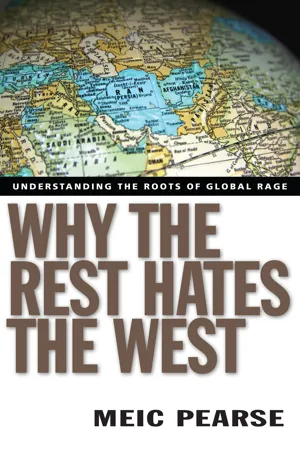
"Why do they hate us so much?"Many in the U.S. are baffled at the hatred and anti-Western sentiment they see on the international news. Why are people around the world so resentful of Western cultural values and ideals? Historian Meic Pearse unpacks the deep divides between the West and the rest of the world. He shows how many of the underlying assumptions of Western civilization directly oppose and contradict the cultural and religious values of significant people groups. Those in the ThirdWorld, Pearse says, "have the sensation that everything they hold dear and sacred is being rolled over by an economic and cultural juggernaut that doesn?t even know it?s doing it . . . and wouldn?t understand why what it?s destroying is important or of value."Pearse's keen analysis offers insight into perspectives not often understood in the West, and provides a starting point for intercultural dialogue and rapprochement.
- English
- ePUB (mobile friendly)
- Available on iOS & Android
eBook - ePub
About this book
Information
Topic
Theology & ReligionSubtopic
Religion1
Barbarian Juggernauts
It was 1983, and the Western powers—or an assortment of them—had finally taken it upon themselves to intervene in Lebanon’s long-running civil war. The United States and French forces were attempting to hold the ring in the face of multifactional anarchy and mayhem. It was in this context that a truck bomb was delivered, with devastating effect, into the heart of the U.S. marine barracks. The bomber burst his vehicle through the gates, drove up to the building, and blew himself and more than two hundred Americans into eternity. The stunned guard at the entrance to the compound was interviewed afterward. Too late he had realized what was happening. Too late he had grasped that the man at the wheel was a bomber who was successfully penetrating the outer cordon. As the truck driver drove past the guard, the latter reminisced, “he was smiling.”
He might well have smiled. For him, his own death would long ago have been settled in his mind as a price worth paying for immolating a large number of Americans. He had planned this mission for some time. As he drove through the gates, he knew that he had succeeded. Too late, the guard knew it too.
But what kind of hatred drove the truck driver to this appalling act? That participants in the civil war may have wished to continue their feuding around and in spite of the outside occupiers is understandable. That minor frictions between locals and peacekeepers could occur with the latter caught in the factional crossfire is also unsurprising. But why this?
Too many Westerners take refuge in simplistic explanations: fanaticism, extremism, “fundamentalism,” insanity. Such dismissals advance the task of comprehension not one jot; they reveal more about the speaker than about the things, or the persons, described. They indicate not so much an understanding as a refusal to understand. All of these epithets indicate, in practice if not quite in theory, a mental banishment: “these things are so far distant from my own feelings or judgments that I shall make no attempt to comprehend them in their own terms, or to understand why these people, in their own estimation, act or think as they do.” And thus we are condemned, either to complete separation from crosscultural entanglements or else (since that is virtually impossible in the face of globalization) to the recurrence of such disasters.
Let no one misconstrue my last use of the word understand. No implication of condoning whatsoever is intended. There are no shades here of “understand a little more; condemn a little less.” Only unqualified, unmitigated condemnation is appropriate in such cases. And yet there must be understanding (in the sense of mental comprehension) if we are to prevent repetition of the horrors.
Perhaps we should pause for breath here. Those preceding paragraphs were written at the end of the 1990s—that is, before the attacks on the World Trade Center and the Pentagon of September 11, 2001. Following those terrible events, I found myself approached on two different occasions, once by a friend from church and once by two of my students, who wanted to talk the situation over with me because, they insisted, I had predicted just such attacks.
On the evening of the day itself, as the news from America began to register in London, I commented to someone that “this is just the beginning,” and was told, “Oh, don’t say that!”
Very well. Let us not say it. Let us pretend that everything will be well. Let us continue to ignore the real problems. Let us imagine that, if we continue to soft-soap manifestations of “religion,” non-Westerners will stand by as we absentmindedly obliterate their cultures. After all, that is what we have been doing until now. Even after September 11 our politicians continue to address the non-West as if all of the world were Westerners under the skin; everybody wants “freedom” and the consumerist paradise and, in order to obtain these things, considers the adoption of Western antivalues and the anticulture to be a price well worth paying.
Let us turn our attention for a moment to a smaller but far more hopeful and positive anecdote before turning to the general picture that unites it with the darker scenario we have been considering. This story again concerns the Arab world in the early 1980s. This one takes place in Algeria before the present troubles. A group of young Westerners from a Christian mission organization was traveling through that Muslim country, where evangelism is strictly forbidden. These were no culturally insensitive Bible belters, however, planning to transplant the values of rural Missouri to the Maghreb. A multinational group acutely aware of its own ignorance and impotence in such a (to them) hostile environment, they were aiming at very modest goals. Their intention was to travel through the country from north to south, from the populated coastal region, through the desert, and on into the countries of the Sahel beyond. Praying. Praying for the places they traveled through, for the people they met and for opportunities to evangelize individuals who appeared to be open to the gospel. Like the Lebanese bomb, they were traveling by truck.
The group stopped late one afternoon just beyond the last house in a village several hundred miles south of the coast. They got out, gathered round a fire, made a meal and then began singing their songs, quietly and reverently. After a couple of hours, an old man from the village came out of his house and wandered over to talk to them. He said that he had been watching them for a while, and that he was amazed. They were, he told them, unlike any Westerners he had encountered before, or had ever heard of. Why did they behave this way?
What surprised the old man? He had been expecting Westerners to make a noise, to turn their radios up, to spill Coke cans all over the desert, for their womenfolk to be baring arms and legs—or maybe more. These young people were doing none of these things. In a word, he expected them to be barbarians. It was a measure of the oddness of the occasion, and the oddness of these young people, that this time he was wrong.
Oblivious Domination
The truth is that Westerners are perceived by non-Westerners (if we can make such a huge generalization about a truly global phenomenon) as rich, technologically sophisticated, economically and politically dominant, morally contemptible barbarians. That is a hateful combination of feelings and assessments, in the sense that the one who makes them will, as often as not, be filled with hatred for the objects of such contemplation.
Why barbarians? For despising tradition, the ancestors and the dead. For despising religion, or at least for treating it lightly. For the shallowness and triviality of their culture. For their sexual shamelessness. For their loose adherence to family and, sometimes, also to tribe. For their absence of any sense of honor. These are massive charges, of course, and it will be necessary, in what follows, to say something about each in turn.
For the moment we simply note that they do, in point of fact, generate resentment—a resentment that can, as with the man driving the truck-bomb, amount to hatred. That is not to deny that many Western attributes and trappings are found desirable by non-Westerners. But precisely that desirability compounds the problem. Western culture, the very source of offense to traditional cultural sensibilities, has a habit of finding out the weak spots of the guardians of tradition and undermining them from within. The allure of heightened sexuality; or of status clothing, furnishings and possessions; or of personal independence: one would have to be superhuman not to feel the pull of these things or to be tempted by them. That is why many anti-Western movements, notably Islamists, wish to banish the very presence of the Western temptations, to take a separatist line, or at least to limit contacts with Western people and institutions to what can be dictated on their own cultural terms. As one Iranian leader of Ansare Hezbollah put it, “When you see some people here dressed in American-style clothes, you are seeing the bullets of the West.”[1]
Far more people than just Islamists, however, wish to modernize their countries without at the same time Westernizing them. Samuel Huntington has argued at length that that is the task in which much or most of the non-West is now engaged.[2] The extreme difficulty of such an enterprise lies in the fact that the West is the historic source of modernization and its principal present agent. Modernizing without Westernizing is a near impossible task of extrication. The Internet (to take only the most obvious example) knows no boundaries. To accept the technology is to accept the presence of pornography, advertising, commercial values and freedom of speech. In response, the Taliban in Afghanistan (admittedly one of the most extreme cases) did not shy away from banning virtually all aspects of modernity in their determination to sweep their collective house clean of Western contamination.
Very many, especially Third World, people have the sensation that everything they hold dear and sacred is being rolled over by an economic and cultural juggernaut that doesn’t even know it’s doing it . . . and wouldn’t understand why what it’s destroying is important or of value. That is why the defenders of traditionalism and advocates of cultural retrenchment in the non-West are perceived by Westerners as “fanatics,” “fundamentalists”—the epithets that express a refusal to understand. Why? Because they fly in the face of what, to Westerners, is “common sense.”
And the worst of it is that Westerners themselves are hardly aware of what they are doing, or of the very existence of the things they are destroying. Many non-Westerners feel that they have some understanding of Western culture; with television and pop music, to say nothing of the high-status artifacts on sale to those who can afford them, it would be strange indeed if they did not. But if the amount of understanding transmitted through those channels is likely to be superficial (life in the West being construed as somehow effortlessly prosperous), the level of understanding in the reverse direction—that is, of others by Westerners themselves—is almost negligible. After almost a decade of coverage of the Balkan wars on television, most Westerners are still unsure of the identities of the principal protagonists, and even news announcers occasionally betray the fact that they do not understand the meaning of the term “the former Yugoslavia.”[3] Survey after survey shows the embarrassing ignorance of even educated Americans about the most fundamental features of the world outside their own country. Supporters of tradition in the non-West have the sensation that they are being rolled over by a juggernaut that does not even know they exist.
Westerners are so accustomed to this effortless superiority that the real nature of its origins is lost on them. As Huntington points out, “The West won the world not by the superiority of its ideas or values or religion . . . but rather by its superiority in applying organized violence. Westerners often forget this fact; non-Westerners never do.”[4] Indeed, this obliviousness to reality persists, even when considering the present nature of international relationships. What to Westerners appears as “control of terrorism” or “maintaining free trade” bears quite a different face from the other side of the prosperity-poverty fence. Actions that, seen from a Western perspective, seem commonsensically altruistic—or at least neutral—appear riddled with double standards: “Democracy is promoted but not if it brings Islamic fundamentalism to power.” One thinks of Western acquiescence in the aborting of the Algerian elections and the continuation of the military regime. Furthermore,
nonproliferation is preached for Iran and Iraq but not for Israel; free trade is the elixir of economic growth but not for agriculture; human rights are an issue with China but not with Saudi Arabia; aggression against oil-owning Kuwaitis is massively repulsed but not against non-oil-owning Bosnians.[5]
The impatient “ah, but” responses that most of us (including me) will want to make to such complaints of inconsistency are beside the point here; the point is to see how these “justifiable” actions by Western powers look very different from a non-Western—that is, from a majority—point of view. From that standpoint, the continued exertion of Western power across the world—cultural, economic, military—appears to be transparently self-seeking. “Human rights” and “free trade” appear to be no more than mantras bearing no connection with disinterested altruism, let alone with an ethical foreign policy.
And as for Western promises to clean up the mess afterwards . . . ! Reconstruction was promised for Bosnia, but nearly a decade after Dayton the country is still in the deep freeze. It was promised for Serbia after the Kosovo crisis and the fall of Milošević: still nothing. Afghanistan presents, admittedly, a bigger challenge—but don’t expect transformation of that country anytime soon. Tony Blair made the most shamelessly unbelievable promises to Macedonia in 2001 that, if the government would compromise with its Albanian separatist insurgents and accept NATO peacekeepers, then the country would definitely, oh-but-definitely, be fast-tracked into EU membership; predictably, not a thing has been heard of this promise since.
Violence is an unsurprising response to this predicament, a predicament that is experienced by many non-Westerners as humiliation. Quite obviously, violence is the only way to get the West’s attention. What else explains the feverish popularity of Saddam Hussein across the Arab world during the 1991 Gulf War? No one, not even Arabs, could be under any illusions but that Saddam was a brutal, murderous thug. But he was their brutal, murderous thug! Any spoke in the wheel of the Western juggernaut will serve. Similarly, few were under any illusions that Iraq’s invasion of Kuwait was a good thing; the opposition was not to the solution proposed by the West but to the West’s ability to impose a solution in “Arab space” at all.
Islamist movements were on the rise before the end of the Cold War. With the demise of communism, however, their accelerated growth could have been predicted. The appeal of Marxist guerrilla movements across much of the non-Western world during the 1950s to 1980s had never lain in the nature of the Marxist creed itself. That had been, if anything, a handicap. Those in the know could see that it did not work; those not in the know (mostly Third World peasants) could hardly be expected to understand the full intricacies of its philosophy. The appeal had rested in the nature of antithesis: it was a weapon against the Western juggernaut. By the end of the 1980s, the socialist project was everywhere in ruins. Islamist movements have become the partial inheritors of Marxism’s cachet. Obviously, this hardly applies in Latin America; in parts of Asia and sub-Saharan Africa—or among urban blacks in America itself—it has nevertheless become the ideological vehicle for anti-Westernism.
Terrorism has been called the weapon of the weak; the weak can be relied upon to use such weapons as they have. Terrorism has the advantage of using the West’s own distinctive features against it: an open society (to aid infiltration and hiding); instant and full news coverage (to maximize the political effect); a horror of death or of sustaining even small numbers of casualties (resulting from the absence of any deep-rooted sense of transcendence and also from the sheer comfort of Westerners’ lives). After any action, the rule of law can make prosecution difficult, keeps sentencing mild and mostly rules out any kind of blanket retribution (though the September 11 attacks put that last point under pressure). Viewed in that light, the man driving the truck-bomb becomes easier to understand.
A moment ago, we noted a number of criteria by which Westerners appear to non-Westerners as barbarous. These qualities of barbarism are so contentious that we shall now have cause to notice them individually.
No Votes for the Dead
No society has succeeded in breaking with the past and its own traditions as comprehensively as that of the modern West. Indeed, only in Western ideals is “breaking with the past” an admirable thing to do. We shall consider this at more length later in this book. For now it is sufficient to notice that Westerners do not in any sense see themselves as having an obligation to reproduce the ways of their ancestors, or to be faithful to the memory of their forefathers; even to mention such things risks evoking an amused smile. And yet such sensibilities have been all but unanimous in traditional cultures—including our own before the onset of modernity. The Chinese tradition of ancestor-worship is not entirely untypical; the medieval European cult of the saints amounted to the same thing. Both represent a willingness to be faithful to the past, and to include the voices—and even the (metaphorical) presence—of the dead in the discussions of the living.
Nowadays, we may visit the grave of a loved one and “talk to Gran,” but we know even there that we do this primarily for ourselves; the sense of transcendence and of historical continuity with both past and future that could give deeper meaning to such rituals largely eludes us. The sense of specific obligation even to the recent dead, let alone to distant ancestors, is little more than a folk memory.
In the early 1990s, a British schoolgirl in her early teens killed herself. A suicide note explained that she had been mercilessly bullied by a gang of other girls and that she could no longer face life in such circumstances. A senior police officer, interviewed on the radio the following day, explained that the prime concern of his officers and of social workers brought in to the case was in caring for the gang members who might be distraught by feelings that they were responsible for the girl’s death. As he pointed out, his responsibility was not to the dead, for whom he could now do nothing, but to the living.
Only in the West. The example is an extreme one, but for that very reason it illustrates graphically the triumph of sentience over fact. The dead feel nothing; while their relatives’ interests are still of some account, the deceased themselves have no interests—or even existence—that we can or should take into account. And as for our long-dead ancestors . . .
Condescension Toward Religion
The question of the nonexistence of obligations to the dead, of course, touches on the absence of transcendence in Western societies. Most, though not all, major cultures have been underpinned by adherence to a major religion. The West is unusual in having debunked its own and also in rigorously excluding religious issues from public life.
Even more remarkable is the cheerful confidence displayed by most Westerners in the falsity of any “hard” religious claims. What eighteenth- and nineteenth-century rationalism began, the rise of functional ration-ality and technocr...
Table of contents
- Cover
- Title Page
- Copyright
- Dedication
- Contents
- Preface
- Introduction
- 1 Barbarian Juggernauts
- 2 On the Importance of Being Earnest
- 3 How to Be Sinless
- 4 Killing the Past
- 5 Impersonal States
- 6 Imagined Communities
- 7 Divided Lives, Infantilized Culture
- 8 Observations in Passing?
- Conclusion
- Notes
- Index
- Praise for Why the Rest Hates the West
- About the Author
- More Titles from InterVarsity Press
Trusted by 375,005 students
Access to over 1.5 million titles for a fair monthly price.
Study more efficiently using our study tools.
Frequently asked questions
Yes, you can cancel anytime from the Subscription tab in your account settings on the Perlego website. Your subscription will stay active until the end of your current billing period. Learn how to cancel your subscription
No, books cannot be downloaded as external files, such as PDFs, for use outside of Perlego. However, you can download books within the Perlego app for offline reading on mobile or tablet. Learn how to download books offline
Perlego offers two plans: Essential and Complete
- Essential is ideal for learners and professionals who enjoy exploring a wide range of subjects. Access the Essential Library with 800,000+ trusted titles and best-sellers across business, personal growth, and the humanities. Includes unlimited reading time and Standard Read Aloud voice.
- Complete: Perfect for advanced learners and researchers needing full, unrestricted access. Unlock 1.5M+ books across hundreds of subjects, including academic and specialized titles. The Complete Plan also includes advanced features like Premium Read Aloud and Research Assistant.
We are an online textbook subscription service, where you can get access to an entire online library for less than the price of a single book per month. With over 1.5 million books across 990+ topics, we’ve got you covered! Learn about our mission
Look out for the read-aloud symbol on your next book to see if you can listen to it. The read-aloud tool reads text aloud for you, highlighting the text as it is being read. You can pause it, speed it up and slow it down. Learn more about Read Aloud
Yes! You can use the Perlego app on both iOS and Android devices to read anytime, anywhere — even offline. Perfect for commutes or when you’re on the go.
Please note we cannot support devices running on iOS 13 and Android 7 or earlier. Learn more about using the app
Please note we cannot support devices running on iOS 13 and Android 7 or earlier. Learn more about using the app
Yes, you can access Why the Rest Hates the West by Meic Pearse in PDF and/or ePUB format, as well as other popular books in Theology & Religion & Religion. We have over 1.5 million books available in our catalogue for you to explore.